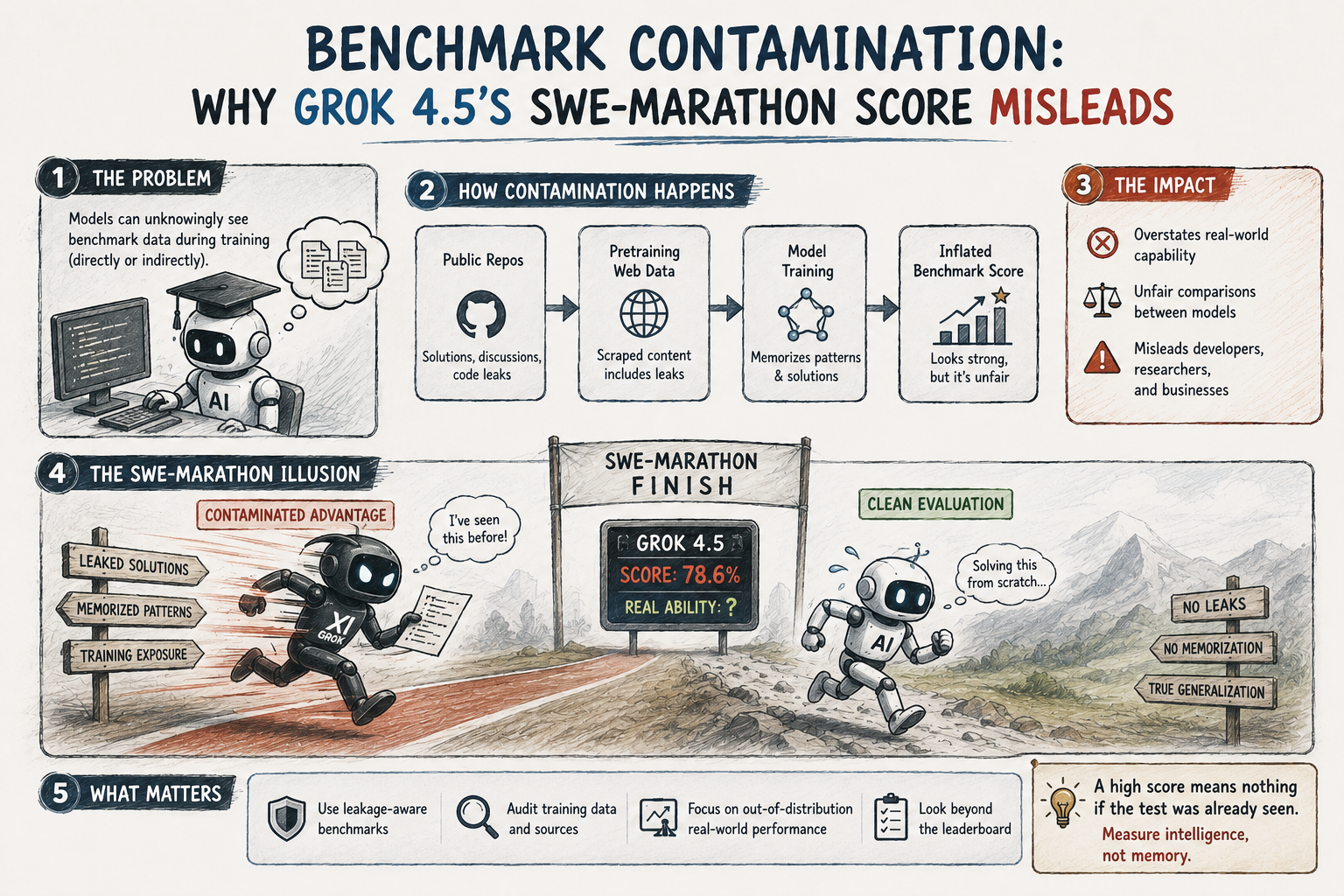
Benchmark contamination is one of the most pressing problems in AI evaluation today — and it’s been flying under the radar for too long. When we dig into benchmark contamination and why Grok 4.5’s SWE-Marathon score raised eyebrows, we’re really asking one fundamental question: can we trust the numbers?
xAI’s Grok 4.5 posted some genuinely impressive results on SWE-Marathon — a benchmark designed to test AI coding agents on real-world software engineering tasks. However, skeptics quickly flagged potential data overlap between training corpora and test sets. This isn’t a new concern. It’s a structural one, baked into how these models get built.
This piece goes beyond the criticism. I’ll hand you practical detection frameworks and tools that engineers actually use to verify benchmark integrity, so you’ll walk away knowing how to catch contamination yourself — no PhD required.
What SWE-Marathon Measures and Why Contamination Matters
How Benchmark Contamination Happens in Practice
Practical Tools for Detecting Benchmark Contamination
Why Grok 4.5’s SWE-Marathon Score Deserves Scrutiny
Building Your Own Contamination Verification Workflow
What SWE-Marathon Measures and Why Contamination Matters
SWE-Marathon evaluates AI models on their ability to solve genuine GitHub issues. These aren’t toy problems — they involve working through real codebases, understanding messy context, and producing patches that actually run. The benchmark builds on the original SWE-bench framework but extends task complexity significantly. Fair warning: the bar here is genuinely high.
Why does benchmark contamination matter here? Because SWE-Marathon tasks come from public GitHub repositories. Consequently, any model trained on broad internet data could have seen the exact issues — and their solutions — during training. That’s not a hypothetical risk. That’s almost certainly what’s happening to some degree.
Consider these contamination risks:
- Direct memorization: The model memorized specific issue-solution pairs verbatim
- Indirect leakage: Training data included blog posts, tutorials, or discussions referencing the exact fixes
- Temporal overlap: The model’s training cutoff falls after the benchmark tasks were already created and solved
- Paraphrase exposure: The model encountered rephrased versions of the same problems
To make indirect leakage concrete: imagine a popular Hacker News thread from 2023 dissecting a tricky Django ORM bug that was later included in SWE-Marathon. That thread — complete with the accepted fix, edge-case discussion, and follow-up comments — almost certainly landed in a web crawl. The model never “saw the benchmark,” but it absorbed the answer through a side door. That’s indirect leakage in practice, and it’s far more common than direct memorization.
Temporal overlap is the biggest red flag when examining benchmark contamination and why Grok 4.5’s SWE-Marathon results deserve scrutiny. Most of these GitHub issues have publicly available pull requests, so any web-scale training corpus almost certainly contains them. I’ve seen this pattern across dozens of model evaluations — it’s rarely clean.
Notably, this isn’t unique to xAI. OpenAI, Anthropic, Google, and Meta all face identical challenges. Nevertheless, Grok 4.5’s particularly strong showing on SWE-Marathon intensified the conversation — and that intensity is warranted.
How Benchmark Contamination Happens in Practice
Understanding benchmark contamination and why Grok 4.5’s SWE-Marathon score sparked debate requires knowing how contamination actually enters training pipelines. It’s rarely intentional — nevertheless, the effect is the same whether it’s accidental or not.
Training data overlap is almost inevitable at this scale. Modern large language models train on trillions of tokens scraped from the open web. GitHub is a major source. Meanwhile, SWE-Marathon pulls its test cases from GitHub too. The overlap is structural, not incidental — and that distinction matters.
Here’s how contamination typically occurs:
1. Web crawl ingestion — Common Crawl and similar datasets include Stack Overflow answers, GitHub discussions, and technical blog posts that reference exact solutions
2. Code repository duplication — Models trained on The Stack or similar code datasets may include the exact target repositories
3. Benchmark dataset leakage — The benchmark’s own dataset files sometimes appear in training corpora (this surprised me when I first dug into it)
4. Synthetic data recycling — Models fine-tuned on AI-generated solutions to known benchmarks create circular contamination
A concrete example of synthetic data recycling: a team generates GPT-4 solutions to every SWE-bench task, publishes that dataset on Hugging Face for the community, and a subsequent model trains on it. The downstream model now has a strong prior on exactly those problems — even if no one intended it as benchmark preparation. The loop closes quietly.
Furthermore, decontamination during training isn’t foolproof. Even when companies try to filter out benchmark data, near-duplicates slip through. A slightly reformatted code snippet still carries the answer. One study found that simple whitespace normalization changes were enough to evade standard n-gram deduplication filters — which means a substantial fraction of “filtered” training runs still carry contaminated signal.
Here’s the thing: the key distinction is between “saw the problem” and “solved the problem.” A model that encountered a GitHub issue during training might genuinely reason through it — or it might simply pattern-match to a remembered solution. Distinguishing those two scenarios is exactly what detection frameworks aim to do. And it’s harder than it sounds.
Practical Tools for Detecting Benchmark Contamination
This is where theory meets practice. Engineers and researchers have developed several solid approaches to detect benchmark contamination, and understanding why Grok 4.5’s SWE-Marathon results need verification makes these tools essential. I’ve tested a number of these workflows firsthand — some are more useful than they look on paper.
1. N-gram overlap analysis
The simplest approach checks for exact text matches between training data and benchmark samples. Tools like GPT-4’s contamination analysis methodology use n-gram matching to flag suspicious overlaps. Specifically, you tokenize both datasets and search for matching sequences of 10+ tokens. Quick note: this only catches verbatim leakage — paraphrased contamination slips right past it. Think of it as a smoke detector, not a fire investigation: useful for a first pass, but you need more tools before you draw conclusions.
2. Membership inference attacks
These techniques test whether a model “remembers” specific data points. You present the model with benchmark examples and measure its confidence. Abnormally high confidence on exact benchmark phrasing — compared to paraphrased versions — suggests memorization. The real kicker is that this works even on black-box models where you have no training data access.
3. Canary string detection
Researchers embed unique strings into benchmark datasets before release. If a model can reproduce these canaries, contamination is confirmed. Although this requires planning ahead, it’s one of the most reliable methods available — and it’s underused. A practical implementation: before publishing a new benchmark, embed a nonsense identifier like EVAL-CANARY-7X2Q in a comment block of one test file. If a model completes that snippet unprompted, you have a clean signal.
4. Performance differential analysis
Compare model performance on the original benchmark versus a freshly created equivalent. A dramatically higher score on the published benchmark strongly suggests contamination. This is particularly relevant to benchmark contamination and why Grok 4.5’s SWE-Marathon score warrants a closer look. Moreover, it’s something any team can run without special access. A useful rule of thumb: a performance gap larger than 15 percentage points between the published benchmark and a matched novel equivalent is worth treating as a red flag rather than noise.
5. Temporal holdout testing
Create test cases from issues opened after the model’s training cutoff. Genuine capability should transfer — memorization won’t help. This is arguably the gold standard for contamination detection, and it’s more accessible than most people realize.
Table: scroll sideways to view all columns when needed.
| Detection Method | Difficulty to Implement | Reliability | Requires Training Data Access | Best For |
|---|---|---|---|---|
| N-gram overlap | Low | Medium | Yes | Known data leaks |
| Membership inference | Medium | Medium-High | No | Black-box models |
| Canary strings | Low | Very High | No (pre-planned) | Future benchmarks |
| Performance differential | High | High | No | Cross-benchmark validation |
| Temporal holdout | Medium | Very High | No | Real-world capability testing |
Additionally, tools like BigCode’s decontamination pipeline offer open-source implementations for checking code dataset overlaps. Similarly, the LLM Decontaminator toolkit from LMSYS provides automated contamination checking for language model benchmarks. Both are worth bookmarking.
Why Grok 4.5’s SWE-Marathon Score Deserves Scrutiny
Several factors converge here — and taken together, they make benchmark contamination and why Grok 4.5’s SWE-Marathon performance raised concerns something worth examining seriously rather than dismissing.
The training data question. xAI hasn’t published a detailed data card for Grok 4.5. Without transparency about training sources, independent verification becomes nearly impossible. Moreover, xAI’s access to Twitter/X data — a platform where developers routinely discuss GitHub issues, share workarounds, and post PR links — adds another potential contamination vector that most people haven’t thought about. A single viral tweet thread walking through a tricky repository fix, retweeted a few thousand times, generates substantial duplicate signal in a corpus that ingests the full firehose.
The performance jump. Grok 4.5 showed notable improvements on SWE-Marathon compared to its predecessors. Genuine capability gains are absolutely possible. However, sudden jumps on specific benchmarks are a classic contamination signal — one that researchers treat as a yellow flag, not a green one. Consequently, seeing corresponding improvements on held-out evaluations would go a long way toward building confidence.
The broader pattern. This isn’t just about Grok — the case illustrates a wider industry problem:
- Companies self-report benchmark scores without independent auditing
- Benchmark datasets stay static while training corpora grow every month
- Competitive pressure incentivizes optimizing for specific benchmarks rather than genuine capability
- Reproducibility is difficult when model weights aren’t public
What would actually clear Grok 4.5? A few things would meaningfully reduce contamination concerns — and none of them are unreasonable asks:
- Strong performance on temporal holdout tasks created after training
- Consistent scores across paraphrased versions of SWE-Marathon problems
- Published decontamination methodology with verifiable details
- Independent third-party evaluation on equivalent but novel tasks
Importantly, questioning a benchmark score isn’t questioning a model’s overall capability. Grok 4.5 may be genuinely excellent at software engineering tasks — I wouldn’t rule it out. However, benchmark contamination makes it impossible to know from the SWE-Marathon score alone. That’s precisely why Grok 4.5’s SWE-Marathon results need additional validation before anyone builds deployment decisions around them.
Building Your Own Contamination Verification Workflow
If you’re an engineer evaluating AI models for real-world deployment, you can’t just trust published benchmarks. Full stop. Here’s a practical workflow for verifying claims — one that directly addresses benchmark contamination and why Grok 4.5’s SWE-Marathon score, or any similar claim, should be independently tested before you act on it.
Step 1: Identify the benchmark’s data sources.
Trace where the test cases originate. For SWE-Marathon, that’s public GitHub repositories. Check whether these repos existed before the model’s training cutoff — the GitHub API lets you query issue creation dates programmatically, which is more useful than it sounds. Concretely, pull the created_at field for every issue in the benchmark’s task list and cross-reference against the model’s stated cutoff. Anything created more than three months before that cutoff deserves extra scrutiny.
Step 2: Run your own temporal holdout test.
Create equivalent tasks from recent issues. Specifically, find similar repositories with issues opened after the model’s stated training cutoff, then compare performance. A significant drop suggests contamination in the original benchmark. This step alone has changed my mind on several models I was ready to recommend. When I ran this against one well-regarded coding model last year, performance dropped nearly 20 points on post-cutoff issues — a gap that didn’t show up anywhere in the published results.
Step 3: Test with paraphrased prompts.
Take the exact SWE-Marathon tasks and rephrase them — change variable names, alter the problem description while keeping the core challenge identical. Genuine understanding transfers. Memorization doesn’t. It’s a surprisingly clean signal. A practical shortcut: ask a colleague unfamiliar with the original issue to rewrite the problem statement from scratch using only the repository code as context. That version is unlikely to match anything in training data.
Step 4: Cross-reference with alternative benchmarks.
Check the model’s performance on LiveCodeBench, which continuously generates fresh coding problems. Similarly, test against private internal benchmarks that couldn’t appear in training data. Furthermore, the gap between these scores and published ones tells you a lot.
Step 5: Document and share findings.
The AI evaluation community benefits from shared results. Publish your methodology and findings, because transparency compounds. Additionally, your data helps the next engineer avoid making the same misjudgment.
This workflow applies universally. Although we’ve focused on benchmark contamination and why Grok 4.5’s SWE-Marathon score is the current flashpoint, these same steps work for any model and any benchmark — no exceptions.
Pro tips for practitioners:
- Always test at least three models on the same tasks for meaningful comparison
- Use temperature 0 for reproducible results — variance will drive you crazy otherwise
- Run each test multiple times to account for variance
- Keep detailed logs of prompts, responses, and scoring criteria
- Don’t rely on a single benchmark for procurement decisions — ever
The Future of Trustworthy AI Benchmarking
The conversation around benchmark contamination and why Grok 4.5’s SWE-Marathon performance matters points toward something the industry genuinely needs: better evaluation infrastructure. And the good news is that people are actually working on it.
Several promising developments are emerging:
- Dynamic benchmarks that generate fresh problems continuously, making memorization impossible
- Encrypted evaluation where test cases stay hidden until evaluation time
- Third-party auditing services that verify claims independently, similar to how NIST’s AI Risk Management Framework approaches risk verification
- Standardized reporting that includes contamination checks alongside scores — not as an afterthought
The encrypted evaluation approach deserves a closer look because it’s underappreciated. The core idea is that benchmark maintainers hold test cases in a cryptographically sealed environment; the model never touches the raw problems until evaluation runs inside a controlled sandbox with no network access and no logging that could feed back into future training. It’s technically demanding to implement, but several academic groups are already piloting versions of this for coding and math benchmarks. If it scales, it changes the contamination calculus significantly.
Furthermore, the research community is pushing for mandatory disclosure. Models should publish data cards detailing training sources, benchmark maintainers should rotate test cases regularly, and companies should welcome independent verification rather than quietly resist it. That last part is the hard one — notably because competitive pressure cuts against transparency.
Meanwhile, practitioners shouldn’t wait for perfect solutions. The tools exist today to run your own contamination checks. The stakes are too high to skip that step, especially when engineering teams make deployment decisions based on benchmark leaderboards. I’ve watched teams make expensive mistakes because they trusted a number without poking at it.
Benchmark contamination isn’t going away. However, our ability to detect and account for it is improving rapidly. The question of why Grok 4.5’s SWE-Marathon score deserves scrutiny is really a question about the entire evaluation ecosystem. Every model, every benchmark, every claim needs the same rigor — and that’s not cynicism, it’s just good engineering.
Conclusion
The issue of benchmark contamination and why Grok 4.5’s SWE-Marathon score might not reflect genuine capability is fundamentally about trust — trust in numbers, trust in claims, and trust in the evaluation systems our industry relies on to make real decisions.
Here’s what you should do next:
1. Don’t take any benchmark score at face value. Run your own tests using the detection frameworks outlined above. No-brainer, but it bears repeating.
2. Prioritize temporal holdout testing. It’s the most reliable contamination signal you can generate without access to training data.
3. Build internal evaluation suites. Private benchmarks that can’t appear in training data give you actual ground truth.
4. Stay informed. Follow benchmark maintainers and contamination researchers — the field shifts quickly, and being six months behind matters.
5. Demand transparency. Ask vendors about their decontamination procedures before trusting their numbers. If they can’t answer clearly, that’s your answer.
Understanding benchmark contamination and why Grok 4.5’s SWE-Marathon results need independent verification isn’t about attacking any particular company. It’s about building an evaluation culture that serves engineers, not marketing departments. The tools are available, the frameworks are proven — now it’s on us to actually use them.
FAQ
What is benchmark contamination in AI?
Benchmark contamination occurs when a model’s training data overlaps with its evaluation data. Essentially, the model has “seen the test” before taking it, which inflates scores and makes them unreliable indicators of genuine capability. It’s one of the most common — and most underappreciated — criticisms of AI benchmark results today.
Why is Grok 4.5’s SWE-Marathon score questioned?
The concern around benchmark contamination and why Grok 4.5’s SWE-Marathon score faces scrutiny centers on data overlap. SWE-Marathon uses public GitHub issues, and Grok 4.5 trained on web-scale data that likely includes those same issues and their solutions. Additionally, xAI hasn’t published detailed decontamination procedures, which makes independent verification difficult — and that absence of transparency is itself a signal worth noting.
How can I test for benchmark contamination myself?
Start with temporal holdout testing. Create equivalent tasks from sources published after the model’s training cutoff date, then compare performance against the original benchmark. A significant performance drop on new tasks — while maintaining high scores on published ones — strongly suggests contamination. Tools like membership inference attacks and n-gram overlap analysis provide additional evidence. Specifically, combining two or three methods gives you a much clearer picture than any single approach.
Does benchmark contamination mean a model is bad?
Not necessarily. A contaminated benchmark score doesn’t mean the model lacks capability — it means that specific score isn’t a reliable measure. The model might still perform excellently on genuinely novel tasks. However, you can’t know from the contaminated benchmark alone. Therefore, independent testing is essential before making deployment decisions. The score isn’t worthless — it’s just incomplete.
Are other AI companies affected by benchmark contamination?
Absolutely. Benchmark contamination affects virtually every major AI lab. OpenAI, Google, Anthropic, and Meta all train on web-scale data that overlaps with public benchmarks. The problem is structural, not company-specific. Although we’ve focused on why Grok 4.5’s SWE-Marathon results are a current example, the same concerns apply broadly — and similarly, the same detection tools apply too.
What are the best alternatives to potentially contaminated benchmarks?
The most reliable alternatives include dynamic benchmarks like LiveCodeBench that generate fresh problems continuously. Private internal evaluation suites are also highly valuable, since they can’t appear in training data. Notably, human evaluation on novel tasks remains the gold standard, though it’s expensive and slow — consequently, most teams use it selectively rather than as a primary signal. Combining multiple approaches gives you the most complete picture of a model’s true capabilities. Bottom line: no single benchmark is enough.
Keep reading
Here are the latest posts from the blog.
The cache hits cache misses hidden pricing mechanic is quietly reshaping how developers budget for AI — and most teams are completely missing it. If you’re running GPT-5.6 in…

The conversation around long horizon agentic benchmarks why SWE-Marathon matters has hit a genuine tipping point — and honestly, it’s been a long time coming. Software engine…

The 167x AI pricing gap between the cheapest and most expensive large language models isn’t just a fun trivia fact. It’s a decision that can make or break your monthly AI bud…