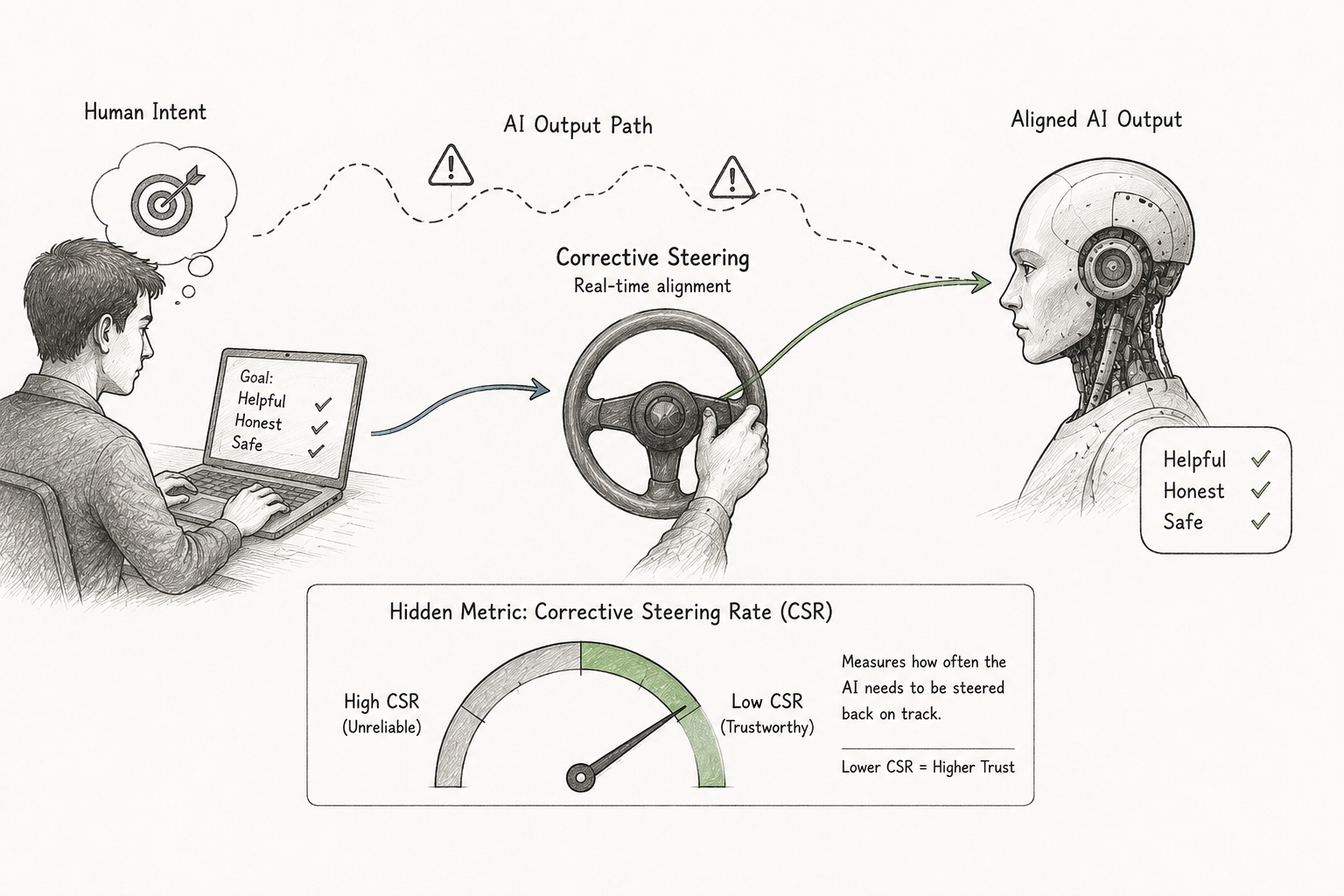
When you hand an AI agent the keys to a critical workflow, you’re trusting it won’t drive off a cliff. Corrective steering AI hidden metric tells how much that trust is actually warranted — and honestly, most teams deploying agents right now have no idea how to measure it. It’s the difference between blind faith and measurable confidence.
Most teams focus on accuracy benchmarks and check outputs after the fact. However, corrective steering flips that model entirely. It measures how an AI system detects and fixes its own mistakes in real time — before those mistakes reach your users, your supply chain, or your production environment.
This metric isn’t theoretical. It’s becoming the quiet standard that separates reliable AI deployments from ticking time bombs.
How Corrective Steering Works Under the Hood
Why Corrective Steering AI Hidden Metric Tells How Trust Should Be Measured
The Supply Chain Risk: When Corrective Steering Gets Corrupted
Corrective Steering AI Hidden Metric Tells How Vulnerability Disclosure Must Evolve
Measuring Corrective Steering: Practical Implementation Guide
How Corrective Steering Works Under the Hood
Corrective steering isn’t a single algorithm. It’s a layered mechanism built into an AI system’s inference pipeline — and the first time I dug into how it works, I was surprised how much was happening between “model generates output” and “user sees response.”
Specifically, it runs between the model’s raw output generation and the final response delivery. Think of it as a quality control station on an assembly line, except it runs in milliseconds and doesn’t require anyone to be awake at 3 AM.
The core loop works like this:
1. The model generates an initial output or action plan
2. A monitoring layer checks that output against safety constraints, factual grounding, and task alignment
3. If the output falls outside acceptable bounds, the system applies a correction vector
4. The corrected output gets re-evaluated before delivery
5. The entire cycle logs deviation magnitude and correction frequency
Notably, this doesn’t require retraining the base model. Instead, it uses lightweight evaluation layers — often called guardrail classifiers — that sit on top of the primary model. That’s what makes it practical for production deployments where you can’t afford weeks of fine-tuning every time something drifts.
Why this matters for trust. Traditional AI evaluation happens offline. You test a model, get a benchmark score, and deploy it. But models behave differently in production — they hit edge cases, adversarial inputs, and distribution shifts that benchmarks never captured. I’ve seen teams discover this the hard way, usually right after something embarrassing surfaces in their logs.
The NIST AI Risk Management Framework explicitly calls for continuous monitoring of AI systems. Corrective steering provides exactly that — a measurable, auditable feedback loop. Consequently, organizations that adopt this approach can show compliance rather than just claim it.
Key components of a corrective steering system:
- Deviation sensors — classifiers that flag when outputs drift from expected behavior
- Correction policies — predefined rules or learned adjustments that redirect outputs
- Confidence thresholds — numerical boundaries that trigger intervention
- Audit logs — timestamped records of every correction event
- Escalation triggers — conditions where the system stops instead of correcting
That last one matters more than people realize. Knowing when to stop and ask for help is a feature, not a failure.
Why Corrective Steering AI Hidden Metric Tells How Trust Should Be Measured
Traditional trust metrics for AI are shallow. Accuracy on a test set tells you nothing about what happens Tuesday at 3 AM when your agent processes an unusual request. Corrective steering AI hidden metric tells how an agent performs under pressure — not just under ideal conditions.
Here’s the thing: a self-driving car’s safety record on a test track means very little. What matters is how it handles a deer on a foggy highway. Similarly, corrective steering captures the AI equivalent of those unpredictable moments — the ones that don’t show up in your benchmark suite but absolutely show up in production.
There are three trust dimensions this metric reveals:
1. Self-awareness — Does the agent recognize when it’s uncertain or wrong?
2. Recovery capability — Can it fix errors without human intervention?
3. Failure transparency — Does it log and report what went wrong?
Moreover, the frequency and magnitude of corrections create a trust fingerprint. An agent that rarely needs corrections might seem ideal. But an agent that frequently catches and fixes small errors might actually be more trustworthy — because it shows active vigilance rather than blissful ignorance. I’ve tested deployments on both ends of that spectrum, and the vigilant one consistently holds up better under stress.
The Partnership on AI has published guidelines emphasizing that trustworthy AI must include mechanisms for ongoing self-assessment. Corrective steering directly addresses this requirement. Therefore, organizations that track this metric can make concrete claims about their AI’s reliability — which, increasingly, is what regulators and enterprise buyers are asking for.
A practical example. Imagine an AI agent managing purchase orders in a supply chain. It processes 10,000 orders daily. Without corrective steering, a subtle prompt injection could redirect shipments. With it, the system detects the unusual instruction, flags it, and reverts to the approved vendor list. The correction gets logged. Additionally, the security team gets alerted.
That’s not hypothetical. It’s precisely the kind of scenario that OWASP’s Top 10 for LLM Applications specifically warns about. Corrective steering turns these warnings into real defenses.
The Supply Chain Risk: When Corrective Steering Gets Corrupted
Here’s where things get dangerous.
Corrective steering is only as trustworthy as its own integrity. If an attacker compromises the steering mechanism itself, the AI agent becomes both blind and confident — the worst possible combination. This attack surface is bigger than most teams expect.
Model Context Protocol (MCP) attacks represent a growing threat. MCP defines how AI agents interact with external tools and data sources. Nevertheless, malicious actors can exploit MCP connections to feed corrupted context into an agent’s decision pipeline. Because the corruption happens upstream of the steering layer, it can be remarkably hard to detect.
Specifically, these attacks can target corrective steering in several ways:
- Poisoning the evaluation layer — injecting data that teaches the guardrail classifier to approve bad outputs
- Threshold manipulation — gradually shifting confidence boundaries so dangerous outputs pass through
- Log suppression — preventing correction events from being recorded
- Feedback loop hijacking — making the system “learn” that errors are acceptable
Consequently, corrective steering AI hidden metric tells how vulnerable your entire AI pipeline might be. The real issue: a sudden drop in correction frequency could mean your agent got smarter. Or it could mean someone disabled the safety net. Without proper monitoring, you won’t know which.
Table: scroll sideways to view all columns when needed.
| Threat Type | Impact on Steering | Detection Difficulty | Mitigation Strategy |
|---|---|---|---|
| MCP context poisoning | Corrupts evaluation criteria | High | Signed context verification |
| Prompt injection | Bypasses correction triggers | Medium | Input sanitization layers |
| Threshold drift | Weakens safety boundaries | High | Immutable threshold baselines |
| Log tampering | Hides correction failures | Medium | Append-only audit storage |
| Model extraction | Reveals steering logic | Low | API rate limiting and monitoring |
The MITRE ATLAS framework catalogs adversarial tactics against AI systems. Importantly, it highlights that attacks on AI safety mechanisms — including corrective steering — represent a distinct and growing threat category. It’s worth bookmarking if you’re doing serious AI security work.
What you should do about it. Treat your corrective steering system like critical infrastructure. Apply the same security controls you’d use for authentication systems or encryption key management. Specifically:
- Isolate steering components from the main model’s runtime environment
- Use cryptographic signing for all correction policies
- Monitor correction frequency for unusual patterns
- Set up redundant evaluation layers from different providers
- Run regular adversarial testing against the steering mechanism itself
None of this is glamorous work. However, it’s the difference between an AI deployment you can defend and one you’re scrambling to explain.
Corrective Steering AI Hidden Metric Tells How Vulnerability Disclosure Must Evolve
When corrective steering fails, it creates an exploitable gap. Right now, most vulnerability disclosure frameworks don’t account for this — and that’s a serious problem the security community isn’t ready for.
Traditional security vulnerabilities have clear boundaries. A buffer overflow exists or it doesn’t. But corrective steering failures are probabilistic. They might only surface under specific input conditions, at certain confidence thresholds, or after prolonged operational drift. That fuzziness makes them hard to reproduce, hard to scope, and hard to disclose responsibly.
Furthermore, these failures don’t fit neatly into existing severity scoring systems. The Common Vulnerability Scoring System (CVSS) wasn’t designed for AI-specific weaknesses. A corrective steering failure might score low on technical complexity but extremely high on potential impact. That’s exactly the kind of mismatch that lets serious risks slip through the cracks.
This creates a disclosure gap. Security researchers who find steering vulnerabilities face several challenges:
- Reproducibility — The failure might not occur consistently across different inputs
- Scope assessment — It’s hard to determine which downstream systems are affected
- Responsible disclosure timing — Fixing steering issues often requires full redeployment, not just a patch
- Vendor awareness — Many AI vendors don’t even monitor their steering metrics
Meanwhile, corrective steering AI hidden metric tells how organizations should rank these disclosures. A steering failure in a customer service chatbot carries different implications than one in an autonomous trading system. Additionally, the gap between those two scenarios is enormous — and your disclosure process should reflect that.
Practical steps for security teams:
1. Add corrective steering metrics to your security monitoring dashboard
2. Define severity thresholds specific to steering failures
3. Create incident response playbooks for steering compromise scenarios
4. Set up communication channels with AI vendors for steering-related disclosures
5. Include steering integrity in your regular penetration testing scope
The Cybersecurity and Infrastructure Security Agency (CISA) has begun issuing guidance on AI-specific security concerns. Although their frameworks are still evolving, early adoption of steering-aware security practices puts you ahead of regulatory requirements — and ahead of most of your competitors.
Measuring Corrective Steering: Practical Implementation Guide
So how do you actually measure this? Corrective steering AI hidden metric tells how much trust to place in an agent, but you need concrete numbers to act on. Here’s what I’d instrument if I were setting this up from scratch.
Start with these five core measurements:
1. Correction frequency rate (CFR) — How often does the steering system intervene per 1,000 inferences?
2. Average deviation magnitude (ADM) — How far off was the original output before correction?
3. Correction success rate (CSR) — What percentage of corrections actually fixed the problem?
4. Time to correction (TTC) — How many milliseconds does the correction cycle add?
5. Escalation rate (ER) — How often does the system decide it can’t self-correct and asks for human help?
Healthy ranges vary by use case. Nevertheless, some general benchmarks apply — and these reflect patterns observed across real production deployments, not pulled from thin air:
Table: scroll sideways to view all columns when needed.
| Metric | Low Risk Application | Medium Risk Application | High Risk Application |
|---|---|---|---|
| CFR (per 1,000) | < 50 | < 20 | < 5 |
| ADM (0-1 scale) | < 0.3 | < 0.15 | < 0.05 |
| CSR (percentage) | > 85% | > 95% | > 99% |
| TTC (milliseconds) | < 500 | < 200 | < 50 |
| ER (per 1,000) | < 10 | < 5 | < 1 |
However, your specific thresholds should reflect your risk tolerance and regulatory environment. Don’t treat these as gospel — treat them as a starting point for a conversation with your team.
Tools that support corrective steering measurement:
- LangSmith by LangChain — provides tracing and evaluation for LLM applications, including correction event logging
- Weights & Biases — offers experiment tracking that can monitor steering metrics over time
- Guardrails AI — built specifically for output validation and correction in LLM pipelines
- Azure AI Content Safety — Microsoft’s content safety service includes real-time output filtering that works as a steering layer
Additionally, open-source frameworks like NeMo Guardrails from NVIDIA offer customizable steering implementations. Because correction policies can be written in plain language, they’re accessible to engineers who aren’t ML specialists — which is one of the more underrated features in that space.
Implementation checklist:
- Define acceptable output boundaries for each use case
- Deploy at least two independent evaluation layers
- Set up real-time dashboards for all five core metrics
- Set alerting thresholds for unusual correction patterns
- Schedule weekly reviews of correction trends
- Store correction policies in version-controlled repositories
- Test steering effectiveness with adversarial inputs monthly
A note on that last point: most teams schedule it quarterly and then skip it. Monthly is worth the discipline, notably because drift can happen faster than you’d expect.
Conclusion
Corrective steering AI hidden metric tells how trustworthy an autonomous agent truly is — and it shouldn’t stay hidden anymore. It deserves a central place in every AI deployment strategy, not buried in a technical appendix, but on the dashboard your leadership actually looks at.
We’ve covered the technical mechanism, the trust implications, the security risks, and the practical measurement approach. Moreover, corrective steering isn’t just a safety feature — it’s a measurable control that bridges the gap between AI capability and AI reliability. Those two things aren’t the same, and treating them as if they are is how teams end up in trouble.
Your actionable next steps:
1. Audit your current AI agents for existing corrective steering capabilities
2. Set up the five core metrics (CFR, ADM, CSR, TTC, ER) for each deployed agent
3. Add steering integrity to your security monitoring and incident response plans
4. Check your vulnerability disclosure processes for AI-specific gaps
5. Set baseline measurements now, before regulatory requirements force you to
Bottom line: the organizations that treat corrective steering AI hidden metric tells how trust is earned — not assumed — will be the ones that deploy AI safely at scale. Conversely, those that ignore it will learn its importance the hard way. That’s not a lesson you want to learn in production.
FAQ
What exactly is corrective steering in AI?
Corrective steering is a real-time feedback mechanism built into an AI system’s inference pipeline. It monitors outputs as they’re generated, checks them against safety and accuracy constraints, and applies corrections before delivery. Importantly, it doesn’t require retraining the base model. Instead, it uses lightweight evaluation layers that run on top of the primary model — which is what makes it practical to deploy without a months-long ML project attached.
Can corrective steering be hacked or compromised?
Yes — and this concern doesn’t get nearly enough attention. Attackers can target corrective steering through MCP context poisoning, threshold manipulation, log suppression, and feedback loop hijacking. Consequently, organizations should treat their steering systems as critical security infrastructure. Specifically, apply cryptographic signing to correction policies, use isolated runtime environments, and watch for unusual changes in correction patterns. If your correction frequency suddenly drops to zero, that’s not necessarily good news.
Does corrective steering slow down AI responses?
It adds some latency — typically 50–500 milliseconds depending on the application’s risk level. For most use cases, this delay is imperceptible to end users. Nevertheless, high-frequency trading or real-time control systems may need optimized implementations. The tradeoff between speed and safety should be an explicit design decision — notably one that gets documented and revisited as your usage patterns change.
How is corrective steering different from traditional AI guardrails?
Traditional guardrails typically block or filter outputs using static rules. Corrective steering goes further. It actively adjusts outputs to meet safety requirements while keeping the original intent intact — which is a meaningfully different approach. Additionally, corrective steering generates detailed audit logs of every intervention, making it both a safety mechanism and a compliance tool. Think of guardrails as a wall, and corrective steering as a GPS that reroutes you when you’re headed somewhere you shouldn’t be.
What tools can I use to implement corrective steering today?
Several production-ready options exist. I’d recommend starting with at least two in combination for redundant protection. Guardrails AI handles output validation and correction for LLM pipelines. NVIDIA’s NeMo Guardrails offers customizable steering policies. LangSmith lets you trace and evaluate correction events. Microsoft’s Azure AI Content Safety provides real-time output filtering. Moreover, you can build custom steering layers using open-source evaluation frameworks. Similarly, combining commercial and open-source tools gives you both reliability and flexibility. The best approach layers multiple tools rather than betting everything on one.
References
Keep reading
Here are the latest posts from the blog.
When a security researcher finds a flaw in an AI system, what actually happens next? The vulnerability disclosure process turns AI security findings from dangerous secrets in…

Anthropomorphic AI laws are quietly reshaping how the world thinks about artificial intelligence — and most people in the West haven’t noticed yet. Specifically, China’s late…

Microsoft Frontier Company AI infrastructure investment strategy is, without exaggeration, the most aggressive capital deployment in tech history. With a reported $100 billio…