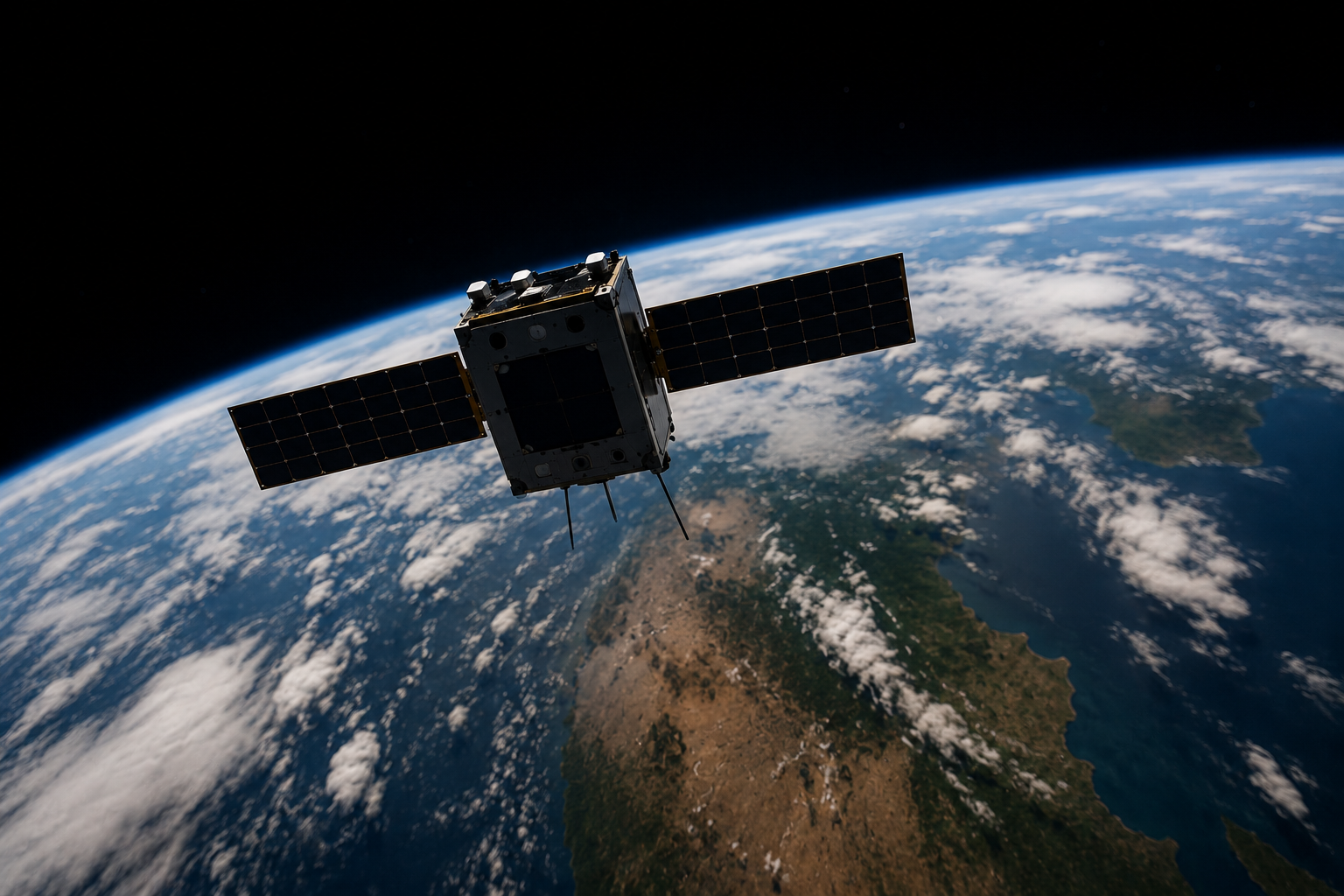
Something genuinely new is happening 550 kilometers above your head right now.
Google’s Gemma 3 — a compact, open-source language model — is running inference directly aboard a spacecraft. Not beaming data down to Earth for processing. Not waiting for a ground station contact window. Thinking, in orbit, in real time.
Google and Loft Orbital announced this milestone in mid-2025, deploying Gemma 3 on the YAM-9 satellite as the first demonstration of a powerful AI model running entirely at the edge of space. I don’t use phrases like “genuine turning point” lightly after a decade of watching “game-changing” announcements fizzle out. This one is different. The implications stretch well beyond a technically impressive demo — they reshape how we think about autonomous systems, bandwidth economics, and what satellites are actually capable of.
Let’s get into it.
Why This Matters More Than Another Tech Milestone
Traditional satellite operations follow a pattern that hasn’t changed much in decades. A satellite captures data, downlinks it to a ground station, and then waits — sometimes hours, sometimes days — while engineers on Earth process everything before uplinking new commands. It’s slow by design, and the industry has accepted that tradeoff because there was no alternative.
YAM-9 changes the calculus.
By running an AI model directly on the satellite, decisions happen in milliseconds instead of hours. The satellite stops being a remote-controlled instrument and starts behaving like an autonomous system. That’s a different thing entirely — not an improvement on the old model, but a replacement for it.
Here’s what that looks like in practice:
- A wildfire breaks out in a remote region. A traditional satellite captures the imagery and queues it for ground processing. By the time analysts flag the anomaly, hours have passed. With onboard AI running on YAM-9-class hardware, the satellite classifies the thermal signature, estimates spread direction, and transmits a structured alert — all within seconds of the first detection.
- The same logic applies to maritime surveillance over open ocean where no ground station is nearby, to crop health monitoring where a three-day delay renders the data nearly useless, and to any defense application where a communication window that opens every 90 minutes is not an acceptable response time.
- Bandwidth is the other piece of this. Downloading raw satellite imagery is genuinely expensive — this surprised me when I first started digging into the commercial economics. A single high-resolution Earth observation satellite can generate terabytes of data daily. Full downloads at scale are practically impossible. But if the AI model processes data onboard and only transmits the relevant findings, you can cut downlink requirements by 90% or more. That’s not a rounding error. That’s a fundamentally different cost structure for the entire commercial remote sensing industry.
- Loft Orbital designed YAM-9 as a flexible, software-defined platform from the start. Rather than serving a single mission, it hosts multiple payloads from different customers simultaneously. That architectural choice — which looked forward-thinking at the time — turned out to be exactly what made YAM-9 the right testbed for this deployment.
Cloud vs. Edge: Why the Old Assumption Breaks Down in Space
Most people assume cloud processing is always superior. More compute, better cooling, easier to update, no power constraints. In space, that assumption falls apart quickly.
The core problem is contact. A low-Earth orbit satellite like YAM-9 might have a communication window of only 10–15 minutes per orbital pass. Any processing that depends on ground contact faces inherent delays — and in time-sensitive situations, those delays have real consequences. You can’t ask a satellite to wait for permission before detecting a launch event.
Here’s how the two approaches actually compare:
| Factor | Cloud-Based (Ground Processing) | Edge Processing (On-Satellite AI) |
|---|---|---|
| Latency | Minutes to hours | Milliseconds |
| Bandwidth cost | High (raw data downlink) | Low (processed results only) |
| Autonomy | Dependent on ground contact | Fully autonomous |
| Power consumption | Lower on satellite, higher on ground | Higher on satellite, lower overall |
| Data freshness | Stale by the time it’s processed | Real-time |
| Coverage gaps | Can’t process without ground link | Works anywhere in orbit |
| Model updates | Easy to update on ground servers | Requires uplink for model swaps |
That last row is worth holding onto. Edge processing gives up something real — updating a model aboard YAM-9 requires a secure uplink during a contact window, whereas updating a ground server is trivial. Anyone pitching pure edge-only as a complete solution is oversimplifying. The practical architecture for most serious deployments will combine both: the satellite handles time-critical inference at the edge, and more complex analysis happens on the ground when latency isn’t the binding constraint.
But for the applications where latency and autonomy matter most, the edge wins clearly. YAM-9 proves that edge processing isn’t theoretical — it works in the harsh environment of space, radiation and thermal extremes and all.
The Engineering Behind Making Gemma 3 Work in Orbit
Running an AI model on YAM-9 isn’t as simple as uploading a model file. Space imposes constraints that don’t exist in any data center, and solving them reveals the real engineering achievement here.
Power. YAM-9 runs on solar panels with limited battery storage. A typical NVIDIA GPU server on Earth draws 300–700 watts. The compute hardware aboard YAM-9 operates on a fraction of that. This single constraint shapes every other decision downstream — the model has to be small enough and efficient enough to run on hardware drawing only a few watts.
Model quantization. Gemma 3 was designed from the start to be efficient, with multiple size variants built for edge deployment. For orbital use, the model went through aggressive quantization — reducing the precision of model weights from 32-bit floating point down to 8-bit or 4-bit integers. The result is a dramatically smaller model that uses less memory, runs faster, and loses less accuracy than you’d expect. The accuracy tradeoff at INT8 is genuinely small; I was skeptical until I looked at the benchmarks closely.
Radiation hardening. Space radiation can flip bits in memory, corrupting data and crashing software in ways that are difficult to predict or reproduce. Consumer hardware would fail quickly in orbit. The compute modules aboard YAM-9 use radiation-tolerant designs, error-correcting memory, and watchdog systems that ensure the AI model keeps running reliably despite the environment.
Thermal management. There’s no air in space for convection cooling. Heat dissipates through radiation and conductive pathways only. The AI processor must stay within its thermal limits even during intensive inference workloads — a constraint that simply doesn’t exist for any server rack on Earth.
The optimization pipeline that produced the final deployed model looks roughly like this:
- Start with the full Gemma 3 model
- Apply structured pruning to remove less critical neural pathways
- Quantize remaining weights to INT8 or INT4 precision
- Compile the model for the specific edge hardware aboard YAM-9
- Test extensively under simulated space conditions — radiation, thermal cycling, power fluctuations
- Upload the optimized model via secure uplink
- Validate inference accuracy against ground-truth data
The bandwidth savings alone justify this effort. Instead of downlinking gigabytes of raw imagery, YAM-9 transmits kilobytes of structured inference results — a reduction of several orders of magnitude. The engineering is genuinely hard, but the payoff is real and measurable.
One thing worth noting: this optimization work builds directly on Google’s broader on-device AI strategy. Gemma 3 already runs efficiently on smartphones and embedded devices, so adapting it for space was a natural extension — though the space-specific constraints added significant engineering work on top of what already existed for consumer edge deployment.
The Geopolitical Dimension Nobody Is Talking About Enough
The YAM-9 deployment carries significance well beyond technology. It raises questions about who controls AI capabilities in space — and those questions don’t have comfortable answers yet.
Sovereignty and access. Currently, satellite data processing depends on ground infrastructure. Countries without advanced ground stations or cloud computing resources face real disadvantages in accessing satellite-derived intelligence. When AI runs directly on satellites like YAM-9, the processing happens in orbit — beyond any single nation’s jurisdictional reach. That could meaningfully open up access to AI-derived insights for countries that currently lack the infrastructure to compete. Or it could create new power imbalances, depending entirely on who owns the satellites doing the processing.
The open-weight question. Gemma 3 is an open-weight model. Google released it for anyone to use, modify, and deploy. That openness matters enormously in this context. A proprietary model locked behind API access creates dependency — you can lose access, face price changes, or find yourself cut off for political reasons. An open model running on a commercially available satellite platform creates opportunity that’s much harder to restrict. The distinction isn’t academic; it’s the difference between a tool you own and a service you rent.
Military and intelligence applications. A satellite that can independently identify military assets, track fleet movements, or detect launches without requiring ground contact is strategically valuable in ways that are obvious to anyone paying attention. Expect significant government interest — and significant government funding — flowing into YAM-9-class capabilities fast. This is already happening; it’s just not always announced publicly.
The regulatory gap. International space law — primarily the Outer Space Treaty of 1967 — doesn’t address autonomous AI decision-making in orbit at all. As more AI models deploy to satellites, new frameworks will be needed. The organizations and governments that shape those frameworks will have enormous influence over what’s permissible up there, and right now that conversation is barely starting.
A few specific dynamics worth watching:
- Export controls may extend to space-optimized AI models, similar to how advanced chip exports are already restricted.
- Data sovereignty questions will intensify as AI processes imagery over foreign territory autonomously.
- Dual-use tension is real — the same model monitoring crop health can surveil military installations, and that tension doesn’t resolve itself.
- Allied cooperation on space AI may become part of intelligence-sharing agreements in ways that formalize new tiers of access.
The YAM-9 mission forces this conversation to start now rather than later. If you work in policy or national security, this one deserves serious attention sooner than the news cycle suggests.
What Comes After YAM-9
This initial deployment is a proof of concept. The real transformation follows — and the roadmap is genuinely ambitious.
More capable hardware, larger models. As space-rated edge processors improve, satellites will run increasingly sophisticated models. The YAM-9 deployment handles specific inference tasks well. Future generations could run multimodal models that process imagery, text, and sensor data simultaneously. The hardware trajectory for space-grade compute is moving faster than most people outside the industry realize.
Distributed AI across satellite constellations. The scenario I find most interesting: dozens or hundreds of satellites sharing inference workloads across a mesh network. One satellite spots something anomalous and alerts nearby satellites to focus their sensors. The constellation acts as a distributed AI system — no ground station required, no human in the loop for routine decisions. The implications of that setup are genuinely difficult to fully reason about in advance.
A continuously updated Earth model. With enough AI-equipped satellites operating on the YAM-9 model, you could maintain a continuously updated representation of Earth’s surface. Changes — natural disasters, environmental shifts, infrastructure development — would be detected and classified within seconds of occurring rather than sitting in a processing queue for days.
Economic compounding. Loft Orbital’s software-defined approach means deploying new AI models doesn’t require launching new hardware. Updated models upload to existing satellites. That’s dramatically cheaper than traditional space missions, and the cost advantage compounds over time as model capabilities improve without additional launch costs.
Near-term applications that are already being discussed seriously in the industry:
- Autonomous collision avoidance, where satellites detect and maneuver around debris without waiting for ground authorization.
- Optimized imaging schedules, where onboard AI decides what to photograph based on cloud cover, lighting, and mission priority in real time.
- Inter-satellite communication routing, where AI models dynamically optimize data paths through satellite mesh networks.
- Predictive maintenance, where the satellite monitors its own component health and flags potential failures before they become critical.
The YAM-9 deployment isn’t the destination. It’s the starting line — and the pace from here will be faster than the pace that got us here.
A few things are worth sitting with as the implications settle.
Edge AI optimization techniques — quantization, pruning, hardware-specific compilation — are becoming relevant across far more industries than space. The methods that made Gemma 3 work on YAM-9 apply equally to remote industrial sensors, autonomous vehicles, underwater systems, and anything else that operates in environments where cloud connectivity isn’t guaranteed. If you work in any of those areas, the engineering choices behind this deployment are worth understanding in detail.
The open-weight model strategy is vindicated in a compelling way by this deployment. Gemma 3’s openness is precisely what made this possible at the speed it happened. Proprietary models with API dependencies don’t adapt well to environments where the API is 550 kilometers away and contact is intermittent. The case for open weights in edge deployment just got a very concrete demonstration.
Satellite data users should be evaluating their architectures. If your organization consumes satellite imagery or derived data, the question worth asking now is whether onboard processing could reduce your costs and improve your timeliness. The economics are shifting, and the organizations that understand the new cost structure early will have an advantage over those that figure it out later.
The regulatory environment will matter more than most technologists want it to. Autonomous AI decision-making in orbit will attract government attention — some of it constructive, some of it restrictive. The organizations that engage with that process early, rather than treating regulation as someone else’s problem, will be better positioned when the frameworks solidify.
Conclusion
The YAM-9 satellite, carrying Google’s Gemma 3 model into low-Earth orbit, demonstrates something that the AI industry has been building toward for years: that real-time intelligence can operate anywhere, without cloud infrastructure, without reliable connectivity, and without human intervention for every decision.
That’s not a minor improvement on existing satellite operations. It’s a different paradigm.
The engineering challenges were real — power constraints, radiation hardening, thermal management, aggressive model optimization. Google and Loft Orbital solved them. The YAM-9 deployment proves that edge AI works in one of the most hostile environments on Earth, or rather above it.
What follows from here will be shaped by how quickly the hardware improves, how the regulatory environment develops, and how the commercial satellite industry responds to a demonstrated alternative to ground-based processing. All three of those trajectories are moving fast.
The AI future isn’t only in the cloud. Part of it is already running in orbit — and YAM-9 is where that started.
FAQ
What is the YAM-9 satellite and who built it?
YAM-9 is a satellite built and operated by Loft Orbital, designed as a flexible software-defined platform that hosts multiple customer payloads simultaneously. That modular architecture made it the right vehicle for deploying Google’s Gemma 3 model in orbit, since the platform was already built to support diverse workloads rather than serving a single fixed mission.
What AI model is running on YAM-9?
Google’s Gemma 3, an open-weight language model specifically designed for efficient edge deployment. For the YAM-9 mission, Gemma 3 was further optimized through quantization and pruning to operate within the strict power, memory, and compute constraints of a satellite operating environment.
How does running AI on YAM-9 reduce latency compared to ground processing?
Traditional satellite workflows require data to travel from orbit to a ground station, get processed, and have results sent back up — a round trip that can take minutes to hours depending on when the next ground station contact window opens. With Gemma 3 running directly aboard YAM-9, inference happens immediately after data capture. Latency drops from hours to milliseconds, which makes time-sensitive applications like disaster detection genuinely practical for the first time.
Can the AI model on YAM-9 be updated after launch?
Yes, and this is one of the more underappreciated advantages of Loft Orbital’s platform. New model versions can be uploaded to YAM-9 via secure uplink during ground station passes. This means the satellite’s AI capabilities can improve over its operational lifetime without launching new hardware — a significant cost advantage over traditional space missions where capability is fixed at launch.
What are the main technical challenges of running AI on a satellite like YAM-9?
The primary challenges are power (solar panels provide limited, variable energy with no option for supplementation), radiation (cosmic rays can corrupt memory in ways that crash software unpredictably), thermal extremes (temperatures swing dramatically between sunlight and shadow with no convective cooling available), and bandwidth constraints for pushing model updates to orbit. The system also has to be exceptionally fault-tolerant from day one, since physical access for repairs isn’t an option.
What does the YAM-9 deployment mean for the broader AI industry?
It validates edge AI in the most extreme environment imaginable. If Gemma 3 works reliably aboard YAM-9, it reinforces the case for edge deployment in any environment where cloud connectivity is unreliable or impossible — remote industrial sites, autonomous vehicles, underwater systems, and more. It also demonstrates the practical value of open-weight models in a way that no benchmark paper could: real hardware, real constraints, real orbit.
References
Keep reading
Here are the latest posts from the blog.

Autonomous penetration testing — when AI stops being told what to hack and starts choosing its own targets — isn’t a future scenario anymore. We’re no longer talking about AI…

Large language models forget everything between conversations. That’s the dirty secret of modern AI — and it’s been quietly wrecking the economics of building useful AI produ…
The OpenAI Jalapeño chip custom semiconductor AI inference project signals a massive shift. OpenAI isn’t just building AI models anymore — it’s building the hardware to run t…