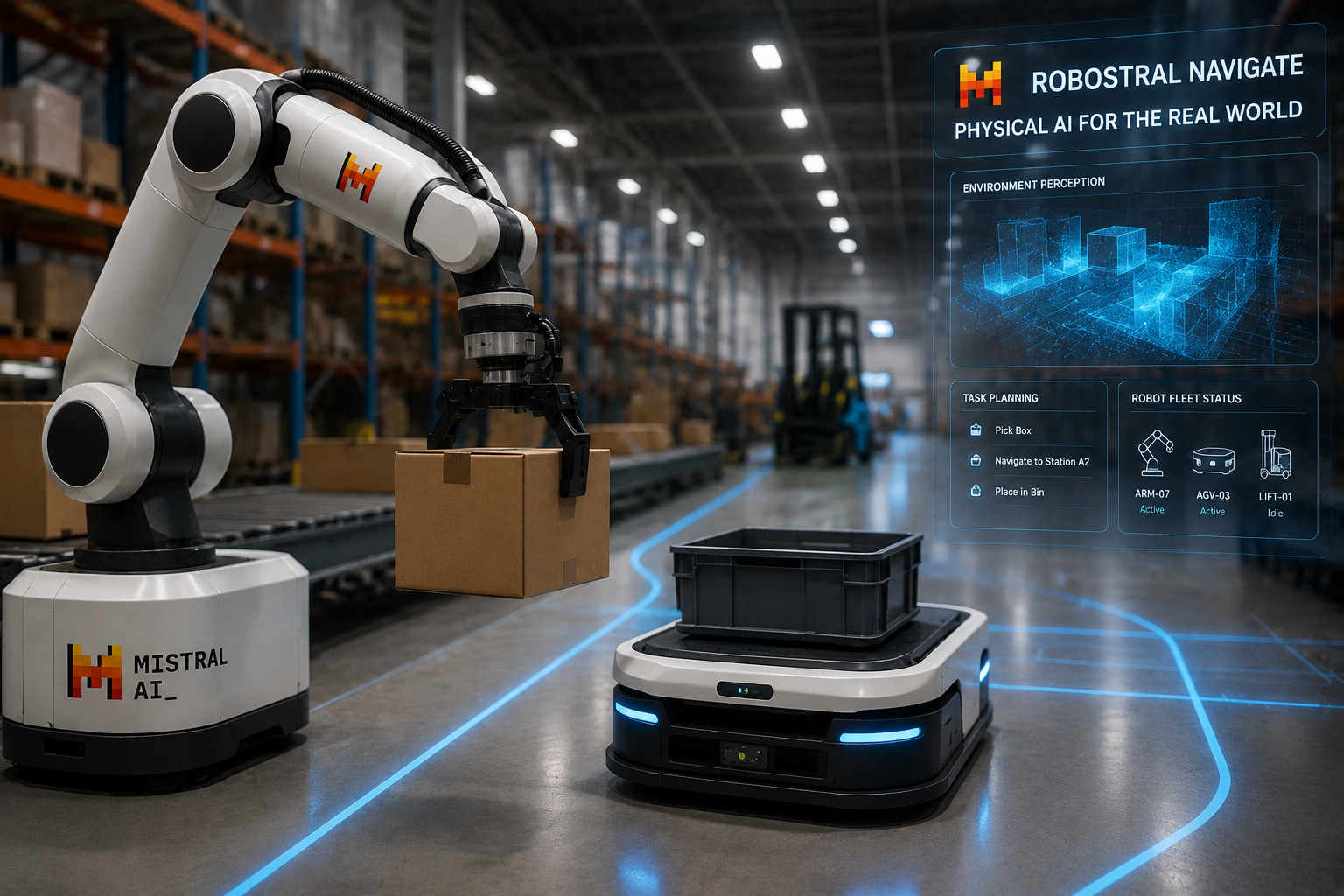
Europe just made its boldest move in the robotics race. Physical AI robots Europe Mistral Robostral Navigate represents a serious attempt to challenge American and Chinese dominance in embodied intelligence. Mistral AI, the Paris-based company already known for its large language models, has entered the physical AI arena with a purpose-built model for robotic navigation and reasoning.
And look — this isn’t a research demo. It’s a production-ready system designed to give European robotics manufacturers a sovereign AI backbone. The geopolitical stakes around physical AI couldn’t be higher right now, and Mistral clearly knows it.
Why Europe Needs Its Own Physical AI Platform
For years, Europe has watched from the sidelines. American companies like NVIDIA, Google DeepMind, and Tesla have poured billions into physical AI. Meanwhile, Chinese firms like Unitree and Agility Robotics have shipped humanoid robots at aggressive price points. Europe’s robotics sector — historically strong in industrial automation — lacked a homegrown AI brain. That gap has been quietly painful to watch.
Mistral’s Robostral Navigate changes that equation. Specifically, it gives European manufacturers an embodied reasoning model that doesn’t depend on American cloud infrastructure or Chinese hardware ecosystems. The model handles spatial reasoning, object manipulation planning, and real-time navigation — all without sending data to servers outside European jurisdiction. I’ve followed Mistral since their early LLM releases, and this is easily their most ambitious product bet yet.
Furthermore, Europe’s regulatory environment actually creates a competitive advantage here. The EU AI Act sets clear rules for high-risk AI systems, including robotics. Consequently, companies building on Robostral Navigate can ship products with regulatory compliance baked in from day one — which, if you’ve ever tried to retrofit compliance into a product late in development, you know is genuinely huge.
Several factors make this timing critical:
- Compute sovereignty is now a national security priority across the EU
- Industrial robotics represents roughly 30% of global robot installations, and Europe leads this segment
- Supply chain disruptions have exposed dangerous dependencies on non-European AI providers
- The push for physical AI robots Europe Mistral Robostral Navigate aligns squarely with broader EU digital sovereignty goals
Moreover, Europe’s manufacturing base gives it a natural deployment advantage. Germany alone has more industrial robots per capita than almost any country on earth. France, Italy, and the Nordic nations aren’t far behind. What they’ve lacked isn’t hardware capability — it’s the AI software layer that ties everything together. That’s the piece Mistral is now handing them.
Technical Architecture Behind Robostral Navigate
Robostral Navigate isn’t just another language model fine-tuned for robotics. Mistral built it from the ground up as a multimodal embodied reasoning system — and the architecture reflects that ambition. Three core components feed into a unified inference pipeline.
1. Spatial perception module. This component processes visual, LiDAR, and depth sensor data at the same time, building real-time 3D world models the robot uses for navigation. Notably, it runs efficiently on edge hardware with no cloud dependency required. That detail matters more than it sounds.
2. Embodied reasoning engine. This is the brain. It takes the spatial model and combines it with task instructions to generate action plans. It understands physical constraints like gravity, friction, and object fragility. It doesn’t just plan paths — it plans interactions. Fair warning: getting this kind of contextual physical reasoning right is notoriously hard, and I’ll be watching the real-world validation closely.
3. Action execution layer. This translates high-level plans into motor commands and adapts in real time to unexpected obstacles or changed conditions. Additionally, the execution layer supports multiple robot form factors, from wheeled platforms to articulated arms — which is smart product design, not an afterthought.
The model also uses a novel training approach. Mistral combined simulation data from NVIDIA Isaac Sim with real-world teleoperation datasets collected from European manufacturing partners. This hybrid approach directly targets the sim-to-real gap that quietly kills so many robotics AI systems before they ever leave the lab.
Here’s the detail that surprised me most: the inference requirements are genuinely modest. Robostral Navigate runs on hardware comparable to NVIDIA’s Jetson Orin platform. So existing European robots can potentially integrate the model without major hardware redesigns. That’s not a given with systems like this — it’s a real engineering achievement.
Table: scroll sideways to view all columns when needed.
| Feature | Robostral Navigate | Google RT-2 | Tesla Optimus AI |
|---|---|---|---|
| Primary market | European industrial/logistics | Research and consumer | Tesla ecosystem |
| Edge deployment | Yes, fully on-device | Partial, cloud-assisted | On-device |
| Open weights | Available under EU license | No | No |
| Sensor fusion | Vision + LiDAR + depth | Vision primarily | Vision + proprietary |
| Regulatory compliance | EU AI Act aligned | Not specifically | Not specifically |
| Form factor support | Multi-platform | Multi-platform | Humanoid only |
| Data sovereignty | European data residency | US cloud | US cloud |
This comparison highlights a crucial distinction. Physical AI robots Europe Mistral Robostral Navigate prioritizes openness and regulatory alignment over chasing raw benchmark numbers. Nevertheless, early testing suggests the model holds its own on standard embodied AI benchmarks. Not dominant — competitive. That’s enough for now.
Benchmarks and Embodied AI Evaluation
Measuring physical AI performance isn’t straightforward. Unlike language models, you can’t just run a multiple-choice test and call it a day. Embodied AI requires evaluation across navigation accuracy, manipulation success rates, safety compliance, and real-time adaptation — and the tooling for all of this is still maturing.
Mistral has evaluated Robostral Navigate against several emerging benchmarks. Importantly, Mistral has submitted results to the NIST AI Risk Management Framework evaluation process, which adds meaningful credibility beyond self-reported numbers.
Key performance areas include:
- Navigation accuracy: The model achieves reliable point-to-point navigation in cluttered environments, handling dynamic obstacles — humans walking through workspaces, for example — without grinding to a halt
- Task completion rates: In pick-and-place scenarios common in logistics, early reports suggest completion rates comparable to leading alternatives
- Safety interventions: The model triggers safety stops appropriately and doesn’t sacrifice safety for speed, which matters enormously in European regulatory contexts
- Latency: End-to-end inference from perception to action takes milliseconds on supported hardware — fast enough for most industrial applications
However, standardized benchmarks for embodied AI remain genuinely immature. The robotics community doesn’t yet have an equivalent of MLPerf for physical AI. Consequently, comparing Robostral Navigate directly against competitors requires real caution — anyone presenting clean apples-to-apples numbers right now is probably oversimplifying.
Similarly, real-world performance often diverges from benchmark results. A model that excels in simulation might struggle with unusual lighting, weird floor textures, or unexpected human behavior. (I’ve seen this exact failure mode derail otherwise impressive demos.) Mistral addresses this by partnering with European robotics companies for continuous real-world validation — which is the right call, not just good PR.
The broader evaluation challenge connects directly to governance questions. Who certifies that a physical AI system is safe? Europe’s answer is emerging through the EU AI Act’s conformity assessment process. Physical AI robots Europe Mistral Robostral Navigate is designed to pass these assessments by default — and that’s a bigger competitive advantage than it might initially appear.
Geopolitical Context and Sovereign AI
Robostral Navigate doesn’t exist in a vacuum. It’s a direct response to escalating geopolitical competition in physical AI, and understanding the strategic context shows why this launch matters far beyond robotics.
The American advantage. US companies dominate AI compute infrastructure. Microsoft’s reported $100 billion investment in AI data centers — including projects like the Kilby facility — gives American AI firms unmatched training capacity. NVIDIA controls the GPU supply chain. Google and OpenAI lead in foundation model research. This creates a gravitational pull that draws talent and capital toward American platforms, and it’s not subtle.
The Chinese challenge. China has taken a different approach. Beijing promotes humanoid robot development while also regulating anthropomorphic AI to prevent social disruption. Chinese manufacturers produce robot hardware at costs that European and American competitors genuinely struggle to match. The combination of cheap hardware and rapidly improving AI creates a strong competitive position.
Europe’s strategic response. The EU has historically been a rule-maker rather than a technology builder — and that’s a polite way of saying Europe has often shown up late to its own party. Robostral Navigate represents a meaningful shift. Mistral, already valued at billions of euros, is proving that European companies can compete in frontier AI development rather than just regulate it.
Furthermore, this connects to the Five Eyes intelligence alliance’s concerns about AI supply chain security. European NATO members need physical AI systems they can actually trust for defense logistics, critical infrastructure maintenance, and disaster response. Depending on American or Chinese AI for these applications creates unacceptable strategic risk — and notably, that argument is landing in policy circles right now.
The sovereignty argument extends to data, too. European manufacturing data — production processes, facility layouts, operational patterns — is enormously valuable IP. Sending it to American cloud providers for AI processing raises both competitive and security concerns. Robostral Navigate’s edge-first architecture keeps this data within European borders by design, not as a checkbox feature.
Additionally, Europe’s approach to physical AI robots Europe Mistral Robostral Navigate reflects a broader industrial strategy. The EU wants to own the full stack: chips (through investments in ASML and semiconductor fabs), models (through Mistral and others), and applications (through its manufacturing base). Whether that ambition translates into execution is the question worth watching.
Supply Chain Resilience and Hardware Integration
Building sovereign physical AI requires more than good software. The hardware supply chain matters enormously — and here, Europe faces both real challenges and underappreciated strengths.
Chip dependencies remain real. Although Europe hosts ASML — which makes the lithography machines essential for advanced chip manufacturing — actual chip fabrication still depends heavily on TSMC in Taiwan and Samsung in South Korea. The European Chips Act aims to fix this by building fabrication capacity within Europe. Nevertheless, results won’t come for several years. That’s not a criticism — it’s just the timeline, and pretending otherwise helps nobody.
Robostral Navigate works around this constraint cleverly. Because it targets existing edge AI chips rather than requiring the latest silicon, it reduces dependency on the most constrained parts of the supply chain. The model runs on hardware you can actually buy today, from multiple suppliers. That’s pragmatic engineering.
Sensor ecosystems are a genuine European strength. Companies like Sick AG, Bosch, and Pepperl+Fuchs produce world-class industrial sensors — and this is an area where Europe genuinely leads. Robostral Navigate’s multi-sensor fusion architecture uses this existing supply chain advantage directly. No proprietary sensors from any single vendor required. I’ve seen too many platforms lock customers into their own sensor ecosystem, so this approach is refreshing.
Robot manufacturers are ready partners. Europe’s industrial robotics companies — including ABB, KUKA (now Chinese-owned, which complicates the sovereignty narrative in ways worth acknowledging), and Universal Robots — have the mechanical platforms. What they’ve needed is an AI layer that matches their hardware quality. Physical AI robots Europe Mistral Robostral Navigate fills this gap directly, and the timing feels right.
The integration model works as follows:
1. Robot manufacturers keep their existing hardware designs
2. They integrate Robostral Navigate as the AI reasoning layer
3. The model adapts to each platform’s specific capabilities and constraints
4. Continuous updates flow through Mistral’s European-hosted infrastructure
5. Manufacturing data stays within the customer’s chosen European jurisdiction
Alternatively, smaller robotics startups can build entirely new platforms around Robostral Navigate. The open-weight licensing model encourages this — and moreover, Mistral has specifically designed the license to allow commercial use by European companies while keeping some restrictions on non-European competitors.
This approach mirrors how Android democratized smartphone development. A shared AI platform cuts development costs for individual manufacturers. Consequently, more companies can enter the physical AI market. Competition drives innovation, and Europe’s robotics ecosystem grows stronger. It’s not a guaranteed outcome, but the structural logic is sound.
What Comes Next for European Physical AI
The launch of Robostral Navigate is a starting point, not a destination. Several developments will determine whether Europe can sustain momentum in the physical AI race — and some of them are outside Mistral’s hands entirely.
Scaling training compute. Mistral needs access to large-scale compute for model training. European cloud providers like OVHcloud and Scaleway are investing heavily — but they’re still orders of magnitude behind American hyperscalers. That gap is real. Partnerships with sovereign cloud initiatives across EU member states could help bridge it. However, this will take time and political will in roughly equal measure.
Expanding beyond industrial applications. The initial focus on manufacturing and logistics makes strategic sense. But the bigger market includes healthcare robotics, agricultural automation, and service robots. Mistral will need to show that Robostral Navigate works across these areas — and that’s a real technical challenge, not just a marketing exercise.
Building the developer ecosystem. A platform succeeds or fails based on its developer community. Mistral has released documentation and SDKs through its developer portal. Attracting robotics developers requires solid tooling, clear documentation, and responsive support. Similarly, the community needs to see real deployments, not just whitepapers. Proof points matter.
Addressing the talent pipeline. Europe trains excellent robotics engineers, but many leave for higher-paying positions at American companies. Keeping talent within the European ecosystem requires competitive pay and genuinely compelling technical challenges. Robostral Navigate could help by creating exciting work that doesn’t require relocating to San Francisco. The real kicker here is that the work itself has to be interesting — money alone doesn’t retain great engineers.
Importantly, the success of physical AI robots Europe Mistral Robostral Navigate depends on factors beyond Mistral’s control. Government procurement policies, EU funding decisions, and trade relationships all play significant roles. The technology is ready. The question is whether the political and economic environment will support its adoption — and that’s a question I genuinely don’t have a confident answer to yet.
Conclusion
Physical AI robots Europe Mistral Robostral Navigate marks a genuine turning point for European technology sovereignty. For the first time, European robotics manufacturers have access to a homegrown, production-ready embodied AI platform that doesn’t compromise on performance or data sovereignty.
The technical architecture is sound. The geopolitical timing is right. The supply chain strategy is pragmatic rather than wishful. And the regulatory alignment with the EU AI Act provides a competitive moat that American and Chinese alternatives can’t easily replicate — because they’d have to rebuild from scratch to get there.
So, here’s what you should do next if this space interests you:
- Follow Mistral’s developer releases for SDK updates and benchmark publications
- Monitor EU AI Act implementation for conformity assessment requirements affecting physical AI
- Track European Chips Act investments that will strengthen the hardware supply chain
- Evaluate Robostral Navigate if you’re building or deploying robots in European markets
- Watch for partnerships between Mistral and major European robot manufacturers
The race for physical AI robots in Europe through Mistral’s Robostral Navigate isn’t won yet. But Europe finally has a credible entry. And honestly? That alone changes the competitive dynamics for everyone — including the American and Chinese players who’ve been comfortable setting the pace.
FAQ
References
Keep reading
Here are the latest posts from the blog.

Understanding DNA storage chip architecture how electrical synthesis works is becoming genuinely essential for anyone tracking where data infrastructure is actually headed. A…

The broadcom apple expanded chip partnership through 2031 is, honestly, one of the most significant deals in a decade of covering this industry. Announced in May 2023 and val…
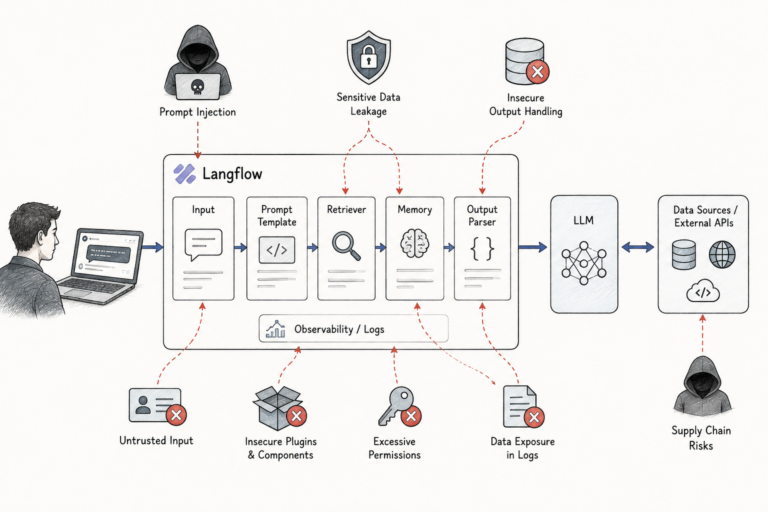
The Langflow LLM application attack surface — why building with visual AI frameworks matters — is something most security teams are dangerously underprepared for. And I mean…