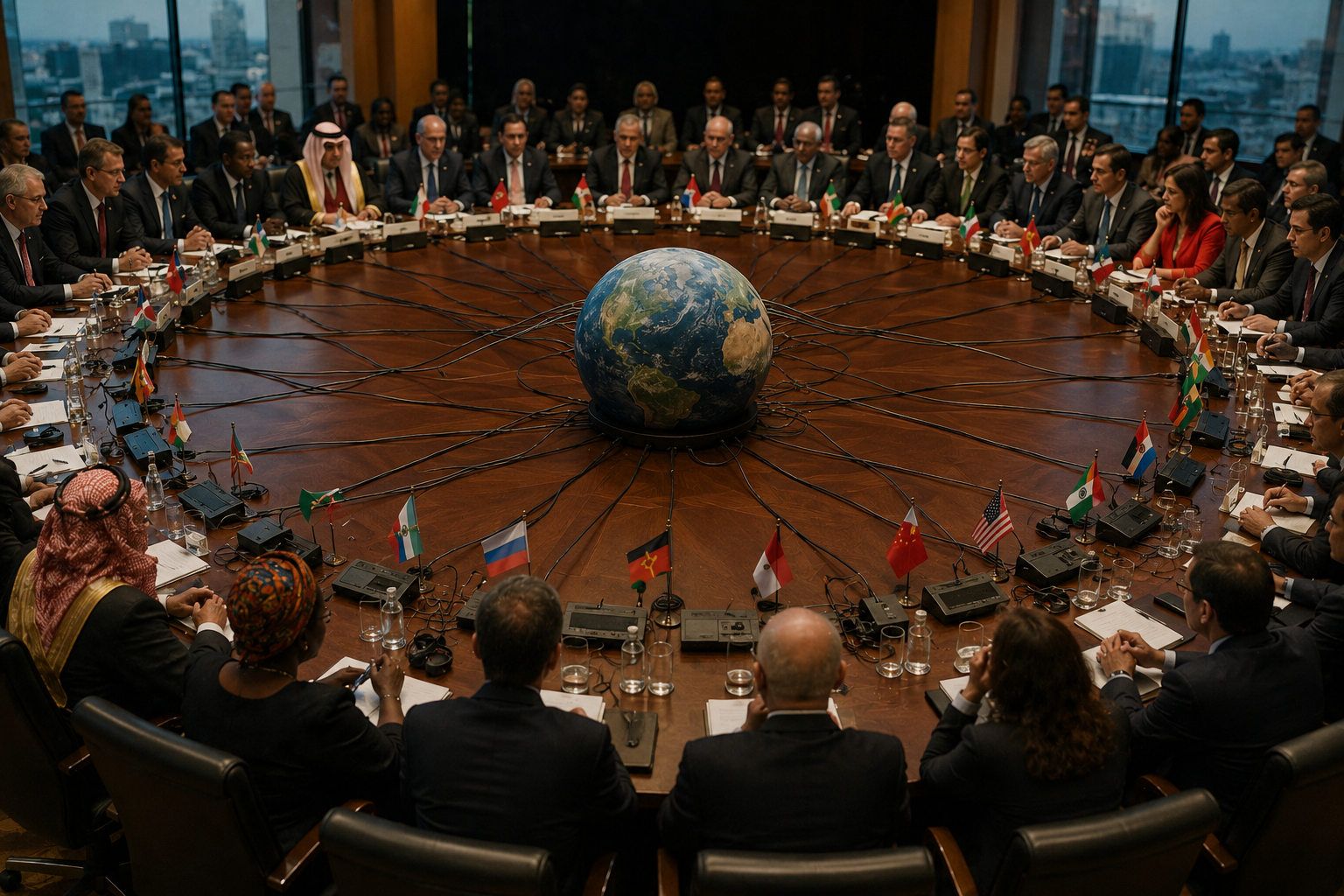
Multilateral AI governance sounds noble on paper. But getting 169 countries to agree on anything about AI? Nearly impossible. Different economies, wildly different values, different levels of technological maturity — they all collide the moment anyone pulls out a draft treaty. Nevertheless, the stakes are simply too high to shrug and walk away.
AI is simultaneously reshaping warfare, employment, healthcare, and finance. No single nation can govern these changes alone. Consequently, the question isn’t whether we need multilateral AI governance — it’s whether we can actually achieve it before the technology outpaces every diplomatic effort we throw at it.
I’ve been watching this space closely for years, and the gap between what’s needed and what’s happening is genuinely alarming. This piece digs into why global consensus keeps collapsing, where regional frameworks are rushing in to fill the void, and what history actually teaches us about getting reluctant nations to cooperate on existential technology risks.
The Structural Barriers to Multilateral AI Governance
The United Nations has 193 member states. Even getting 169 countries to send delegates to a single AI summit is a logistical nightmare. However, logistics aren’t the real problem. The real problem is structural — and it runs deep.
Divergent economic interests top the list. Countries actively building AI industries want light-touch regulation. Countries importing AI products want consumer protections, while countries with no AI industry at all want technology transfer guarantees. These positions aren’t just different — they’re fundamentally incompatible, and no amount of diplomatic goodwill changes that arithmetic.
Furthermore, definitions matter enormously. What even counts as “artificial intelligence”? The EU defines it broadly, China defines it narrowly around specific applications, and the United States has avoided a single federal definition entirely. You can’t regulate something you can’t agree to define. (I’ve sat through enough policy briefings on this to find it genuinely maddening.)
Key structural barriers include:
- Sovereignty concerns — nations resist ceding regulatory authority to international bodies
- Capacity gaps — many countries simply lack the technical expertise to meaningfully evaluate AI governance proposals
- Speed mismatch — AI evolves in months; treaties take years or decades
- Enforcement vacuum — no international body has real teeth to enforce AI standards
- Geopolitical rivalry — US-China competition quietly poisons cooperative efforts before they start
- Industry lobbying — tech companies shape national positions behind closed doors, often very effectively
Additionally, the power asymmetry here is staggering. Roughly seven countries control most advanced AI development. The remaining 162 are essentially rule-takers, not rule-makers — a dynamic that breeds resentment and resistance at every negotiating table. Notably, this isn’t a new dynamic in international governance, but AI makes it sharper and faster-moving than anything we’ve dealt with before.
The OECD AI Principles, adopted in 2019, represent one of the few genuinely successful multilateral efforts. But they’re non-binding. And non-binding principles don’t stop anyone from deploying facial recognition on vulnerable populations. That’s the real kicker — good intentions without enforcement mechanisms are basically just press releases.
Three Competing Regional Frameworks
Because multilateral AI governance involving 169 countries remains elusive, regional approaches have rushed to fill the gap. Three dominant models have emerged, each reflecting its creator’s values and strategic interests. And honestly, each one is a window into a completely different theory of what AI governance is even for.
The EU AI Act model prioritizes rights and risk classification. It sorts AI systems by risk level — unacceptable, high, limited, and minimal — and specifically bans social scoring and certain biometric surveillance outright. The EU AI Act became the world’s first comprehensive AI law in 2024. Fair warning: the compliance burden for high-risk systems is substantial, and smaller companies are already struggling with it.
China’s model takes an application-specific approach. Beijing has issued separate rules for recommendation algorithms, deepfakes, and generative AI. Moreover, China’s rules emphasize social stability and state control alongside innovation — the government reviews algorithms before deployment, which is something essentially unthinkable in Western democracies. This surprised me when I first started mapping these frameworks side by side.
The US approach relies on executive orders, sector-specific guidance, and voluntary commitments. President Biden’s 2023 executive order on AI safety was sweeping in scope but not legislation. Consequently, its durability depends entirely on political winds — and we’ve already seen how quickly those can shift.
Table: scroll sideways to view all columns when needed.
| Feature | EU AI Act | China’s Model | US Approach |
|---|---|---|---|
| Legal status | Binding regulation | Binding regulations | Executive orders + voluntary |
| Scope | Comprehensive, risk-based | Application-specific | Sector-specific guidance |
| Enforcement | Fines up to €35 million | Government pre-review | Agency-level enforcement |
| Transparency | Extensive requirements | State-focused disclosure | Limited mandates |
| Innovation impact | Potentially restrictive | Controlled innovation | Industry-friendly |
| Global influence | Brussels Effect | Belt and Road adoption | Soft power + market access |
This fragmentation creates real, concrete problems. Companies operating globally face contradictory compliance requirements — simultaneously. Similarly, AI supply chains that cross regulatory boundaries create legal nightmares that even experienced teams aren’t fully equipped to solve, and fragmented governance opens security gaps that adversaries can and do exploit.
Meanwhile, countries outside these three blocs face a genuinely difficult choice. Adopt the EU model and potentially slow innovation? Follow China’s approach and accept surveillance infrastructure baked into the deal? Mirror the US and hope voluntary commitments hold when the pressure’s on? None of these options are great. Smaller nations are being asked to make high-stakes choices with very little leverage.
When Consensus Worked and When It Didn’t
History offers both real hope and serious warnings for multilateral AI governance. Understanding why getting 169 countries to agree succeeded in some areas — and failed spectacularly in others — reveals patterns worth paying close attention to.
The biosecurity success story is genuinely instructive. The Biological Weapons Convention (BWC) of 1972 achieved near-universal adoption, with 187 states now party to it. Several factors made this work:
1. Clear and present danger — biological weapons had already been used in warfare
2. Mutual vulnerability — no nation could fully protect itself from bioweapons, regardless of how powerful it was
3. Limited commercial interest — banning bioweapons didn’t threaten major industries
4. Scientific consensus — researchers broadly agreed on the risks
5. Verification feasibility — although imperfect, monitoring was at least conceptually possible
AI governance, unfortunately, lacks almost every one of these conditions. Nevertheless, the BWC’s history shows that consensus is achievable when the threat feels tangible and mutual. That’s an important data point.
The algorithmic transparency failure tells the opposite story. For over a decade, international bodies have tried to establish common standards for algorithmic transparency. The results? Almost nothing binding. I’ve watched this play out in real time, and it’s been genuinely frustrating.
The Global Partnership on AI (GPAI), launched in 2020, aimed to bridge this gap by bringing together 29 countries around shared principles. However, its working groups have produced reports, not rules. Importantly, reports don’t change corporate behavior — and everyone involved knows this.
So why did algorithmic transparency efforts fail where biosecurity succeeded?
- Commercial stakes are enormous — transparency requirements genuinely threaten trade secrets worth billions
- Technical complexity — explaining how a neural network actually makes a decision is hard, not just politically inconvenient
- Uneven impact — algorithmic bias harms marginalized communities, not powerful nations sitting at the negotiating table
- No “smoking gun” — unlike bioweapons, algorithmic harm is diffuse, statistical, and easy to dismiss
- Industry capture — tech companies participate directly in governance discussions and shape outcomes accordingly
The lesson here is sobering. Multilateral AI governance is hardest precisely where it matters most — in areas where powerful commercial interests are lined up against regulation.
The Governance Gap Creates Real-World Harm
Abstract discussions about multilateral AI governance and why getting 169 countries to agree matters can feel academic. The governance gap, however, produces concrete harm every single day. And that’s what makes this more than a policy wonk debate.
Autonomous weapons proliferation is perhaps the starkest example. The Campaign to Stop Killer Robots has pushed for international rules since 2013. Over a decade later, no binding treaty exists. A handful of nations — primarily major arms exporters — have blocked consensus at the UN Convention on Certain Conventional Weapons. Consequently, autonomous weapons development proceeds without meaningful international oversight. That’s not a hypothetical risk. It’s the current situation.
Cross-border data exploitation represents another clear failure. AI systems trained on data from countries with weak privacy laws are routinely deployed in countries with strong ones. Specifically, facial recognition systems trained on African datasets — often without meaningful consent — are sold to authoritarian governments for surveillance purposes. No international framework addresses this pipeline. Additionally, the communities harmed have essentially no recourse.
Labor displacement without coordination compounds everything. When AI eliminates jobs in one country, workers can’t simply relocate to another. Although the International Labour Organization has studied AI’s employment impact extensively, no coordinated international response exists. Each nation faces the disruption alone, which means the weakest economies absorb the worst of it.
AI-generated disinformation crosses borders effortlessly and was built to do so. Deepfakes produced in one jurisdiction target elections in another, and the technology doesn’t respect national boundaries. Therefore, national regulations are inherently insufficient on their own — and everyone governing this space knows it, even if they won’t say so publicly.
These aren’t hypothetical scenarios. They’re happening now, and they’ll accelerate as AI capabilities advance. The absence of multilateral AI governance isn’t just a diplomatic inconvenience — it’s a policy emergency.
Emerging Pathways Forward
So if getting 169 countries to agree on comprehensive AI governance is nearly impossible, what’s the realistic path forward? Several emerging approaches show genuine promise. None is perfect — I want to be upfront about that. But together, they might build something functional enough to matter.
Minilateral agreements involve small groups of like-minded nations moving together rather than waiting for universal consensus. The G7’s Hiroshima AI Process is one concrete example. These coalitions establish shared norms among willing participants and, importantly, can create templates that other nations adopt later. The real advantage is that they can actually move at something approaching AI’s pace.
Technical standards bodies offer another underappreciated avenue. Organizations like ISO and IEEE develop AI standards through expert consensus rather than diplomatic negotiation. Notably, technical standards often achieve broader adoption than treaties because they’re practical, not political. I’ve seen this pattern play out in cybersecurity, and it’s worth taking seriously here.
Sector-specific agreements may succeed where sweeping frameworks have failed. Aviation already has international AI safety standards through ICAO — and it works. Healthcare could follow through the WHO, finance through the Financial Stability Board. This piecemeal approach lacks elegance, but it has real precedent behind it. Sometimes boring and incremental beats ambitious and stalled.
Promising pathways include:
- AI incident reporting systems — modeled on aviation’s mandatory incident reporting, which has genuinely improved safety over decades
- Compute governance — controlling access to the specialized hardware that powers frontier AI development
- Red line agreements — narrow, specific bans on applications like autonomous nuclear launch decisions
- Capacity building programs — helping developing nations build the technical expertise to participate meaningfully in governance discussions, not just attend them
- Interoperability frameworks — making regional rules compatible rather than flatly contradictory
Moreover, the private sector’s role can’t be ignored or dismissed. Companies like Anthropic, Google DeepMind, and OpenAI have published responsible scaling policies — voluntary commitments with specific capability thresholds and safety benchmarks. These aren’t substitutes for regulation. However, they can establish norms that regulation later codifies, and that sequencing has historical precedent.
The most realistic near-term scenario isn’t a grand AI treaty. It’s a messy patchwork of minilateral deals, technical standards, and sector-specific agreements. Importantly, this patchwork needs deliberate coordination to avoid internal contradictions — otherwise, fragmentation just continues under a different name with better branding.
Multilateral AI governance — even the imperfect, incremental kind — requires sustained diplomatic investment. The alternative isn’t no governance. It’s governance by the powerful, for the powerful.
Conclusion
The challenge of multilateral AI governance — why getting 169 countries to agree on anything about AI is nearly impossible — isn’t going away. Structural barriers, competing interests, and geopolitical rivalries are deeply entrenched, and anyone promising a quick fix is selling something. Nevertheless, the cost of inaction grows with every meaningful advancement in AI capability. That math is unforgiving.
History shows that international cooperation on dangerous technologies is possible. It’s just painfully slow and politically expensive. The biosecurity precedent proves that mutual vulnerability can drive genuine consensus when the threat feels real enough. Conversely, the algorithmic transparency failure shows that commercial interests can block progress almost indefinitely when the political will isn’t there to override them.
Actionable next steps for those who care about this issue:
1. Support minilateral efforts — push your representatives to engage seriously with G7 AI processes and bilateral agreements rather than waiting for universal consensus
2. Follow technical standards development — ISO and IEEE standards will shape multilateral AI governance more than most people realize, and they’re happening largely out of public view
3. Demand transparency — pressure companies and governments to disclose AI deployment practices with specifics, not vague commitments
4. Fund capacity building — developing nations need real technical expertise to participate in governance discussions meaningfully, not just symbolically
5. Connect the dots — understand how AI governance intersects with supply chain security, trade policy, and national defense, because policymakers who don’t connect those dots will make worse decisions
We may never achieve perfect consensus. But imperfect coordination is infinitely better than none at all. And the window for shaping multilateral AI governance — before the technology shapes us — is closing faster than most people in this conversation want to admit.
FAQ
Why is multilateral AI governance harder than other technology agreements?
AI touches virtually every sector simultaneously — and that’s what makes this uniquely difficult. Unlike nuclear technology or chemical weapons, AI has massive commercial applications that make regulation politically costly in ways that other technology treaties simply didn’t face. Furthermore, AI’s dual-use nature means the same technology powers both medical breakthroughs and autonomous weapons systems. This breadth makes multilateral AI governance uniquely difficult to scope, let alone enforce. Additionally, the speed of AI development outpaces traditional diplomatic timelines by orders of magnitude — and that gap keeps widening.
What role does the United Nations play in AI governance?
The UN has established an AI Advisory Body that published concrete recommendations in 2024. However, the UN lacks enforcement mechanisms for AI standards — that’s not a criticism, it’s just the structural reality of how the UN works. Its primary value lies in bringing together diverse nations and establishing non-binding norms that can later inform harder agreements. Specifically, the UN serves as a forum where developing nations can voice concerns that would otherwise get steamrolled in smaller coalitions dominated by powerful economies.
Could a single global AI treaty actually work?
Almost certainly not in the near term — and most serious experts will tell you the same thing off the record. A complete global AI treaty would require unprecedented agreement on definitions, risk thresholds, enforcement mechanisms, and intellectual property protections simultaneously. Consequently, most experts advocate for narrower agreements on specific AI applications rather than a single overarching framework. The Montreal Protocol on ozone succeeded partly because it addressed one specific, well-defined problem. AI governance involves hundreds of distinct problems, many of which are still evolving.
How does the EU AI Act affect countries outside Europe?
The EU AI Act creates a “Brussels Effect” — companies wanting access to the European market must comply regardless of where they’re headquartered or where their AI systems were built. Therefore, EU standards effectively become global standards for many companies, giving the EU outsized influence on multilateral AI governance that goes well beyond European borders. Similarly, GDPR reshaped global privacy practices even though it’s technically a European regulation. It’s one of the most effective tools in the EU’s regulatory arsenal, and they know it.
What are the biggest risks of failing to achieve multilateral AI governance?
The most immediate risks include autonomous weapons proliferation without meaningful oversight, cross-border AI-enabled surveillance sold to authoritarian governments, unchecked algorithmic discrimination built into hiring and lending decisions, and AI-powered disinformation campaigns targeting democratic elections. Moreover, without coordination, a race to the bottom on AI safety standards becomes increasingly likely. Nations may weaken protections to attract AI investment and talent, creating systemic risks that affect everyone — including the nations doing the weakening.
How can ordinary citizens influence AI governance outcomes?
Citizens have more leverage here than they typically realize. Vote for representatives who treat technology governance as a serious policy priority, not a niche issue. Support civil society organizations working on AI policy with actual resources. Participate in public comment periods on proposed AI rules — they do get read. Importantly, stay informed about how AI systems affect your daily life, from hiring algorithms to content recommendation systems shaping what you see and believe. Public awareness and sustained demand for accountability remain powerful forces in shaping governance outcomes, even at the international level. Policymakers respond to pressure — but only when it’s consistent and informed.
References
Keep reading
Here are the latest posts from the blog.

The emergence of agentic ransomware hasn’t just shifted the threat environment — it’s blown up the assumptions most security teams have been operating on for years. Specifica…
When you hand an AI agent the keys to a critical workflow, you’re trusting it won’t drive off a cliff. Corrective steering AI hidden metric tells how much that trust is actua…
The gap between what AI promises and what it actually delivers in biology isn’t shrinking — it’s growing. Benchmark datasets AI model evaluation biology tools exist specifica…