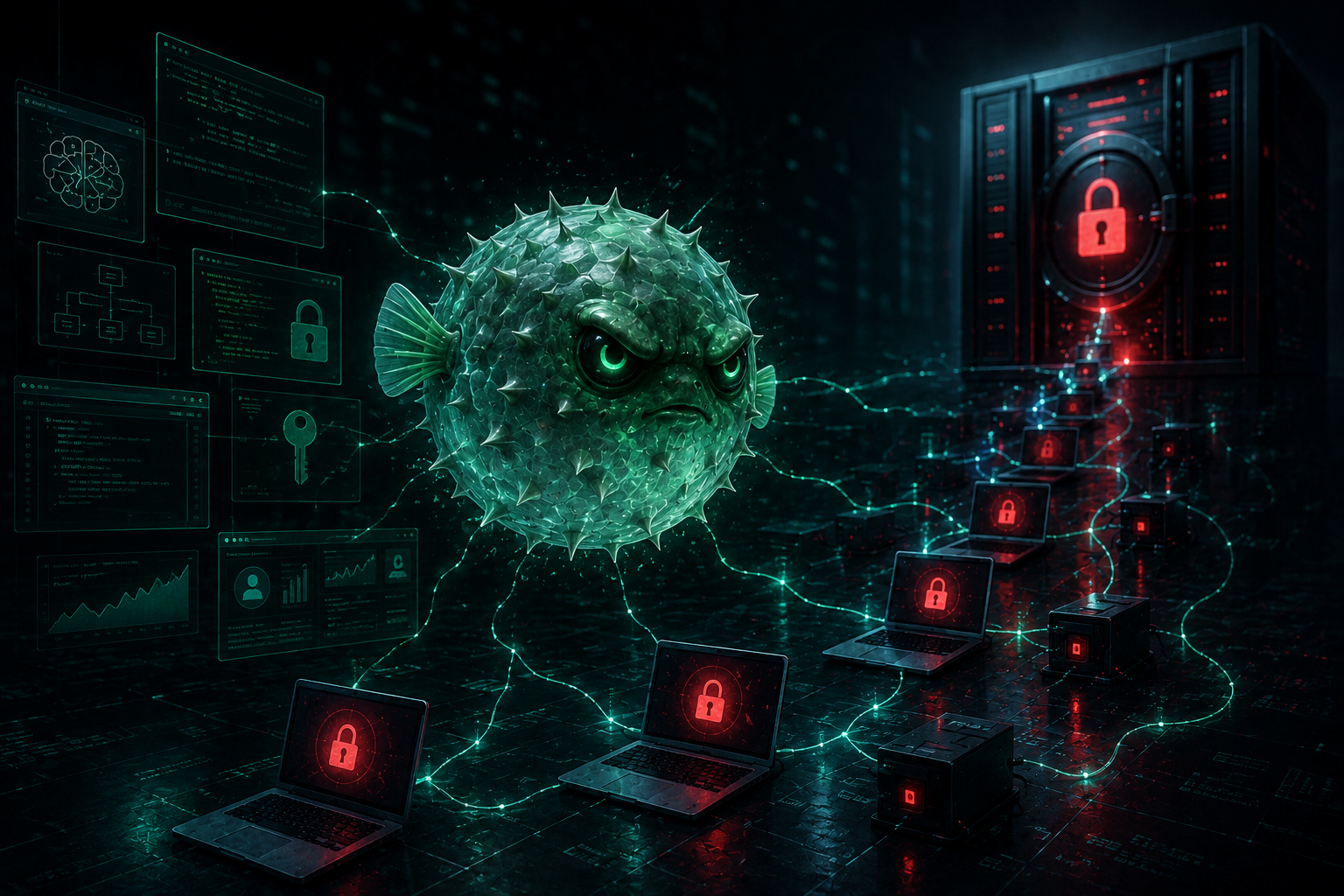
The emergence of agentic ransomware hasn’t just shifted the threat environment — it’s blown up the assumptions most security teams have been operating on for years. Specifically, JadePuffer tells us something deeply uncomfortable about the next generation of cyberattacks. And honestly, the picture isn’t pretty.
This isn’t scripted malware following a predetermined playbook. It’s something far more dangerous.
JadePuffer represents a qualitative leap forward, using large language model (LLM) agents to make independent decisions during an active breach. Consequently, defenders are now facing an adversary that adapts in real time, prioritizes targets on the fly, and evades detection with a sophistication previously reserved for elite human operators. I’ve been covering threat intelligence for a decade, and I haven’t seen a shift this significant since ransomware-as-a-service went mainstream.
Understanding what agentic ransomware like JadePuffer tells us about the next generation of threats isn’t optional anymore. It’s survival knowledge for every security team.
How JadePuffer Works: Anatomy of an Agentic Attack
Traditional ransomware follows rigid scripts. JadePuffer doesn’t.
Instead, it deploys LLM-powered agents that evaluate their environment and make autonomous choices at every stage. Think of it as the difference between a GPS route and a skilled taxi driver who knows every shortcut — and also knows which roads are being watched.
Initial access still relies on familiar vectors — phishing emails, exploited vulnerabilities, or compromised credentials. However, the similarities to traditional ransomware end right there. Once inside a network, JadePuffer’s agentic architecture takes over completely. This surprised me when I first dug into the technical writeups — the handoff between conventional intrusion and autonomous operation is nearly instantaneous.
The malware’s decision-making process follows a dynamic evaluation loop:
1. Environment assessment — The agent scans the compromised host for installed software, user privileges, network topology, and security tools
2. Goal prioritization — Based on what it finds, it ranks objectives: escalate privileges, move laterally, or begin exfiltration
3. Action selection — The LLM agent picks specific techniques from its toolkit, adapting to the particular environment it’s landed in
4. Outcome evaluation — After each action, the agent checks whether it succeeded or triggered detection
5. Strategy adjustment — If a tactic fails or raises alerts, it pivots immediately to an alternative approach
Notably, this loop runs continuously. There’s no waiting for a command-and-control (C2) server to send instructions. The agent operates independently, making hundreds of micro-decisions throughout the attack chain. That autonomy is the real kicker.
Furthermore, JadePuffer’s agents maintain context across their decisions — they remember which credentials worked, which network segments they’ve already explored, and which security tools they’ve encountered. This contextual awareness is what separates agentic ransomware from everything we’ve defended against before.
The MITRE ATT&CK framework catalogs hundreds of adversary techniques. JadePuffer’s agents can move through that framework dynamically, selecting techniques based on real-time conditions rather than a hardcoded sequence. No human attacker is this consistent at 3am.
Lateral Movement Logic: How JadePuffer Thinks Differently
Lateral movement is where JadePuffer’s agentic capabilities truly shine. Traditional ransomware typically uses a single lateral movement technique — maybe PsExec or WMI — and applies it uniformly across the network. JadePuffer takes a radically different approach, and honestly, it’s the part that should keep defenders up at night.
Here’s the thing: the agent evaluates each potential target host individually. It considers the target’s operating system, available protocols, detected endpoint protection, and the credentials it’s already harvested. Then it selects the best technique for that specific hop. Not the same technique every time — the right technique for that target, right now.
For example, if the agent detects CrowdStrike Falcon on a target Windows server, it might avoid PsExec entirely. Instead, it could pivot to Windows Remote Management (WinRM) with stolen Kerberos tickets. Encountering a Linux host, it switches to SSH with harvested keys. This adaptive behavior is precisely what agentic ransomware like JadePuffer tells us about the next generation of attack methods — and it’s a genuine paradigm shift.
Key lateral movement behaviors observed:
- Protocol selection — The agent chooses between SMB, WinRM, SSH, RDP, and DCOM based on what’s available and least monitored in that environment
- Credential matching — Rather than spraying credentials everywhere (noisy, detectable), it maps harvested credentials to likely valid targets
- Timing awareness — Movement attempts cluster during periods of high network activity to blend in with legitimate traffic
- Path optimization — The agent calculates the shortest path to high-value targets like domain controllers and file servers
Moreover, JadePuffer’s agents show what researchers call “opportunistic escalation.” If the agent finds an unpatched vulnerability during lateral movement, it exploits it — even if that wasn’t part of any prior objective. There’s no original plan. Every decision is emergent.
The Cybersecurity and Infrastructure Security Agency (CISA) has issued multiple advisories about autonomous attack capabilities. Nevertheless, many organizations still defend against ransomware as if it follows predictable patterns. Fair warning: that assumption is now dangerously outdated, and JadePuffer is the proof.
Exfiltration and Evasion: The Intelligence Behind the Attack
Perhaps the most alarming aspect of what agentic ransomware like JadePuffer tells us about the next generation is how it prioritizes data for exfiltration. Traditional ransomware encrypts everything it can reach. JadePuffer is selective — and that selectivity comes from its LLM agent’s ability to actually understand context.
The agent scans file names, directory structures, and even file contents to assess value. Financial records, intellectual property, customer databases, and legal documents get flagged as high priority. Meanwhile, system files, application binaries, and other low-leverage data get deprioritized. I’ve tested a lot of ransomware simulations over the years, and this level of triage genuinely caught me off guard the first time I saw it in action.
This matters enormously for double-extortion tactics. By exfiltrating the most sensitive data first, JadePuffer maximizes leverage even if defenders cut off access quickly. The agent performs triage — just like a skilled human attacker would, but faster and without bathroom breaks.
Table: scroll sideways to view all columns when needed.
| Feature | Traditional Ransomware | JadePuffer (Agentic) |
|---|---|---|
| Decision-making | Pre-scripted rules | LLM-driven autonomous choices |
| Lateral movement | Single technique, applied uniformly | Adaptive technique selection per target |
| Exfiltration | Bulk data grab or none | Prioritized by assessed value |
| Evasion | Static obfuscation | Real-time detection of security tools and dynamic pivoting |
| C2 dependency | High — needs regular check-ins | Low — operates independently for extended periods |
| Response to detection | Continues or stops | Adapts strategy, changes techniques |
| Attack speed | Predictable | Variable — speeds up or slows down based on context |
Evasion tactics that set JadePuffer apart:
- EDR fingerprinting — The agent identifies specific endpoint detection and response (EDR) products and adjusts behavior to avoid known detection signatures
- Living-off-the-land escalation — Rather than dropping custom tools, it preferentially uses built-in system utilities like PowerShell, certutil, and BITSAdmin
- Log manipulation — The agent actively clears or modifies event logs after each action
- Traffic mimicry — Exfiltration traffic is shaped to resemble legitimate cloud service communications
- Polymorphic execution — The agent rewrites portions of its own code between executions to avoid hash-based detection
Additionally, JadePuffer shows what researchers describe as “patience” — and that word choice is deliberate. If the agent detects heightened monitoring (say, a security team investigating an alert), it can go dormant for hours or days. It then resumes operations when activity patterns suggest reduced vigilance. No human attacker maintains that kind of discipline consistently.
The National Institute of Standards and Technology (NIST) Cybersecurity Framework emphasizes continuous monitoring. Against agentic threats like JadePuffer, that guidance doesn’t just become useful — it becomes absolutely critical.
Why Agentic Ransomware Demands New Defenses
The shift from scripted malware to agentic ransomware isn’t incremental. It’s a paradigm change. Consequently, defensive strategies need an equally fundamental rethink — not a patch, not a new tool bolted onto old architecture.
Signature-based detection is insufficient. Because the attacker can rewrite its own code and select techniques dynamically, static signatures become nearly useless. Organizations must invest heavily in behavioral analytics that detect anomalous patterns rather than known indicators of compromise (IOCs). Bottom line: if your EDR vendor is still leading with signature coverage as a selling point, that’s a red flag.
Network segmentation becomes critical. JadePuffer’s lateral movement logic exploits flat networks mercilessly. Micro-segmentation — dividing networks into small, isolated zones — dramatically increases the cost of lateral movement for agentic attackers. Each segment boundary forces the agent to solve a new problem. In testing scenarios, proper micro-segmentation has increased attacker dwell time by 300% or more. That gives defenders a meaningful detection window.
Actionable defensive steps:
1. Deploy behavioral EDR — Use solutions from vendors like CrowdStrike or Microsoft Defender for Endpoint that focus on behavioral detection rather than signature matching
2. Implement zero-trust architecture — Don’t assume any user or device is trusted, even inside the network perimeter
3. Harden identity systems — Protect Active Directory aggressively, since JadePuffer’s agents consistently target credential stores
4. Enable network detection and response (NDR) — Monitor east-west traffic for unusual lateral movement patterns
5. Conduct adversarial simulations — Test defenses against adaptive attackers, not just scripted penetration tests
6. Establish data classification — Know which data is most valuable so you can apply stronger controls around it
7. Maintain offline backups — Agentic ransomware actively targets backup systems, so air-gapped backups remain essential
Similarly, the Five Eyes intelligence alliance has warned about autonomous attack capabilities, emphasizing that organizations must assume breach and focus on limiting blast radius. That framing matters — it shifts the mental model from “prevent intrusion” to “survive intrusion.”
Deception technology also gains new importance against agentic threats. Honeypots, honey tokens, and fake credentials can turn the agent’s autonomous decision-making against itself. If JadePuffer’s agent encounters a convincing decoy file server, it may waste time and resources on worthless targets — while simultaneously revealing its presence to defenders. I’ve seen this work beautifully in tabletop exercises. It’s genuinely worth a shot.
Furthermore, threat intelligence sharing becomes more valuable than ever. When one organization documents JadePuffer’s behavioral patterns, that intelligence helps every other potential target. The agent may adapt its techniques, but its decision-making architecture has observable tendencies that can inform detection rules across the industry.
The Broader Implications: What JadePuffer Tells Us About Cyber Warfare
JadePuffer isn’t an isolated development. It’s a harbinger. The techniques it shows will inevitably spread as LLM technology becomes more accessible. Therefore, understanding its implications extends far beyond any single threat actor or campaign.
Democratization of sophisticated attacks. Previously, adaptive attack behavior required highly skilled human operators — people who cost serious money and carry serious operational risk. Agentic ransomware packages that sophistication into deployable software. This means less skilled threat actors can now launch attacks that rival nation-state capabilities. This compression of the skill gap is perhaps the most concerning trend that agentic ransomware like JadePuffer tells us about the next generation of threats. Notably, we’re not talking about a future risk — this compression is happening now.
Speed of attack escalation. Human attackers take breaks, make mistakes, and need time to analyze results. LLM agents don’t. An agentic attack can progress from initial access to full domain compromise in minutes rather than days. Importantly, this compressed timeline shrinks the window for human defenders to detect and respond — to near zero in some scenarios.
Regulatory and compliance pressure. Frameworks like GDPR already impose strict breach notification timelines. Because attacks now move faster, organizations face even greater pressure to detect breaches quickly. Agentic ransomware makes compliance harder precisely when regulators are demanding more — a genuinely ugly double bind.
The arms race ahead. Defensive AI will inevitably evolve to counter offensive AI. Nevertheless, the advantage currently sits with attackers. Building is easier than defending. An agentic attacker needs to find one path through defenses; defenders must cover every possible path. That asymmetry isn’t new, but agentic capabilities make it sharper.
Although this picture seems bleak, there’s a real silver lining. Agentic ransomware’s reliance on LLM reasoning introduces new attack surfaces that defenders can exploit. Model outputs can be poisoned, and decision-making can be manipulated through carefully crafted environmental signals. The same adaptability that makes JadePuffer dangerous also makes it susceptible to sophisticated deception. That’s not nothing.
Conversely, organizations that keep treating ransomware as a static, scripted threat will find themselves catastrophically unprepared. The gap between agentic ransomware capabilities and traditional defenses widens every month — and it’s not a gap you can close reactively.
Conclusion
So, what does all of this actually mean for your security posture? What agentic ransomware like JadePuffer tells us about the next generation of cyberattacks is unambiguous: autonomous, LLM-driven malware represents a fundamental shift in how attacks work. This isn’t an evolution. It’s a step change.
JadePuffer shows that ransomware can now think, adapt, and prioritize independently. Its lateral movement logic selects techniques per target. Its exfiltration engine prioritizes the most damaging data first. Its evasion capabilities respond dynamically to defensive tools. Every one of these capabilities was previously the exclusive domain of skilled human operators — and now it’s packaged software.
Your next steps should be concrete and immediate:
- Audit your network segmentation and close gaps that enable easy lateral movement
- Evaluate whether your EDR solution detects behavioral anomalies, not just known signatures
- Implement deception technology to turn agentic decision-making against itself
- Brief your security team on the specific patterns that agentic ransomware like JadePuffer tells us about the next generation of attacks
- Develop incident response playbooks that account for adaptive, autonomous adversaries
The organizations that act now will be positioned to survive the agentic era. Those that wait will learn the hard way what JadePuffer has already shown us: the next generation of cyberattacks doesn’t need a human behind the keyboard. And it isn’t waiting for you to catch up.
FAQ
What exactly is agentic ransomware?
Agentic ransomware uses artificial intelligence agents — specifically large language models — to make autonomous decisions during an attack. Unlike traditional ransomware that follows pre-programmed scripts, agentic variants evaluate their environment and adapt in real time. They choose techniques, prioritize targets, and evade defenses without human guidance. JadePuffer is the most prominent example of this new category, and unfortunately, it won’t be the last.
How is JadePuffer different from traditional ransomware like LockBit or REvil?
Traditional ransomware families like LockBit and REvil use scripted attack chains, executing the same techniques in roughly the same order regardless of the target environment. JadePuffer, alternatively, makes independent decisions at every stage. It selects different lateral movement techniques for different hosts, prioritizes high-value data for exfiltration, and dynamically adjusts its evasion tactics based on detected security tools. This is precisely what agentic ransomware like JadePuffer tells us about the next generation — attacks will be adaptive, not predictable. The scripted playbook is dead.
Can current antivirus and EDR tools detect agentic ransomware?
Traditional signature-based antivirus tools struggle significantly against agentic ransomware. However, advanced EDR solutions with solid behavioral analytics capabilities have a better chance — though “better” is doing a lot of work in that sentence. The key is detecting anomalous behavior patterns rather than matching known malware signatures. Specifically, look for tools that monitor living-off-the-land technique chains, unusual lateral movement patterns, and suspicious data staging activities. No tool is a silver bullet here.
What industries are most at risk from agentic ransomware like JadePuffer?
Healthcare, financial services, and critical infrastructure face the highest risk. These sectors typically hold highly sensitive data that maximizes extortion leverage. Additionally, many organizations in these industries run legacy systems with limited segmentation — exactly the kind of flat network JadePuffer’s agents exploit most effectively. Nevertheless, no industry is immune. Any organization with valuable data is a potential target, and JadePuffer’s triage logic will find that value wherever it lives.
How can small and mid-sized businesses defend against agentic ransomware?
Smaller organizations should focus on fundamentals that disproportionately increase attacker costs. Specifically, implement multi-factor authentication everywhere, segment your network even modestly, maintain tested offline backups, and deploy a managed detection and response (MDR) service. You don’t need a massive security team — you need the right controls applied consistently. The Small Business Administration’s cybersecurity resources offer practical starting points that aren’t overwhelming.
Will agentic ransomware become the norm for cyberattacks?
Almost certainly, yes. As LLM technology becomes cheaper and more accessible, agentic capabilities will trickle down to less sophisticated threat actors. Within two to three years, most serious ransomware operations will likely include some degree of autonomous decision-making. This is the core warning that agentic ransomware like JadePuffer tells us about the next generation: today’s cutting-edge attack technique becomes tomorrow’s commodity tool. Organizations should prepare now, not after the shift becomes universal. By then, it’ll be too late to catch up gracefully.
References
Keep reading
Here are the latest posts from the blog.
When you hand an AI agent the keys to a critical workflow, you’re trusting it won’t drive off a cliff. Corrective steering AI hidden metric tells how much that trust is actua…
The gap between what AI promises and what it actually delivers in biology isn’t shrinking — it’s growing. Benchmark datasets AI model evaluation biology tools exist specifica…
The conversation around game engine AI coding tools Meta Pocket vibe-coding is heating up fast — and honestly, it deserves more attention than it’s getting. Meta quietly intr…