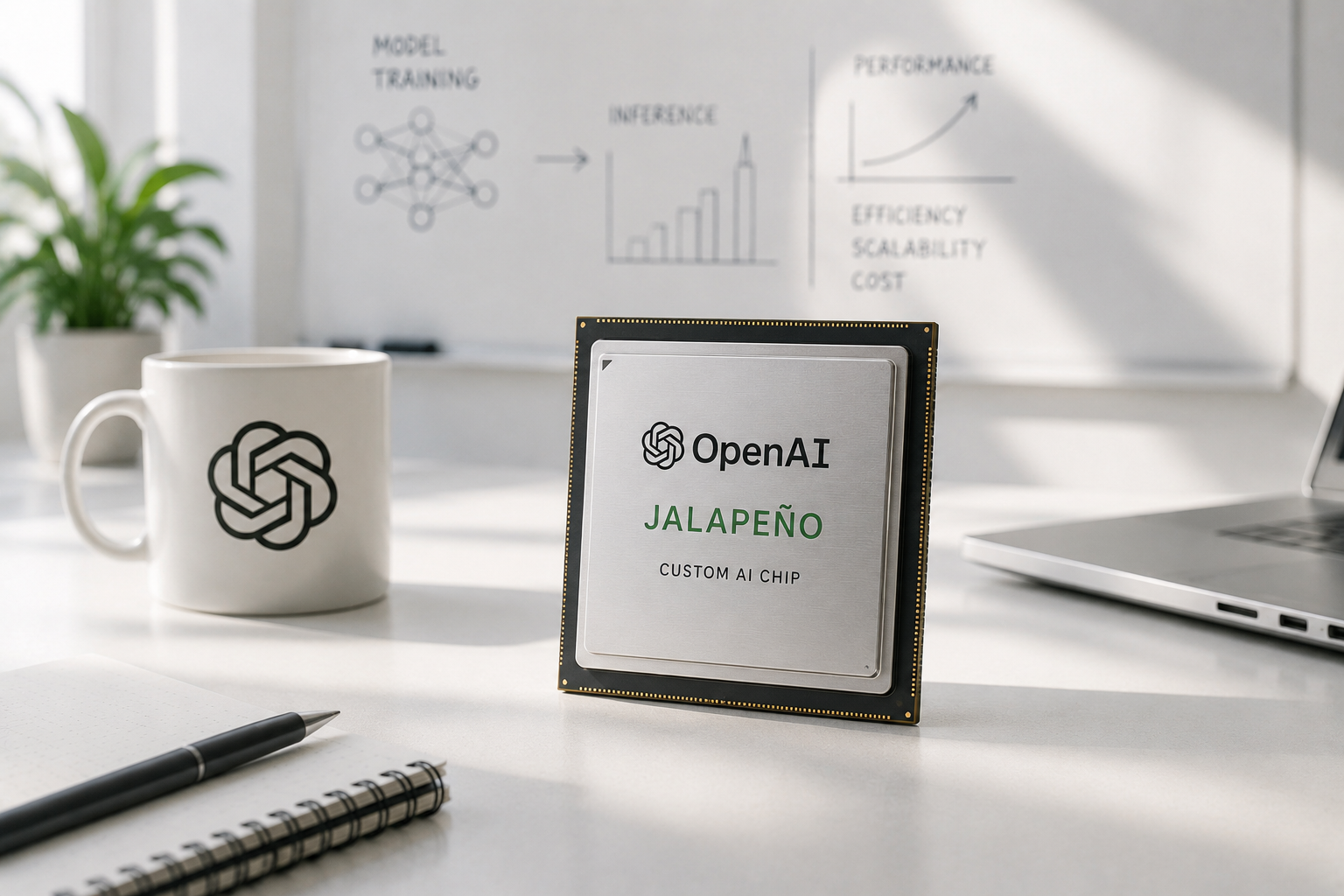
The OpenAI Jalapeño chip custom semiconductor AI inference project signals a massive shift. OpenAI isn’t just building AI models anymore — it’s building the hardware to run them. And honestly? This could reshape how we think about AI infrastructure, cost, and competition more than any model release in recent memory.
Specifically, the Jalapeño chip targets inference workloads. That’s the process of running trained models to generate answers, images, or code. Training gets the headlines, but inference is where the real money goes. So OpenAI wants to own that pipeline from top to bottom — and I can’t say I’m surprised.
Furthermore, this decision doesn’t exist in a vacuum. EUV lithography machines cost hundreds of millions. Export controls limit chip access globally. Meanwhile, NVIDIA dominates AI hardware with sky-high margins. Consequently, OpenAI is doing exactly what Apple, Google, and Amazon did before it — building custom silicon to break free from someone else’s roadmap.
Why OpenAI Is Designing Its Own Inference Chip
The simplest answer? Cost and control.
OpenAI reportedly spends billions annually on NVIDIA GPUs. Every ChatGPT query, every API call, every DALL-E image runs on rented or purchased NVIDIA hardware. That’s expensive — and it puts OpenAI at the mercy of another company’s priorities, pricing, and production schedule.
The Jalapeño chip targets this dependency directly. By designing a custom semiconductor for AI inference, OpenAI can optimize every transistor for its specific workloads. General-purpose GPUs are powerful but genuinely wasteful for narrow tasks. A purpose-built chip strips away all that unnecessary overhead.
Moreover, supply chain risk is real. NVIDIA’s H100 and B200 chips face massive demand, and wait times stretch for months. Additionally, geopolitical tensions around semiconductor export controls make future GPU access increasingly uncertain. Building your own chip is insurance — expensive insurance, but insurance nonetheless.
I’ve watched a lot of companies announce custom silicon ambitions and quietly shelve them. What’s different here is the scale of motivation. Here are the key reasons this move makes sense:
- Cost reduction — Custom chips can cut inference costs by 50% or more compared to general-purpose GPUs
- Latency optimization — Purpose-built silicon delivers faster response times for deployed models
- Supply independence — No more waiting in NVIDIA’s queue alongside every other AI company
- Architectural control — OpenAI can design hardware that matches its model architectures precisely
- Margin protection — Lower hardware costs mean better unit economics on API pricing
Notably, this isn’t OpenAI’s first hardware play. The company hired several key chip designers from Google’s TPU team and other semiconductor veterans. The Jalapeño project has been in development for some time, and it reflects a deliberate long-term strategy — not a panic move.
To make the stakes concrete: consider what happens when a new model version ships and query volume spikes 3x overnight. Right now, OpenAI has to absorb that surge on hardware it either already owns or scrambles to lease — at whatever price NVIDIA and cloud providers are charging that week. A proprietary chip changes that calculus entirely. OpenAI can plan capacity around its own production schedule rather than someone else’s allocation queue.
How Custom Silicon Cuts Latency and Cost
Understanding why the OpenAI Jalapeño chip custom semiconductor AI inference approach matters requires a quick look at how inference actually works. Bear with me — it’s worth knowing.
When you send a prompt to ChatGPT, the model doesn’t “think” the way humans do. It runs billions of mathematical operations — matrix multiplications, attention calculations, memory lookups. Each operation needs silicon to execute. General-purpose GPUs handle these operations well, but they also carry overhead built for gaming, scientific computing, and a dozen other tasks OpenAI doesn’t care about.
A custom inference chip eliminates that overhead. This surprised me when I first dug into the architecture tradeoffs — the inefficiency of running GPT-scale models on general-purpose hardware is genuinely enormous. Specifically, a purpose-built chip can optimize for:
1. Transformer architecture operations — The mathematical backbone of GPT models
2. Memory bandwidth — Moving data on and off the chip faster
3. Power efficiency — Less energy per inference means lower operating costs
4. Batch processing — Handling thousands of simultaneous requests efficiently
5. Quantization support — Running smaller, faster versions of models natively
A practical illustration helps here. Imagine a restaurant that serves only one dish versus a full-service kitchen equipped to make everything on a ten-page menu. The specialized kitchen needs far less equipment, wastes almost no prep time, and can plate that single dish faster and cheaper than the generalist kitchen ever could. A custom inference chip is the specialized kitchen. The GPU is the full-service operation — impressive, but carrying overhead you’re paying for whether you use it or not.
Google proved this model works. Its Tensor Processing Units (TPUs) have powered Search, YouTube, and Gmail recommendations for years. TPUs aren’t better than GPUs at everything — however, they’re dramatically better at Google’s specific workloads. That’s the whole point of specialization.
Similarly, Amazon’s Inferentia and Trainium chips power AWS AI services at lower cost than equivalent GPU instances. The pattern is clear. Companies running AI at massive scale eventually build their own chips. Every single time.
The economics are genuinely compelling. OpenAI processes hundreds of millions of queries daily through ChatGPT alone. Even a 30% reduction in per-query cost translates to hundreds of millions in annual savings. Furthermore, lower latency means better user experience, which drives retention and growth. That’s not a rounding error — that’s the business.
Nevertheless, designing chips is extraordinarily difficult. It takes years and billions of dollars. Fair warning: the Jalapeño chip won’t replace NVIDIA overnight, and it doesn’t need to. Even handling 20–30% of inference workloads on custom silicon would meaningfully transform OpenAI’s cost structure. A reasonable near-term scenario is that Jalapeño handles high-volume, lower-complexity queries — the kind of short completions and simple API calls that make up the bulk of daily traffic — while NVIDIA hardware continues handling the heaviest workloads. That hybrid approach alone could move the unit economics significantly.
Who Else Is Building Custom AI Chips
OpenAI isn’t alone in this race. The custom semiconductor AI inference trend has become an industry-wide movement — and honestly, the table below tells the story better than I can in prose.
| Company | Chip Name | Primary Use | Status | Key Advantage |
|---|---|---|---|---|
| OpenAI | Jalapeño | AI inference | In development | Optimized for GPT models |
| TPU v5p | Training & inference | Production | Mature ecosystem, years of iteration | |
| Amazon | Inferentia2 | AI inference | Production | Tight AWS integration |
| Meta | MTIA v2 | AI inference | Testing | Optimized for recommendation models |
| Microsoft | Maia 100 | AI inference | Early production | Azure cloud integration |
| Tesla | Dojo D1 | Training | Limited deployment | Full self-driving focus |
Importantly, most of these chips target inference rather than training. Training still demands the raw power of NVIDIA’s top-tier GPUs — but inference is where volume lives. And volume determines profitability.
Microsoft’s role adds an interesting wrinkle. As OpenAI’s largest investor and cloud partner, Microsoft is simultaneously developing its own Maia AI accelerator. So the two companies could end up competing on hardware while cooperating on software. That tension will be worth watching — it’s the kind of awkward dynamic that tends to get messier over time, not cleaner. If OpenAI’s Jalapeño chip eventually runs workloads that Microsoft had expected to host on Azure using Maia, the commercial relationship between the two companies gets complicated in ways neither side has fully addressed publicly.
Meanwhile, NVIDIA isn’t standing still. Jensen Huang’s company continues releasing faster, more efficient chips, and the Blackwell architecture promises significant inference improvements. Consequently, OpenAI’s Jalapeño chip needs to beat a moving target — not just today’s NVIDIA hardware, but tomorrow’s. That’s the real kicker.
Additionally, the broader semiconductor supply chain affects everyone. TSMC manufactures chips for Apple, NVIDIA, AMD, and likely OpenAI. Foundry capacity is finite. Building a custom chip doesn’t eliminate supply chain risk entirely — it just shifts where that risk sits. I’ve seen this tradeoff get glossed over a lot in breathless coverage of custom silicon announcements. The practical implication: OpenAI will need to secure long-term foundry commitments with TSMC or Samsung well in advance, which means making large financial bets on volume projections that are genuinely hard to forecast two or three years out.
Vertical Integration: The Apple and Google Playbook
The OpenAI Jalapeño chip strategy follows a proven playbook. Apple’s shift from Intel to its own M-series processors transformed the Mac lineup — performance jumped, battery life doubled, and Apple controlled its own destiny. I remember when people said that transition would never work smoothly. It worked better than anyone expected.
Google’s TPU journey tells a similar story. The company started buying GPUs for machine learning in the early 2010s. By 2015, it had designed its first TPU. Today, TPUs power most of Google’s AI services internally, and the investment has paid off many times over. Critically, Google didn’t flip a switch — it ran TPUs and GPUs in parallel for years, gradually shifting workloads as the custom hardware matured. OpenAI will almost certainly follow the same gradual migration path rather than attempting an abrupt cutover.
What makes vertical integration so powerful?
- Tight hardware-software co-design — Because you build both the chip and the models, you can optimize each for the other in ways that simply aren’t possible otherwise
- Faster iteration cycles — No waiting for a vendor’s product roadmap to align with your needs
- Competitive moat — Proprietary hardware creates advantages competitors can’t easily replicate
- Pricing power — Lower costs enable more aggressive API pricing, which attracts more developers
Conversely, vertical integration carries real risks. Chip design requires specialized talent that’s incredibly scarce — we’re talking about a global pool of maybe a few thousand people who can do this work at the highest level. Manufacturing partnerships with foundries like TSMC demand massive commitments. If the chip underperforms, billions are wasted. It’s not a decision you make lightly. And unlike a failed software product, which you can patch or roll back, a chip that misses its performance targets by a meaningful margin can’t be fixed with an update — you wait for the next silicon generation, which is another two to three years away.
Nevertheless, OpenAI’s scale justifies the bet. The company reportedly generates over $3 billion in annualized revenue, and its inference costs likely represent its single largest expense. Therefore, even modest hardware improvements create enormous financial impact. The math isn’t subtle.
The connection to export controls matters here too. As governments restrict chip exports, companies that depend entirely on third-party hardware face real strategic exposure. A custom chip designed and built through secure supply chains provides meaningful resilience. The OpenAI Jalapeño chip custom semiconductor AI inference initiative is partly a geopolitical hedge — and in 2024, that’s not paranoia, it’s planning.
What Jalapeño Means for Developers and the Industry
If the Jalapeño chip succeeds, the ripple effects will reach far beyond OpenAI’s data centers. Here’s what developers, businesses, and competitors should actually expect — and some of this surprised me when I thought it through.
For API users and developers:
- Lower prices — Reduced inference costs should translate to cheaper API calls over time (though “over time” is doing a lot of work in that sentence)
- Faster responses — Custom silicon optimized for GPT models means meaningfully lower latency
- New capabilities — Hardware designed for specific model architectures could enable features that general-purpose GPUs can’t support efficiently
- Greater reliability — Less dependence on a single GPU supplier means fewer supply-driven outages
A practical tip for developers building on the OpenAI API right now: design your applications to be latency-tolerant where possible, and track your per-token costs carefully. When Jalapeño-era pricing eventually arrives, you’ll want a clear baseline to measure the actual savings against — and to make the case internally for scaling up usage.
For competitors:
The barrier to entry in AI just got higher. Companies without custom hardware will face a structural cost disadvantage. Startups building on NVIDIA GPUs will pay more per inference than OpenAI does on its own silicon. That gap compounds at scale — and it’s the kind of advantage that’s almost impossible to close without building your own chip. Smaller AI companies should think carefully about which cloud provider’s custom silicon they run on, because that choice increasingly determines their long-term cost floor.
For NVIDIA:
Losing OpenAI as a major customer would hurt. However, NVIDIA’s ecosystem extends far beyond any single buyer, and training workloads still strongly favor NVIDIA’s GPUs. The real threat isn’t one company leaving — it’s the trend. When every major AI company builds custom inference chips, NVIDIA’s addressable market shrinks. That’s worth watching over the next five years.
For the semiconductor industry:
More custom chip projects mean more demand for foundry capacity, EDA tools, and chip design talent. Companies like Synopsys and Cadence, which make the software tools for chip design, stand to benefit enormously. I’ve tested a lot of investment theses in this space, and the picks-and-shovels angle here is genuinely compelling.
Importantly, the custom semiconductor AI inference trend validates a broader thesis — one I’ve been writing about for years. AI isn’t just a software shift. It’s a hardware shift too. The companies that win will master both.
Conclusion
The OpenAI Jalapeño chip custom semiconductor AI inference initiative represents more than a cost-cutting measure. It’s a strategic transformation. By designing purpose-built silicon, OpenAI is following the proven path of Apple, Google, and Amazon toward hardware-software vertical integration — and doing so at a moment when the stakes couldn’t be higher.
This move connects directly to broader semiconductor trends. Export controls reshape chip access. NVIDIA’s dominance creates dependency risks. EUV lithography machines cost hundreds of millions. Consequently, building custom silicon isn’t optional for companies operating at OpenAI’s scale — it’s necessary. The Jalapeño chip is the logical conclusion of that reality.
Bottom line — here’s what you should actually do with this information:
1. If you’re a developer — Watch for API pricing changes as OpenAI’s hardware costs drop. Plan your architecture around potentially faster inference speeds.
2. If you’re building an AI startup — Consider how hardware costs affect your competitive position. Partnerships with cloud providers offering custom silicon (Google Cloud, AWS) can help level the playing field.
3. If you’re investing — Pay attention to the semiconductor supply chain. Companies making chip design tools, foundry services, and advanced packaging will benefit from this trend.
4. If you’re in enterprise AI — Evaluate whether your inference provider’s hardware strategy aligns with your long-term cost and performance needs.
The Jalapeño chip won’t arrive overnight. Custom semiconductor development takes years — but the strategic direction is clear. OpenAI is betting its future on owning the full stack, from model weights to transistors. And based on every precedent we have, that’s a bet worth taking seriously.
FAQ
What is OpenAI’s Jalapeño chip?
The Jalapeño chip is OpenAI’s internally designed custom semiconductor built specifically for AI inference workloads. Unlike general-purpose GPUs from NVIDIA, this chip is optimized to run trained AI models like GPT efficiently. It targets lower latency, reduced power consumption, and significantly lower per-query costs. The chip is currently in development and hasn’t entered mass production yet.
Why is OpenAI building its own custom semiconductor for AI inference?
OpenAI spends billions on NVIDIA GPUs annually. Building a custom semiconductor for AI inference reduces that dependency directly. Additionally, purpose-built chips can deliver better performance per watt for specific workloads. OpenAI also gains supply chain independence, which matters increasingly as geopolitical tensions affect chip availability. Furthermore, controlling the hardware enables tighter optimization between models and silicon — and that’s where the real performance gains live.
How does the OpenAI Jalapeño chip compare to NVIDIA GPUs?
NVIDIA GPUs are general-purpose processors designed for many workloads — gaming, scientific computing, AI training, and inference. The OpenAI Jalapeño chip focuses exclusively on inference. This specialization means it can potentially deliver faster responses at lower cost for running GPT models. However, it won’t replace GPUs for training, where NVIDIA’s hardware remains dominant. The comparison is more about specialization versus versatility than raw performance — and that distinction matters.
Will the Jalapeño chip make ChatGPT cheaper to use?
Likely, yes — over time. Custom semiconductor AI inference hardware typically reduces per-query costs significantly compared to general-purpose GPUs. Google’s TPUs and Amazon’s Inferentia chips have demonstrated this pattern clearly. If OpenAI achieves similar results, those savings could translate to lower API prices and more affordable subscription tiers. Nevertheless, the timeline depends entirely on when the chip reaches production scale.
Which other companies are building custom AI inference chips?
Several major tech companies are pursuing custom AI inference hardware. Google has its TPU lineup, now in its fifth generation. Amazon offers Inferentia2 through AWS. Meta is developing MTIA for recommendation systems. Microsoft built the Maia 100 accelerator for Azure. Notably, this trend confirms that vertical integration in AI hardware is becoming an industry standard — not an exception.
How does the Jalapeño chip relate to semiconductor export controls?
U.S. semiconductor export controls restrict access to advanced AI chips in certain markets. These restrictions create supply uncertainty even for domestic companies. By designing its own custom semiconductor, OpenAI reduces vulnerability to supply chain disruptions and third-party allocation decisions. The Jalapeño chip is partly a strategic hedge against an increasingly complex geopolitical environment surrounding advanced chip technology — and given where things are heading, that hedge looks smarter every quarter.
References
Keep reading
Here are the latest posts from the blog.

The NSA cybersecurity breach internal systems vulnerability story shocked even seasoned security professionals. America’s most secretive intelligence agency — the one literal…

Context window security matters more than most teams realize — and I say that as someone who’s watched organizations make this exact mistake repeatedly over the past decade.…

Researchers at MIT recently proved something that genuinely surprised me — and I’ve been covering AI long enough to be pretty hard to surprise. Their work on MIT AI finds ato…