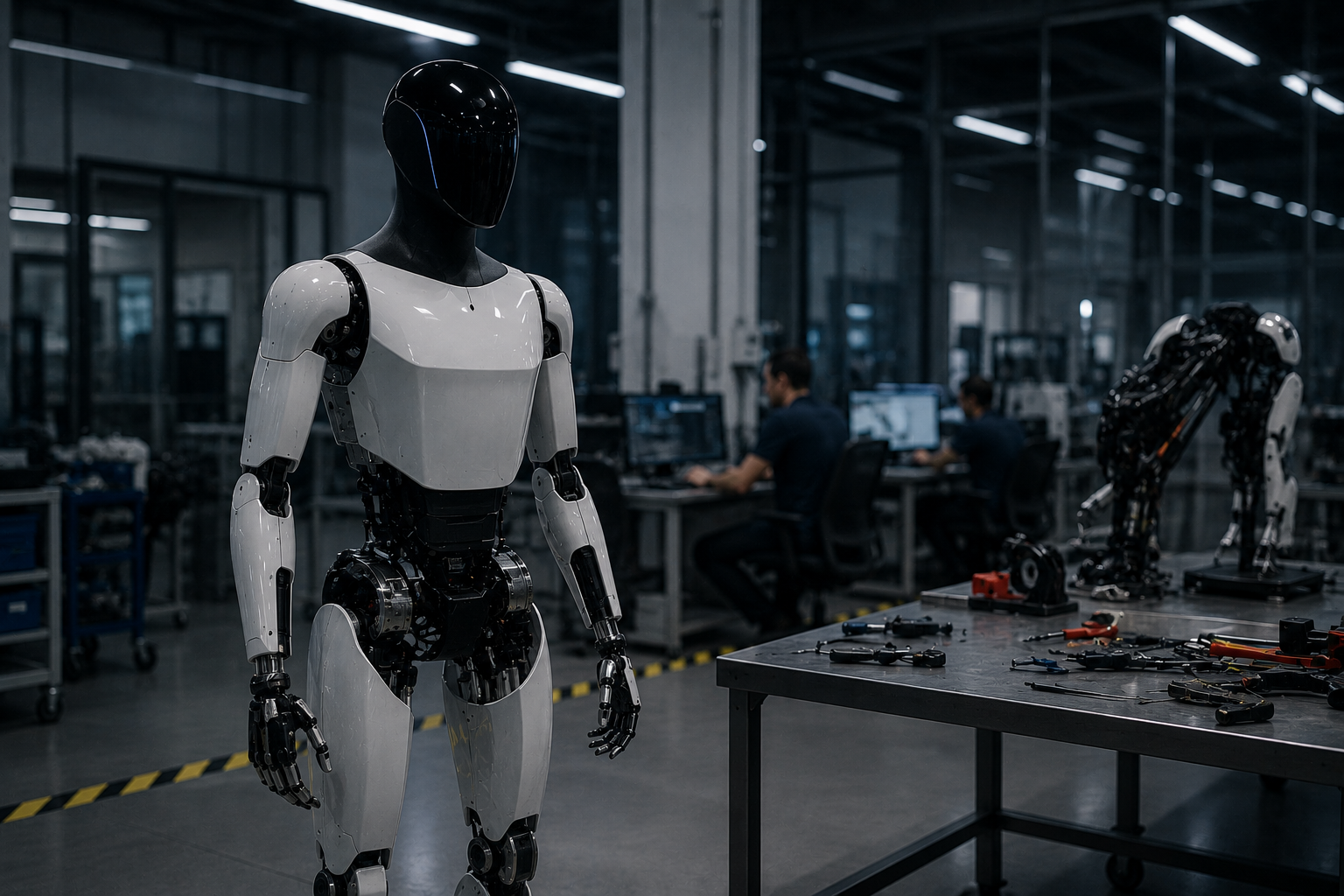
Elon Musk said Tesla would be selling humanoid robots to outside customers by 2025. That hasn’t happened, and every recent earnings call has leaned on the same phrase to explain why: “low volume.” It sounds like routine corporate hedging. It isn’t. In hardware manufacturing, that phrase is code for deep, unresolved production problems — and understanding what’s actually going on with Tesla Optimus matters well beyond Tesla shareholders. It’s a preview of what the entire “robots as capital expenditure” trend is actually going to look like in practice.
This piece walks through why the Tesla Optimus Gen 3 ramp keeps slipping, what “low volume” really means on a factory floor, how Tesla’s timeline stacks up against every other serious humanoid robotics program, the specific supply chain and engineering barriers nobody’s talking about on earnings calls, and what all of this means if you’re trying to evaluate humanoid robotics as an investment thesis rather than a demo reel.
Why Tesla Optimus Gen 3 Production Keeps Slipping
What “Low Volume” Really Means for Tesla Optimus Manufacturing
How Tesla Optimus Stacks Up Against Other Humanoid Robots
The Supply Chain Barriers Standing Between Tesla Optimus and Mass Production
What Tesla Optimus Delays Mean for the Robotics Capex Cycle
Conclusion: Final Thoughts on Tesla Optimus and What Comes Next
Why Tesla Optimus Gen 3 Production Keeps Slipping
Musk first unveiled the concept behind Tesla Optimus back in August 2021, predicting production-ready robots within a few years and telling investors Tesla would begin selling units externally by 2025. Neither of those things has materialized on schedule.
The goalposts have shifted repeatedly and predictably. In August 2021, Musk announced the “Tesla Bot” at AI Day and promised a working prototype within a year. By September 2022, a stumbling early prototype walked onstage, and Musk started talking about “millions” of eventual units. December 2023 brought a smoother-walking Gen 2 demo, with claims that production could start in 2025. Early 2025 saw the Gen 3 design announced, with internal production still described as “low volume” testing. By mid-2025, the timeline had shifted again, pushing meaningful production into late 2025 or beyond.
Every delay in the Tesla Optimus program follows the same shape: a bold public commitment gets quietly replaced by vaguer language a few months later. Analysts have started treating Tesla Optimus timelines the same way they treat Tesla’s Full Self-Driving timelines — aspirational rather than operational, useful as a direction but not as a date.
Tesla’s own definition of “production” has drifted too. Early on, it meant robots actually working inside Tesla factories. Now it more often means small internal test batches. The gap between a polished demo and an actually deployed robot hasn’t closed — if anything, it’s widened, because the demo only has to survive a controlled stage with known lighting and a safety handler standing just out of frame. A production Tesla Optimus unit destined for a real factory floor has to handle unexpected obstacles, inconsistent surface friction, and partial slips, and recover from all of it without supervision, repeatedly, across a full shift. Those are fundamentally different engineering problems, and no amount of demo polish bridges the gap between them. In hardware, the demo is always the easy part — shipping is where a company finds out what it actually built.
What “Low Volume” Really Means for Tesla Optimus Manufacturing
When most people hear “low volume,” they picture a small, deliberate batch. In manufacturing, the phrase carries much heavier baggage, and for Tesla Optimus specifically, it usually points to one or more of the following problems.
Yield issues. Components aren’t passing quality checks at acceptable rates. For a humanoid robot, that means actuators, sensors, or structural parts failing testing before they ever reach assembly. Even a 10% failure rate on a single critical actuator becomes catastrophic at scale — if Tesla needed 10,000 finished Tesla Optimus units and one actuator type had a 10% defect rate, the company would need to source and test parts for roughly 11,000 units just to ship 10,000. That math compounds across every distinct component in the robot’s body.
Supply chain gaps. Critical parts don’t yet have reliable suppliers at real scale. Tesla designs much of Optimus in-house, but the custom actuators and specialized sensors involved often depend on niche vendors, and some components may still be hand-assembled — a process that simply doesn’t scale and introduces unit-to-unit variability that makes software calibration significantly harder, since every individual robot behaves slightly differently right out of the box.
Cost barriers. Musk has targeted a price point of $20,000 to $30,000 per Tesla Optimus unit. At today’s low volumes, actual per-unit cost is likely many times higher. Manufacturing economics only improve with scale, but scale isn’t achievable until yield and supply chain problems are solved first — which is exactly the loop nobody addresses on an earnings call.
Integration complexity. A humanoid robot isn’t really one product — it’s dozens of subsystems that all have to work together flawlessly at once. The hands alone contain dozens of actuators and sensors. If a hand’s force sensors report slightly stale data mid-grip, the robot can crush a component it was meant to handle gently. Catching and eliminating that entire class of failure across thousands of units takes a level of systems integration maturity that takes years to build, not months.
There’s also a structural signal worth watching: “low volume” for Tesla Optimus often means the production line itself isn’t finalized yet. Tesla may still be iterating on tooling, fixtures, and assembly sequences. One practical way to track this from the outside is watching Tesla’s job postings for roles like “manufacturing process engineer — robotics” or “tooling design lead — Optimus.” A spike in those listings usually signals the production line is being actively redesigned, not ramped up. That’s normal for early-stage hardware, but it directly contradicts any suggestion that mass production of Tesla Optimus is right around the corner.
The core reason Tesla Optimus keeps slipping schedule after schedule comes down to one simple fact: hardware manufacturing at this level of complexity doesn’t compress the way software timelines sometimes can. You can’t sprint through physics.
How Tesla Optimus Stacks Up Against Other Humanoid Robots
Tesla isn’t the only company building humanoid robots, and the competitive landscape offers a genuinely useful benchmark for how aggressive — and arguably unrealistic — Tesla’s public commitments around Optimus have actually been.
| Company | Robot Name | First Prototype | Production Status (Mid 2025) | Estimated Unit Cost |
|---|---|---|---|---|
| Tesla | Optimus Gen 3 | 2022 | Low-volume internal testing | $20K–$30K (target) |
| Boston Dynamics | Atlas (Electric) | 2024 (electric version) | R&D / limited commercial pilots | Not publicly disclosed |
| Figure AI | Figure 02 | 2024 | Pre-production partnerships | Not publicly disclosed |
| Agility Robotics | Digit | 2019 (early version) | Small-batch commercial shipments | ~$250K+ estimated |
| Sanctuary AI | Phoenix | 2023 | Prototype stage | Not publicly disclosed |
A few things stand out from this comparison. Nobody in the industry is at real mass production yet. Agility Robotics is arguably furthest along commercially, having shipped Digit units to partners like Amazon, but even Agility is operating at very small volumes. Boston Dynamics has decades of robotics experience and still hasn’t mass-produced its electric Atlas — a company with that much runway not having cracked the problem says something meaningful about how hard it actually is, not about a lack of ambition.
Tesla’s cost targets for Optimus are also aggressive relative to everyone else in the field. Agility’s Digit reportedly costs over $250,000 per unit at current volumes, while Tesla is targeting $20,000 to $30,000 — an order-of-magnitude gap that requires manufacturing breakthroughs nobody has publicly demonstrated yet. That’s not pessimism, just arithmetic. For context, the automotive industry spent decades refining stamping, welding, and paint processes before achieving the per-unit economics that make a $30,000 car possible. Humanoid robotics, including Tesla Optimus, is roughly at the hand-built prototype stage of that same journey.
Experience gaps matter too. Boston Dynamics has been building robots since 1992. Tesla only started its robotics program in 2021. Tesla brings genuine automotive manufacturing expertise to the table, but humanoid robotics involves fundamentally different engineering challenges — actuator design, balance control, and dexterous manipulation don’t transfer directly from car assembly, and assuming they would is arguably where a lot of the early optimism around Tesla Optimus went wrong.
Figure AI is worth watching closely here too. It’s attracted significant investment and secured a partnership with BMW for factory deployment, and even Figure openly acknowledges that real production scale remains years away. The entire humanoid robotics industry faces the same fundamental bottlenecks Tesla does with Optimus — which means Tesla Optimus running behind schedule isn’t some unusual failure. It’s the industry norm. What’s actually unusual is how confidently Tesla has marketed timelines that no competitor has come close to hitting either.
The Supply Chain Barriers Standing Between Tesla Optimus and Mass Production
Most coverage of Tesla Optimus focuses on AI capability questions — can it fold laundry, can it walk smoothly. Those are legitimate questions, but they obscure the much harder underlying problem: manufacturing.
Actuators are the core bottleneck. A humanoid robot needs dozens of actuators — the motors that create movement at each joint — and every one of them has to be compact, powerful, efficient, and affordable all at once. Tesla has designed custom actuators for Optimus, but custom components are inherently harder to produce at scale than off-the-shelf parts. There’s a real tradeoff hiding here too: high-torque actuators that give a robot meaningful lifting capability tend to run hotter and wear out faster, while lower-torque actuators that last longer limit what the robot can actually do. Tesla hasn’t publicly said where Optimus Gen 3 lands on that curve, which itself suggests the design isn’t fully locked yet.
Sensor integration creates cascading failures. Tesla Optimus uses cameras, force sensors, and inertial measurement units throughout its body, sourced from different suppliers with different quality standards. When one sensor type develops yield problems, it can stall entire production runs. Early smartphone makers faced a similar multi-supplier coordination problem, but a phone with a slightly underperforming camera still ships fine. A humanoid robot with a degraded force sensor in its wrist can damage property or injure someone standing nearby — the tolerance for variability here is categorically lower than in consumer electronics.
Battery and thermal management add real complexity. Optimus has to carry its own power supply while managing heat generated by dozens of motors packed into a human-sized frame. Tesla’s EV battery expertise genuinely helps here, but the form factor of a humanoid body creates thermal challenges a car never faces — motors packed tightly into a torso or limb generate concentrated heat that’s difficult to dissipate. In practice, that likely means a Tesla Optimus unit running a demanding task cycle, like repeatedly lifting and placing parts, may need to throttle output after sustained use to avoid thermal damage — directly limiting productivity in exactly the factory settings Tesla is targeting.
Software and hardware have to evolve together, which slows everything down. Unlike a car, where the mechanical platform is largely finalized before software refinement begins, a humanoid robot’s software and hardware develop in lockstep. A concrete example: Tesla’s AI team discovers the robot’s balance-recovery algorithm performs better with faster feedback from the ankle actuators. Implementing that requires a hardware revision, which resets supplier qualification timelines, which delays the next round of software testing. Each one of these cycles can cost weeks or months, and Tesla Optimus has to go through many of them before a design is truly final.
On top of all that, Tesla faces an internal resource competition most outside observers don’t account for. The Optimus team competes for engineering talent and budget against the automotive division, the energy division, and the Full Self-Driving team. Musk has repeatedly said Optimus will become Tesla’s single most valuable product long-term, but publicly available hiring and organizational data doesn’t yet show resource allocation matching that stated priority.
Each of these barriers reinforces the others. You can’t solve cost without scale. You can’t achieve scale without reliable supply chains. You can’t build reliable supply chains without a finalized design. And you can’t finalize a design without extensive low-volume testing first. It’s a closed loop — and right now, Tesla Optimus is still inside it.
What Tesla Optimus Delays Mean for the Robotics Capex Cycle
The delays in the Tesla Optimus program matter well beyond Tesla itself. They say something important about the broader idea of companies treating humanoid robots as capital expenditure — buying robots the way they’d buy machinery, instead of hiring workers.
That capex cycle hasn’t actually started yet. For robots to genuinely replace or meaningfully augment human labor at scale, they need to be affordable, reliable, and available — and none of those three conditions exist today for Tesla Optimus or any of its competitors. Traditional industrial robots from companies like FANUC and ABB, by contrast, have been deployed successfully for decades precisely because they meet all three criteria for narrow, structured tasks. A FANUC welding arm does one thing, in a fixed position, on a known part geometry, running 24 hours a day with predictable maintenance intervals. That’s the reliability bar a general-purpose humanoid robot still has to clear, across a far wider range of tasks and environments.
Investor expectations are running well ahead of that reality. Tesla’s market valuation already includes a significant premium tied to Optimus’s future potential, and analysts at major banks have modeled scenarios where Optimus generates hundreds of billions in revenue down the line. Those models generally assume manufacturing timelines that keep slipping in practice. If Tesla Optimus production stays in “low volume” through 2026, those revenue projections need real revision — arguably overdue revision. Anyone evaluating those models is better off asking directly what unit-production assumption is baked in for each year; if the answer is tens of thousands of units before 2027, that assumption deserves serious skepticism given everything the industry has actually demonstrated so far.
Safety certification adds another timeline layer that runs in parallel rather than waiting its turn. Before Tesla Optimus or any humanoid robot can work alongside humans in a factory or home, it needs formal safety certification. ISO standards — specifically ISO 10218 and ISO/TS 15066 — govern robot safety in industrial settings today, but humanoid robots introduce new safety considerations those existing standards don’t fully address yet. Developing and certifying against updated standards takes years on its own, independent of manufacturing progress. In the EU, CE marking requirements for machinery add another compliance layer before commercial deployment; in the U.S., OSHA’s general duty clause means employers deploying robots like Optimus alongside human workers carry liability exposure most legal and insurance frameworks haven’t fully priced in yet.
Even if Tesla solved every manufacturing problem tomorrow, regulatory and safety certification timelines would still add years before Tesla Optimus could be deployed commercially at any real scale. Platforms aiming to speed up safety validation exist, but the underlying process remains inherently slow. The long-term vision behind Tesla Optimus is genuinely compelling — but the near-term reality calls for patience measured in years, not quarters.
Conclusion: Final Thoughts on Tesla Optimus and What Comes Next
The delays hitting Tesla Optimus aren’t surprising, and they aren’t unique to Tesla — they reveal fundamental truths about hardware manufacturing at the frontier of robotics that apply to every company in this space. “Low volume” means unresolved yield problems, immature supply chains, and per-unit costs far above target, and every humanoid robot company faces the same underlying barriers. Tesla’s specific challenge is that its public commitments have consistently outpaced what the physics of manufacturing actually allows.
A few practical takeaways worth holding onto: don’t anchor expectations to Musk’s stated timelines — track actual reported unit counts instead, and treat dates as aspirational until Tesla reports something concrete. Watch supply chain signals like supplier contracts and hiring patterns at Tesla’s robotics facilities, since they tend to reveal more than earnings call rhetoric. Compare Tesla Optimus against the rest of the industry rather than in isolation — if no humanoid robot company reaches real mass production by late 2026, the entire capex cycle thesis needs recalibrating, not just Tesla’s piece of it. Keep an eye on safety standards development too, since ISO working groups and national safety bodies will shape deployment timelines as much as manufacturing readiness will. And track internal deployment separately from external sales — Tesla running Optimus units inside its own factories is a real milestone, but it’s a different business entirely from selling robots commercially, and the two shouldn’t be treated as interchangeable evidence.
The humanoid robotics shift itself is real, and Tesla Optimus is a genuine part of that story. But it’s arriving on hardware timelines, not software timelines — and hardware, as the Tesla Optimus program keeps demonstrating, doesn’t care about press releases.
FAQ About Tesla Optimus and the Delayed Ramp
Why is the Tesla Optimus Gen 3 ramp behind schedule?
The delays stem from several overlapping manufacturing challenges. Custom actuators have yield issues at scale, and supply chains for specialized sensors and components remain immature. Per-unit cost at current volumes far exceeds Tesla’s $20,000–$30,000 target. These problems are interconnected — solving one often exposes or worsens another. The fundamental issue is that building a humanoid robot at automotive scale is genuinely unprecedented as a manufacturing challenge.
What does “low volume” actually mean in Tesla’s Optimus updates?
It’s manufacturing terminology for production runs that haven’t achieved economies of scale. Specifically, it signals that the production line isn’t finalized, component yields sit below acceptable thresholds, or assembly still requires significant manual work. It doesn’t mean Tesla is choosing to build few units — it means the company can’t yet build many reliably or affordably.
How does Tesla Optimus compare to competitors like Boston Dynamics and Figure AI?
No humanoid robot company has reached true mass production as of mid-2025. Boston Dynamics has the deepest robotics experience but hasn’t mass-produced its electric Atlas. Figure AI has secured real manufacturing partnerships but remains in pre-production. Agility Robotics has shipped small numbers of Digit robots commercially. Tesla’s public timeline for Optimus is aggressive relative to all of them, especially given that Tesla only entered robotics in 2021.
Will Tesla Optimus actually cost $20,000 to $30,000?
That target requires production scale that doesn’t exist yet. At today’s low volumes, per-unit costs are likely many times higher — for comparison, Agility Robotics’ Digit reportedly costs over $250,000 per unit. Tesla’s automotive manufacturing expertise could eventually drive Optimus costs down significantly, but only after the yield, supply chain, and design-finalization problems currently causing delays are actually solved.
What safety certifications does Tesla Optimus need before commercial deployment?
Keep reading
Here are the latest posts from the blog.
Nvidia has owned the AI chip market for years now, and nobody’s come close to seriously threatening that position. That might be starting to change — not because of a flashy…

Illinois passed a law saying an employer’s AI can’t discriminate against candidates or employees. That part is straightforward. What isn’t straightforward is what comes next:…

Six months ago, a piece of malware called JadePuffer showed up and made security teams rethink what ransomware could actually do. It didn’t just run through a fixed checklist…