In April, CoreWeave sold $1.75 billion of 9.75% senior unsecured notes due October 2031 at par. A week later it added another $1 billion of the same notes, and investors paid 102 cents on the dollar for them. On Thursday, 15 October, CNBC reported the yield to maturity on those notes at 15.78% (as cited by Benzinga). On our arithmetic, that yield corresponds to a price of roughly 80 cents. In six months, the buyers of the add-on have lost about a fifth of their money on paper. CoreWeave hasn’t missed a payment, cut its revenue guidance or defaulted on anything.
That gap is the story. The coupon CoreWeave pays hasn’t changed, and neither has a single dollar of what it owes. What changed is the price at which other people are willing to take on that obligation. This article asks what that price says about AI infrastructure debt: whether lenders are punishing one company after a bad week for its shares, or repricing a business model in which expensive, fast-ageing GPUs must earn enough to cover both the technology and the loan that bought it.
The short answer is that the evidence supports a repricing of financing risk, not a forecast of default. The longer answer depends on three things that are easy to blur: what a GPU is worth to a lender, how quickly contracted demand turns into cash, and what happens when the cost of borrowing rises for a company that must keep borrowing.
Key Takeaways
- A 15% yield is a price, not a verdict. CoreWeave’s 9.75% 2031 notes yielding 15.78% means they trade near 80 cents. It doesn’t mean a missed payment or a promised 15% return.
- CDS spreads overstate default odds if read naively. Converting about 1,088 basis points into a default probability depends on recovery assumptions, and the spread also includes a premium for fear and illiquidity.
- GPU collateral is weaker than its purchase price suggests. Lenders anchored CoreWeave’s secured loans on customer contracts first, a sign of how little they rely on resale value alone.
- $103.7 billion of RPO is not $103.7 billion of cash. Only 41% is due within two years, and most of it requires capacity that hasn’t been built yet.
- Refinancing is the pressure point. About $10.6 billion of principal falls due by the end of 2027, so the price of new money matters more than the price of old bonds.
- The $18 billion junior tranche is Anthropic’s, not CoreWeave’s. It belongs to the Broadcom TPU financing, and its pricing is still unknown.
Quick Navigation
- Reading the AI infrastructure debt signal in CoreWeave's bonds
- How GPU-backed AI infrastructure debt is secured
- Backlog is not cash
- The refinancing loop in AI infrastructure debt
- Where CoreWeave differs from the $60 billion Anthropic chip deal
- What would change the case on AI infrastructure debt
- Frequently Asked Questions
Reading the AI infrastructure debt signal in CoreWeave’s bonds
A fixed coupon, a moving yield
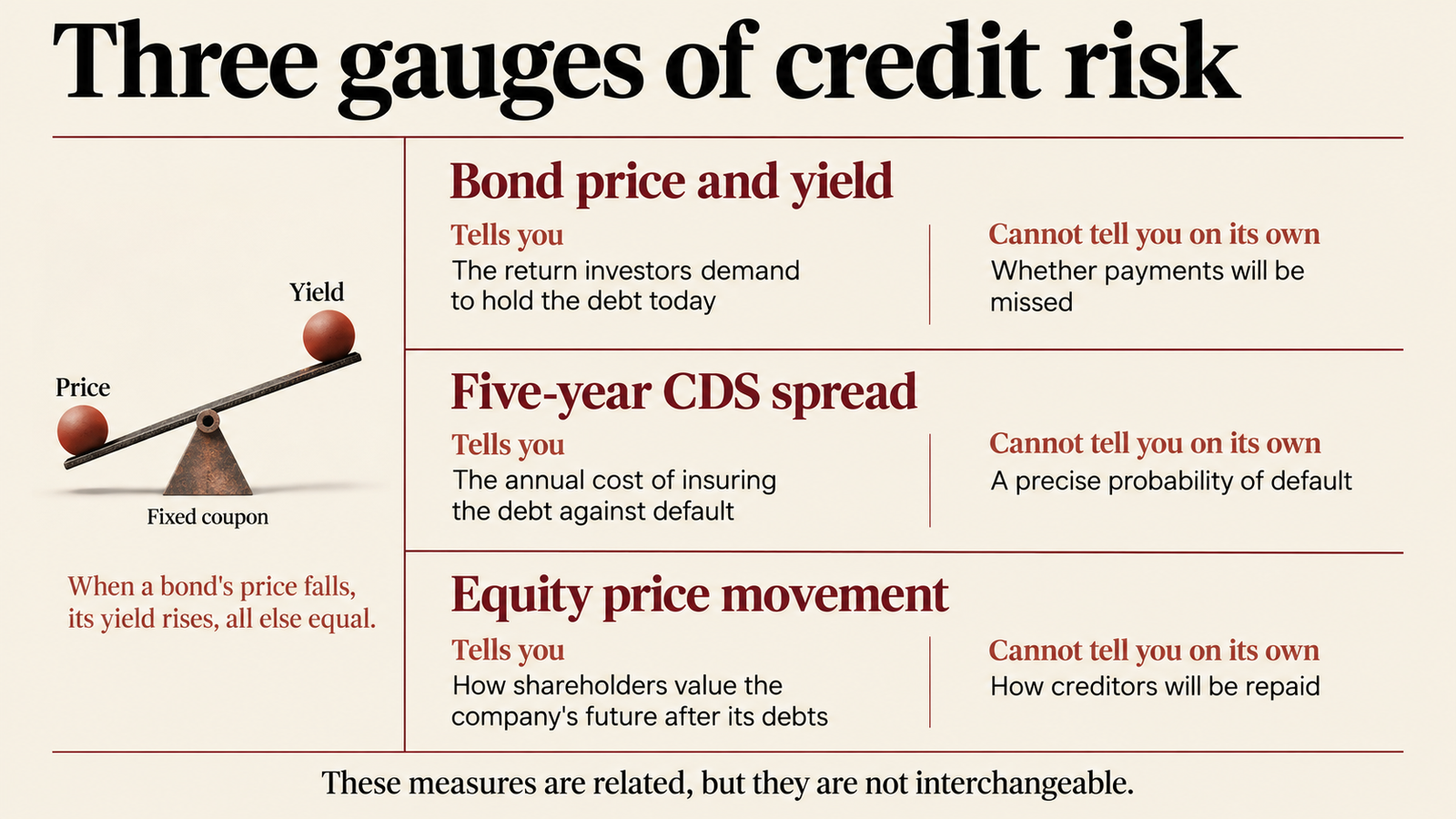
A bond’s coupon is the interest written into the contract. CoreWeave’s June 2026 dollar notes pay 9.625% a year on $1.25 billion until July 2032, whatever happens to the share price. The yield to maturity is different. It is the annual return a buyer would earn by paying today’s market price, collecting every coupon and getting 100 cents back at maturity. When the price falls, the same fixed coupons plus a larger gain at maturity produce a higher yield. Price and yield move in opposite directions.
The numbers reported around 14 and 15 October fit together once that relationship is applied. On Wednesday, CNBC put the 2032 notes at about 14.8%, after touching 15% briefly, and the 2031 notes at about 14.9% (via investingLive). A 9.625% bond maturing in mid-2032 yields about 14.9% at a price of 80, by our calculation using semi-annual compounding and settlement on 15 October. That matches separate reporting, based on Forbes data, that the 2032 notes had fallen below 80 cents. On Thursday the 2031 notes were reported at 15.78% by CNBC and “past 16%” by Reuters. Different dealers, quote times and bid or offer sides easily explain a gap of a few tenths. Corporate bonds trade over the counter, and a quoted yield is often an indicative level rather than a trade.
Two cautions follow. A 15% yield isn’t a promised 15% return. It’s what a buyer earns only if CoreWeave pays every coupon and repays principal in full. If the company restructured, the realised return would depend on what creditors recovered. Suppose a buyer paid 79.8 for the 2031 notes, collected two years of coupons (19.5 points), then recovered 40 cents in a restructuring. That buyer would end up with 59.5 against 79.8 invested, a loss of about a quarter. The 40% recovery figure is purely illustrative. Nor does crossing 15% prove anything on its own. It’s a round number, and round numbers attract headlines more than they mark legal or economic thresholds.
Bonds, CDS and shares measure different things
A credit default swap (CDS) is insurance-like protection on a borrower’s debt. The buyer pays an annual premium, quoted in basis points, and is compensated if a defined credit event occurs. CNBC reported CoreWeave’s five-year CDS briefly above 1,140 basis points on 15 October before settling at 1,088. In other words, protecting $10 million of debt cost about $1.09 million a year. Reuters put the cost at about 1,000 basis points and translated it into a “nearly 63%” chance of default within five years.
That kind of conversion needs its assumptions shown. Assume 40% recovery and a constant default rate, and a 1,088bp spread implies roughly 60% cumulative default probability over five years. Change the recovery assumption and the answer moves a lot. More importantly, CDS spreads also price fear, illiquidity and the cost of hedging, which is why spread-implied probabilities usually run well above realised default rates. The figure is a market price, not an actuarial estimate.
The share price fell 15.46% to $65.78 on Wednesday, then recovered on Thursday after Nvidia’s chief executive, Jensen Huang, said publicly that CoreWeave’s cost of capital was falling. Equity holders get the upside and absorb losses first. Bondholders get at most par. When shares, bond yields and CDS spreads all move the same way, they’re related, but they aren’t measuring the same thing. In this case they did move together, and the bond and CDS markets kept pricing stress while the shares bounced.
How GPU-backed AI infrastructure debt is secured
Not all AI infrastructure debt is the same, even inside one company. The 2031 and 2032 notes under stress are senior unsecured: they rank ahead of shareholders but have no specific assets pledged to them. Much of the rest is delayed-draw term loans (DDTLs) held in special-purpose subsidiaries. CoreWeave’s Q2 10-Q says these are “collateralized with the assets underlying the contributed contracts and the pledged contractual cash flows, generally from investment grade counterparties.” StockTitan’s reading of the debt note puts DDTL debt at $13.6 billion and unsecured senior notes at $10 billion, out of $35.6 billion of principal at 30 June.
The DDTL lender, in other words, is mainly lending against a customer contract, with the GPUs as a second line of defence. That’s a sensible structure. It also means the unsecured noteholders sit behind lenders with claims on many of the company’s most valuable assets.
One accelerator, five different values
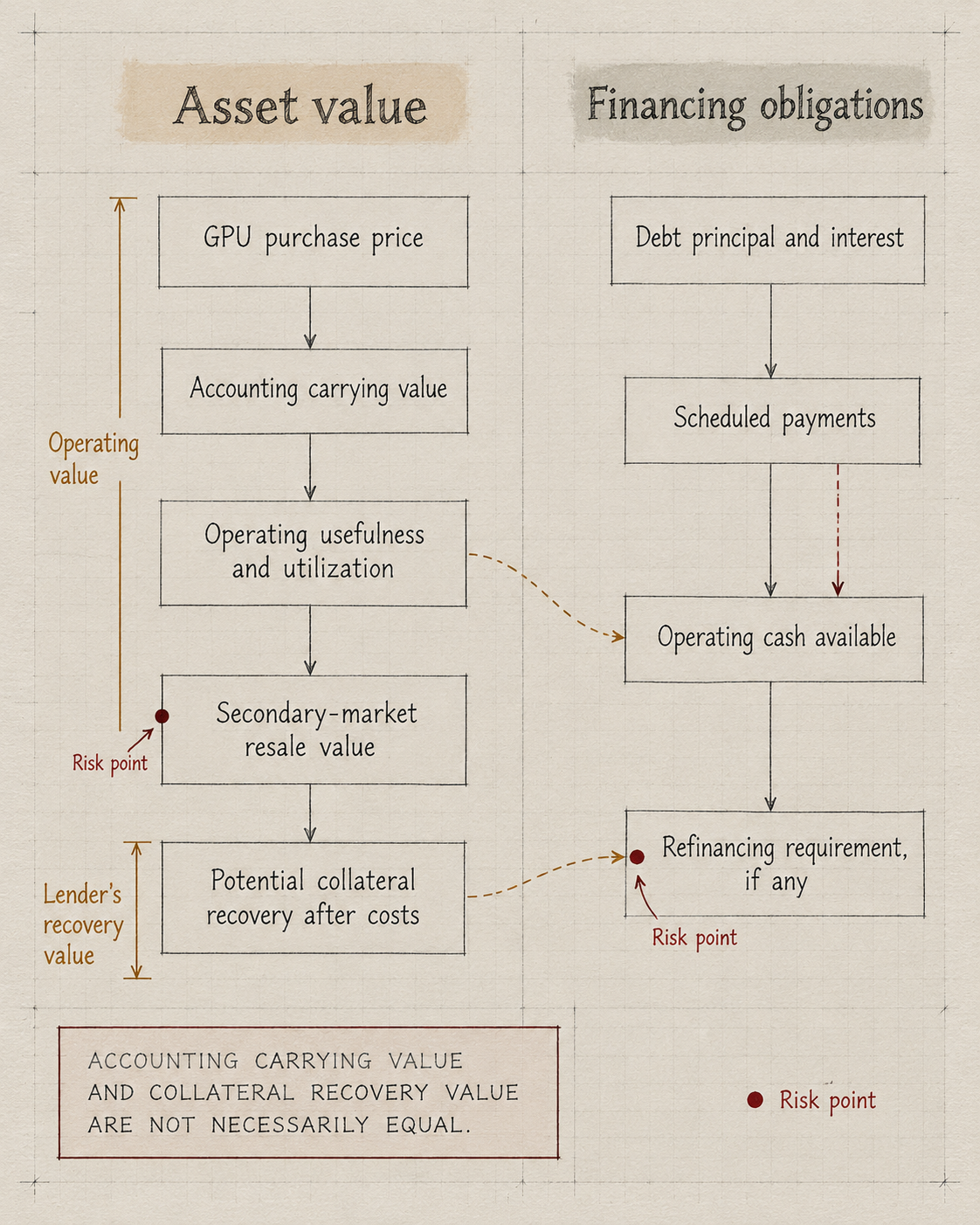
A GPU has several values at once, and they aren’t interchangeable:
- Purchase price, what CoreWeave paid, often under supplier financing.
- Carrying value, the purchase price less accumulated depreciation. CoreWeave’s FY2025 10-K depreciates technology equipment over six years.
- Resale value, what a buyer in the secondary market would pay for that specific card, today, in that condition.
- Value to a customer, which can be much higher than resale value inside a powered, networked cluster with a contract attached.
- Collateral recovery value, what a lender actually collects after removal, transport, refurbishment, legal costs and a forced-sale discount.
The last figure is the one that matters in a default, and it’s the one with the least public evidence. As we argued in our piece on why accelerator useful-life assumptions deserve more scrutiny, a six-year accounting life is a management estimate. It isn’t a measurement of how long a chip will earn its keep. An accelerator can keep computing long after newer models outgrow its memory and its rental price collapses.
When AI infrastructure debt outlives its collateral
The risk for a lender isn’t that GPUs stop working. It’s that the loan amortises more slowly than the market value of the hardware falls. If a new chip generation arrives every year or two, the cards backing a five-year loan may be two generations old before half the principal is repaid. Their value also depends on things that don’t travel with them. A rack of liquid-cooled accelerators is worth far more in a data centre with contracted power than on a loading dock. Our analysis of the residual-value problem in the $60 billion AI chip financing made the same point about TPUs: secondary markets for accelerators are thin and untested under stress, and the conditions that push a borrower towards default are likely to depress resale prices at the same time.
We found no public disclosure of the loan-to-value ratios or advance rates on CoreWeave’s DDTLs, so we won’t guess at them. What the filings do show is that lenders chose to anchor these loans on contracts rather than on hardware alone. That choice says something about how much confidence they place in GPU collateral by itself.
Backlog is not cash
CoreWeave’s chief executive, Mike Intrator, answered the sell-off in a memo to staff. According to Reuters, he argued that the company’s backlog “more than covers” its debt obligations. He also wrote, as Yahoo Finance reported, that “there will be periods of time when the market misunderstands” and “acts irrationally”. The argument deserves to be taken seriously, because on the company’s own numbers it is arithmetically true. It just doesn’t answer the question lenders are asking.
What $103.7 billion of RPO actually promises
The term CoreWeave uses in its filings is remaining performance obligations, or RPO: contracted revenue it has not yet earned because it hasn’t yet delivered the compute. At 30 June the 10-Q reported “$103.7 billion of unsatisfied RPO”. It expected 41% of that to be recognised within 24 months, 39% in months 25 to 48, and the rest by month 78. Set against $35.6 billion of debt principal, that is a ratio of almost three to one.
Here is what sits between that RPO figure and a bond coupon:
- Revenue must be earned first. Roughly $42.5 billion is scheduled for the next two years, and most of it depends on capacity that hasn’t been built yet. CoreWeave spent $14.1 billion on property and equipment in the first half of 2026 alone, and the 10-Q lists $35.5 billion of future lease payments on data-centre leases that haven’t started.
- Revenue isn’t free cash. Every dollar recognised carries power, staffing, lease and interest costs. The Q2 net loss was $626 million on $2.58 billion of revenue.
- Timing doesn’t line up. About $10.6 billion of principal falls due by the end of 2027. The 41% tranche of RPO arrives over the same window, but only as new data halls are energised.
- Contracts aren’t immune to change. The 10-Q says the transaction price can include “potential reductions” in future. The termination terms in customer contracts weren’t disclosed in the sections we could read.
- Customer concentration is falling but still high. CoreWeave’s largest customer was 36% of Q2 revenue, down from 71% a year earlier. Reuters names Microsoft and OpenAI among the biggest customers.
There’s also a point in the company’s favour. CoreWeave held $9.7 billion of deferred revenue at 30 June, which is cash customers have paid ahead of delivery. Deutsche Bank told clients on 15 October that roughly two-thirds of a backlog above $100 billion sits with investment-grade counterparties (World Today News, republishing CNBC). A big customer’s appetite for AI spending doesn’t make its contract unreliable. The question isn’t whether the customers will pay. It’s whether CoreWeave can deliver the capacity on time and on budget, while servicing debt raised before that capacity earns anything.
The refinancing loop in AI infrastructure debt
Refinancing means repaying maturing debt with new debt. In the early years, AI infrastructure debt is usually rolled over rather than repaid from profits. A company that is investing faster than it generates cash has to keep doing that, so the market price of its existing bonds becomes an operating variable rather than a scorecard.
The pieces are all in the filings. Q2 interest expense was $640 million, about a quarter of revenue for the quarter, and cash interest paid in the first half was $806 million. Reuters reports that CoreWeave lifted its 2026 capital-expenditure forecast in August to as much as $39 billion. About $4.4 billion of principal is due in the rest of 2026 and $6.2 billion in 2027, according to StockTitan’s reading of the maturity table. Cash at 30 June was $5.5 billion. Since then CoreWeave has added a $2.6 billion DDTL facility and $4.2 billion of 2.875% convertible notes, which shows that at least one door is still open.
Here is an illustrative calculation, not a forecast. If CoreWeave refinanced the $6.2 billion due in 2027 at 15% rather than at the 9.75% it paid in April, the extra interest would be about $325 million a year. That’s roughly half of one quarter’s current interest bill. It’s survivable on its own, but it sets the mechanism in motion. Higher financing costs must be recovered through higher prices or higher utilisation. As our analysis of why accelerator utilisation decides the cost of every token showed, idle capacity is paid for whether or not anyone uses it. A GPU cloud that charges more to cover its borrowing costs loses ground to hyperscalers that fund capex from operating cash flow. Lower prices, in turn, make the next loan harder to justify.
The loop also explains why commercial success doesn’t settle the matter. CoreWeave can win contracts, grow revenue and deliver well, and still find each new dollar of capital more expensive. It runs the other way too. A wide credit spread doesn’t stop the business from executing. A spread at 1,088 basis points mostly means that the next unsecured bond, if CoreWeave chose to issue one, would be expensive. Convertibles at 2.875% are cheaper in cash terms, but they shift some of the cost to shareholders through dilution.
Nvidia’s role cuts both ways. Its 2025 order form commits it to buy qualifying unused capacity through 13 April 2032, from an initial value of $6.3 billion. That supports utilisation. As TokenPost notes, though, it is not a guarantee to CoreWeave’s lenders, and either side can end it under defined conditions. Huang’s public reassurance on 15 October helped the shares, but it doesn’t change any creditor’s claim.
Where CoreWeave differs from the $60 billion Anthropic chip deal
The sell-off didn’t happen in isolation. On 14 October Oracle shares closed down nearly 9% and Nebius fell about 10%, according to CNBC figures carried by investingLive. The same CNBC report put Oracle’s five-year CDS at 288 basis points, up more than 12% on the week. Intrator’s memo itself blamed “weakness and delays surrounding the attempted IPOs and debt financings” of rivals. These moves were correlated, but correlation doesn’t prove a common cause. Oracle is an investment-grade company with a large legacy software business. Nebius has a different balance sheet and depreciates its GPUs over four years rather than six. What they share is sensitivity to one variable: how quickly AI demand turns into cash for whoever owns the hardware.
The comparison most often drawn is with Broadcom’s financing for Anthropic. As reported by Bloomberg and summarised by Quartz on 2 October, banks were assembling about $60 billion of debt. According to Tech Times, the borrower is a special-purpose vehicle that buys Google TPUs from Broadcom and leases them to Anthropic under a five-year, $125.2 billion lease. The structure has a $42 billion Class A senior secured tranche with a partial residual-value guarantee from Broadcom, and an $18 billion Class B junior tranche.
The two have shared risks. Both rest on the value of specialised AI accelerators and on whether an AI customer keeps paying. But the structures are different in ways that matter. The SPV has one lessee and one revenue stream, and the chip vendor stands behind part of the hardware’s value. CoreWeave is an operating company with many customers, data-centre leases, construction risk and a stack of debt in which the stressed notes are unsecured claims on the parent. A lender to the Anthropic SPV is mainly underwriting Anthropic’s credit. A CoreWeave bondholder is underwriting CoreWeave’s ability to build, operate and refinance. The two are not equivalent, and price moves in one say little directly about the other. We covered the obligation side of that deal in Anthropic’s $518 billion compute commitment.
The $18 billion junior tranche belongs to that deal
Some commentary this week has linked an “$18 billion unguaranteed junior tranche” to CoreWeave. The reporting we could verify places it in the Anthropic financing as Class B, with Blackstone committing about $9 billion and syndicating the rest. Junior means it is repaid after the senior tranche. The absence of Broadcom’s guarantee on Class B isn’t stated outright in the reports, and even if it applies, that doesn’t mean the tranche has no collateral or covenants. Those terms haven’t been published. Neither has the pricing. Tech Times reports that Class B lenders may wait for Anthropic’s planned IPO before committing in full.
That makes the tranche a useful gauge of how much appetite there is for subordinated AI infrastructure credit, once it prices. It can’t tell us anything about CoreWeave’s own bonds, and we won’t guess at its clearing level.
What would change the case on AI infrastructure debt
The market’s message about AI infrastructure debt is narrower than the headlines suggest. CoreWeave’s unsecured lenders now want about 15% to hold paper that was issued at under 10% this year. That repricing applies to the model, a highly leveraged GPU cloud funding years of construction ahead of revenue, as much as to the company. It isn’t evidence of an imminent default. CoreWeave’s ratings, as last published in April, were B+ with a positive outlook at S&P and Ba3 at Moody’s. Since June it has raised fresh money, and its largest contracts sit with investment-grade customers.
What the evidence can’t settle yet is whether the gap between contracted demand and cash in hand closes before the 2027 maturities do. Several observable facts would move the assessment:
- The Q3 10-Q. Watch whether RPO conversion keeps pace with the 24-month schedule, whether deferred revenue grows, and how interest expense compares with revenue.
- Rating-agency action. Any change from S&P or Moody’s, and the rationale behind it, would be the first independent credit judgement since the sell-off.
- The next financing. Its form (secured DDTL, unsecured note or convertible) and its price will show which doors remain open, and at what cost.
- Delivery milestones. Data-centre energisation dates and lease commencements govern when RPO becomes revenue.
- Secondary GPU prices. Prices for previous-generation accelerators are the only market test of collateral value, and they’re poorly documented today.
- Class B pricing in the Anthropic deal. This is the clearest gauge of appetite for subordinated AI credit, even though it isn’t CoreWeave’s debt.
If the next quarter shows RPO converting on schedule, with financing still available at falling spreads, Huang’s claim that capital is getting cheaper would start to look right. If deliveries slip while 2027 maturities approach, the bond market’s 15% will look like the more accurate forecast.
Frequently Asked Questions
What is AI infrastructure debt?
It’s borrowing used to buy AI accelerators and build or lease the data centres that run them. It includes corporate bonds, loans secured on equipment and customer contracts, supplier financing, and lease obligations.
Why can a bond’s yield rise above its coupon?
The coupon is fixed in cash terms. If the bond’s price falls below 100, a buyer collects the same coupons plus a gain at maturity, so the yield rises. CoreWeave’s 9.625% 2032 notes yield about 15% at a price near 80.
Does a 15% bond yield mean CoreWeave will default?
No. It means investors want a high return to hold the risk. Default depends on whether CoreWeave can meet its payments and refinance. Its last published ratings, from April 2026, were B+ (S&P) and Ba3 (Moody’s).
How does GPU-backed financing work?
Typically a subsidiary borrows against a pool of GPUs and the customer contracts they serve. Lenders take security over both, and the contract cash flows repay the loan. CoreWeave’s DDTLs follow this pattern.
Why is GPU collateral hard to value?
Accounting value follows a fixed schedule (six years at CoreWeave), but resale value depends on new chip generations, condition, power and cooling, and whether there’s a buyer in a downturn. Public data on forced-sale prices is thin.
Is contracted AI backlog the same as available cash?
No. RPO is revenue still to be earned by delivering compute. It turns into cash only as capacity comes online and customers are billed, and the costs of delivering it come first.
What should investors watch next?
Quarterly RPO conversion, any rating action, the cost and form of CoreWeave’s next financing, data-centre delivery dates, and secondary-market GPU prices.
Keep reading
Here are the latest posts from the blog.

AI Infrastructure Debt: CoreWeave Repricing

LLM Benchmark Scores 2026: Every Model Compared
Anthropic Unplugged Its Evals. What AI Agent Containment Costs