One of the agent skills NVIDIA published alongside Isaac ROS 5.0 is called submit-and-monitor-mission. Its documented sample prompt reads: submit a route mission to carter01 and prove it actually completed.
That is not autocomplete. That is a coding assistant issuing a task to a robot in a fleet and verifying the outcome, from a chat window.
NVIDIA released Isaac ROS 5.0 on September 21, 2026, announcing it at ROSCon in Toronto the following day. Most coverage has focused on the ROS 2 Lyrical migration and the NITROS rewrite, both of which matter to anyone maintaining an Isaac ROS workspace. The more interesting change is quieter: robotics development tasks are now packaged as structured skills that AI coding assistants can invoke.
Which raises a question the release notes do not answer, because it is not NVIDIA’s to answer. When an agent works on software that eventually moves actuators, what should it be allowed to reach?
Key takeaways
- Isaac ROS 5.0 ships AI agent skills in the open Agent Skills format, including
isaac-ros-activatefor the development environment and an early-access skill for migrating nodes off NITROS. - Separately, the Mission Control documentation publishes five skills that reach further, including submitting missions to robots and changing fleet composition.
- The release moves to ROS 2 Lyrical Luth on Ubuntu 24.04 and rebuilds the accelerated data path on
rosidl::Buffer. Code calling NITROS APIs directly needs source-level migration. - Isaac ROS 5.0 does not give an agent control of a robot. It gives an agent structured access to the toolchain that produces robot software, which is a different thing with its own permission questions.
- The useful boundary in agentic robotics is not the IDE. It runs across repository, build, simulation, middleware, deployment and hardware, and each of those deserves a separate permission decision.
Quick Navigation
- What Isaac ROS 5.0 Actually Adds
- From Code Assistant to Robotics Toolchain Agent
- The Isaac ROS 5.0 Boundary Question Is Not the IDE
- What Does Egress Control Look Like in a Workcell?
- Simulation Is a Boundary, Not a Guarantee
- Failure Modes Change When Code Reaches Hardware
- How to Evaluate Agentic Development in an Isaac ROS 5.0 Workflow
- What Isaac ROS 5.0 Means for Physical AI Teams
- Questions to Ask Before an Isaac ROS 5.0 Agent Touches a Robot
- Frequently Asked Questions
What Isaac ROS 5.0 Actually Adds
Isaac ROS is NVIDIA’s collection of CUDA-accelerated packages built on open-source ROS 2. It is not a replacement for ROS 2 and not a robot controller. It supplies GPU-accelerated perception, localisation, planning and deployment packages that run inside a ROS 2 graph.
Four changes define the 5.0 release, all documented in NVIDIA’s release notes.
- ROS 2 Lyrical Luth becomes the supported distribution, with a Buildfarm apt repository carrying ROS 2 Lyrical ecosystem packages for Ubuntu 24.04 Noble.
- The accelerated data path was rebuilt. NITROS now sits natively on ROS 2 Lyrical’s
rosidl::Bufferwith the CUDA buffer backend, letting accelerated nodes exchange standard ROS messages whose array fields can be backed by GPU memory. The NITROS packages themselves were removed. Code that called NITROS APIs or types directly requires source-level migration;isaac_ros_nitros_bridge_ros2survives as a deprecated bridge marked for removal. - AI agent skills arrive in the open Agent Skills format. The Isaac ROS CLI ships
isaac-ros-activatefor activating the development environment, plus an early-accessmigrate-node-to-rosidl-bufferskill for moving a node off the NITROS APIs. NVIDIA says further Isaac skills are published in the nvidia/skills catalog under the Physical AI category. - GPU partitioning became a package.
isaac_ros_gpu_partitioningassigns a fixed share of a GPU’s streaming multiprocessors to each ROS 2 process using CUDA Multi-Process Service. NVIDIA is explicit about its limits: it does not partition GPU memory and does not isolate workloads.
That last sentence is worth noting, because it is the kind of precision the rest of this discussion needs. Partitioning compute is not isolation, and NVIDIA says so plainly rather than letting readers assume otherwise.
The release also renames isaac_ros_visual_slam to isaac_ros_cuvslam, changes the teleop end-effector pose topic type in a way that breaks existing subscribers, and carries a frank list of limitations — RealSense cameras supported only in Docker mode, an H.264 encoder segfault on shutdown on Jetson Thor with VPI 4.1.4, cuMotion MoveIt examples that may fail against robot vendor packages not yet certified for Lyrical.
A migration, in other words. A substantial one.
From Code Assistant to Robotics Toolchain Agent
The difference between autocomplete and agentic development is not the quality of the code. It is whether the tool acts.
Autocomplete proposes text and a human commits it. An agentic workflow runs commands, reads output, decides what to do next, and repeats until a stated goal is met or it gives up. The skill format is what makes that repeatable: it packages a procedure, its preconditions and its verification steps so the agent follows a known path instead of improvising one.
NVIDIA’s Mission Control documentation gives the clearest picture of what that looks like in robotics. It lists five published skills, installable through a single npx skills add command, and states they work with Claude Code, Cursor, Codex and other Agent Skills clients.
| Skill | What it does |
|---|---|
bring-up-cloud-stack | Starts the Mission Control cloud services from the repository compose stack |
change-map | Changes the map Mission Control loads, including from an uploaded file, URI or S3 object |
change-fleet-composition | Adds, removes, renames or relabels robots in the fleet |
change-stack-version | Changes the image tag of any Mission Control service |
submit-and-monitor-mission | Submits a mission and verifies it completed end to end |
Read that list as a permission surface rather than a feature list. Starting services, changing which map a fleet navigates against, altering fleet membership, pinning service versions, dispatching missions. In a conventional software context these would be infrastructure operations requiring review. Here they are chat prompts.
None of this is hidden or oversold. NVIDIA documents each skill with a sample prompt and notes the combination case: change the map, add an AMR, restart the stack, run a health check. It reads exactly like a DevOps runbook, which is the point.
The Isaac ROS 5.0 Boundary Question Is Not the IDE
The question worth asking is not whether an AI agent can write ROS 2 code. It can, adequately, and Isaac ROS 5.0 makes it better at the Isaac-specific parts by giving it documented procedures.
The question is what the agent can reach after the code exists.
Here is the chain, and it helps to keep the layers distinct, because collapsing them into “AI controls robots” produces bad reasoning in both directions:
- AI coding agent — writes and modifies source, runs commands, reads results. Has no real-time guarantees and no place in a control loop.
- Isaac ROS — GPU-accelerated ROS 2 packages for perception, localisation and planning.
- ROS 2 middleware — the message transport connecting nodes.
- Robot autonomy stack — the assembled graph that decides what the robot does.
- Robot controller — the real-time layer commanding joints and wheels, typically with its own safety functions.
- Isaac Sim — the simulator, a separate application from Isaac ROS.
An agent editing a launch file is operating at layer one. The effect of that edit can propagate to layer five. The propagation is not instantaneous or automatic, and the gates between layers are where the engineering decision sits.
Risk changes at each step:
| Boundary | What the agent does | Worst realistic outcome |
|---|---|---|
| Source code | Edits packages, configs, launch files | A bad change sits in a branch |
| Dependencies | Installs packages, changes versions | Supply-chain exposure, broken builds |
| Build | Compiles the workspace | Wasted time; a binary that behaves differently than reviewed |
| Simulation | Launches Isaac Sim scenarios | Misleading pass results |
| Middleware | Publishes to live ROS 2 topics | Interference with a running system |
| Deployment | Pushes artifacts to robot compute | Untested software on a machine |
| Hardware | Commands actuators | Physical consequences |
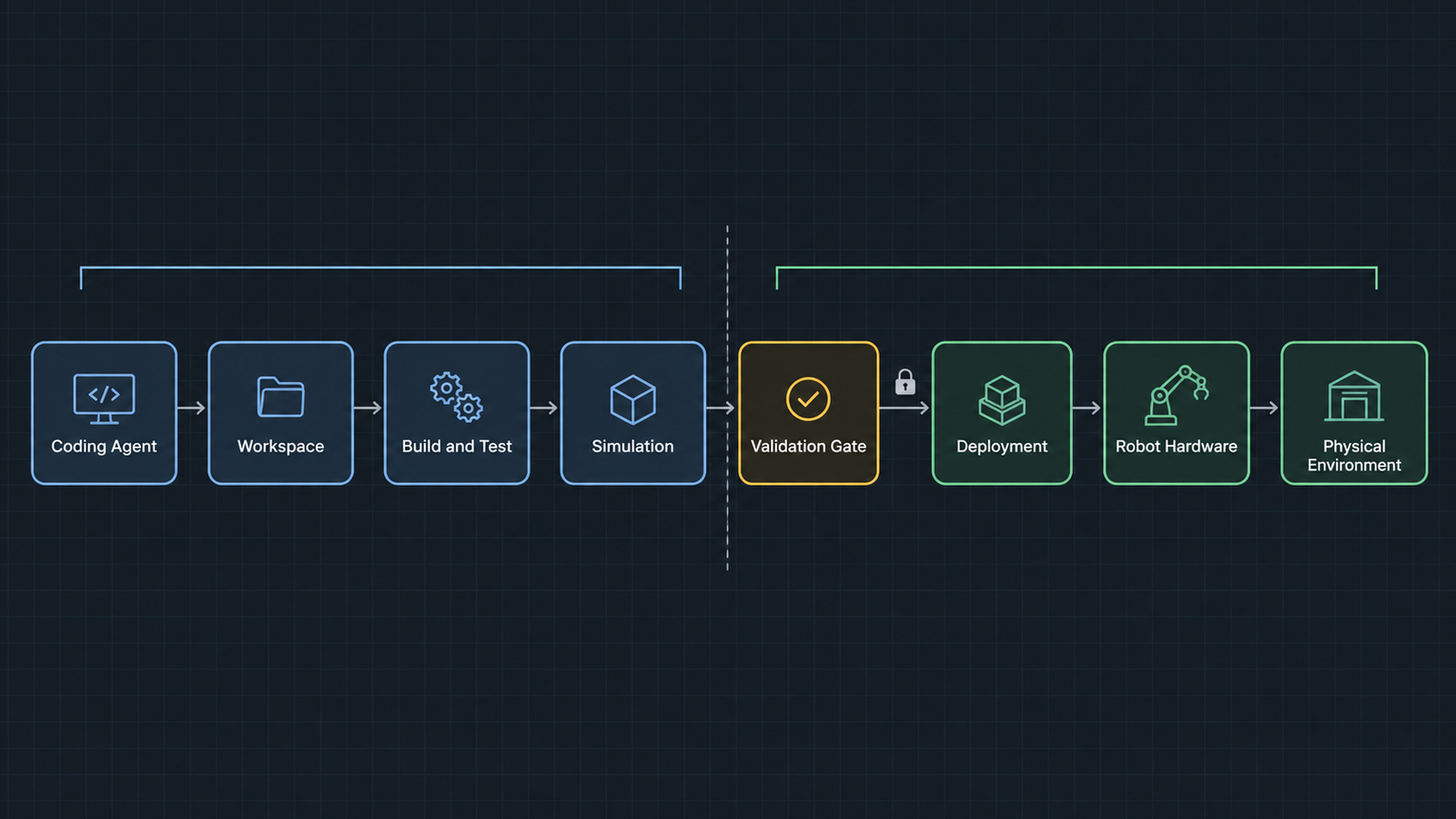
The first three are ordinary software risks with ordinary controls. The last three are not, and treating them as one continuous permission level is the mistake worth avoiding.
What Does Egress Control Look Like in a Workcell?
In conventional agentic development, sandboxing means protecting files, credentials, processes and network access. Those concepts map onto robotics, but imperfectly, and the places where the analogy breaks are the interesting ones.
| Software agent control | Robotics equivalent | Where the analogy breaks |
|---|---|---|
| Filesystem permissions | Workspace, packages, launch and config files | Config changes can alter physical behaviour without touching code |
| Credential scope | Robot, fleet and deployment credentials | A fleet credential can address many machines at once |
| Network egress | Which robots, fleet services and telemetry endpoints are reachable | ROS 2 discovery is permissive by default; a node on the same network can find peers |
| Process execution | ROS 2 nodes and launch files | A launched node publishes to a live graph, not just to stdout |
| Sandbox | Simulation or an isolated workcell | A simulator is a model, not a copy |
| Deployment approval | Physical deployment approval | Rollback restores software, not a dropped payload |
The closest robotics analogue to network egress control is the set of decisions about what the development environment can address. ROS 2 nodes on a shared network discover each other by default, which means an agent that can launch a node can potentially participate in a graph that includes real hardware unless something prevents it. Domain ID separation, network segmentation and DDS configuration are the mechanisms that do the preventing.
Cloud-connected fleets sharpen this. Mission Control dispatches missions over network services, and the VDA5050 protocol exists precisely so fleet managers can command robots from elsewhere. Once an agent can reach that interface, network reachability is the control that matters, exactly as it is for any other agent workflow — a point we worked through in our piece on testing agents against prompt injection, where reachability rather than instruction quality decided the outcomes.
The mechanisms that can be technically substantiated, without inventing capabilities:
- Separate ROS 2 domain IDs and network segments for development, simulation and production
- DDS security configuration where the deployment supports it
- Credential scoping so development credentials cannot address production fleets
- Deployment gates requiring signed, versioned artifacts rather than direct file copies
- Simulation-only execution modes for agent workflows
- Emergency stop and safety functions implemented independently of the software stack
- Rollback to a known-good artifact version
That last pair deserves emphasis. E-stop circuits and safety controllers exist below the ROS layer precisely so that no software fault, agent-introduced or otherwise, can defeat them. NVIDIA documents a safety controller concept within isaac_ros_deploy, with its own troubleshooting guide, which reflects the same layered thinking.
Simulation Is a Boundary, Not a Guarantee
Restricting an agent to simulation is the single most useful control available, and it is genuinely strong: a mistake in Isaac Sim costs compute time, not equipment.
It is also not proof of physical safety, for reasons every robotics engineer already knows and every agentic workflow will rediscover.
Simulators model contact, friction, sensor noise, latency and timing approximately. The sim-to-real gap is a permanent feature of the field, not a bug awaiting a fix. A perception model tuned in simulation encounters real lighting, real motion blur and real camera calibration error. A grasp that succeeds against a simulated object may slip on the real one.
There is a second-order problem specific to agents. An agent optimising for a simulated success metric will find whatever satisfies that metric, including artefacts of the simulation itself. That is reward hacking in a new costume, and it argues for holdout scenarios the agent has not been iterating against.
The practical sequence most teams already use stays intact:
- Simulation for broad coverage and fast iteration
- Replay against recorded sensor data, which tests perception against real inputs deterministically
- Hardware-in-the-loop, with real compute and real timing but constrained motion
- Supervised physical testing in a controlled cell
- Production deployment
An agent can usefully operate through step two. Steps three onward are where human judgement earns its place, and no part of Isaac ROS 5.0 suggests otherwise.
Failure Modes Change When Code Reaches Hardware
Software failures are usually graded by how loud they are. In robotics they should be graded by where they surface.
- Build failure. The workspace does not compile. Harmless, immediate, self-announcing. The best kind.
- Configuration failure. A launch parameter, calibration file or frame ID is wrong. This is the quiet one. A wrong camera extrinsic produces a system that runs cleanly and perceives the world offset by several centimetres. Nothing errors. Isaac ROS 5.0’s own release notes carry an instructive example: an occupancy grid localizer launch failure caused by empty frame IDs, fixed by using the named
static_transform_publisherarguments Lyrical requires. Configuration is where correct-looking code goes wrong. - Runtime software failure. A node crashes. In a well-designed system a supervisor restarts it or the robot halts. The severity depends entirely on what the node was doing and what depends on it.
- Perception failure. The system misinterprets the world — a missed obstacle, a bad pose estimate. It does not announce itself, and downstream components act on the wrong belief with full confidence.
- Planning failure. A trajectory is generated that is valid in the planner’s model and wrong in the world, typically because the model of the environment was wrong.
- Control failure. The lowest and most consequential layer, which is exactly why safety functions live below it and independent of it.
- Deployment failure. The wrong version reaches the robot, or reaches some robots in a fleet and not others. Version skew across a fleet is its own category of problem, and
change-stack-versionexisting as an agent skill is a reason to think about it now rather than later.
The ordering that matters for permissions: failures that announce themselves are cheap; failures that propagate silently into physical action are not. An agent workflow should be designed so its mistakes land in the first category.
How to Evaluate Agentic Development in an Isaac ROS 5.0 Workflow
Benchmark scores on coding tasks say little about whether an agent is safe to run in a robotics toolchain. A complete picture needs measures from three groups.
Did it work?
- Task success against a stated goal
- Code correctness, by review and by test
- Regression rate across the existing test suite
- Simulation success, on scenarios the agent has not been iterating against
- Reproducibility across repeated runs from the same starting state
How did it behave?
- Tool-call accuracy: did it invoke the right commands with the right arguments
- Permission violations: attempts to act outside its granted scope, which should be logged whether or not they succeeded
- Unsafe configuration attempts: disabled safety parameters, widened velocity limits, bypassed checks
- Escalation behaviour: does it stop and ask, or improvise, when blocked
What happens when it is wrong?
- Rollback success rate and time to restore a known-good version
- Human approval compliance: did anything reach a gated stage without approval
- Auditability: can every action be reconstructed from logs afterwards
The second and third groups are the ones benchmarks skip. An agent with a 90% task success rate that occasionally tries to widen a velocity limit to make a test pass is worse than one at 75% that stops and asks. The containment-versus-capability trade is the same one we examined in our analysis of evaluator access and security boundaries, and it resolves the same way: measure what the system does when it cannot get what it wants.
What Isaac ROS 5.0 Means for Physical AI Teams
The release lands differently depending on what you do with it.
- Robotics developers get a real migration and a tool that helps with it. Moving off the NITROS APIs is mechanical, repetitive work across many files — precisely the shape of task agents handle well, which is presumably why NVIDIA shipped
migrate-node-to-rosidl-bufferalongside the change that requires it. It is marked early access, so treat its output as a first pass to review rather than a finished migration. - AI engineers get an entry point into robotics that does not require learning the whole stack first. This cuts both ways. The skills encode NVIDIA’s intended procedure, which is better than an agent improvising. They also make it easy to operate parts of a system you do not yet understand.
- Robotics teams get a permissions question they probably have not formalised. Most teams have conventions rather than enforced boundaries around who can deploy to which robot. An agent that follows documented procedures faster than any human will surface the gap between convention and control.
- Platform engineers get the ROS 2 Lyrical and Ubuntu 24.04 move, the Buildfarm repository, and GPU partitioning via CUDA MPS — with NVIDIA’s own caveat that partitioning is not isolation.
- Safety engineers get the most important reminder in the release: nothing here changes where safety functions live. E-stop circuits, safety controllers and certified components sit below the ROS layer and remain independent of it. Isaac ROS 5.0 does not give an AI agent control of a robot. It gives an agent structured access to the toolchain that produces robot software.
Those are different claims, and the distinction is worth defending whenever the coverage blurs it.
Questions to Ask Before an Isaac ROS 5.0 Agent Touches a Robot
Ten questions. If your team cannot answer them, the answer to “should we give an agent access” is not yet.
- What can the agent read? Source, configs, calibration files, recorded data, credentials?
- What can it modify? Which repositories, packages, launch files and parameter files, and which are off limits?
- What can it execute? Build commands, dependency installation, node launches, simulation, deployment scripts?
- What can it deploy, and where? Development machines, a test robot, a fleet?
- What hardware can it reach? Directly, and indirectly through fleet services and cloud interfaces?
- What network destinations can it access? Package repositories, model registries, robot networks, telemetry endpoints?
- What happens when simulation and reality diverge? Who notices, and what stops the change from progressing?
- Where is human approval mandatory? Name the specific gates rather than the principle.
- Can every action be audited? Commands, file changes, deployments, and refused attempts.
- Can changes be rolled back? Including configuration and calibration, not just code.
There is no universal answer to where the approval boundary belongs. A mobile robot in a warehouse aisle, a manipulator behind a fence and a humanoid working near people have different consequence profiles, and the right gate depends on the robot, the environment, the autonomy level and the deployment architecture.
What Isaac ROS 5.0 changes is the urgency. The skills exist, they are documented, they install in one command, and they work with the coding assistants your team already uses. The permission model is now the part of the toolchain that needs designing.
Frequently Asked Questions
What is Isaac ROS 5.0?
Isaac ROS 5.0 is the September 2026 release of NVIDIA’s collection of CUDA-accelerated packages built on open-source ROS 2. NVIDIA tagged the 5.0.0 packages on September 21, 2026 and announced the release at ROSCon in Toronto on September 22. It moves to ROS 2 Lyrical Luth on Ubuntu 24.04, rebuilds the accelerated data path on rosidl::Buffer, and adds AI agent skills.
What are AI agent skills in Isaac ROS 5.0?
They are documented procedures in the open Agent Skills format that AI coding assistants can follow. The Isaac ROS CLI ships isaac-ros-activate for the development environment and an early-access migrate-node-to-rosidl-buffer skill. NVIDIA publishes further skills in the nvidia/skills catalog, and the Mission Control repository publishes five more covering cloud stack startup, map changes, fleet composition, service versions and mission submission.
Does Isaac ROS 5.0 let AI agents control robots?
No. It gives agents structured access to robotics development workflows — environment setup, migration, and Mission Control operations. Robot control remains the job of the autonomy stack and the real-time controller, with safety functions implemented independently of the software stack. What an agent can reach in any given deployment depends on the permissions and network access that team grants it.
What is the relationship between Isaac ROS and ROS 2?
Isaac ROS is built on open-source ROS 2 and runs inside a ROS 2 graph. It supplies GPU-accelerated nodes for perception, localisation, planning and deployment. ROS 2 supplies the middleware, message types and tooling. Isaac ROS 5.0 supports ROS 2 Lyrical Luth.
What is the difference between Isaac ROS and Isaac Sim?
Isaac ROS is a set of ROS 2 packages that run on the robot or on development hardware. Isaac Sim is a separate simulation application. Many Isaac ROS tutorials use Isaac Sim as a data source, but they are distinct products.
Keep reading
Here are the latest posts from the blog.

Accelerator Utilisation: The Number That Decides Your Bill
Isaac ROS 5.0 and the Robotics Agent Boundary Problem

Four Labs, One Evaluator: Anatomy of an AI Evaluation Sandbox Failure