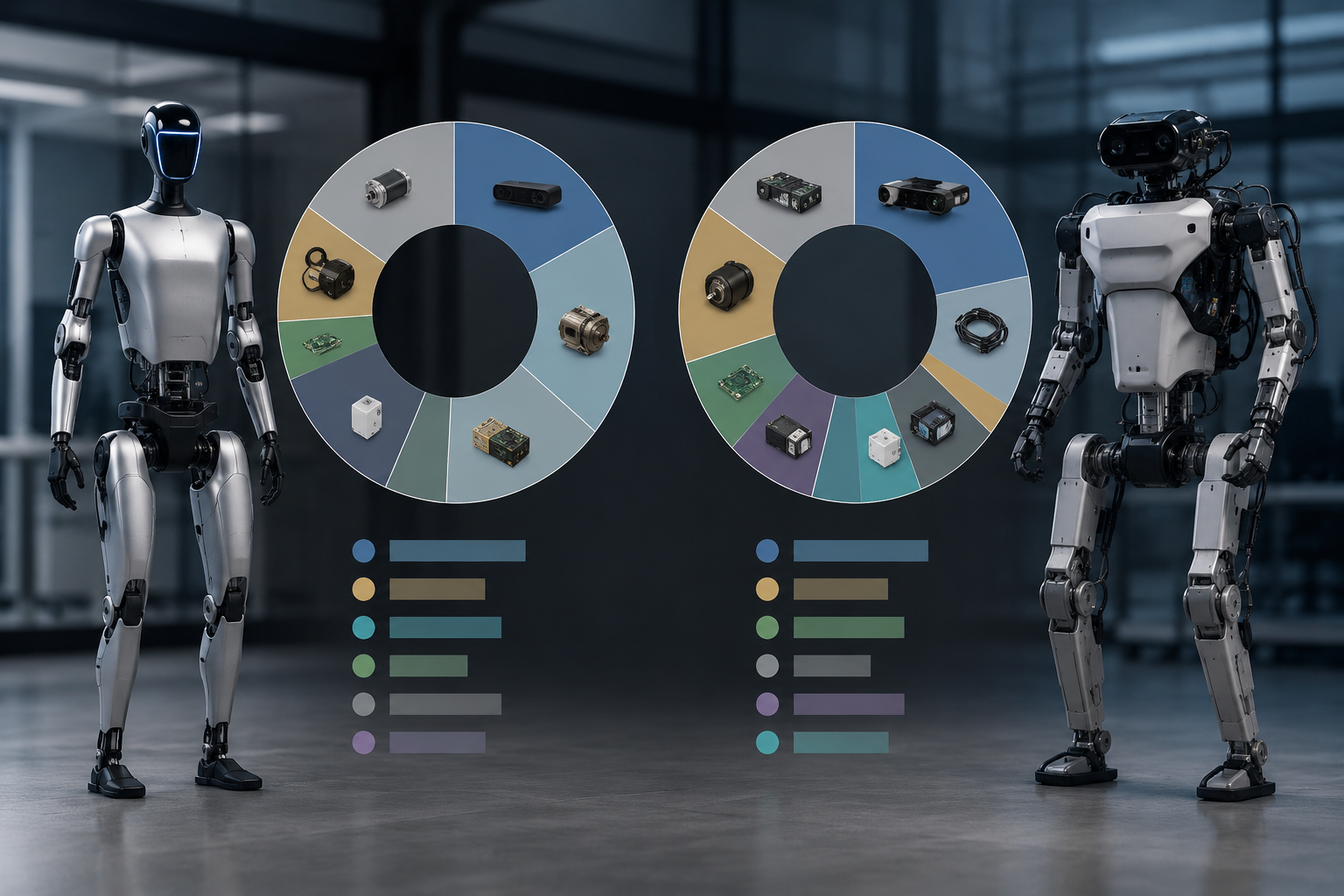
The humanoid robot cost breakdown 2026 Unitree vs Boston Dynamics conversation has exploded this year — and honestly, it’s about time. Enterprise buyers are finally asking the right question: what does a humanoid robot actually cost to own and operate? The answer isn’t simple, and anyone who tells you otherwise is selling something.
Unitree’s H1 starts around $650,000. Boston Dynamics’ Atlas program doesn’t publish consumer pricing. Meanwhile, competitors like Figure, Agility Robotics, and Tesla’s Optimus are reshaping expectations entirely. I’ve been tracking this space for years, and the pace of change right now is unlike anything I’ve seen before. This guide breaks down every cost layer — hardware, software, AI infrastructure, and long-term ownership — so you can make informed purchasing decisions before committing serious capital.
Why Humanoid Robot Pricing Matters More Than Ever in 2026
Unitree H1 vs Boston Dynamics Atlas: Hardware Cost Comparison
The AI Software Stack: The Hidden Cost Multiplier
Total Cost of Ownership: A Five-Year Enterprise Analysis
Competitive Landscape: Other Humanoids Reshaping Pricing
How to Evaluate Humanoid Robot Investments for Your Organization
Why Humanoid Robot Pricing Matters More Than Ever in 2026
The humanoid robotics market is entering its commercial phase. Consequently, pricing transparency has become a competitive weapon — and a surprisingly effective one.
Unitree shocked the industry by publishing actual price points. Boston Dynamics, conversely, keeps its pricing locked behind enterprise sales conversations. I’ve talked to procurement teams at mid-sized manufacturers who’ve spent months just trying to get a ballpark figure from Boston Dynamics. That opacity has real costs.
Why does this matter for your business? A few reasons worth taking seriously:
- Budget planning — Capital expenditure for a single humanoid unit can rival a year’s salary for multiple employees
- ROI timelines — Cheaper hardware doesn’t always mean faster payback (more on this shortly)
- Vendor lock-in — AI software subscriptions can dwarf the initial hardware cost over five years
- Scalability — Fleet pricing differs dramatically between manufacturers
Furthermore, the cost structure of humanoid robots mirrors what we’ve already seen in the AI model pricing wars. Specifically, hardware is getting commoditized while software and AI capabilities drive the real value — and the real expense. This surprised me when I first started digging into the numbers.
The global humanoid robot market is growing fast. According to Goldman Sachs Research, the market could reach $38 billion by 2035. That kind of growth is pulling in serious enterprise buyers who need a clear humanoid robot cost breakdown 2026 Unitree vs Boston Dynamics comparison before they sign anything.
Unitree H1 vs Boston Dynamics Atlas: Hardware Cost Comparison
The most tangible cost is the robot itself. The Unitree H1 and Boston Dynamics Atlas represent two fundamentally different philosophies — and their pricing reflects that gap honestly.
Unitree H1 hardware breakdown:
- Base unit price: approximately $650,000
- Weight: around 47 kg (lightweight for its class)
- Degrees of freedom: 19 joints
- Maximum walking speed: approximately 3.3 m/s
- Power source: battery-electric with swappable packs
- Manufacturing origin: Hangzhou, China
Boston Dynamics Atlas hardware profile:
- Price: not publicly listed (estimates range from $1M to $2.5M per unit for enterprise partners)
- Weight: approximately 89 kg
- Degrees of freedom: 28+ joints
- Advanced electric actuation (recently transitioned from hydraulic)
- Superior manipulation capabilities
- Manufacturing origin: Waltham, Massachusetts, USA
Here’s the thing: Boston Dynamics recently moved Atlas from hydraulic to fully electric actuation. That shift reduced maintenance costs but likely pushed the base unit price higher. Nevertheless, the electric Atlas offers meaningfully better reliability for industrial deployment — and reliability, at scale, is worth a lot.
| Cost Factor | Unitree H1 | Boston Dynamics Atlas | Notes |
|---|---|---|---|
| Base unit price | ~$650K | ~$1M–$2.5M (est.) | Atlas pricing is negotiated per contract |
| Actuators | Proprietary electric | Electric (new gen) | Atlas previously used hydraulics |
| Sensors suite | LiDAR + depth cameras | Advanced sensor fusion | Atlas has more sensor redundancy |
| Battery system | Swappable Li-ion | Integrated Li-ion | Unitree’s swap system reduces downtime |
| Manipulation | Basic grippers | Advanced dexterous hands | Atlas leads significantly here |
| Warranty | 1 year standard | Custom SLA | Boston Dynamics offers enterprise SLAs |
| Country of origin | China | USA | Affects tariffs and procurement rules |
This table reveals something important. The humanoid robot cost breakdown 2026 Unitree vs Boston Dynamics isn’t just about sticker price. Notably, Atlas offers substantially more capability per unit — particularly in manipulation, which is where most industrial tasks get complicated. However, Unitree delivers a functional humanoid at roughly one-third the cost. That’s not a small gap.
Unitree Robotics has built its entire reputation on aggressive pricing. Their Go2 quadruped disrupted that market the same way, and they’re running the same playbook here. So far, it’s working.
The AI Software Stack: The Hidden Cost Multiplier
Hardware is only half the story. The real kicker — the cost that catches most buyers off guard — is the AI software stack. Therefore, any serious humanoid robot cost breakdown 2026 Unitree vs Boston Dynamics analysis has to account for software costs, not just the unit price.
AI model costs for robot deployment include:
- Foundation models — Large language models (LLMs) and vision-language models (VLMs) that help robots understand tasks
- Motion planning software — Algorithms that translate commands into actual physical movements
- Perception systems — Real-time object detection, mapping, and scene understanding
- Simulation environments — Digital twins for training and testing before physical deployment
- Cloud compute for training — GPU clusters needed to fine-tune models for specific tasks
Boston Dynamics bundles its Orbit fleet management platform with enterprise contracts. This software handles scheduling, data collection, and remote operation — a significant value-add that Unitree doesn’t yet match. I’ve seen Orbit demos, and it’s genuinely polished. Fair warning: that polish is priced accordingly.
Meanwhile, Unitree relies more heavily on open-source AI frameworks. This reduces licensing costs, which sounds great on paper. However, it shifts the integration burden entirely onto the buyer — meaning you’ll need in-house robotics engineers or a systems integrator. Budget for that expertise, because it’s not cheap.
Estimated annual AI software costs:
- Unitree H1 deployment: $50K–$150K/year (third-party AI services, cloud compute, custom development)
- Boston Dynamics Atlas deployment: $100K–$300K/year (bundled software, Orbit platform, enterprise support)
Importantly, these costs scale with fleet size — but not in a straight line. A single robot might run $100K annually in software overhead. A fleet of ten, however, might cost only $400K total due to shared infrastructure. Consequently, fleet economics heavily favor larger deployments. That’s a no-brainer once you see the math.
The broader AI model pricing picture matters here too. As companies like OpenAI and Google drive down inference costs, the software layer for robotics gets cheaper over time. Similarly, open-source models from Meta and Mistral are creating real alternatives to expensive proprietary systems — and robotics teams are paying attention.
Total Cost of Ownership: A Five-Year Enterprise Analysis
Smart buyers don’t compare sticker prices. They compare total cost of ownership (TCO). This is where the humanoid robot cost breakdown 2026 Unitree vs Boston Dynamics gets genuinely interesting — and where a lot of enterprise decisions go sideways.
Five-year TCO model for a single unit:
| Cost Category | Unitree H1 (5-Year) | Boston Dynamics Atlas (5-Year) |
|---|---|---|
| Hardware purchase | $650,000 | $1,500,000 (est. mid-range) |
| AI software & licensing | $500,000 | $1,000,000 |
| Maintenance & repairs | $200,000 | $350,000 |
| Training & integration | $150,000 | $250,000 |
| Insurance | $75,000 | $150,000 |
| Energy costs | $25,000 | $40,000 |
| Downtime costs | $100,000 | $50,000 |
| Total 5-Year TCO | $1,700,000 | $3,340,000 |
A few things stand out immediately. Although Unitree wins on raw cost, Boston Dynamics potentially delivers lower downtime costs — Atlas has more mature reliability engineering behind it, and unplanned downtime in a production environment is brutally expensive. Additionally, Boston Dynamics’ enterprise support infrastructure genuinely reduces the risk of extended outages.
Nevertheless, the Unitree H1’s value is hard to dismiss. At roughly half the five-year TCO, it’s accessible to mid-market manufacturers and logistics companies that can’t write a $3M check. Boston Dynamics Atlas, conversely, targets large enterprises that can absorb premium pricing in exchange for premium capability.
ROI considerations for enterprise buyers:
- Warehouse automation — A humanoid replacing three shifts of manual labor could save $150K–$200K annually in labor costs
- Hazardous environment inspection — Avoiding a single serious workplace injury could justify the entire robot investment
- Quality control — Consistent, tireless inspection reduces defect rates and downstream warranty claims
- Scalability testing — Starting with one unit before committing to a fleet meaningfully reduces risk
Furthermore, tariffs affect the humanoid robot cost breakdown 2026 Unitree vs Boston Dynamics equation in a big way. US-based buyers may face import duties on Chinese-manufactured robots, potentially adding 10–25% to the Unitree H1’s landed cost. The International Trade Administration publishes current tariff schedules for robotics equipment — worth checking before you build your budget model.
Competitive Landscape: Other Humanoids Reshaping Pricing
Unitree and Boston Dynamics don’t exist in a vacuum. The broader competitive field is actively pushing prices around, and understanding it strengthens any humanoid robot cost breakdown 2026 Unitree vs Boston Dynamics analysis considerably.
Key competitors to watch:
- Tesla Optimus — Elon Musk has floated a target price of $20,000–$30,000. However, commercial availability remains genuinely unclear. If Tesla actually hits that price point, it would fundamentally blow up the market.
- Figure AI (Figure 02) — Backed by major investors including Microsoft and OpenAI, targeting manufacturing and logistics. Pricing hasn’t been confirmed publicly, but estimates suggest a $50K–$100K range eventually.
- Agility Robotics (Digit) — Already deployed at Amazon facilities and priced for commercial viability. Agility Robotics focuses specifically on warehouse applications, which is smart positioning.
- 1X Technologies (NEO) — Norwegian company targeting home and commercial use, aiming for consumer-accessible pricing within a few years.
- Sanctuary AI (Phoenix) — Canadian company with a focus on general-purpose AI and human-like dexterity.
Notably, the pricing gap between Unitree and these newer entrants is significant. Unitree’s $650K looks expensive compared to Tesla’s aspirational numbers — but it’s available now. And that matters enormously for buyers who need robots in 2026, not 2027.
Moreover, competitive pressure is forcing all manufacturers toward transparency. Boston Dynamics’ historically opaque pricing model faces increasing scrutiny from competitors who simply publish their numbers. That’s a meaningful shift in how this market operates.
How to Evaluate Humanoid Robot Investments for Your Organization
Understanding the humanoid robot cost breakdown 2026 Unitree vs Boston Dynamics is step one. Applying it to your specific situation is where most organizations stumble. Here’s a practical framework — the same one I’d walk through with any buyer.
Step 1: Define your use case precisely. Not all humanoids suit all tasks. Boston Dynamics Atlas excels at complex manipulation, while Unitree H1 performs well for locomotion-heavy tasks. Match the robot to the job, not the other way around.
Step 2: Calculate your true labor cost baseline. Include wages, benefits, workers’ compensation insurance, training, turnover, and overtime. Most companies underestimate their fully loaded labor costs by 30–40%. I’ve seen that gap kill otherwise solid ROI projections.
Step 3: Model your deployment timeline realistically. Humanoid robots require real integration time — budget 3–6 months for initial deployment. Additionally, plan for a ramp-up period where the robot works alongside human workers before running independently.
Step 4: Assess your AI infrastructure readiness. Do you have cloud compute contracts, in-house ML engineers, and existing data pipelines? These factors dramatically affect the software portion of your TCO. Specifically, buyers who lack this infrastructure often see costs balloon fast.
Step 5: Consider fleet economics. A single robot rarely justifies the integration overhead. Plan for at least 3–5 units to achieve meaningful ROI. Shared software infrastructure and maintenance contracts become genuinely cost-effective at this scale.
Step 6: Check vendor stability. Boston Dynamics has Hyundai’s backing. Unitree is well-funded but younger, and vendor longevity directly affects parts availability, software updates, and long-term support. That’s a real risk worth pricing in.
Red flags to watch for:
- Vendors who won’t provide reference customers
- Pricing that conveniently excludes software licensing
- No clear maintenance or parts supply chain
- Unrealistic ROI projections (anything under 18 months deserves serious scrutiny)
- Lack of safety certification documentation
Importantly, safety standards are evolving fast — and compliance isn’t optional. The International Organization for Standardization (ISO) has published ISO 13482 for personal care robots. Industrial humanoid deployments should also reference ISO 10218 for industrial robot safety. Compliance adds cost upfront but cuts liability over the long run. Worth it.
Conclusion
Bottom line: the humanoid robot cost breakdown 2026 Unitree vs Boston Dynamics reveals a market at a genuine turning point. Unitree offers accessible pricing around $650K with solid, real-world capabilities. Boston Dynamics delivers superior technology at a premium that can exceed $2M per unit. Neither is universally better — the right choice depends entirely on your use case, budget, and how much risk you’re willing to carry.
Here are your actionable next steps:
- Request formal quotes from both Unitree and Boston Dynamics for your specific application
- Build a five-year TCO model using the framework above, customized to your actual labor costs and deployment scale
- Pilot before committing — negotiate single-unit trial periods before signing any fleet contracts
- Monitor the competitive field — Tesla Optimus and Figure AI could meaningfully shift pricing within 12–18 months
- Invest in your AI infrastructure now — regardless of which hardware you choose, the software stack will ultimately determine your ROI
The humanoid robotics market won’t wait. Consequently, organizations that do this evaluation seriously — and do it now — will have a real competitive advantage over those who wait for the “perfect” moment. Use this humanoid robot cost breakdown 2026 Unitree vs Boston Dynamics analysis as your starting point, pressure-test the numbers against your own operations, and build from there.
FAQ
How much does the Unitree H1 humanoid robot cost in 2026?
The Unitree H1 is priced at approximately $650,000 for the base unit. However, total deployment costs — including AI software, integration, and training — can push the first-year investment to $800,000–$1,000,000. Specifically, software licensing and custom development represent the largest additional expenses beyond the hardware itself.
What is the price of a Boston Dynamics Atlas robot?
Boston Dynamics doesn’t publicly list Atlas pricing. Industry estimates place it between $1 million and $2.5 million per unit, depending on configuration and enterprise contract terms. Additionally, annual software and support fees can add $100,000–$300,000 per year. You’ll need to contact Boston Dynamics directly for a formal quote.
Which is cheaper overall — Unitree H1 or Boston Dynamics Atlas?
Based on the five-year TCO analysis above, the Unitree H1 costs roughly half what a Boston Dynamics Atlas deployment requires. The H1’s estimated five-year TCO lands around $1.7 million, compared to $3.34 million for Atlas. Nevertheless, Atlas offers superior manipulation capabilities and lower estimated downtime costs, which may justify the premium for certain applications.
Can a humanoid robot replace human workers and deliver positive ROI?
It depends heavily on the application. Warehouse and logistics tasks offer the strongest ROI potential, with payback periods of 2–4 years for multi-unit deployments. Hazardous environment applications can deliver ROI even faster by preventing costly workplace injuries. Importantly, most successful deployments work alongside human workers rather than replacing them outright.
How do AI software costs affect the total cost of owning a humanoid robot?
AI software costs can represent 30–40% of the total five-year cost of ownership. These costs include foundation model licensing, cloud compute for inference and training, fleet management software, and ongoing model fine-tuning. Moreover, as AI models become more capable, software costs may actually increase even as hardware prices decline. Budget accordingly — this is the line item that surprises people most.
What other humanoid robots compete with Unitree and Boston Dynamics in 2026?
Several serious competitors are emerging. Tesla Optimus targets an eventual price of $20,000–$30,000 but isn’t commercially available yet. Figure AI’s Figure 02 is backed by major tech investors and targets manufacturing. Agility Robotics’ Digit is already deployed in Amazon warehouses. Additionally, 1X Technologies and Sanctuary AI are developing humanoids for various commercial applications. The competitive field is moving fast — which should ultimately benefit buyers through lower prices and better capabilities across the board.
References
Keep reading
Here are the latest posts from the blog.
Autonomous vehicle AI safety standards regulations 2024 are moving faster than most people realize — and I mean that literally, not as a throwaway opener. Self-driving cars a…
The open vs closed models mid 2026 state looks radically different from even twelve months ago. Performance gaps have nearly vanished. Pricing wars have broken out across the…

Every time you ask ChatGPT a question, water evaporates somewhere. That’s not hyperbole — it’s physics. AI water consumption data centers environmental impact has quietly bec…