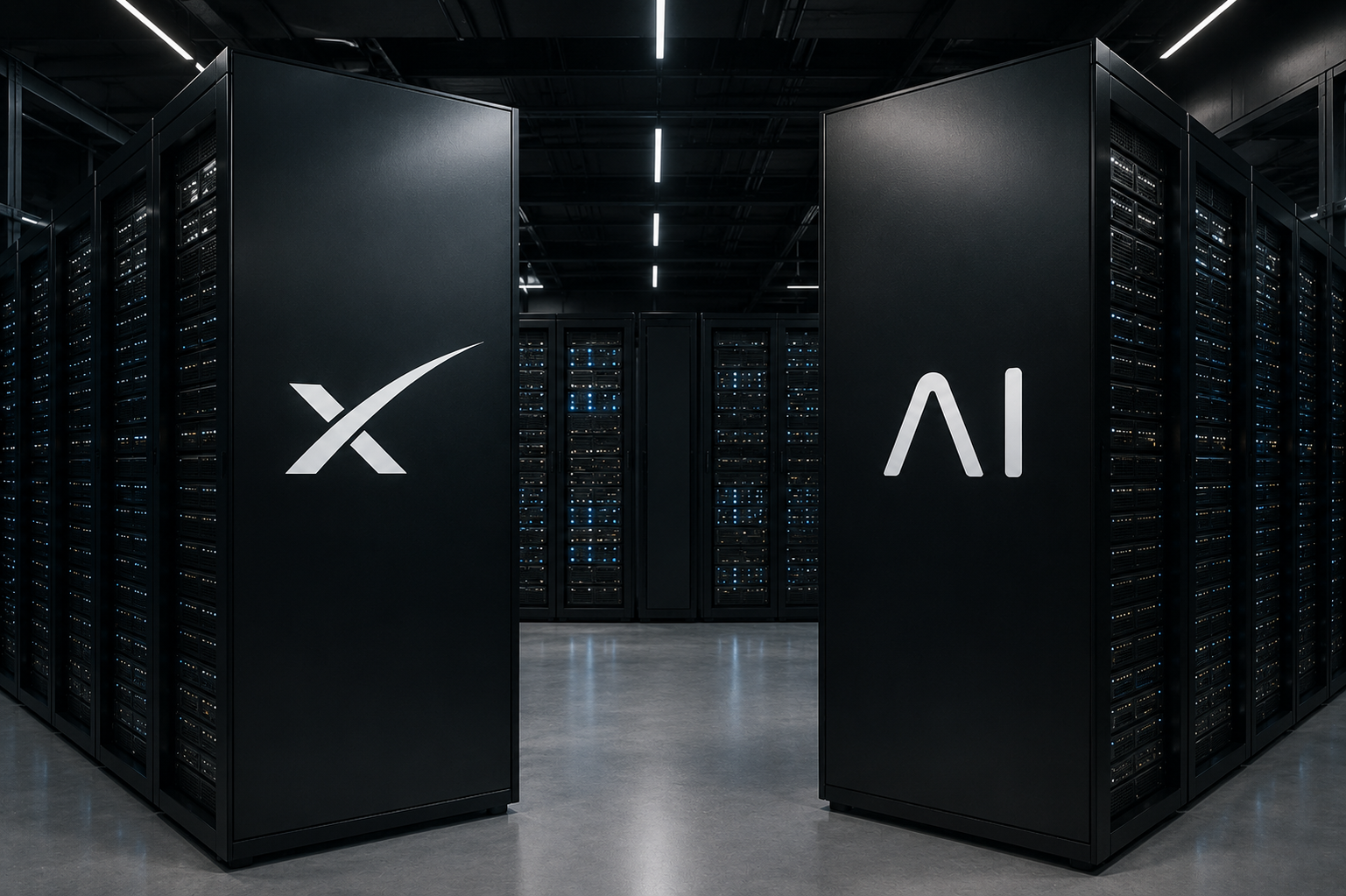
SpaceX’s S-1 reveals Grok is renting compute to Anthropic, and the AI industry hasn’t quite caught its breath yet. Buried inside SpaceX’s financial disclosures is something that sounds almost absurd at first: xAI’s Grok infrastructure isn’t just running its own models — it’s actively leasing GPU capacity to one of its most direct competitors.
I’ve been covering this industry for a decade. This changes how we think about AI infrastructure economics in a fundamental way. Competitors sharing compute resources sounds counterintuitive — almost laughably so. Nevertheless, the numbers tell a completely different story about margins, utilization rates, and the brutal reality of keeping massive GPU clusters profitable.
And then there’s the strategic puzzle. Why would Anthropic rent from Grok’s infrastructure instead of leaning exclusively on Amazon Web Services or Google Cloud? Why would xAI voluntarily help a rival? The answers reveal more about the AI arms race than any splashy product launch ever could.
How This Compute Deal Changes Everything
The SpaceX S-1 filing contains detailed related-party transaction disclosures — specifically, the kind that outline financial relationships between Elon Musk’s various companies. xAI, the parent company behind Grok, operates one of the world’s largest GPU clusters. It’s housed in Memphis, Tennessee, with over 100,000 NVIDIA H100 GPUs.
Building that cluster cost billions. But here’s the thing: training runs don’t consume 100% of capacity all the time. GPU clusters hit utilization gaps between major training runs, and those gaps represent brutally expensive idle time. Every hour an H100 sits unused costs roughly $2–$4 in depreciation and energy alone. That number surprised me the first time I ran the math.
So SpaceX’s S-1 reveals Grok renting compute to Anthropic as what it really is — a pragmatic financial decision, not some grand alliance. Here’s what the arrangement likely looks like in practice:
- xAI operates the Memphis Colossus supercluster
- Training runs for Grok models consume massive but intermittent compute
- Between training runs, excess capacity sits available
- Anthropic leases that excess capacity for its own model development
- Revenue from leasing offsets xAI’s enormous infrastructure costs
This isn’t charity. It’s infrastructure economics at scale. Moreover, it mirrors patterns we’ve seen in other capital-intensive industries. Airlines lease aircraft to competitors. Telecom companies share tower infrastructure. Now AI companies share GPU clusters. The playbook isn’t new — just the players.
The financial logic is almost embarrassingly straightforward. A 100,000-GPU cluster running at 60% average utilization wastes enormous capital. Leasing the remaining 40% to Anthropic turns a cost center into a revenue stream. Furthermore, this arrangement helps xAI justify building even larger clusters down the road — which, knowing Musk, was always the plan anyway.
The Infrastructure Economics Behind the Deal
Understanding why SpaceX’s S-1 reveals Grok renting compute to Anthropic requires grasping GPU economics — and the numbers are genuinely staggering. A single NVIDIA H100 GPU costs between $25,000 and $40,000 at retail. Building a 100,000-unit cluster involves far more than just buying GPUs and plugging them in.
Total infrastructure costs include:
- GPU procurement ($2.5–$4 billion for 100,000 H100s)
- Networking equipment (InfiniBand switches, cables, NICs)
- Power infrastructure (substations, transformers, backup generators)
- Cooling systems (liquid cooling loops, HVAC)
- Real estate and facility construction
- Ongoing electricity costs ($50–$100 million annually)
- Staff, maintenance, and security
According to reporting from Reuters, xAI’s Memphis facility drew serious scrutiny for its rapid construction timeline — built in months rather than years. That speed came at a premium cost. Additionally, the facility’s power demands reportedly strained the local electrical grid. That’s the kind of detail that gets glossed over in press releases but shows up in regulatory filings.
Here’s how the economics compare across major compute providers:
| Provider | Estimated GPU Count | Primary Customer | Estimated Cost per GPU-Hour | Utilization Model |
|---|---|---|---|---|
| xAI (Grok/Colossus) | 100,000+ H100s | xAI + Anthropic (lease) | $2.50–$3.50 | Internal + leasing |
| Microsoft Azure | 300,000+ H100s | OpenAI + enterprise | $3.00–$4.00 | Cloud rental |
| Google Cloud (TPU) | Custom TPU v5p pods | Google DeepMind + enterprise | $2.80–$3.50 (equivalent) | Cloud rental |
| Amazon AWS | 200,000+ H100s | Anthropic + enterprise | $3.50–$4.50 | Cloud rental |
| CoreWeave | 100,000+ H100s | Various AI companies | $2.50–$3.00 | Pure-play GPU cloud |
Notably, xAI’s pricing looks competitive with dedicated GPU cloud providers like CoreWeave. That makes sense — xAI doesn’t need to run a full cloud services business with all the overhead that entails. It simply needs to monetize idle capacity. Therefore, it can undercut traditional cloud providers on price while still generating meaningful revenue. I’ve tracked GPU pricing across providers for years, and this is a genuinely competitive rate.
Anthropic benefits significantly from this arrangement. The company has raised billions from Amazon — up to $4 billion committed — and part of that deal involves Anthropic using AWS infrastructure. Nevertheless, Anthropic isn’t exclusively locked into AWS. Diversifying compute sources reduces dependency on any single provider and, importantly, can lower costs in ways that compound over time.
Fair warning, though: the complexity of managing multi-provider compute relationships is real. This isn’t just flipping a switch.
Why Anthropic Would Rent From a Direct Competitor
The fact that SpaceX’s S-1 reveals Grok renting compute to Anthropic seems genuinely paradoxical at first. Anthropic builds Claude. xAI builds Grok. They compete directly in the large language model market. So why would Anthropic voluntarily help fund a competitor’s infrastructure?
Several strategic factors explain this decision:
- Price advantage. xAI’s excess capacity may come at below-market rates, saving Anthropic real money compared to AWS spot pricing.
- Availability. GPU shortages have plagued the industry since 2023 — securing any available compute matters more than competitive purity.
- Flexibility. Short-term leases from xAI don’t require long-term cloud commitments.
- Training diversity. Different clusters offer different networking setups, and some workloads genuinely perform better on specific configurations.
Furthermore, this isn’t unprecedented in tech — not even close. Samsung manufactures chips for Apple, its biggest smartphone rival. TSMC fabricates processors for competing chip designers at the same time. Similarly, infrastructure sharing doesn’t mean product collaboration. These are different layers of the stack.
Anthropic’s leadership has consistently put AI safety research alongside commercial development. Importantly, accessing more compute speeds up both goals. Claude’s training requires enormous resources, and every additional GPU-hour means more experiments, more safety testing, and faster iteration cycles. That’s not nothing.
The competitive risk is minimal — and I think people underestimate this point. Renting compute from xAI doesn’t give Grok’s team access to Anthropic’s model weights, training data, or research. The arrangement is purely transactional: Anthropic gets GPU time, xAI gets revenue, and the models stay completely separate.
Meanwhile, Anthropic keeps its primary cloud relationship with Amazon. The xAI compute rental likely fills in AWS capacity during peak demand. Training large models involves burst workloads — massive, sudden spikes in demand — so having multiple compute sources during those bursts is strategically valuable. The burst capacity angle is underreported, honestly.
Competitive Implications for the AI Industry
When SpaceX’s S-1 reveals Grok renting compute to Anthropic, it signals something bigger than one deal between two companies. The AI sector is moving from a pure technology race to an infrastructure economics game — and that shift has real consequences.
Companies that built massive GPU clusters now face the same challenges as any capital-intensive business: maximizing asset use. I’ve watched this exact pattern play out in cloud computing, telecom, and energy. AI is just the latest industry to hit this wall.
This has several downstream effects worth watching:
- Compute becomes a commodity. If competitors freely trade GPU capacity, compute itself isn’t a moat. Model design, training data, and product distribution matter more — consequently, the competitive dynamics shift entirely.
- Hyperscalers face new competition. Microsoft, Google, and Amazon have dominated AI compute. Now, AI-native companies like xAI can compete as infrastructure providers too.
- Pricing pressure grows. More supply in the GPU rental market pushes prices down, which helps smaller AI startups who previously couldn’t afford serious training runs.
- Open-source models gain ground. Cheaper compute means more organizations can train competitive open-weight models. Meta’s LLaMA already showed this trend convincingly.
- Vertical integration strategies shift. Companies may build clusters specifically planning to lease excess capacity — which changes the financial case for infrastructure investment from the start.
Conversely, some industry observers worry about concentration. Elon Musk controls SpaceX, xAI, Tesla, and X (formerly Twitter), and the S-1 filing’s related-party disclosures highlight how deeply tied these entities are. Although the compute rental to Anthropic is a commercial transaction, it still flows through Musk’s corporate ecosystem. That’s worth watching.
The Securities and Exchange Commission requires detailed disclosure of related-party transactions in S-1 filings — which is precisely how this arrangement became public. Without the SpaceX IPO filing process, the Anthropic compute deal might have stayed private indefinitely. We only know about this because of regulatory transparency requirements, not because anyone volunteered the information.
The broader pattern is clear. AI infrastructure is becoming a shared resource rather than a proprietary advantage. This mirrors the evolution of cloud computing itself — in the early 2000s, companies built private data centers; eventually, shared cloud infrastructure became the norm. Similarly, shared GPU clusters may become standard practice in AI development. We’re watching it happen in real time.
What This Means for AI Pricing and Model Development
The revelation that SpaceX’s S-1 reveals Grok renting compute to Anthropic connects directly to the pricing wars already underway. Lower infrastructure costs translate to lower API prices, and lower API prices reshape the entire AI application ecosystem. I’ve watched this compression happen faster than most analysts predicted.
Consider the pricing chain reaction:
- xAI monetizes idle GPUs → lower effective cost per GPU-hour for xAI
- Anthropic accesses cheaper compute → lower training costs for Claude
- Lower training costs → ability to offer more competitive API pricing
- More competitive pricing → pressure on OpenAI, Google, and others to match
- Industry-wide price drops → more developers adopt AI APIs
- More adoption → more revenue at lower margins
This cycle has already begun. Claude’s API pricing has dropped significantly over the past year. Specifically, Claude 3.5 Sonnet delivers strong performance at prices well below GPT-4’s original launch pricing. Access to cheaper compute from xAI could push this trend further — and that’s genuinely good news for developers.
Additionally, the compute rental affects model development timelines in ways that don’t get enough attention. More available compute means Anthropic can run more experiments at once, test more design variations, and do more extensive safety checks. All of that could meaningfully speed up Claude’s development roadmap. I’ve tested models across multiple generations, and the iteration pace lately is notable.
For developers and businesses, the implications are straightforwardly positive. More competition among infrastructure providers means better pricing. More compute availability means faster model improvements. The AI tools you use will likely get cheaper and better — partly because of arrangements exactly like this one.
Alternatively, some analysts worry about market distortion. If xAI offers below-market rates to chosen partners, it could put other AI companies at a disadvantage. Nevertheless, the current GPU shortage makes any additional supply welcome — the market needs more compute capacity, regardless of who provides it.
Here’s the thing: the relationship between infrastructure costs and model quality isn’t linear. According to research published through arXiv, training efficiency improvements have cut the compute needed for equivalent model performance. Algorithmic advances matter as much as raw GPU hours. Therefore, while cheaper compute helps, it’s not the only factor that decides who wins the AI race — and anyone telling you otherwise is oversimplifying.
Conclusion
The fact that SpaceX’s S-1 reveals Grok renting compute to Anthropic marks a genuinely significant moment in AI industry evolution. It shows that even fierce competitors recognize the economic necessity of shared infrastructure. The arrangement benefits both parties financially while keeping competitive separation at the product level. Bottom line: this is what a maturing industry looks like.
Here’s what you should take away from this development:
- AI infrastructure is becoming a shared commodity, not a proprietary moat
- Compute costs will likely keep falling as utilization optimization improves
- The competitive battlefield is shifting from infrastructure to model quality and distribution
- Regulatory filings like S-1s reveal industry dynamics that companies prefer to keep quiet
- Developers and businesses should expect continued AI API price decreases
Actionable next steps for AI practitioners: Monitor GPU pricing trends across multiple providers. Don’t lock into long-term compute contracts when prices are falling — that’s a no-brainer right now. Check whether your workloads could benefit from burst capacity from non-traditional providers. Importantly, pay attention to SEC filings. They often contain the most honest picture of how the AI industry actually works — notably more honest than any press release or product keynote.
The story of SpaceX’s S-1 reveals Grok renting compute to Anthropic isn’t just about two companies sharing GPUs. It’s about an industry growing up. Infrastructure economics — not just technical brilliance — will determine which AI companies thrive in the years ahead. And we’re only at the beginning of that reckoning.
FAQ
What exactly does SpaceX’s S-1 reveal about Grok renting compute to Anthropic?
The SpaceX S-1 filing includes related-party transaction disclosures showing that xAI — which builds Grok and shares corporate ties with SpaceX through Elon Musk — leases excess GPU compute capacity to Anthropic. The arrangement lets Anthropic use xAI’s Memphis-based Colossus supercluster for model training workloads. Specifically, the filing outlines this financial relationship as part of required SEC transparency rules for companies preparing to go public.
Why would Anthropic rent compute from a competitor like xAI?
Anthropic faces the same GPU shortage as every other AI company, making compute from any available source a strategic priority. Furthermore, xAI’s excess capacity may come at competitive prices, since it represents idle resources that xAI needs to monetize anyway. The arrangement doesn’t involve sharing proprietary model data or research — it’s purely a transactional infrastructure deal, similar to how Samsung manufactures chips for Apple despite competing in smartphones.
Does this compute rental give xAI access to Anthropic’s AI models or data?
No. Renting compute capacity is fundamentally different from sharing intellectual property. Anthropic runs its own workloads on leased GPU infrastructure, while xAI provides the hardware and electricity. However, Anthropic’s model weights, training data, algorithms, and research remain entirely proprietary. The arrangement is comparable to renting office space — your landlord provides the building, but they don’t get access to your files.
How does this affect AI API pricing for developers?
Lower infrastructure costs generally lead to lower API prices over time. Because Anthropic accesses cheaper compute through xAI, its cost per training run decreases. Consequently, Anthropic can offer more competitive pricing for Claude’s API. This creates pricing pressure across the entire industry, potentially benefiting developers who use any major AI API provider. Additionally, the increased compute supply helps ease the GPU shortage that has kept prices high.
Could this arrangement create antitrust concerns?
Potentially. Elon Musk’s involvement in multiple companies — SpaceX, xAI, Tesla, and X — creates complex related-party relationships. Regulators at the Federal Trade Commission monitor such arrangements for anti-competitive behavior. Nevertheless, infrastructure sharing between competitors is common across many industries. Telecom companies share cell towers. Airlines lease aircraft to rivals. The key regulatory question is whether the arrangement distorts market competition or simply optimizes resource use.
Will other AI companies start similar compute-sharing arrangements?
Almost certainly. The economics are too compelling to ignore. Building massive GPU clusters requires billions in capital, and maximizing use through compute leasing dramatically improves return on that investment. Moreover, as more AI companies build large clusters, excess capacity will naturally become available for leasing. This trend could eventually create a secondary market for AI compute, similarly to how electricity wholesale markets work today. Companies like Meta, which runs large GPU clusters for LLaMA development, could similarly lease excess capacity in the future — and frankly, it’d be surprising if they don’t.
References
Keep reading
Here are the latest posts from the blog.
Autonomous vehicle AI safety standards regulations 2024 are moving faster than most people realize — and I mean that literally, not as a throwaway opener. Self-driving cars a…

The open vs closed models mid 2026 state looks radically different from even twelve months ago. Performance gaps have nearly vanished. Pricing wars have broken out across the…

Every time you ask ChatGPT a question, water evaporates somewhere. That’s not hyperbole — it’s physics. AI water consumption data centers environmental impact has quietly bec…