
When Fable 5 went dark for 19 days, a lot of people in this industry had the same uncomfortable realization at roughly the same time. It wasn’t really about the outage itself — export restrictions come and go, and this one lifted almost as fast as it started. What stuck was the moment right after access came back, when teams sat down to figure out whether they’d made good decisions while Fable 5 was unavailable. Most of them couldn’t tell.
That’s the part worth sitting with. Standard benchmarks — the leaderboard numbers everyone quotes — turned out to be almost useless for the one question that actually mattered during those three weeks: does this model work for my specific job, right now, under real conditions?
This piece is about what that gap looked like in practice, and it’s about a methodology — one I’ve now run with several teams — for building benchmarks that don’t have that blind spot. If you work in biology, robotics, or anywhere agentic systems touch supply chains, there’s something here you can use this week, not eventually.
Why the Fable 5 Outage Forced a Benchmark Reckoning
Let’s be precise about what actually happened. Anthropic paused access to Fable 5 and its sibling model, Mythos 5, in order to comply with U.S. Department of Commerce export controls. The restriction held for 19 days before it was lifted and access was restored. On paper, that’s a policy story. In practice, for anyone whose production stack leaned on Fable 5, it was an unplanned stress test — and most teams didn’t pass it.
When engineers suddenly lost their default model, the first instinct everywhere was the same: find a replacement, fast. That’s when things got uncomfortable. Teams discovered, often in real time and in front of stakeholders, that they had no reliable way to compare alternatives. Their evaluation process was generic, mostly vibes, and completely disconnected from what their systems actually did in production.
Public benchmarks like MMLU or HumanEval are fine for what they measure — broad capability, general reasoning. But none of that tells a robotics engineer whether a candidate model can hold up under real-time sensor fusion, or tells a compliance team whether an alternative will hallucinate on a regulated task. I’ve sat in on these debates. Teams spend weeks arguing over leaderboard scores, pick a “winning” model, and then watch it fall apart the moment it hits their actual workload.
Here’s what the outage exposed, bluntly:
- Model selection was running on vibes (“this one just feels better”) more than data
- Public leaderboards had almost no predictive power for domain-specific work
- Nobody had a standard way to test a candidate model against real production tasks
- Switching costs were invisible right up until switching stopped being optional
The organizations that already had custom benchmarks in place adapted inside of 48 hours. The ones that didn’t spent weeks in a holding pattern, running informal bake-offs and hoping something stuck. The lesson underneath all of it: domain-specific evaluation isn’t a nice-to-have anymore, it’s table stakes.
There’s a bigger point buried in here too. A lot of teams had, without quite meaning to, built their entire stack around one model family. When Fable 5 came back online, the sharper teams didn’t just breathe out and move on. They treated the gap as free evidence that their evaluation approach needed to change, and they built resilience into it directly. That’s arguably the most useful thing to come out of the whole episode — a forcing function for work that should have happened already.
Building Domain-Specific Benchmarks, Step by Step
Knowing the problem is easy. The Fable 5 gap made it obvious that generic benchmarks weren’t cutting it — so what actually replaces them? I’ve worked through this build with a handful of teams now, in different domains, and the process holds up reasonably well across all of them.
Step 1 — Map your critical task taxonomy. Write down every task the model actually handles in production. Be thorough about it; the edge cases are usually where the real risk lives. A supply chain team, for instance, might list demand-forecast interpretation, exception handling, and vendor communication drafting as three separate categories, each with its own failure modes.
Step 2 — Pull real examples, not synthetic ones. Go to your production logs. Stanford HAI’s research has found that synthetic test cases tend to overstate model performance by somewhere in the range of 15–30% relative to real-world tasks. That’s not a small margin of error if you’re using the results to make a deployment call.
Step 3 — Set a human baseline. Have your actual domain experts do the same tasks the model will do. Time them, score their accuracy, note how they reasoned through ambiguous cases. Without this, you’re just comparing models to each other in a vacuum, with no anchor for what “good” even looks like.
Step 4 — Build a rubric with real dimensions, not a simple pass/fail:
- Factual accuracy — is the underlying domain knowledge actually correct?
- Reasoning quality — does the logic hold together, or does it just sound confident?
- Actionability — could someone act on this output as-is?
- Safety — does it avoid recommending something harmful?
- Latency tolerance — does it come back fast enough to be useful?
Step 5 — Automate the parts that scale, and keep humans on the parts that don’t. Tools like LangSmith handle repeatable evaluation runs well. But subjective quality — tone, judgment calls, edge-case nuance — still needs a person looking at it. Pretending otherwise is how benchmarks quietly stop measuring anything real.
Step 6 — Version it and revisit it. Your domain moves, so your benchmark has to move with it. A quarterly refresh keeps it from going stale. Just as important: track how benchmark scores correlate with actual production outcomes over time. That correlation, more than any single score, is what tells you whether the benchmark is doing its job.
One honest caveat: your first version of this will be rough. Build it anyway. An imperfect benchmark built around your actual use case will still beat a polished generic one, every time.
Case Studies: Biology, Robotics, and Supply Chain
Theory only gets you so far, so here’s how three different teams actually applied this — and what the Fable 5 gap taught each of them along the way.
Biology: benchmarking protein function prediction. Most published biology benchmarks, the ones you’d find on Papers With Code, focus on sequence-level tasks. That’s useful, but it’s not the whole job. Practitioners also need models that can reason about protein interactions, walk through pathway analysis, and suggest sensible next experiments — a genuinely different kind of reasoning than sequence prediction.
One computational biology team built a 200-question benchmark pulled straight from real research questions their scientists were already asking, each one requiring multi-step reasoning across published literature. When Fable 5 went offline, they had three alternative models tested within 48 hours. Their custom benchmark surfaced performance gaps between those models that a generic evaluation would have completely missed — the kind of signal that actually changes a decision.
Robotics: evaluating physical AI. Robotics has its own set of demands — models need to reason about spatial relationships, physics constraints, and safety boundaries all at once, often in the same response. Unsurprisingly, teams here found that standard code-generation benchmarks told them almost nothing useful.
A physical AI startup built out a benchmark in three categories: spatial reasoning (object placement, collision avoidance), physics interpretation (force calculations, trajectory planning), and safety constraint adherence (flagging genuinely dangerous action sequences before they happen). During the outage, this let them evaluate open-source alternatives with some rigor instead of guessing. One finding stood out — some smaller models actually beat larger ones on safety-critical reasoning, something a generic leaderboard would never have surfaced.
Supply chain: evaluating agentic decision-making. Supply chain AI increasingly runs on agentic setups, where a model makes a sequence of decisions across a long planning horizon rather than answering one question. That means the benchmark has to evaluate multi-step planning, not single-turn responses.
One logistics company built a simulation-based benchmark that threw realistic disruption scenarios at candidate models — port closures, sudden demand spikes, a supplier going dark — and asked for a multi-step action plan in response. They scored plan quality, cost optimization, and risk mitigation together, as one combined picture. Single-turn evaluation, they found, simply couldn’t capture whether a plan actually worked.
| Domain | Benchmark Size | Key Metric | Generic Benchmark Correlation | Custom Benchmark Correlation |
|---|---|---|---|---|
| Biology | 200 questions | Reasoning accuracy | 0.31 with production quality | 0.78 with production quality |
| Robotics | 150 scenarios | Safety compliance | 0.22 with deployment readiness | 0.85 with deployment readiness |
| Supply Chain | 80 simulations | Plan viability | 0.28 with business outcomes | 0.82 with business outcomes |
The pattern across all three is hard to miss: custom benchmarks track real outcomes far more closely than generic ones do. And it shows in how each team weathered the disruption — not because any of them were smarter than the rest of the industry, but because they’d already done the preparation.
Where SWE-Marathon Falls Short — and How to Fill the Gaps
If you’ve followed the conversation around SWE-Marathon, you’ve probably seen its limitations discussed already, and the Fable 5 outage put a finer point on those concerns. SWE-Marathon is genuinely good at testing long-horizon coding tasks. It just wasn’t built to answer a lot of the questions practitioners actually have.
Here’s what it doesn’t cover:
- Domain-specific knowledge application
- Multi-modal reasoning — text, images, and sensor data together
- Real-time decision-making under hard constraints
- Agent-to-agent collaborative evaluation
- Safety and compliance verification
So what fills that in? These are validation techniques meant to sit alongside your existing benchmarks, not replace them.
Shadow evaluation. Run your custom benchmark in parallel with live production traffic, and compare what it predicted against what actually happened. This is how you find out, fairly quickly, whether your benchmark is measuring the right thing.
Adversarial testing. Build test cases on purpose to be tricky — ambiguous inputs, edge cases, situations where the obvious answer is the wrong one. Promptfoo makes it easier to automate this kind of testing. Models that look great on clean inputs often fall apart on adversarial ones, and that gap matters a lot once you’re in production.
Cross-model calibration. Run at least five models through your benchmark. If they all score about the same, your benchmark probably isn’t discriminating enough to be useful. A good benchmark should reveal real differences between models — if it isn’t, that’s worth fixing before you trust it for anything.
Temporal stability checks. Rerun the same benchmark every month. Scores should hold steady unless the model itself changed. If you see wild swings without a model update behind them, that’s a reliability problem in the benchmark, and it’s worth chasing down before you rely on the results.
Stakeholder validation. Bring domain experts in to look at the results directly and ask them plainly: does this ranking match what you’ve seen using these models yourself? If they say no, find out why before you move on. Their gut sense is real data.
It also helps to think in terms of a benchmark suite rather than one monolithic test:
- A core competency test (100–200 items)
- A stress test (50 adversarial items)
- A latency test (20 time-sensitive items)
- A safety test (30 boundary cases)
That layered setup gives you a lot more insight than any single test could. If the full suite feels like too much to start, begin with just the core competency test and build outward from there — it’s a reasonable starting point that doesn’t demand a huge upfront investment.
What the Fable 5 outage made obvious is that teams running this kind of layered evaluation adapted in days, not weeks, when their default option disappeared. That gap is entirely a function of preparation.
Building Evaluation Pipelines That Don’t Break Next Time
Here’s the uncomfortable truth: the Fable 5 outage won’t be the last disruption like this. Export policy shifts. Models get deprecated with little warning. Pricing changes overnight. And through all of it, your production systems still need to run.
Resilient evaluation pipelines tend to share a few specific traits. Worth building these in now, while things are calm, rather than scrambling for them mid-crisis.
Track more than one model as a baseline. Don’t limit ongoing evaluation to your primary model. Keep at least three alternatives under regular evaluation and watch how their performance trends over time. When disruption hits, you’ll already have data-backed fallback options instead of starting from zero.
Automate the runs. Benchmarks should execute on a schedule without someone manually kicking them off, and should trigger automatically whenever a model updates. GitHub Actions handles this well — unglamorous infrastructure, but exactly the kind of thing that saves you at 2 a.m. during an actual incident.
Turn scores into decisions, not just numbers. A raw benchmark score doesn’t tell anyone what to do in a crisis. Build a simple decision tree instead:
- Score above 85% — deploy to production
- Score 70–85% — deploy with human oversight
- Score below 70% — don’t deploy
Write it down. Document why each benchmark item exists and how the scoring rubric works. People leave teams; that shouldn’t mean the institutional knowledge leaves with them. I’ve watched teams rebuild their entire evaluation setup from scratch after a key person moved on — entirely avoidable, and genuinely painful to watch happen twice.
A few more habits worth adopting:
- Keep benchmark datasets in a version-controlled repository
- Write evaluation code that isn’t locked to any single provider’s SDK
- Maintain working relationships with more than one model provider
- Test open-source alternatives on a quarterly cadence, even when you have no intention of switching
The teams that handled the Fable 5 outage best weren’t necessarily the most technically advanced. They were just the most prepared. That distinction tends to matter more than raw sophistication, especially under time pressure.
The lesson extends past this one event, obviously. It’s really about building evaluation infrastructure that holds up regardless of what happens upstream — treating your benchmarks as something you invest in and maintain, not something you throw together after the fact.
Conclusion
The Fable 5 outage was a genuine wake-up call, and it showed something a little uncomfortable: most AI practitioners don’t have the evaluation infrastructure to handle a disruption like this gracefully. It also pointed toward a clear way forward, which is the part worth actually focusing on.
Custom, domain-specific benchmarks aren’t optional anymore. The approach laid out here — from task taxonomy through the multi-technique validation layer — holds up across biology, robotics, supply chain, and honestly most domains where AI is doing real work.
Your next steps, concretely:
- Audit your current evaluation approach this week. Find the gap between what you’re measuring and what actually matters in production.
- Pull 50 real test cases from your production logs. That’s your benchmark seed, and it already exists — you just haven’t organized it yet.
- Set human baselines for at least 20 of those cases.
- Run your first custom benchmark across three models within 30 days.
- Automate monthly evaluation runs so maintaining this doesn’t require heroics every time.
The Fable 5 outage changed how serious practitioners think about model evaluation. Don’t let that lesson fade just because things feel comfortable again. Build the benchmarks now, and you’ll be ready for whatever comes next.
FAQ
What exactly happened during the Fable 5 outage?
Anthropic paused access to Fable 5 and Mythos 5 for 19 days to comply with U.S. Department of Commerce export controls, then restored access once those controls were lifted. For teams that depended on the models, it meant evaluating alternatives under real time pressure — and it exposed weaknesses in model evaluation that had been building quietly for a while.
How is a domain-specific benchmark different from a standard one?
Standard benchmarks like MMLU test general knowledge and broad reasoning. Domain-specific benchmarks test the tasks that actually matter for your work — a robotics benchmark evaluates spatial reasoning and safety compliance, not trivia recall. In practice, custom benchmarks tend to correlate with production performance 2–3x better than generic ones. That’s a big enough gap to take seriously.
How many test cases does a reliable custom benchmark actually need?
Fifty is a reasonable floor for something minimally viable. 150–200 gives you better statistical reliability and coverage. Coverage across your critical task categories matters more than raw volume, though — and each case should come from real production scenarios, since synthetic generation tends to inflate performance estimates.
Can a small team realistically build one of these?
Yes. Two or three focused people can put together a solid benchmark in two to four weeks. Prioritize your highest-impact tasks first, and lean on tools like Promptfoo to automate evaluation runs. You don’t need a dedicated evaluation team — you need domain expertise, a systematic process, and a willingness to keep iterating.
How often should these benchmarks get updated?
Quarterly, at minimum. Your domain keeps moving, new edge cases show up, and models change in ways that shift what you need to measure. A stale benchmark quietly stops telling you anything useful. It’s also worth revisiting immediately after any production failure your benchmark didn’t catch — that failure is pointing at a real gap.
What did the outage teach us specifically about agentic evaluation?
Mainly that agentic systems need multi-step evaluation, full stop. A single-turn benchmark can’t capture whether a model plans well across a sequence, recovers from a mid-task error, or coordinates cleanly with other agents. Simulation-based benchmarks — where models work through realistic, multi-step scenarios — turned out to be far more predictive of real agentic performance. Teams using that approach adapted to the Fable 5 outage noticeably faster than teams still relying on single-turn evals.
Keep reading
Here are the latest posts from the blog.
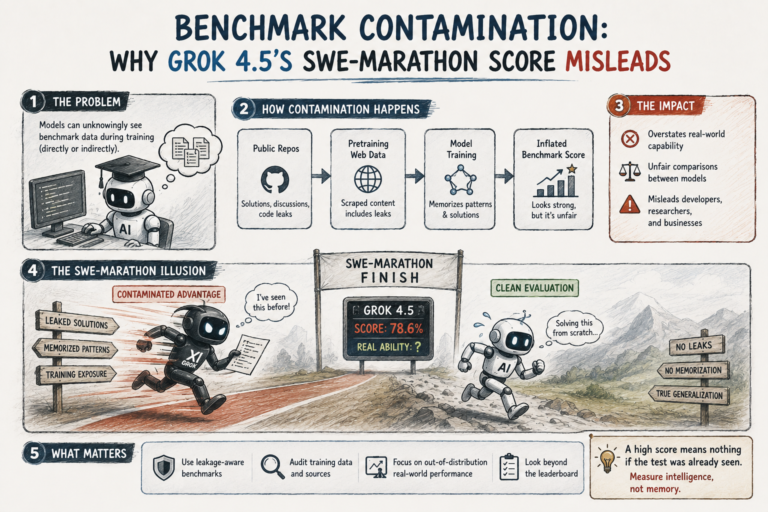
Benchmark contamination is one of the most pressing problems in AI evaluation today — and it’s been flying under the radar for too long. When we dig into benchmark contaminat…
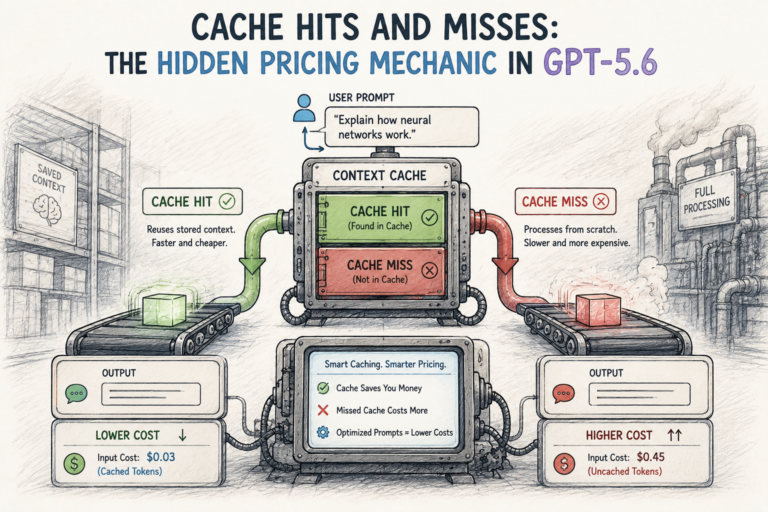
The cache hits cache misses hidden pricing mechanic is quietly reshaping how developers budget for AI — and most teams are completely missing it. If you’re running GPT-5.6 in…
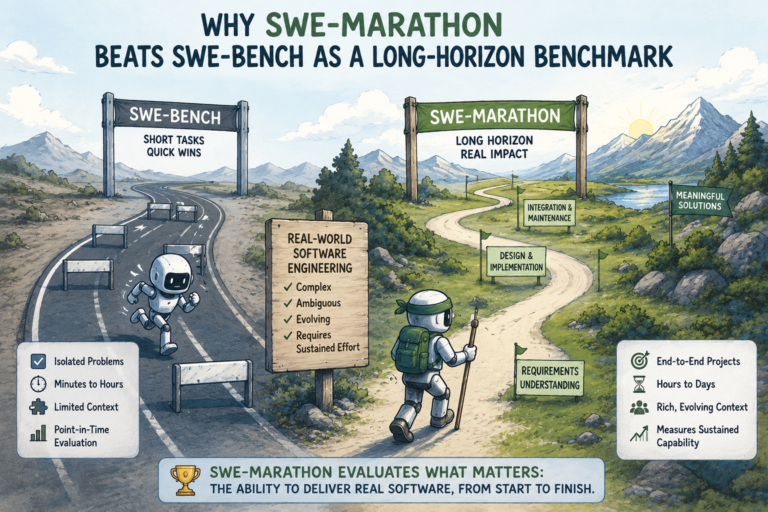
The conversation around long horizon agentic benchmarks why SWE-Marathon matters has hit a genuine tipping point — and honestly, it’s been a long time coming. Software engine…