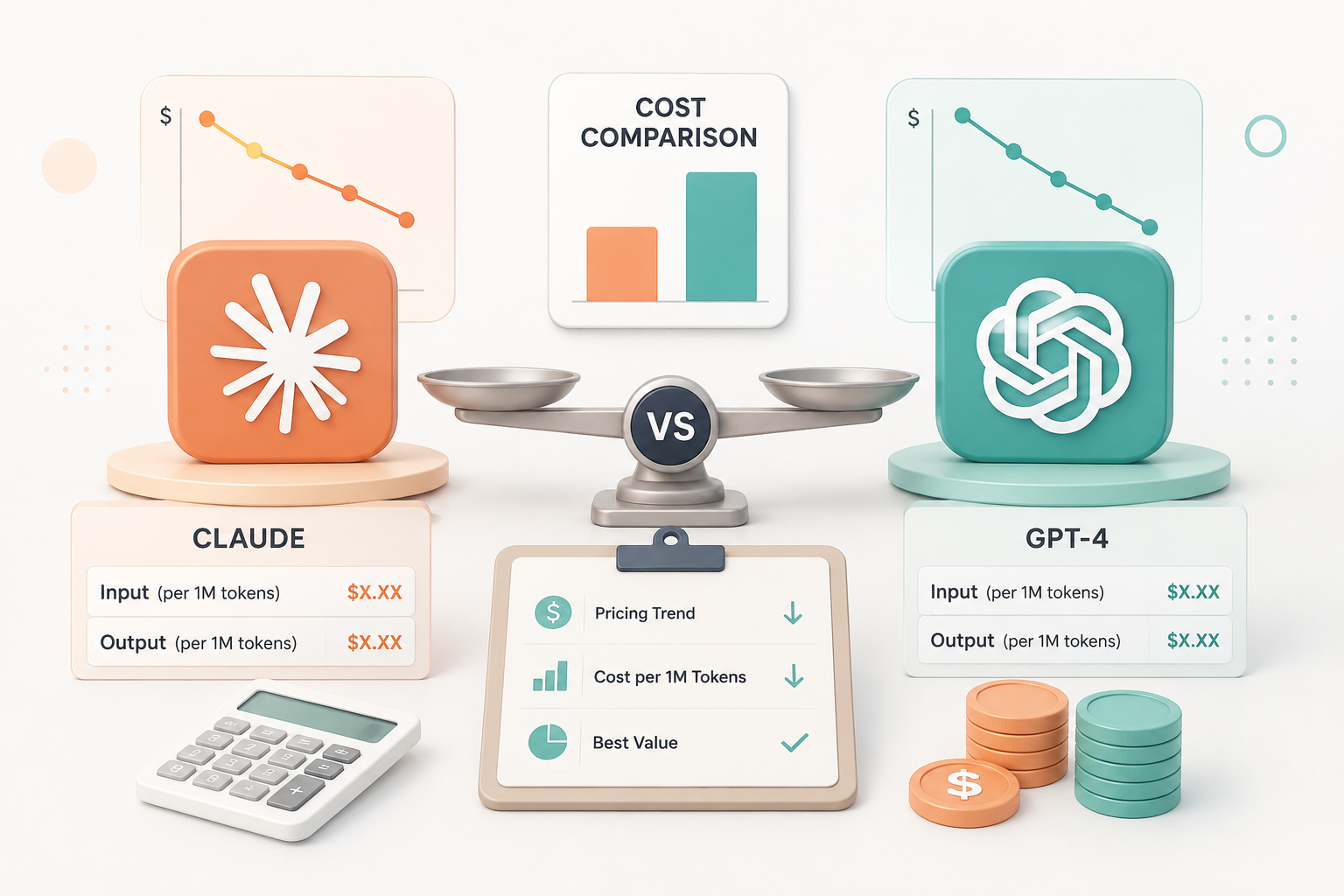
The AI model pricing wars 2024 Claude vs GPT-4 comparison has been one of the loudest conversations in tech this year — and honestly, for good reason. OpenAI slashed prices aggressively, Anthropic fired back with the Claude 3 family, and startups everywhere are burning time trying to figure out which model actually stretches their budget furthest.
Here’s the thing: pricing isn’t just about cost per token anymore. It’s about value per dollar, and consequently, picking the wrong model can drain your runway faster than a bad hire. I’ve helped teams work through this decision more times than I can count, so let me break down every pricing tier, compare real-world costs, and actually help you land on something that fits your situation.
Why the AI Model Pricing Wars 2024 Claude vs GPT-4 Comparison Matters Now
OpenAI kicked off 2024 with a move nobody ignored. GPT-4 Turbo dropped input token costs by roughly 3x compared to the original GPT-4 — and that single cut reshaped the entire market overnight.
Anthropic didn’t sit still. They launched the Claude 3 family — Haiku, Sonnet, and Opus — each targeting a different price-performance sweet spot. Meanwhile, Google’s Gemini models and open-source alternatives like Llama 3 piled on even more pressure. The incumbents suddenly had real competition breathing down their necks.
Why does this matter for your business? A few things worth keeping in mind:
- API costs can represent 30–60% of an AI startup’s total infrastructure spend
- Token pricing differences compound dramatically at scale — we’re talking thousands of dollars monthly
- The cheapest model isn’t always the most cost-effective (I’ve watched teams learn this the hard way)
- Performance gaps between models are narrowing faster than anyone expected
Furthermore, the AI model pricing wars 2024 Claude vs GPT-4 comparison isn’t just academic. It directly affects product margins, feature feasibility, and how competitive you can actually be. Every dollar saved on inference is a dollar you can put somewhere that grows the business.
Consider a concrete example: a Series A startup running a legal document summarization product discovered mid-year that switching from GPT-4 Turbo to Claude 3.5 Sonnet for their core summarization pipeline cut their monthly API bill by roughly 35% while maintaining output quality their customers accepted without complaint. That difference funded two additional months of runway. The pricing wars created that opportunity — but only because the team was paying attention.
Full Cost-Per-Token Breakdown: Claude 3 vs GPT-4 Models
Here are the actual numbers. Pricing shifts frequently, so these reflect mid-2024 published rates — always verify against official pricing pages before committing to anything.
| Model | Input (per 1M tokens) | Output (per 1M tokens) | Context Window | Best For |
|---|---|---|---|---|
| GPT-4 Turbo | $10.00 | $30.00 | 128K | Complex reasoning |
| GPT-4o | $5.00 | $15.00 | 128K | Balanced performance |
| GPT-4o Mini | $0.15 | $0.60 | 128K | High-volume, simple tasks |
| Claude 3 Opus | $15.00 | $75.00 | 200K | Research, analysis |
| Claude 3 Sonnet | $3.00 | $15.00 | 200K | Enterprise workflows |
| Claude 3 Haiku | $0.25 | $1.25 | 200K | Fast, lightweight tasks |
| Claude 3.5 Sonnet | $3.00 | $15.00 | 200K | Best quality-to-cost ratio |
Notably, output tokens always cost more than input tokens — and that gap is critical. If your app generates long responses, output pricing matters far more than input pricing. This surprised me when I first started modeling costs seriously. Most people anchor on input price and get blindsided later.
One practical way to internalize this: imagine a customer-facing feature that returns a 600-token explanation for every 200-token user query. You’re spending three times as many tokens on output as input. At GPT-4 Turbo rates, that ratio means output costs alone are six times what you’re paying for input — a ratio that flips your entire cost model if you designed it assuming rough parity.
GPT-4o Mini vs Claude 3 Haiku is the budget-tier battle. GPT-4o Mini wins on raw price. However, Haiku offers a larger context window, so your specific workload ultimately determines the winner here — don’t let the sticker price make that decision for you.
Claude 3.5 Sonnet vs GPT-4o is the mid-tier showdown everyone’s actually fighting over. They’re priced similarly. Nevertheless, Claude 3.5 Sonnet has benchmarked competitively against GPT-4 Turbo on plenty of tasks while costing significantly less than Opus. That’s a meaningful value story.
At the premium end, Claude 3 Opus is the most expensive mainstream option — 2.5x more for output tokens than GPT-4 Turbo. Therefore, Opus only makes sense when its unique strengths, like nuanced long-context reasoning or deep analysis, genuinely justify the premium. For most teams, it won’t. A reasonable rule of thumb: if you can’t articulate a specific capability gap that only Opus closes, you’re probably paying for prestige rather than performance.
Use-Case ROI Analysis: Matching Models to Workloads
The AI model pricing wars 2024 Claude vs GPT-4 comparison only makes sense when you tie pricing to actual use cases. A cheaper model that produces worse results costs more in the long run — full stop.
Customer support chatbots handle high volume with relatively simple queries. GPT-4o Mini or Claude 3 Haiku are your best bets here. At 100,000 conversations per month — averaging 500 input and 200 output tokens each — the monthly cost difference is stark:
- GPT-4o Mini: approximately $19.50
- Claude 3 Haiku: approximately $37.50
- GPT-4o: approximately $550
GPT-4o Mini wins decisively for this workload. Additionally, its speed advantage cuts latency for end users — and that matters more than people realize when you’re building customer-facing products. A 200ms response feels snappy; a 900ms response feels broken, even when the answer is identical. Budget models often win on latency precisely because they’re lighter, which is a secondary benefit that rarely appears in cost comparisons but shows up clearly in user retention data.
Content generation — blog posts, marketing copy, reports — demands higher quality. Because output-heavy workloads amplify cost differences, the numbers shift significantly. For generating 1,000 articles averaging 1,000 input tokens and 3,000 output tokens each:
- Claude 3.5 Sonnet: approximately $48
- GPT-4o: approximately $50
- Claude 3 Opus: approximately $240
Claude 3.5 Sonnet and GPT-4o are nearly identical in cost here. Specifically, your choice should depend on output quality for your particular content type — test both before committing. I’ve seen teams assume one was better and waste weeks on a suboptimal setup. One content platform I worked with ran a blind evaluation where their editorial team rated 50 outputs from each model without knowing the source. The scores were close enough that cost became the tiebreaker — which is exactly how it should work.
Code generation and review is where things get genuinely interesting. According to benchmarks tracked by the research community, Claude 3.5 Sonnet performs exceptionally well on coding tasks. Consequently, it often delivers better ROI than GPT-4 Turbo despite similar pricing — which is a straightforward call if code quality is your bottleneck. Teams building developer tools in particular have reported that Claude’s tendency to explain its reasoning alongside code changes makes review cycles shorter, which is a productivity gain that doesn’t show up in token cost calculations but absolutely affects total cost of shipping.
Document analysis with large context is where Claude holds a structural advantage. Its 200K context window outpaces GPT-4 Turbo’s 128K limit. However, if your documents regularly exceed 128K tokens, Claude becomes your only mainstream option. Otherwise you’re engineering chunking strategies with GPT-4, which adds complexity and hidden cost that rarely shows up in initial estimates. Chunking isn’t free — it requires extra prompting, reassembly logic, and often degrades output quality because the model loses cross-document coherence. That engineering overhead can easily cost more than the token price difference.
How Startups Should Evaluate Model Selection Beyond Price
Price per token is just one variable. Smart startups evaluating the AI model pricing wars 2024 Claude vs GPT-4 comparison look at total cost of ownership. Here’s a framework that actually works — I’ve watched teams use this to cut their AI spend significantly without sacrificing quality.
Step 1: Define your quality threshold. Not every task needs the best model. Categorize your AI workloads into tiers:
- Tier 1: Mission-critical, customer-facing (use premium models)
- Tier 2: Internal tools, moderate quality needs (use mid-tier)
- Tier 3: Background processing, classification, routing (use budget models)
A practical starting point: list every AI-powered feature in your product, assign each one a tier, and calculate what you’re currently spending on each. Most teams discover they’re running Tier 3 workloads on Tier 1 models simply because nobody revisited the default after the initial prototype.
Step 2: Run parallel evaluations. Don’t trust benchmarks alone. Similarly, don’t trust gut instinct — I know that’s tempting. Build a test harness with 200+ real examples from your domain. Score outputs on accuracy, tone, and completeness. Then calculate cost-per-acceptable-output, not just cost-per-token.
Step 3: Factor in hidden costs. These often dwarf token costs:
- Prompt engineering time differs meaningfully between models
- Retry rates vary — a model that fails 10% more often effectively costs 10% more
- Rate limits affect throughput and architecture decisions
- Fine-tuning availability changes the equation entirely
OpenAI offers fine-tuning for GPT-4o and GPT-4o Mini. Anthropic doesn’t currently offer public fine-tuning for Claude. Therefore, if fine-tuning is essential to your workflow, OpenAI has a clear advantage — that’s a real tradeoff worth understanding before you pick a primary provider. Fine-tuning can dramatically reduce prompt length for specialized tasks, which compounds into meaningful token savings over time, so the absence of that option at Anthropic has real downstream cost implications for certain use cases.
Step 4: Plan for model routing. The smartest approach isn’t picking one model — it’s using multiple models strategically. Route simple queries to cheap models and escalate complex ones to premium tiers. This hybrid strategy can cut costs by 40–70% compared to using a single premium model for everything.
Tools like LiteLLM and OpenRouter make multi-model routing surprisingly straightforward. Moreover, they let you switch providers without rewriting your application code — which is worth more than most teams realize until they’re mid-pivot. A simple routing classifier — even a rules-based one that checks query length and keyword presence — can correctly direct 70–80% of traffic to cheaper models without any noticeable quality degradation for end users.
Step 5: Negotiate enterprise pricing. Published rates are retail prices. Both OpenAI and Anthropic offer volume discounts, and importantly, if you’re spending more than $5,000 per month on API calls, reach out to their sales teams. Committed-use discounts can cut costs by 20–30% — real money at scale.
Emerging Alternatives Reshaping the Pricing Wars
Claude and GPT-4 aren’t the only players. The competitive field is shifting fast, and ignoring the alternatives means potentially leaving significant savings on the table.
Google Gemini 1.5 Pro offers a massive 1 million token context window. Its pricing is competitive with GPT-4o, and although it trails slightly on some benchmarks, the context window advantage is genuinely unmatched. For document-heavy workloads, Gemini deserves serious consideration — don’t dismiss it just because it’s not the default conversation. A team processing full legal contracts or lengthy financial filings, for example, can pass an entire document in a single call rather than chunking it, which simplifies architecture considerably and eliminates the quality degradation that chunking introduces.
Meta’s Llama 3 is free and open-source — you pay only for compute. Running Llama 3 70B on your own infrastructure can be dramatically cheaper at scale. Nevertheless, you’re taking on real operational complexity: GPU infrastructure, monitoring, and model serving expertise all become your problem. Fair warning — the learning curve is real, and the hidden costs of that complexity add up fast.
Here’s a rough comparison for self-hosted vs API costs at scale (1 billion tokens per month):
| Approach | Estimated Monthly Cost | Operational Complexity |
|---|---|---|
| GPT-4o API | ~$10,000 | Low |
| Claude 3.5 Sonnet API | ~$9,000 | Low |
| Llama 3 70B (self-hosted, AWS) | ~$3,000–5,000 | High |
| Llama 3 8B (self-hosted, AWS) | ~$800–1,500 | Medium |
| Mixtral 8x7B (self-hosted) | ~$1,500–3,000 | Medium-High |
The self-hosted numbers above assume reasonably efficient GPU utilization. In practice, teams new to model serving often run at 40–60% utilization initially, which pushes real costs toward the top of those ranges until infrastructure is properly tuned. Budget for that ramp-up period before assuming the savings materialize on day one.
Mistral AI is another strong contender that doesn’t get enough airtime. Their models offer excellent performance at lower price points, and specifically, Mistral Large competes with GPT-4o on many tasks while often costing less. I’ve tested a handful of these and Mistral consistently delivers more than people expect.
The AI model pricing wars 2024 Claude vs GPT-4 comparison increasingly includes these alternatives. Conversely, jumping to unproven models introduces quality risk — so don’t get reckless just because the price tag is attractive.
The bottom line on alternatives: test them. Run your evaluation suite against two or three options. The results might genuinely surprise you. Many startups discover that a mix of providers — perhaps Claude for reasoning, GPT-4o Mini for volume tasks, and Llama for batch processing — delivers the best cost-performance balance. That mix is often where the real savings hide.
Conclusion
The AI model pricing wars 2024 Claude vs GPT-4 comparison comes down to one truth: there’s no universally cheapest option. The right choice depends entirely on your workload, quality requirements, and scale — and anyone who tells you otherwise is selling something.
Here are your actionable next steps:
- Audit your current AI spend. Break it down by use case, token volume, and model tier. Know exactly where your money is going before you optimize anything.
- Run head-to-head tests. Pick your top two or three models. Test them on real data from your application. Measure quality and cost together — not separately.
- Set up model routing. Don’t lock into a single provider. Use routing to match each request with the most cost-effective model for that specific job.
- Revisit pricing quarterly. Both OpenAI and Anthropic update pricing frequently. Set calendar reminders — this isn’t a set-it-and-forget-it situation.
- Negotiate when you can. Volume discounts are real. Enterprise agreements can save you thousands monthly, and moreover, they’re more accessible than most founders assume.
Prices will keep falling and performance will keep improving — that’s just the direction things are heading. But the startups that win won’t necessarily be the ones who picked the cheapest model today. They’ll be the ones who built flexible systems that adapt as the AI model pricing wars 2024 Claude vs GPT-4 comparison continues to shift. Build for optionality. That’s the actual edge.
FAQ
Which is cheaper overall, Claude or GPT-4?
It depends on the specific model tier — and that distinction matters a lot. GPT-4o Mini is cheaper than Claude 3 Haiku for most workloads. At the mid-tier, Claude 3.5 Sonnet and GPT-4o are priced similarly. However, Claude 3 Opus is significantly more expensive than GPT-4 Turbo. Always compare within the same performance tier rather than across model families — otherwise you’re not really comparing the same thing.
How much can model routing save my startup?
Model routing typically saves 40–70% compared to using a single premium model for all requests. The savings depend on your workload distribution. If 80% of your queries are simple enough for budget models, routing delivers massive savings. Importantly, you’ll need to invest engineering time to build classification logic that routes effectively — it’s not magic, it’s architecture. A reasonable starting point is a simple prompt complexity classifier that flags queries containing multi-step reasoning, ambiguous intent, or domain-specific nuance for escalation, while sending everything else to the budget tier.
Is self-hosting Llama 3 actually cheaper than using Claude or GPT-4 APIs?
At high volume — roughly above 500 million tokens per month — self-hosting often becomes cheaper. Below that threshold, API costs are usually lower once you factor in infrastructure management, GPU costs, and engineering time. Additionally, self-hosting requires expertise in model serving, scaling, and monitoring that many startups simply don’t have in-house yet. Know your team’s actual capacity before going down that road.
Do OpenAI and Anthropic offer volume discounts?
Yes, both companies offer enterprise pricing for high-volume customers. OpenAI’s enterprise plans include higher rate limits and dedicated support alongside volume discounts. Anthropic similarly offers custom pricing for large deployments. You’ll typically need to commit to minimum monthly spend levels to qualify — but it’s worth the conversation earlier than you think.
How often do AI model prices change?
Prices have been changing roughly every two to four months throughout 2024. OpenAI has been particularly aggressive with cuts. Consequently, any cost analysis has a short shelf life — build your financial models with the assumption that prices will drop 20–40% annually. Lock in rates through enterprise agreements if predictability matters more to you than catching every price cut.
Should I wait for prices to drop further before building my AI product?
No — and I’d push back hard on this one. Waiting is almost always the wrong strategy. Build now with cost-efficient model routing and design your architecture to be model-agnostic. That way, you benefit from future price drops automatically. Moreover, the competitive advantage of shipping sooner typically outweighs any savings from waiting for cheaper tokens. The window doesn’t stay open forever.
References
Keep reading
Here are the latest posts from the blog.

The open vs closed models mid 2026 state looks radically different from even twelve months ago. Performance gaps have nearly vanished. Pricing wars have broken out across the…

Every time you ask ChatGPT a question, water evaporates somewhere. That’s not hyperbole — it’s physics. AI water consumption data centers environmental impact has quietly bec…

If you’ve been searching for why Fable 5 discontinued Anthropic Claude, you’re not alone. Thousands of developers and AI enthusiasts noticed when Anthropic quietly retired it…