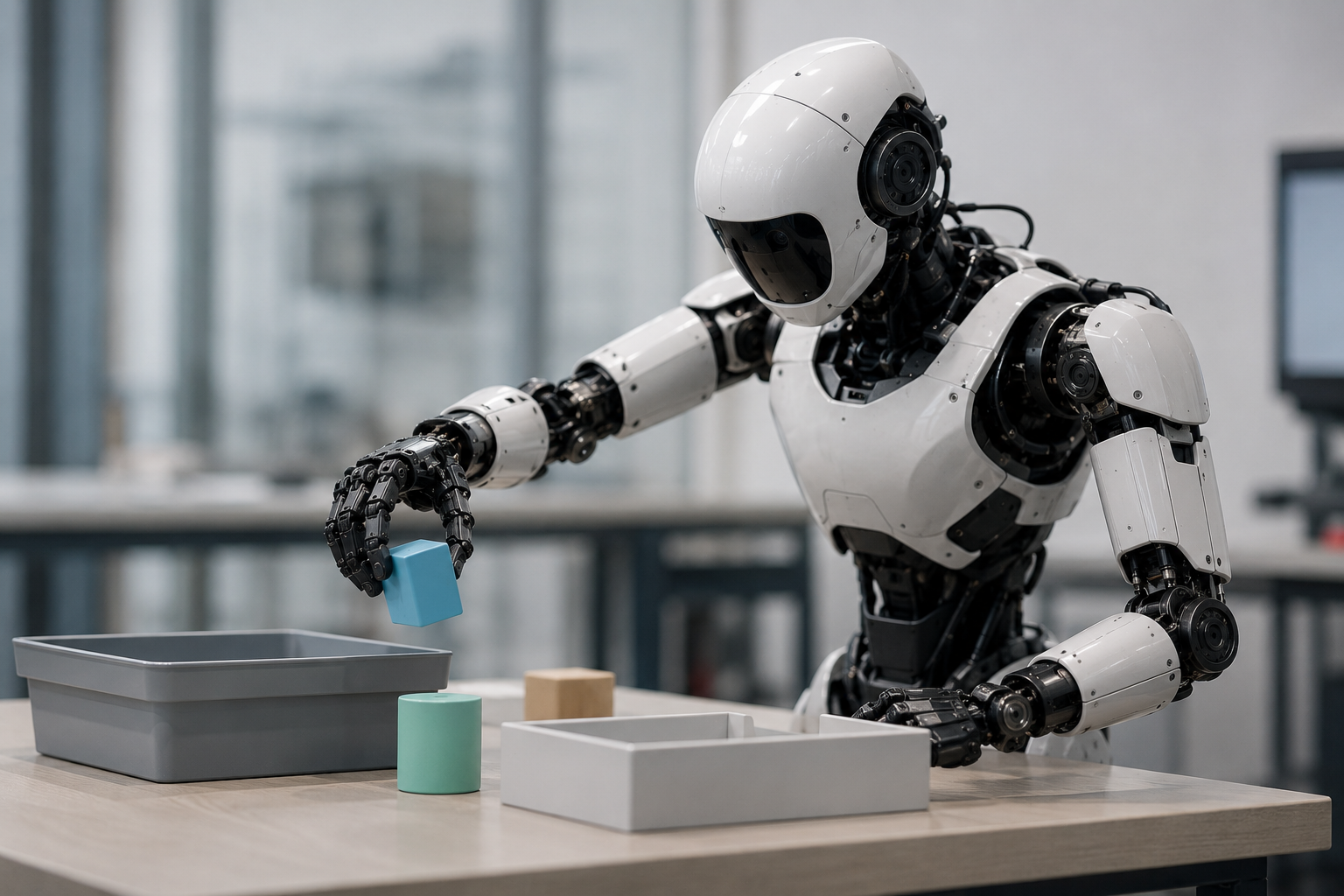
Any overview of modern AI robotics from first principles has to start with perception. Before a robot can walk, grasp, or move through a crowded warehouse, it needs to actually sense the world around it. That sensory foundation is the real bedrock — the thing every humanoid robot and autonomous vehicle is quietly built on top of.
Most coverage of AI robotics chases flashy demos or cost breakdowns. However, the perception layer — computer vision, LIDAR, sensor fusion — rarely gets the attention it deserves. I’ve spent years digging into robotics stacks, and this gap consistently surprises me. This piece fills it. You’ll understand exactly how robots “see,” why multiple sensors matter, and how these architectures connect to autonomous vehicle safety standards.
Think of this as the missing chapter. Specifically, it’s the first principles perception layer that makes everything else in modern robotics possible.
How Robots Perceive the World: First Principles of Sensing
Sensor Fusion: The Brain Behind Modern AI Robotics
The Perception-to-Action Pipeline in AI Robotics First Principles
Shared Perception Architectures Across Robotics and Autonomous Vehicles
How Robots Perceive the World: First Principles of Sensing
An overview of modern AI robotics from first principles begins with a deceptively simple question: how does a machine understand its surroundings? The answer involves three core sensing technologies working together — and none of them alone is enough.
Computer vision uses cameras to capture 2D images, then convolutional neural networks (CNNs) pull meaning from those pixels. They identify objects, estimate distances, and track motion across frames. Tesla’s Autopilot system famously leans hard on camera-based vision. Nevertheless, cameras alone have serious limitations — they struggle in low light, heavy rain, and fog. I’ve seen demos fall apart in a light drizzle. It’s humbling.
LIDAR (Light Detection and Ranging) fires laser pulses to build precise 3D point clouds of the surrounding environment. Each pulse bounces off surfaces and returns to the sensor, producing a depth map with centimeter-level accuracy. Companies like Velodyne Lidar and Luminar have driven costs down sharply over the past five years. Consequently, LIDAR is now within reach for mid-range robotic platforms — not just the big-budget players.
Radar and ultrasonic sensors round out the perception stack. Radar excels at detecting speed and holds up well in bad weather, while ultrasonic sensors handle close-range detection reliably and cheaply. Furthermore, inertial measurement units (IMUs) track acceleration and rotation — think of them as the robot’s inner ear.
Here’s the thing: no single sensor is sufficient. Each one has blind spots, literally and figuratively. Therefore, modern AI robotics combines them all through a process called sensor fusion. More on that in a moment.
| Sensor Type | Strengths | Weaknesses | Typical Range |
|---|---|---|---|
| Camera | Rich color/texture data, low cost | Poor in low light, no native depth | 1–250 m |
| LIDAR | Precise 3D mapping, works at night | Expensive, struggles in heavy rain | 1–300 m |
| Radar | All-weather, speed detection | Low resolution, no color data | 1–350 m |
| Ultrasonic | Very low cost, close-range accuracy | Extremely short range | 0.02–5 m |
| IMU | Tracks orientation/acceleration | Drifts over time without correction | N/A (internal) |
This table captures the core tradeoff in one place. Importantly, understanding these tradeoffs is essential to any honest first principles approach to robotics perception — and it’s something a lot of people skip over.
Sensor Fusion: The Brain Behind Modern AI Robotics
Sensor fusion is where everything actually comes together.
It’s the process of combining data from multiple sensors into one clear picture of the world — and arguably the most critical layer in the entire robotics stack. I’ve tested dozens of perception pipelines, and the ones that fall apart almost always have weak fusion, not weak sensors.
Why fusion matters. A camera might spot a pedestrian but misjudge their distance by two meters. LIDAR nails the distance but can’t tell if the object is a person or a mailbox. Radar knows something is moving but lacks the detail to care what it is. Sensor fusion merges all three inputs, giving the robot a richer, more reliable model of its environment than any single sensor could provide.
There are three main approaches:
- Early fusion — Raw data from all sensors gets combined before any processing. This keeps maximum information intact. However, it demands enormous computing power, which is a real constraint on embedded hardware.
- Late fusion — Each sensor processes its data independently first, then the system merges the results. Cheaper to run, but it may lose subtle cross-sensor patterns along the way.
- Mid-level fusion — A hybrid approach where features are pulled from each sensor, then combined before final decision-making. Most modern production systems use this method, and there’s a good reason for that.
Notably, the NVIDIA DRIVE platform uses mid-level fusion extensively. It processes camera, LIDAR, and radar feeds through dedicated neural networks, then merges the outputs in a shared layer. Similarly, Boston Dynamics’ robots fuse depth cameras with IMU data for real-time balance adjustments — which is part of why Spot looks unnervingly stable on uneven ground.
This overview of modern AI robotics from first principles wouldn’t be complete without mentioning probabilistic frameworks. Kalman filters and particle filters help robots handle uncertainty — because sensors are noisy and readings sometimes conflict. These tools weigh each sensor’s reliability and produce the best possible estimate of reality. This surprised me when I first dug into it: the “intelligence” in a lot of robotic perception is really just well-tuned statistics.
Additionally, transformer architectures are now entering the fusion pipeline. Originally built for language processing, transformers are good at finding relationships across different data types. Tesla’s “BEV (Bird’s Eye View)” network is a clear example — it turns multiple camera feeds into a unified top-down view without LIDAR. Whether that’s enough on its own is still hotly debated.
The Perception-to-Action Pipeline in AI Robotics First Principles
Sensing the world is only half the story. The robot still has to decide what to do with all that information.
This perception-to-action pipeline is the backbone of autonomous behavior. Moreover, it’s where modern AI robotics first principles directly translate into real-world capability — or expose real-world failure modes.
The pipeline flows through several stages:
- Perception — Sensors capture raw data, and fusion algorithms create a unified world model the system can actually reason about.
- Localization — The robot figures out where it is. SLAM (Simultaneous Localization and Mapping) algorithms are standard here — they build a map while tracking the robot’s position within it at the same time. Fair warning: SLAM in dynamic environments is still genuinely hard.
- Planning — The system decides what to do next. Path planning algorithms like A* or RRT (Rapidly-exploring Random Trees) generate safe routes through space.
- Control — Low-level controllers turn those plans into actual motor commands. PID controllers and model predictive control (MPC) are the workhorses here.
- Feedback — New sensor data flows back in, and the cycle repeats dozens or hundreds of times per second.
Specifically, humanoid robots like those from Agility Robotics run this entire loop in real time. Their Digit robot uses depth cameras and LIDAR to move through warehouse environments, stepping over obstacles and adjusting its gait on uneven surfaces. Because the perception stack feeds directly into locomotion planning, those adjustments happen continuously — not as discrete decisions.
Autonomous vehicles share this exact architecture. The Society of Automotive Engineers (SAE) defines six levels of driving automation, and Levels 4 and 5 require full perception-to-action autonomy. The real kicker is that the same sensor fusion and planning techniques power both humanoid robots and self-driving cars. That means advances in one field directly speed up the other.
Real-time constraints are critical. A robot moving at walking speed needs perception updates every 50–100 milliseconds. An autonomous car at highway speed needs updates every 10–20 milliseconds. That’s a punishing requirement. Edge computing hardware from companies like NVIDIA and Qualcomm makes this possible. Meanwhile, cloud computing handles heavier tasks like map updates and model retraining — the stuff that doesn’t need to happen in 15 milliseconds.
Shared Perception Architectures Across Robotics and Autonomous Vehicles
One of the most useful insights from this overview of modern AI robotics from first principles is how much overlap exists between very different robotic platforms. Humanoid robots, autonomous vehicles, drones, and industrial robots are increasingly sharing the same perception components. That’s not a coincidence — it’s an efficiency play.
Common building blocks include:
- Object detection models — YOLO (You Only Look Once) and similar architectures run across platforms, identifying people, vehicles, and obstacles in real time with impressive speed.
- Depth estimation networks — Monocular depth prediction lets single cameras estimate 3D structure, which cuts hardware costs for cost-sensitive applications.
- Occupancy networks — These predict which 3D spaces are occupied versus free. They appear in both Tesla’s FSD system and warehouse robotics — a notably wide deployment range.
- Foundation models — Large pretrained models like Google DeepMind’s RT-2 can transfer knowledge across robotic tasks. A model trained on manipulation can genuinely help with navigation. I find this exciting — it suggests we’re getting closer to generalist robotic intelligence.
Although the end applications differ enormously, the underlying math is remarkably consistent. A LIDAR point cloud from a Waymo robotaxi uses the same processing algorithms as one from a Boston Dynamics Spot robot. Therefore, improvements in autonomous vehicle perception directly benefit humanoid robotics — and vice versa. The knowledge transfers in both directions.
Safety standards are converging too. The International Organization for Standardization (ISO) publishes ISO 13482 for personal care robots and ISO 26262 for automotive functional safety. Nevertheless, the perception requirements in both standards share significant common ground — both demand redundancy, fail-safe behavior, and validated sensor performance. This convergence is speeding up as humanoid robots move from research labs into public spaces where mistakes have real consequences.
| Feature | Humanoid Robot | Autonomous Vehicle | Industrial Robot |
|---|---|---|---|
| Primary sensors | Depth cameras, IMU | Cameras, LIDAR, radar | LIDAR, force sensors |
| Fusion approach | Mid-level | Mid-level or early | Late fusion |
| Update frequency | 10–50 Hz | 20–100 Hz | 10–30 Hz |
| Key challenge | Dynamic balance | High-speed decisions | Precision grasping |
| Safety standard | ISO 13482 | ISO 26262 / SAE J3016 | ISO 10218 |
Look at that table and something becomes obvious. The first principles of perception are universal — platform differences are mostly about speed, precision, and safety requirements. The foundations are shared.
Emerging Trends Shaping Modern AI Robotics First Principles
The perception layer isn’t static. It’s moving fast — faster, honestly, than most coverage reflects.
Several trends are reshaping how robots sense and understand their environments. Importantly, these trends reinforce why a first principles approach matters more than ever. When the technology shifts, the fundamentals are what keep you oriented.
Neuromorphic sensors mimic biological eyes. Unlike traditional cameras that capture full frames at fixed intervals, event cameras only register changes in light — making them incredibly fast and power-efficient. They’re especially useful for high-speed robotics where milliseconds matter. Additionally, they handle extreme lighting conditions far better than conventional cameras, which is a meaningful practical advantage.
4D imaging radar is gaining real traction. Traditional radar gives you range, speed, and angle. 4D radar adds elevation data, creating point clouds similar to LIDAR but at a fraction of the cost. Conversely, it still can’t match LIDAR’s resolution — that’s the honest tradeoff. For many applications, however, it’s good enough, and “good enough at a lower price” wins a lot of engineering arguments.
Sim-to-real transfer is changing how perception systems are trained. Robots learn in simulated environments first, and tools like NVIDIA Isaac Sim generate photorealistic training data at scale. The trained models then transfer to physical robots. This sharply cuts the need for expensive real-world data collection. Moreover, it allows safe testing of genuinely dangerous edge cases — the kind you can’t manufacture on a test track.
Multimodal foundation models may represent the biggest shift of all. These large AI models understand images, text, depth data, and even tactile information at the same time — and they generalize across tasks without task-specific training. Consequently, a single perception model could plausibly power walking, grasping, and navigation within the same system. That’s a real departure from the traditional approach of building separate specialized models for each capability. It’s a clear direction for the field, even if we’re not fully there yet.
Edge AI hardware keeps improving rapidly. Chips built specifically for neural network inference are getting faster and more power-efficient every cycle. Because robots can’t always rely on cloud connectivity — especially in industrial environments or disaster response scenarios — autonomous perception must happen on-device. Hardware advances therefore directly expand what’s possible at the perception layer, and the pace isn’t slowing down.
Conclusion
This overview of modern AI robotics from first principles has traced the perception layer from individual sensors all the way to full autonomy pipelines. You’ve seen how cameras, LIDAR, radar, and supporting sensors each bring unique strengths — and specific weaknesses. Sensor fusion combines these inputs into reliable world models. And shared architectures connect humanoid robots, autonomous vehicles, and industrial systems in ways that make progress in one area compound across all of them.
The key takeaway is straightforward. Modern AI robotics from first principles starts with perception — full stop. Every impressive robotic behavior you’ve seen in a demo, whether walking, driving, or picking up a coffee cup, depends entirely on the sensory foundation covered here. Without solid perception, planning and control have nothing to work with.
Here are your actionable next steps:
- Study sensor fusion frameworks. Explore open-source tools like ROS 2’s sensor fusion packages to see these concepts running in real code.
- Follow safety standards. Understanding ISO 13482 and SAE J3016 will help you evaluate robotic systems with genuine critical thinking — not just marketing claims.
- Experiment with simulation. NVIDIA Isaac Sim and Gazebo let you build and test perception pipelines without buying a single piece of hardware. Worth trying even if you’re just curious.
- Track foundation model research. Models like RT-2 are changing how robots generalize across tasks. Stay current with publications from Google DeepMind and other leading labs — this area is moving monthly, not annually.
- Think cross-platform. Skills in autonomous vehicle perception transfer directly to humanoid robotics. Don’t silo your knowledge unnecessarily.
Whether you’re an engineer, an investor, or just someone who finds this stuff genuinely fascinating, understanding the first principles of robotic perception gives you a durable advantage. The specific sensors and algorithms will keep changing. The foundational concepts covered in this overview of modern AI robotics, however, will stay relevant for years to come — and that’s the whole point of starting from first principles.
FAQ
What does “first principles” mean in the context of AI robotics?
First principles thinking means breaking a complex system down to its most basic truths rather than reasoning by analogy. In AI robotics, that means starting with perception — specifically, how robots sense the world. Rather than accepting a robot’s capabilities at face value, you look at the underlying sensors, algorithms, and data pipelines that make those capabilities possible. This first principles approach shows why certain designs work, where limitations exist, and what would need to change to push further.
Why can’t robots rely on cameras alone for perception?
Cameras capture rich visual data — no question. However, they lack native depth information and struggle badly in poor lighting. Additionally, camera-based systems can be fooled by reflections, shadows, and unusual angles in ways that are hard to predict. That’s why modern AI robotics combines cameras with LIDAR, radar, and other sensors through fusion. Redundancy makes the overall system far more reliable than any single sensor could be on its own.
How does sensor fusion actually work in practice?
Sensor fusion algorithms take inputs from multiple sensors and combine them mathematically into a single clear estimate of the environment. Kalman filters are a classic tool — they weigh each sensor’s reading based on its known accuracy and uncertainty. More advanced systems use neural networks to learn optimal fusion strategies directly from data. Specifically, mid-level fusion — pulling features from each sensor before merging them — is the most common approach in production systems today. It balances computing cost with information quality reasonably well.
What’s the connection between humanoid robots and autonomous vehicles?
They share the same core perception architecture — more than most people realize. Both use cameras, LIDAR, and radar as primary sensors. Both rely on sensor fusion, object detection, and path planning to operate safely. Furthermore, safety standards for both domains are actively converging. Advances in autonomous vehicle perception directly benefit humanoid robotics, and vice versa. This overview of modern AI robotics from first principles highlights these shared foundations throughout because understanding the connection is genuinely useful for anyone tracking either field.
Is LIDAR still necessary, or can AI replace it with cameras?
This is one of the biggest ongoing debates in robotics — and honestly, it hasn’t been settled. Tesla argues that advanced neural networks can pull sufficient 3D information from cameras alone. Nevertheless, most other companies — including Waymo and Agility Robotics — still rely on LIDAR as a core sensor. The general view is that LIDAR provides a valuable safety layer that’s hard to replicate cheaply. Although camera-only systems are improving rapidly, LIDAR remains the gold standard for precise 3D mapping in safety-critical applications.
How can beginners start learning about AI robotics perception?
Start with open-source tools — they’re genuinely good now. ROS 2 (Robot Operating System 2) provides sensor fusion and perception packages you can run on a standard laptop. NVIDIA Isaac Sim offers free simulation environments for testing perception pipelines. Moreover, online courses from Stanford and MIT cover computer vision and SLAM fundamentals at a solid level. Building a small robot with a depth camera and IMU is an excellent hands-on project that teaches you more than any course will. Importantly, focus on understanding the first principles before chasing advanced techniques — the fundamentals build on each other in ways that shortcuts simply don’t.
References
Keep reading
Here are the latest posts from the blog.

Three of the most consequential people in tech are about to walk into one of the most politically charged rooms on the planet. Sam Altman, Dario Amodei, and Demis Hassabis at…
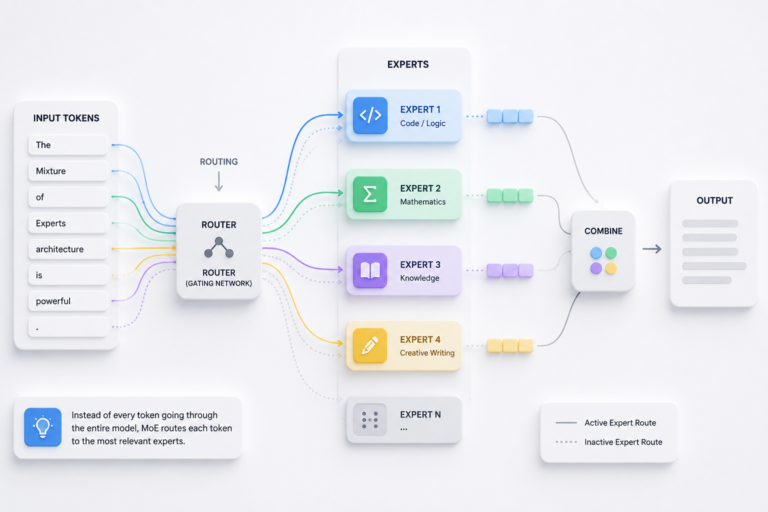
The phrase mixture of experts explained why biggest AI models aren’t monolithic often comes up in AI discussions, and there’s a good reason for that. Today’s leading AI syste…
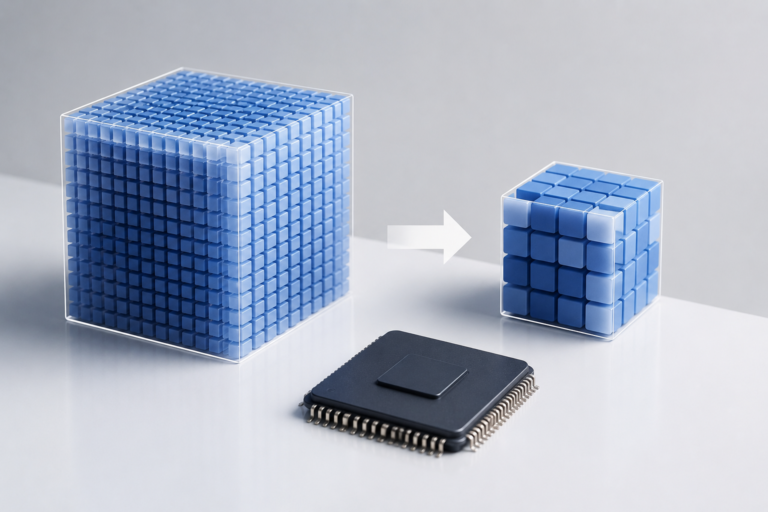
Quantization is how AI models get smaller without getting dumber — it’s reshaping machine learning deployment. Ever wondered how a 70-billion-parameter model runs smoothly on…