An A100 with 80GB of HBM2e still computes exactly as well in 2026 as it did when it was installed. Nothing has degraded. It passes every diagnostic.
It is also increasingly hard to justify running, and the reason has almost nothing to do with its arithmetic throughput. A model that fits comfortably in 141GB on an H200 must be sharded across two A100s, halving effective utilisation and doubling the interconnect traffic. A context window that one newer accelerator holds in its KV cache does not fit at all.
The hardware works. The workload moved.
That gap — between an accelerator that functions and one that earns — is the subject of this article, and it sits directly on top of an accounting assumption that carries tens of billions of dollars of reported profit across the industry. AI accelerator depreciation is the allocation of an accelerator’s cost across its estimated useful life, and the estimate is exactly that: an estimate, chosen by management, disclosed in a sentence, and rarely examined against the physics of the workloads the hardware actually has to serve.
Key takeaways
- AI accelerator depreciation is an accounting allocation, not a measurement of hardware lifespan. The disclosed figure is an estimate of economic benefit, and the hyperscalers apply it to “servers and network equipment” as a category rather than to accelerators specifically.
- Four different lifetimes hide inside one number: physical, accounting, economic and competitive. They rarely coincide, and the shortest one determines when replacement actually happens.
- The hyperscalers no longer agree. Microsoft and Alphabet moved servers to six years in 2022–23 and have held there; Amazon shortened a subset back to five effective January 2025, citing the pace of AI development; Meta extended to 5.5 years the same month.
- Changing a four-year assumption to three raises annual depreciation on the same asset by roughly a third, which flows straight into cost per accelerator-hour and cost per token.
- Memory capacity is the underexamined obsolescence driver. Accelerator HBM has gone from 40–80GB on A100 to 141GB on H200, 192GB on B200 and up to 288GB on B300-class parts, while models, context windows and KV caches grew to match.
- An accelerator becomes economically obsolete when the workload outgrows its memory envelope, not when it stops computing. We call this obsolescence by memory footprint — an analytical framing, not an accounting term.
Quick Navigation
- AI Accelerator Depreciation Starts With an Accounting Assumption
- AI Accelerator Depreciation Hides Four Different Lifetimes
- What Major Operators Disclose About AI Accelerator Depreciation
- Why AI Accelerator Depreciation at Three Years Differs From Four
- The Accelerator Can Still Compute, But the Workload Has Moved
- HBM Changes the AI Accelerator Depreciation Clock
- Obsolescence by Memory Footprint
- A Practical Test for an Aging AI Accelerator
- What AI Accelerator Depreciation Should and Should Not Tell You
- Conclusion: Useful Life Is Not Competitive Life
- FAQ
AI Accelerator Depreciation Starts With an Accounting Assumption
Depreciation spreads the cost of a long-lived asset across the periods that benefit from it. For an accelerator bought outright, the mechanics are simple:
Annual depreciation = (asset cost − salvage value) ÷ estimated useful life
The cost is known. Salvage value for accelerators is usually assumed to be small or zero. Useful life is the judgement call, and it is the only input management chooses.
That choice does three things at once. It sets reported operating income, because depreciation is an expense. It sets the capital recovery burden built into internal transfer pricing and cloud rate cards. And it signals to investors how long management believes the hardware will produce economic benefit.
One structural point deserves emphasis before any of the numbers below. None of the major operators discloses a useful life specifically for AI accelerators. They disclose useful lives for categories such as “servers and network equipment” or “technical infrastructure”, which bundle accelerators with CPUs, memory, storage, chassis and switches. Treating a disclosed six-year server life as a statement about GPU lifespan is an inference, not a reading of the filing.
AI Accelerator Depreciation Hides Four Different Lifetimes
The same physical accelerator has four expiry dates, and they are set by different forces.
| Lifetime | What ends it | Who decides |
|---|---|---|
| Physical | Component failure — HBM faults, VRM degradation, thermal damage | Physics and operating conditions |
| Accounting | The end of the disclosed useful life | Management estimate, audited for reasonableness |
| Economic | The point at which running it costs more than the value it produces | Power prices, utilisation, alternatives |
| Competitive | The point at which it cannot serve the workload at acceptable throughput, latency or memory | Model architecture and customer requirements |
Physical life is usually the longest. Well-cooled data-centre hardware runs for many years, and the secondary market for previous-generation accelerators exists precisely because they still work.
Accounting life sits in the middle by construction, since auditors want an estimate that reflects expected economic benefit rather than either extreme.
Economic life turns on operating cost against output. An older accelerator drawing 400W to produce a fraction of what a newer part produces at 700W can lose on performance per watt badly enough that electricity alone justifies replacement, before any capital consideration.
Competitive life is usually the shortest, and it is the one nobody discloses. It ends when the accelerator can no longer hold what the workload needs it to hold.
The practical consequence: a fleet can be fully depreciated and still valuable, or carry substantial book value while being commercially unusable for current workloads. Neither situation is visible from the depreciation schedule.
What Major Operators Disclose About AI Accelerator Depreciation
Between 2022 and 2024 the major operators moved in one direction. In January 2025 they stopped agreeing.
| Company | Disclosed change | Stated scope | Reported effect |
|---|---|---|---|
| Microsoft | 4 → 6 years, effective FY2023 (July 2022) | Servers and network equipment | ~$3.7bn lower depreciation, ~$3.0bn higher net income in FY23 |
| Alphabet | Servers 4 → 6 years; certain network equipment 5 → 6, effective January 2023 | Servers and certain network equipment | ~$3.9bn lower 2023 depreciation, ~$3.0bn higher net income |
| Amazon | 5 → 6 years, effective January 2024 | Servers | ~$3.2bn lower 2024 depreciation, ~$2.5bn higher net income |
| Amazon | 6 → 5 years, effective January 2025 | A subset of servers and networking equipment | Roughly $0.7bn lower operating income, with accelerated depreciation on early retirements |
| Meta | Most assets → 5.5 years, effective January 2025 | Servers and network assets | ~$2.9bn lower 2025 depreciation, ~$2.6bn higher net income |
| Oracle | Extended to 5 years, 2023 | Servers and related equipment | Disclosed in that year’s filing |
Four points about how to read that table.
- The direction reversed, once. Amazon is the only operator in the group to have shortened, and its stated reason is specific: the increased pace of technology development, particularly in artificial intelligence and machine learning. That is a company statement about AI hardware turnover, from the operator with the largest cloud footprint.
- The categories are not comparable. Microsoft’s disclosure covers servers and network equipment together as a range of two to six years. Alphabet separates servers from certain network equipment. Amazon’s January 2025 change applies to a subset it does not size. Lining these up in one column is convenient and slightly misleading, which is why the scope column is there.
- Sources disagree on some figures. Alphabet’s 2023 effect appears in coverage as both a ~$3.9bn actual reduction and a ~$3.4bn estimate made at the time of the change. Those are different things — an estimate disclosed in the 2022 10-K versus the outcome reported later — and the difference is a good illustration of why the primary filing matters more than the summary.
- Nothing here is about GPUs. No line in that table tells you how long a specific accelerator generation remains useful. It tells you what period management chose to spread the cost over for a category of equipment.
The analyst commentary around these disclosures has been vocal, and it should be labelled as commentary. In November 2025, investor Michael Burry argued publicly that hyperscalers were overstating earnings by extending useful lives beyond what two-to-three-year product cycles justify, putting the understatement at $176bn across 2026–2028. That is an outside estimate built on assumptions about true economic life, not a company disclosure, and it depends entirely on whether the accelerators concerned really do lose their economic value that fast.
Management has not been entirely silent on the tension. Satya Nadella has described not wanting to be “stuck with four or five years of depreciation on one generation” when a supplier’s migration pace increases — an acknowledgement that generational turnover, not hardware failure, is the pressure on useful life.
Why AI Accelerator Depreciation at Three Years Differs From Four
The arithmetic is simple enough to do in your head, which is part of why the assumption escapes scrutiny. The consequences are not simple at all.
The figures below are illustrative assumptions chosen for round numbers, not vendor prices or disclosed costs.
Take an accelerator server costing $300,000, assume zero salvage value, and assume 8,760 hours in a year at 100% availability.
| Useful life | Annual depreciation | Depreciation per hour | Change vs 6 years |
|---|---|---|---|
| 6 years | $50,000 | $5.71 | — |
| 5 years | $60,000 | $6.85 | +20% |
| 4 years | $75,000 | $8.56 | +50% |
| 3 years | $100,000 | $11.42 | +100% |
Moving from four years to three raises the hourly capital recovery burden by a third. Moving from six to three doubles it. No hardware changed, no electricity was consumed differently, and no workload got slower.
Now push it through to the number that matters operationally. Depreciation is only part of the cost of an accelerator-hour, but it is the largest part for recently purchased hardware. Assume power, cooling, networking and facility costs add $4.00 per hour:
| Useful life | Depreciation/hr | Other costs/hr | Total/hr | At 60% utilisation, cost per useful hour |
|---|---|---|---|---|
| 6 years | $5.71 | $4.00 | $9.71 | $16.18 |
| 4 years | $8.56 | $4.00 | $12.56 | $20.93 |
| 3 years | $11.42 | $4.00 | $15.42 | $25.70 |
The last column is the one to sit with. Two variables — an accounting estimate and a utilisation rate — move the cost of an hour of useful compute by roughly 60% between the top and bottom rows. Neither is a property of the hardware.
This is why the assumption is not a footnote. It determines the floor under every internal chargeback rate, every cloud price built on cost-plus logic, and every build-versus-rent comparison. A team that models its costs on a six-year life and then replaces hardware after three has been systematically understating what its inference actually costs.
The converse is equally true, and worth saying because the commentary rarely does: an operator that depreciates over three years and then runs the hardware profitably for six has been overcharging its own product teams and understating its own margins. Conservative is not automatically correct.
The Accelerator Can Still Compute, But the Workload Has Moved
Everything above concerns the numerator of the cost equation. The rest of this article is about the denominator, which is where the interesting failure happens.
An accelerator becomes economically difficult long before it becomes technically incapable, and several forces push in the same direction at once:
- Performance per watt. Newer parts do more work for the same power. In a facility with a fixed power envelope — which is most facilities now — every rack slot occupied by older hardware has an opportunity cost measured in the throughput a newer part would have produced from the same watts.
- Rack density and cooling. Older air-cooled deployments cannot always be upgraded in place, so the constraint is the building, not the card.
- Interconnect. Model and tensor parallelism depend on inter-GPU bandwidth. An older interconnect generation caps how effectively multiple accelerators can be combined, which matters most precisely when you are combining them to compensate for insufficient memory.
- Software support. Kernel optimisation follows the current generation. New attention implementations, quantisation formats and serving features arrive tuned for recent hardware, and older parts receive them late, partially, or not at all.
- Numerical formats. FP8 and FP4 support is architectural. An accelerator that cannot execute the format a model was quantised for either runs a less efficient variant or does not run it.
None of these makes the hardware stop working. They make it progressively less attractive than the alternative, which is what economic obsolescence means.
HBM Changes the AI Accelerator Depreciation Clock
The memory story is the one that deserves more attention than it gets, because it produces a hard boundary rather than a gradual decline.
Here is how accelerator memory has moved across generations, using vendor-published specifications:
| Accelerator | Memory | Type | Bandwidth |
|---|---|---|---|
| A100 (2020) | 40GB or 80GB | HBM2e | 1.55–2.0 TB/s |
| H100 SXM (2022) | 80GB | HBM3 | 3.35 TB/s |
| H200 (2023) | 141GB | HBM3e | 4.8 TB/s |
| B200 (2024) | 192GB | HBM3e | 8 TB/s |
| B300-class | up to 288GB | HBM3e | ~8 TB/s |
Capacity roughly tripled from A100’s 80GB to B200’s 192GB, and bandwidth rose about fourfold. Compute throughput rose faster still in raw terms, but compute and memory are not interchangeable, and that is the point.
Three things compete for accelerator memory during inference:
- Model weights. A 70B-parameter model at FP16 needs roughly 140GB before anything else — which is why the H200’s 141GB is frequently described as the point where 70B-class models fit on a single accelerator, and why the same model on 80GB parts requires either quantisation or sharding across two.
- KV cache. Attention state for every token in every active sequence, growing linearly with context length and with batch size. Long-context serving is a KV cache problem before it is anything else. We went through the economics of this memory in our breakdown of AI memory costs.
- Activations and working space. Intermediate results, communication buffers, and whatever the serving framework reserves.
Memory capacity is therefore a feasibility constraint, while compute throughput is a speed constraint. Insufficient compute makes a workload slow. Insufficient memory makes it impossible without changing the deployment — and the changes available all cost something.
Obsolescence by Memory Footprint
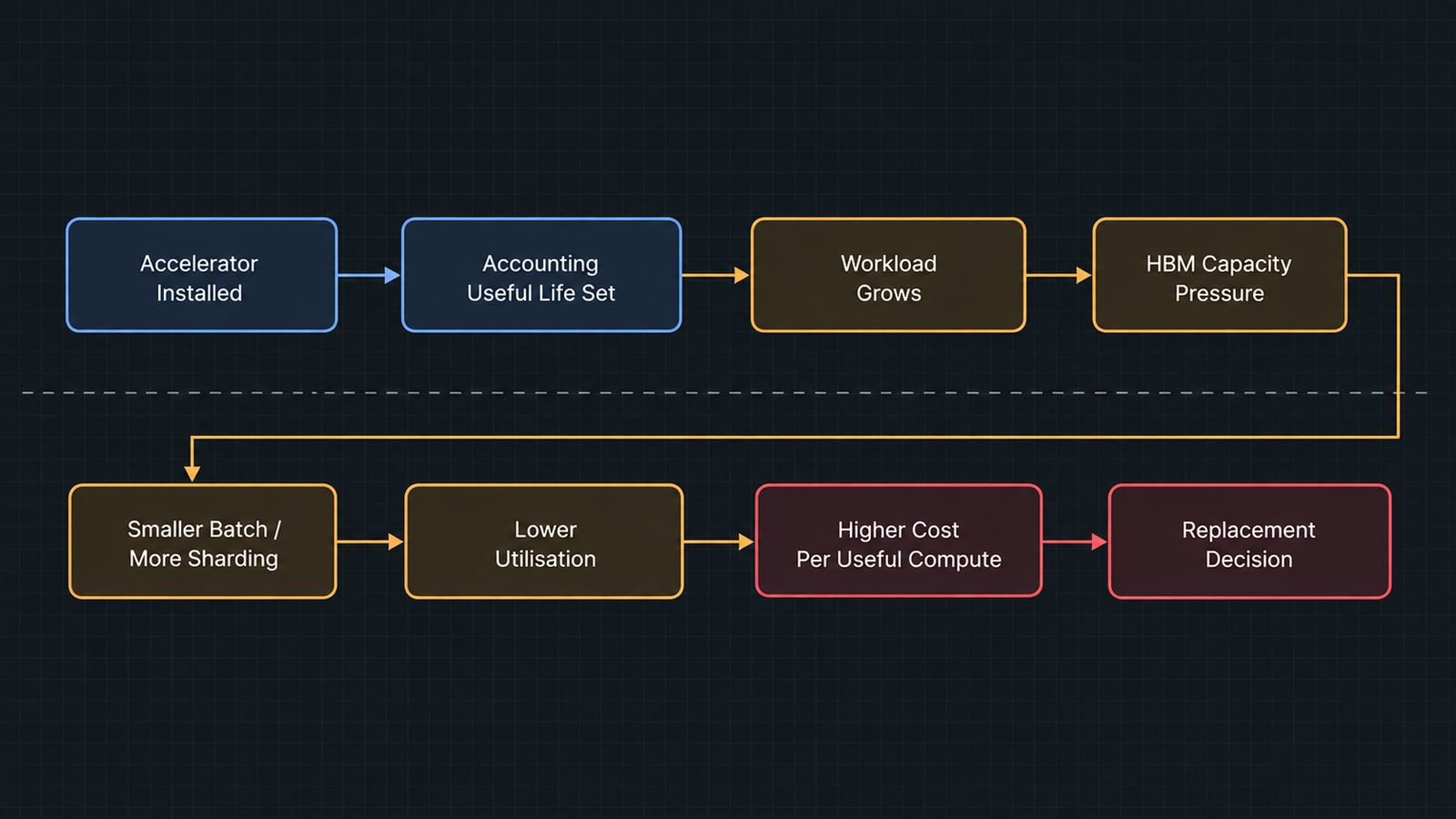
Hardware does not need to stop computing to become obsolete. The workload can simply outgrow its memory envelope.
Obsolescence by memory footprint is our analytical framing, not an accounting term or an industry standard. It describes the case where an accelerator retains sufficient compute capability for a workload but lacks the memory capacity to hold that workload efficiently — and where every available workaround degrades the economics rather than restoring them.
The workarounds, and what each costs:
| Workaround | Immediate effect | Economic consequence |
|---|---|---|
| Reduce batch size | Fits in memory | Lower throughput per accelerator; weights re-read for fewer tokens |
| Shard across more accelerators | Model fits | Two devices doing one device’s work; interconnect traffic and synchronisation overhead |
| Shorten context | Fits in KV cache | A product limitation, not a technical fix |
| Offload to host memory | Fits | PCIe-bound transfers at a fraction of HBM bandwidth |
| Quantise more aggressively | Smaller footprint | Possible quality loss; may need formats the hardware lacks |
Each of those paths ends in the same place: more accelerator-hours per unit of useful output, and therefore a higher cost per token on hardware whose hourly cost was fixed the day it was installed.
Work through the arithmetic informally. If a model requires two 80GB accelerators where one 141GB accelerator would serve it, the older deployment needs twice the devices, pays two sets of hourly costs, and absorbs the interconnect overhead of tensor parallelism. Even if the older accelerators were fully depreciated and cost nothing in capital terms, they still consume power, rack space and operational attention — and in a power-constrained facility, they consume the scarcest resource of all.
What makes this form of obsolescence distinctive is that it arrives as a step, not a slope. Performance-per-watt disadvantages accumulate gradually. Memory capacity either holds the model or it does not, and the moment a workload crosses the boundary, everything downstream changes at once: the parallelism strategy, the device count, the utilisation, the cost per token.
Four trends push workloads across that boundary, and all four are moving in the same direction:
- Context windows lengthened. Frontier models moved from tens of thousands of tokens to hundreds of thousands and beyond, and KV cache scales linearly with context.
- Reasoning models generate more tokens per task, which means longer sequences held in cache for longer.
- Agentic workloads accumulate context across many turns within a single task.
- Multimodal inputs consume far more tokens per unit of content than text.
None of these trends required more FLOPS specifically. All of them required more memory, and the demand pressure this creates across the accelerator market is part of what we examined in our analysis of what pacing the frontier does to AI chip demand.
The implication for depreciation policy is uncomfortable. An accounting useful life is chosen partly on the assumption that the hardware remains productive across the period. Memory-footprint obsolescence means that productivity can end abruptly, for reasons entirely external to the asset, when the models being served grow past what it can hold.
A Practical Test for an Aging AI Accelerator
There is no universal answer to how long an accelerator lasts, and anyone offering one is selling something. Useful life depends on workload, generation, memory capacity, utilisation, electricity price, cooling efficiency, whether the work is training or inference, software support and what the replacement would cost.
What can be built is a test. Five layers, in order — and the accelerator’s economic life ends at the first layer it fails.
Layer 1 — Can it still run the workload? Does the model fit, with its KV cache, at the context length your product promises? A no here is memory-footprint obsolescence, and it is binary.
Layer 2 — Can it run it efficiently? What batch size does it sustain? How much sharding is required? Every extra device is an efficiency tax on the older generation.
Layer 3 — Can it hit the required throughput and latency? Tokens per second, TTFT and p95 against your actual SLA rather than a benchmark.
Layer 4 — Does it compete economically? Cost per useful token, including power, cooling and rack space, against the same figure for current hardware. Fully depreciated hardware often wins this comparison, which is exactly why it stays in service.
Layer 5 — Does replacement create enough additional capacity to justify the capital? The relevant question is not whether new hardware is better but whether the throughput gain per watt and per rack unit, in a facility with fixed power, repays the spend.
The metrics to gather for that test:
| Signal | What indicates approaching obsolescence |
|---|---|
| HBM capacity pressure | Frequent OOM, forced sharding, capped batch sizes |
| Memory bandwidth utilisation | Sustained near ceiling while compute sits idle |
| Achieved throughput | Falling well short of what newer parts deliver per watt |
| Batch size ceiling | Constrained by memory rather than by latency targets |
| Context length supported | Below what the product now requires |
| Power per useful token | Rising against the current generation |
| Utilisation | Falling because the hardware cannot take the current workload mix |
| Replacement cost per unit of added capacity | The decision variable at layer 5 |
A fleet failing at layer 1 or 2 should be redeployed rather than retired — older accelerators remain genuinely useful for smaller models, embeddings, batch scoring, fine-tuning and development environments. Economic obsolescence for one workload is not obsolescence generally, which is the strongest argument the hyperscalers have for longer useful lives.
What AI Accelerator Depreciation Should and Should Not Tell You
Depreciation tells you how a company has chosen to allocate cost across periods, and by extension what management believes about the duration of economic benefit. Read across a group of filings, it tells you whether that belief is converging or diverging — and since January 2025 it has been diverging.
It does not tell you how long the hardware physically lasts, how long a specific accelerator generation stays competitive, what the fleet would fetch on the secondary market, or whether the assets are impaired. Those are separate questions with separate evidence, and the disclosure of useful life answers none of them.
The most useful reading of a change in useful life is as a signal about management’s expectations rather than as a fact about hardware. Amazon shortening a subset while Meta extended, in the same month, tells you two large operators looked at similar hardware and reached different conclusions about how long it would keep earning.
For anyone reading filings closely, the disclosures worth tracking are the scope statements rather than the headline numbers — what equipment the estimate covers, and whether the company breaks out accelerators at all. We looked at how much a detailed filing can reveal about AI cost structure in our analysis of what an Anthropic S-1 would disclose; the same reading applies here, and the answer is usually that the category is broader than the question.
Conclusion: Useful Life Is Not Competitive Life
An accelerator’s accounting life is a management estimate applied to a broad equipment category. Its competitive life is set by model architecture, context length and memory capacity, and nobody discloses it.
The gap between them is where the risk sits. If competitive life is shorter than accounting life, depreciation is understated and the reported cost of AI compute is too low. If it is longer — because older accelerators find second lives serving smaller models — the schedules are conservative and the hardware keeps earning after its book value reaches zero.
Both outcomes are happening simultaneously, on different parts of the same fleets. That is the honest answer, and it is why a single industry number has never made sense.
What operators can do is stop treating depreciation as the measure of how long hardware stays useful. It was never that. Measure the memory envelope against the workload, and you will know when an accelerator’s competitive life is ending long before its depreciation schedule notices.
FAQ
How long does an AI accelerator typically last?
Physically, well beyond the period it is depreciated over — data-centre accelerators commonly run for many years without failure. Economically, it depends on workload, memory capacity, power costs and what replaces it. There is no single industry figure, and the disclosed accounting lives of five to six years are estimates for equipment categories rather than measurements of accelerator lifespan.
Why do companies depreciate AI accelerators over different periods?
Because useful life is an estimate of expected economic benefit, and companies have different fleets, workloads, refresh patterns and judgements. Amazon cited the increased pace of technology development in AI when shortening; Microsoft cited software efficiency improvements when extending.
Can an older GPU still be economically useful?
Yes, frequently. Fully depreciated accelerators carry no capital cost, and older parts remain well suited to smaller models, embeddings, batch scoring, fine-tuning and development. Obsolescence for frontier inference is not obsolescence for every workload.
How does HBM affect GPU obsolescence?
Memory capacity determines whether a model, its KV cache and its activations fit on the device. When they do not, the workload must be sharded, batched smaller or offloaded, each of which raises cost per token. Capacity has risen from 40–80GB on A100 to 141GB on H200, 192GB on B200 and up to 288GB on B300-class parts.
What is the difference between GPU depreciation and GPU obsolescence?
Depreciation is an accounting allocation of cost over an estimated period. Obsolescence is the economic event of hardware no longer being worth operating relative to alternatives. They are independent: an accelerator can be fully depreciated and still productive, or carry book value and be commercially unusable.
Does more GPU memory increase useful life?
It extends competitive life, which is usually the binding constraint. A higher-memory accelerator stays able to hold larger models, longer contexts and bigger batches as workloads grow, which is why capacity has become a differentiator independent of compute throughput.
How can companies determine when to replace AI accelerators?
Test in order: does the workload fit in memory, does it run efficiently, does it meet throughput and latency targets, does it compete on cost per useful token, and does replacement add enough capacity per watt to justify the capital. The first failure in that sequence marks the end of economic life for that workload.
Keep reading
Here are the latest posts from the blog.
AI Accelerator Depreciation: The Assumption Nobody Audits
Accelerator Utilisation: The Number That Decides Your Bill
Isaac ROS 5.0 and the Robotics Agent Boundary Problem