Agents Are Reshaping Server CPU Design. The Evidence Is Narrower.

CPU for AI agents

Modal ran 50 coding tasks one at a time on NVIDIA’s new Vera CPU and on Intel, AMD and AWS chips. Vera was often faster, “but not always, and not by a particularly large margin,” the company wrote. Then Modal packed the same machines with concurrent containers. On that test, it says, Vera finished up to twice as many tasks as an Intel Granite Rapids server.

That gap between the serial and concurrent results is the most useful fact in this month’s argument about the CPU for AI agents. NVIDIA says agents are bringing single-threaded performance back. AMD has announced an agent-focused rack that can hold 32,768 CPU cores. Yet the clearest public data point so far points less at faster cores than at how a processor behaves when hundreds of small jobs compete for memory.

Key Takeaways
  • Confirmed: NVIDIA has shipped its first Vera systems and markets them for agent work. AMD has announced Helion, a rack blueprint planned for November 2026. Both vendors now pitch CPUs specifically for agentic workloads.
  • Reported: Modal measured up to 2x the task throughput on Vera against an Intel Granite Rapids machine. The test used one node and a synthetic benchmark with network calls removed, and nobody has independently checked it.
  • Analysis: Modal attributes its result to memory bandwidth under concurrency, not single-threaded speed. That supports a narrower claim than “single-core performance is back.”
  • Analysis: A faster core only speeds up the CPU-bound share of an agent’s task. When most time goes to GPU inference, external APIs or rate limits, the end-to-end gain is small.
  • Practical: Before buying hardware, trace where one task’s time goes, then load-test at your real concurrency and track p99 latency and cost per successful task.

Quick Navigation


What the Vera, Modal and Helion announcements establish

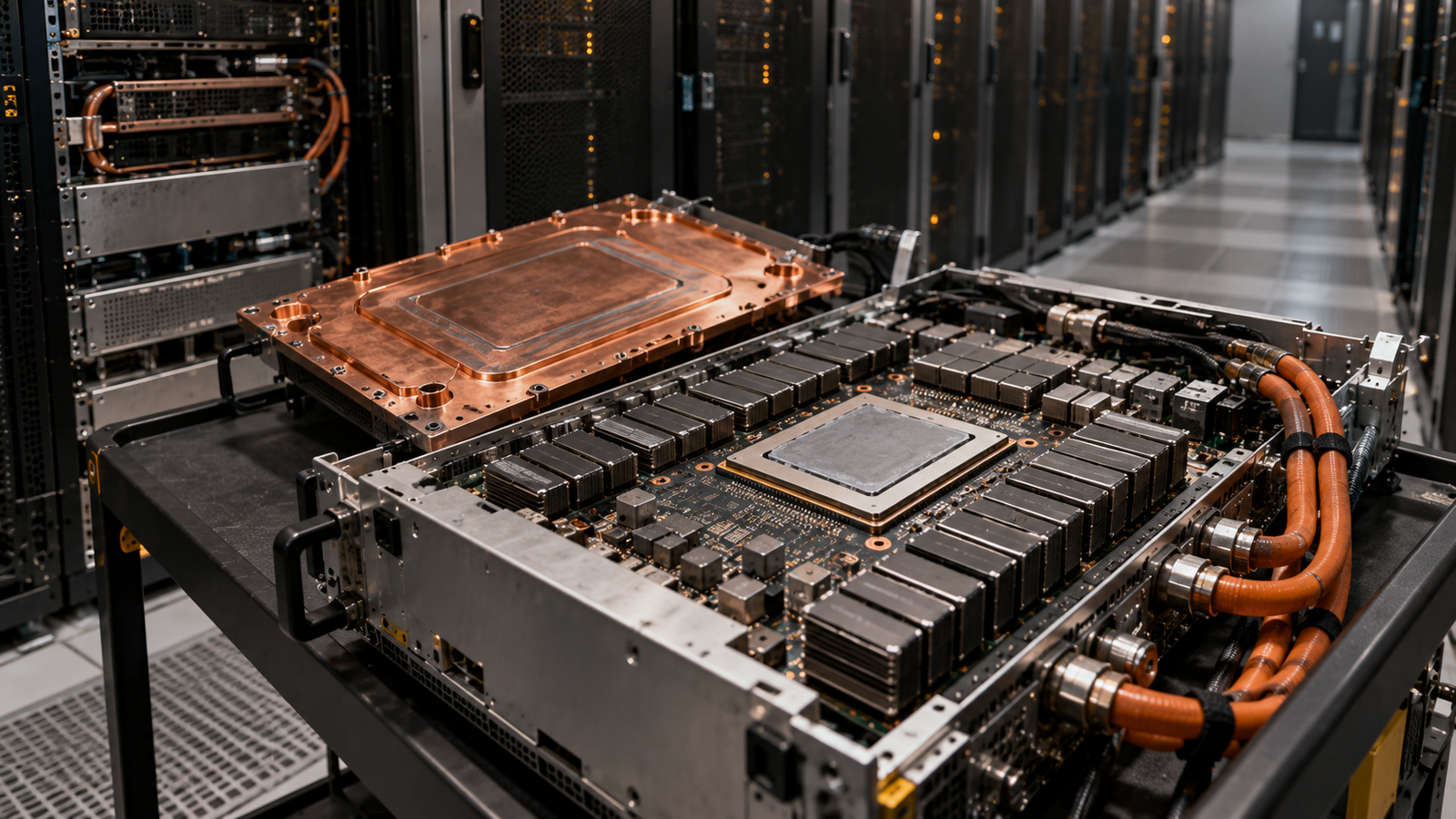
NVIDIA’s position is the most developed. Vera has 88 custom Olympus cores and 176 threads through what NVIDIA calls spatial multithreading. It supports up to 1.5 TB of LPDDR5X memory at up to 1.2 TB/s, and all of this sits on a single compute die. NVIDIA markets it explicitly for “the CPU work behind agentic AI”: code execution, tool use, sandboxing and orchestration. It says it has hand-delivered the first systems to Anthropic, OpenAI, Oracle Cloud Infrastructure and SpaceXAI. It hasn’t given a date for general availability.

The design argument came in a Wccftech interview with NVIDIA’s Vera team, published on 18 October; the interviewees aren’t named. Their claim is that chiplet-based server CPUs gave up per-core performance to reach high core counts. “What suffered over that time in terms of CPU design was really single-threaded perf and IPC,” the team said. They put Vera at up to 2x faster than leading x86 chips on agentic workloads, and the product page claims “up to 1.8x” on sandbox tasks. Both are vendor figures, with no configuration disclosed.

The first customer data

Modal, which runs sandboxed code for AI agents, published the first customer-side data a day later. It has received its first Vera server and plans to move its Sandboxes product onto the platform. That first requires porting its infrastructure and image builds to Arm, and Modal hasn’t given an availability date.

AMD’s rack-scale answer

AMD’s Helion, announced on 12 October, is an open rack blueprint based on an Open Compute Project design. The CPU-only version holds up to 32,768 Zen 6 cores. Its product page lists three blades: dense 256-core servers, balanced 256-core servers and a 96-core high-frequency “performance” option. A separate configuration adds Instinct MI350P GPUs. AMD says configurations are planned for November and has published no benchmarks.

Together, these establish that NVIDIA and AMD now both sell server CPUs configured specifically for agents. They don’t yet establish that agent workloads, in general, reward per-core speed over core count. AMD hedges by offering both. Its 96-core high-frequency blade is a quiet concession that some agent work wants fast cores, while its 256-core blades bet that most of it wants density.

Why agent execution reaches the CPU

A conventional inference request is short and GPU-heavy. Text arrives, the model generates a response, and the CPU’s job is mostly moving data and scheduling batches. An agent loop is different, because it alternates between model calls and work the model asked for:

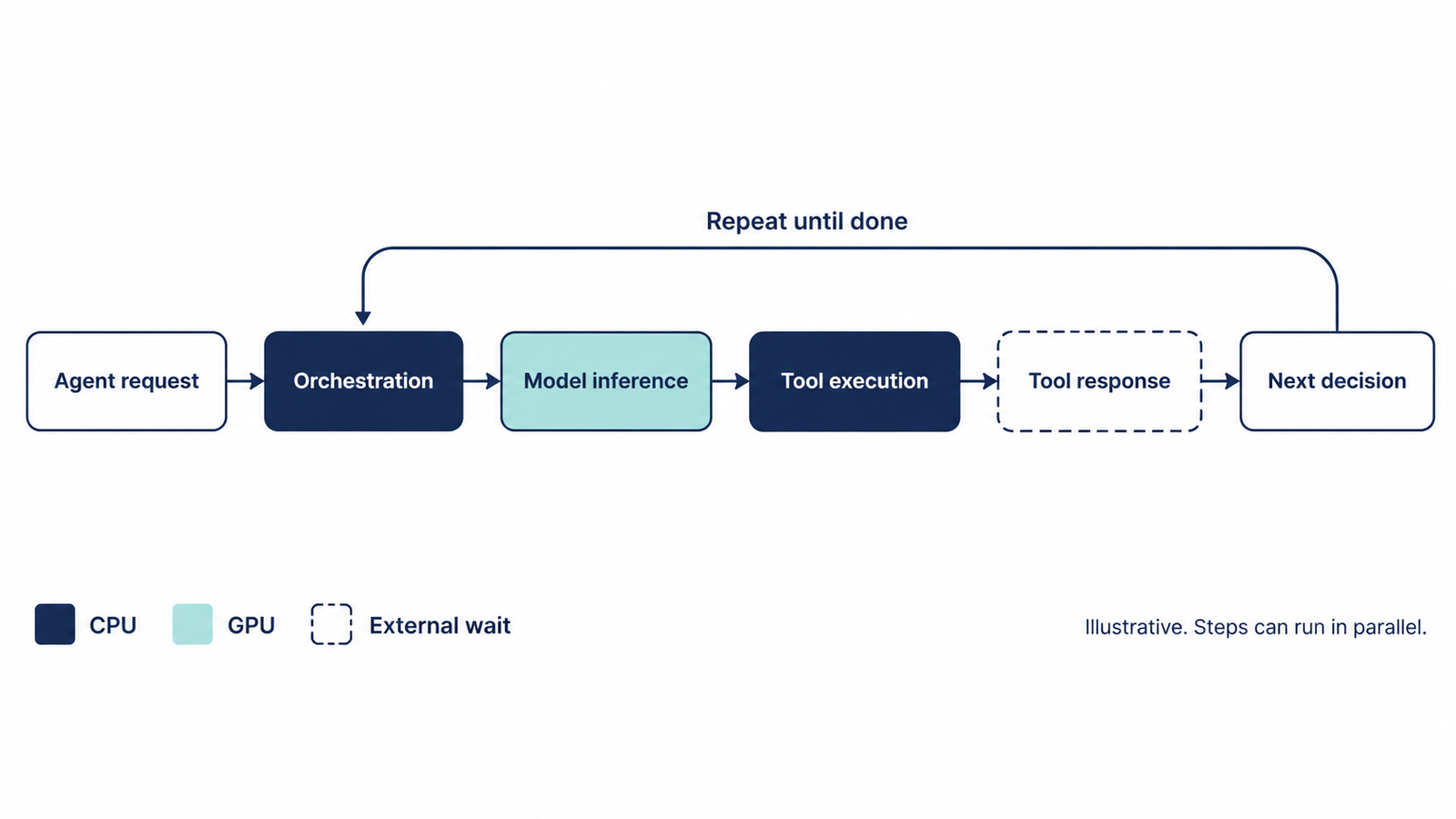
Agent request → orchestration → model inference → tool execution → tool response → next decision → … → final response

Each tool step may compile code, run tests, search files, query a database or call an external API. Several of those run on the CPU. Each step also depends on the previous one: the model can’t choose the next action until the tool returns. That serial dependency is what makes per-step latency matter.

Real systems aren’t this tidy. Many agents issue several tool calls in parallel, and some frameworks overlap model inference with tool execution. Many tool calls leave the machine entirely. The diagram is a skeleton, not a description of every agent.

Independent research supports the CPU’s role, with caveats. A study from Georgia Tech and Intel profiled several agent frameworks on an Intel Emerald Rapids host with an NVIDIA B200 GPU. It found that “tool processing on CPUs can take up to 90.6% of the total latency.” The top figure came from retrieval in a RAG pipeline. In the SWE-agent coding workloads, bash and Python execution took between 43.8% and 78.7% of latency, depending on the benchmark. The authors also found throughput saturating on CPU factors, such as core over-subscription, cache coherence and synchronisation, at larger batch sizes.
CPU for AI agents

Where a faster CPU for AI agents helps, and where it doesn’t

The useful question is which resource each step is waiting on. A faster core only shortens steps that are bound by that core.

Step is bound byTypical examplesWhat helpsWhat a faster CPU core does
CPUCompiling, running tests, parsing, local search, orchestration logicFaster cores, more memory bandwidth, less contentionShortens the step directly
GPUModel inference, time to first token, long-context prefillGPU capacity, batching, caching, smaller modelsLittle, beyond feeding the GPU
Network or external serviceWeb search, third-party APIs, remote databasesCaching, parallel calls, closer endpointsAlmost nothing
Rate limitProvider request or token capsBackoff, queueing, higher tiers, fewer callsNothing; it may hit the limit sooner
An illustrative coding agent

Amdahl’s law sets the ceiling. Take an illustrative coding agent, with assumed numbers rather than measured ones. Each of 12 steps spends 3 seconds waiting for remote model inference and 1.5 seconds compiling and testing on the local CPU, for a 54-second task. A core that is 20% faster cuts each CPU step to 1.25 seconds and the task to 51 seconds. That’s a 6% end-to-end gain from a 20% faster chip.

Now change one assumption. Under load, contention for memory bandwidth stretches each 1.5-second CPU step to 3 seconds. The task now takes 72 seconds, a third longer than on an idle machine. In this case, the hardware’s behaviour under concurrency matters far more than its single-thread speed. That is roughly the situation Modal describes.

Tail latency adds a second reason to care. In “The Tail at Scale”, Jeffrey Dean and Luiz André Barroso showed how rare slow responses multiply when a request depends on many components. Their example was a server that answers in 10 ms but takes a second at the 99th percentile. If a request has to wait on 100 such servers, 63% of requests take more than a second. An agent that runs a dozen dependent steps has the same exposure in sequence: a slow p99 on any step becomes the user’s wait.

Reading Modal’s “up to 2x” result

Modal deserves credit for publishing the method and the code. Its Agentless Agent Bench replays oracle solutions from the Terminal-Bench dataset in prewarmed Docker containers, with network calls stubbed out. Throughput is defined as verified task completions per 60 seconds, and the test raises the number of concurrent containers until the machine saturates. That isolates host CPU behaviour cleanly. It also means the benchmark contains no model inference and no external I/O, which a real agent always has.

What the published material doesn’t settle matters for anyone thinking of buying:

  • Concurrency: Modal doesn’t say at which container count the 2x occurs. “Up to” means the gap is smaller elsewhere.
  • Equivalence: Modal calls the Intel Granite Rapids system “equivalent”, but it had 128 physical cores to Vera’s 88. Memory configuration and SKUs aren’t given.
  • Cost and power: nothing suggests the systems were matched on price, power or rack space. Throughput per dollar or per watt could differ in either direction.
  • Latency: Modal says task latency under load was “equal to, or sometimes even lower than” on x86, but publishes no p95 or p99 figures.
  • Sample size: Modal ran a single node, early in testing. No third party has reproduced the result.

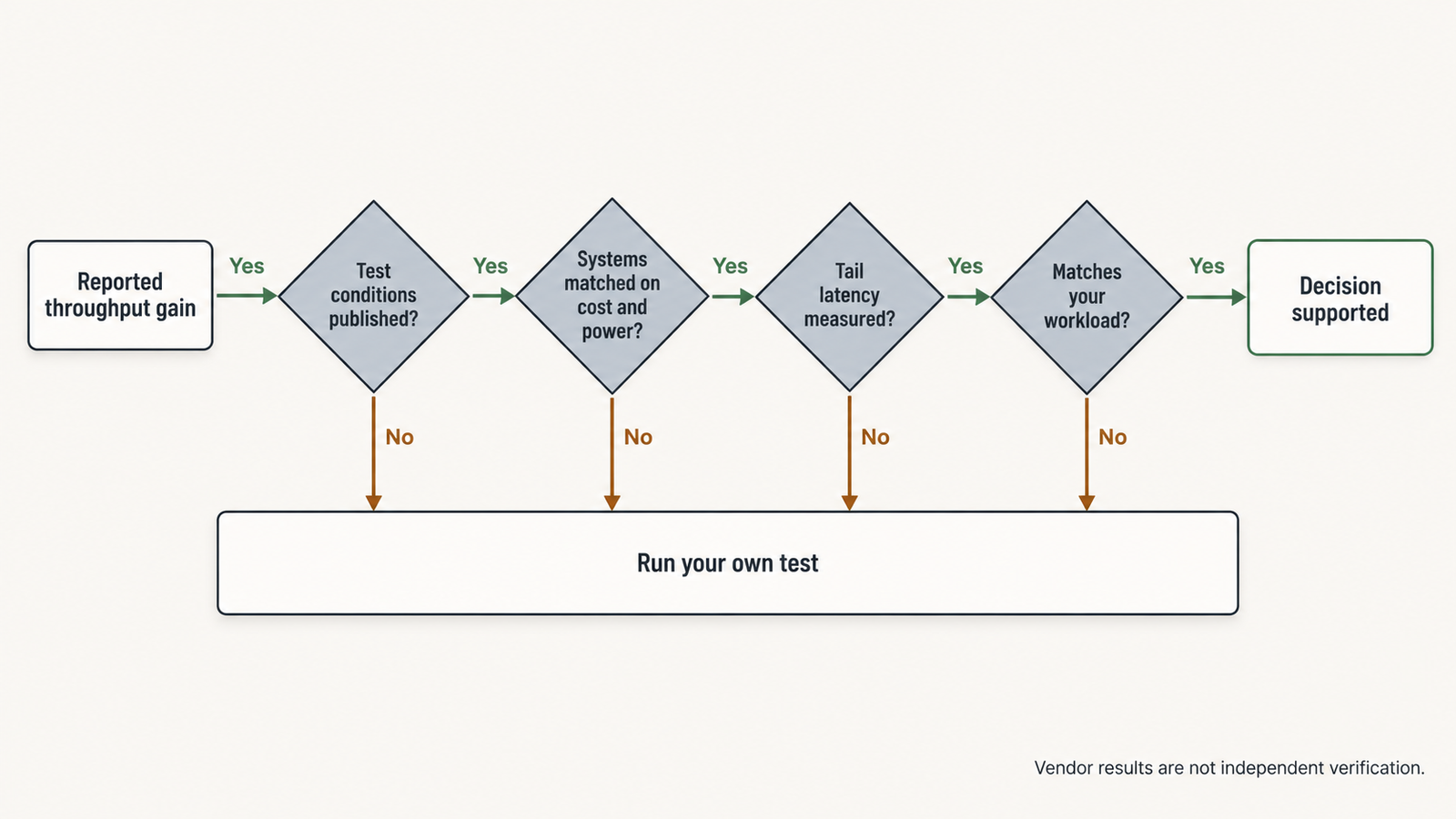
None of that makes the result wrong. It makes it a strong hint about one kind of workload: many concurrent, CPU-heavy coding sandboxes on a single server. A purchasing decision would need the same benchmark run at your concurrency, on cost-matched systems, with tail latency reported and with your real tools, including their network waits.
CPU for AI agents

Memory bandwidth, scheduling and the cost of concurrent agents

Modal’s explanation is that Vera’s memory bandwidth “allows for significantly more container workloads to pack per core, without CPU throttling.” That fits the physics. Compiling and test runs are often memory-intensive. When hundreds run at once, cores spend time stalled on memory rather than executing instructions, and adding cores past that point adds waiting, not work. NVIDIA claims Vera has twice the memory bandwidth of x86 CPUs with DDR5, and three times the bandwidth per core.

Scheduling compounds the problem. Hundreds of mostly idle agent sessions, each waking briefly to run a tool, generate context switches and run-queue pressure. The operating system must decide which waiting process gets a core. The Georgia Tech and Intel study found throughput saturating from core over-subscription in two frameworks at a batch size of 128. Its proposed batching and scheduling changes, which need no new hardware, cut P50 latency by up to 1.7x in some configurations. Software fixes come before silicon.

For the business, the unit that matters is cost per successfully completed task at a given latency target. A platform hosting agents sells sessions, not cores. If a server can carry more concurrent sandboxes before p99 latency breaks the service-level objective, each task costs less, whatever the per-core score. That’s the economic case for agent-tuned CPUs, and it depends on concurrency behaviour as much as on clock speed. Our analysis of when adding another agent stops paying for itself applies the same per-task arithmetic to model tokens.

Deciding whether a faster CPU for AI agents is worth paying for

The decision gets easier if you work through four questions in order.

  1. What share of task time is CPU-bound? If tool execution and orchestration on your hosts take less than a fifth of end-to-end time, even a much faster CPU will move task latency by a few per cent. Spend on inference capacity, caching or parallel tool calls first.
  2. Does CPU time grow with concurrency? Compare a step’s duration on an idle host and at production load. If it stretches sharply, the constraint is contention, which points to memory bandwidth, cache size, core count or scheduling, not raw single-thread speed.
  3. Is something else capping throughput? Provider rate limits and slow external APIs put a ceiling on completed tasks that no host hardware can lift. Our reference on AI API rate limits in 2026 sets out where those ceilings sit.
  4. What does a successful task cost at your SLO? Run candidate platforms at target concurrency and divide total cost by tasks completed within the latency target. A chip that wins on throughput but loses on tail latency may not win here.

For a hosted platform running thousands of untrusted coding sandboxes, the answers may well point to a high-bandwidth, agent-tuned CPU. For an enterprise agent that mostly calls SaaS APIs and waits on a remote model, they usually won’t.

What to measure before choosing a CPU for AI agents

Start small. Three measurements answer most of the question:

  • A per-task time breakdown: orchestration, model inference (including time to first token), each tool call, and waits on external services.
  • End-to-end latency at p50, p95 and p99, both idle and at target concurrency.
  • Completed successful tasks per second, along with failure, retry and rate-limit counts.

If the breakdown shows meaningful CPU time, add:

  • CPU utilisation, run-queue length and time spent waiting, to separate busy cores from contended ones;
  • memory bandwidth and cache misses, where the platform exposes them;
  • concurrent sessions and active work per core, to find the packing limit;
  • power and rack constraints, if density is the reason for changing platform.

Then test candidates with your own workload, not a vendor benchmark, using the same metric: cost per successful task at the latency you’ve promised users.

Conclusion

The evidence supports a narrower claim than the headlines. Agent platforms do put real, serial, latency-sensitive work on CPUs, and vendors are now designing and marketing processors for it. But the one public customer benchmark points mainly at memory bandwidth and behaviour under concurrency. Single-thread speed played a smaller part. And it comes from a synthetic test on a single node, with network calls removed.

The defensible takeaway is that the right CPU for AI agents depends on where your agents spend their time. Measure that first. If the answer is CPU-bound tool work under heavy concurrency, agent-tuned chips like Vera and the high-frequency Helion blades are worth testing. If the answer is model inference or someone else’s API, they aren’t where your next dollar should go.

FAQ

Why does CPU performance matter for AI agents?

Agents alternate between model calls and tool work, such as compiling code, running tests or searching files. Much of that tool work runs on the CPU, and each step waits for the previous one. CPU-bound steps add directly to task latency.

Are AI agents more CPU-intensive than traditional inference?

Often, yes. A single chat request is mostly GPU work. An agent task adds tool execution, orchestration and sandbox overhead between model calls. How much depends on the tools: local code execution is CPU-heavy, while calls to external APIs mostly wait on the network.

Does a faster CPU reduce LLM inference latency?

Not much. Model inference runs on GPUs or other accelerators. A faster CPU can help with tokenisation, batching and data movement around inference, but the main gains for agents come from shortening the tool and orchestration steps between model calls.

What does Modal’s reported 2x throughput figure establish?

That on one Vera server, Modal’s synthetic coding benchmark completed up to twice as many tasks as on an Intel Granite Rapids server under heavy concurrency. It doesn’t establish cost or power efficiency, tail latency, or results for agents that spend time on network calls. It hasn’t been independently reproduced.

When should a team prioritise CPU upgrades over GPUs?

When tracing shows that CPU-side tool execution or orchestration takes a large share of task time, and that share grows with concurrency. If most time is spent on model inference, external APIs or rate-limit waits, GPU capacity or software changes will do more.

How should engineers benchmark CPUs for agent workloads?

Replay real agent tasks, including their tool calls, at production concurrency on cost-matched systems. Record p50, p95 and p99 latency, completed tasks per second, failures, and CPU and memory contention. Compare platforms on cost per successful task at a fixed latency target.


Keep reading

Anthropic IPO valuation

Anthropic IPO: The $895 Billion Question Behind Its Valuation

Last updated: 9 November 2026. Latest confirmed development: Anthropic’s amended S-1, filed on 2 November, still leaves the share count and the IPO price range …
Claude Opus vs Sonnet

Claude Opus vs Sonnet: What the 2026 Price Gap Actually Buys

Last verified: 8 November 2026. All prices are Anthropic’s standard first-party API rates in US dollars per million tokens. They aren’t Claude Pro or Max …
RSA-1024

Did AI Break RSA? What DeepMind Actually Found

Last verified: 8 November 2026. Both papers are unreviewed working papers, and no outside group has reproduced the results yet. No, AI did not break …
Model Distillation

Model Distillation Explained: When AI Learning Becomes Extraction

Last verified: 7 November 2026. Government and company claims are attributed throughout. None has been tested in court. A support team trains a small, cheap …

Alibaba’s Zhenwu V900 and the Memory Wall Behind a 500,000-Card Cluster

Zhenwu V900

Alibaba’s T-Head published a spec sheet for the Zhenwu V900 on September 22 with two numbers on it and one conspicuous absence. The numbers are 216 GB of memory per card and 1,200 GB/s of chip-to-chip bandwidth. The absence is any FLOPS figure at all.

That combination tells you what the company thinks the hard problem is. A chip announcement that leads with memory capacity and interconnect bandwidth, rather than peak arithmetic throughput, is an announcement about systems engineering.

CEO Eddie Wu said a single cluster could hold up to 500,000 of these chips. Multiply that by 216 GB and you get roughly 108 petabytes of accelerator memory — a number worth sitting with, because it describes a procurement problem more than a computing one.

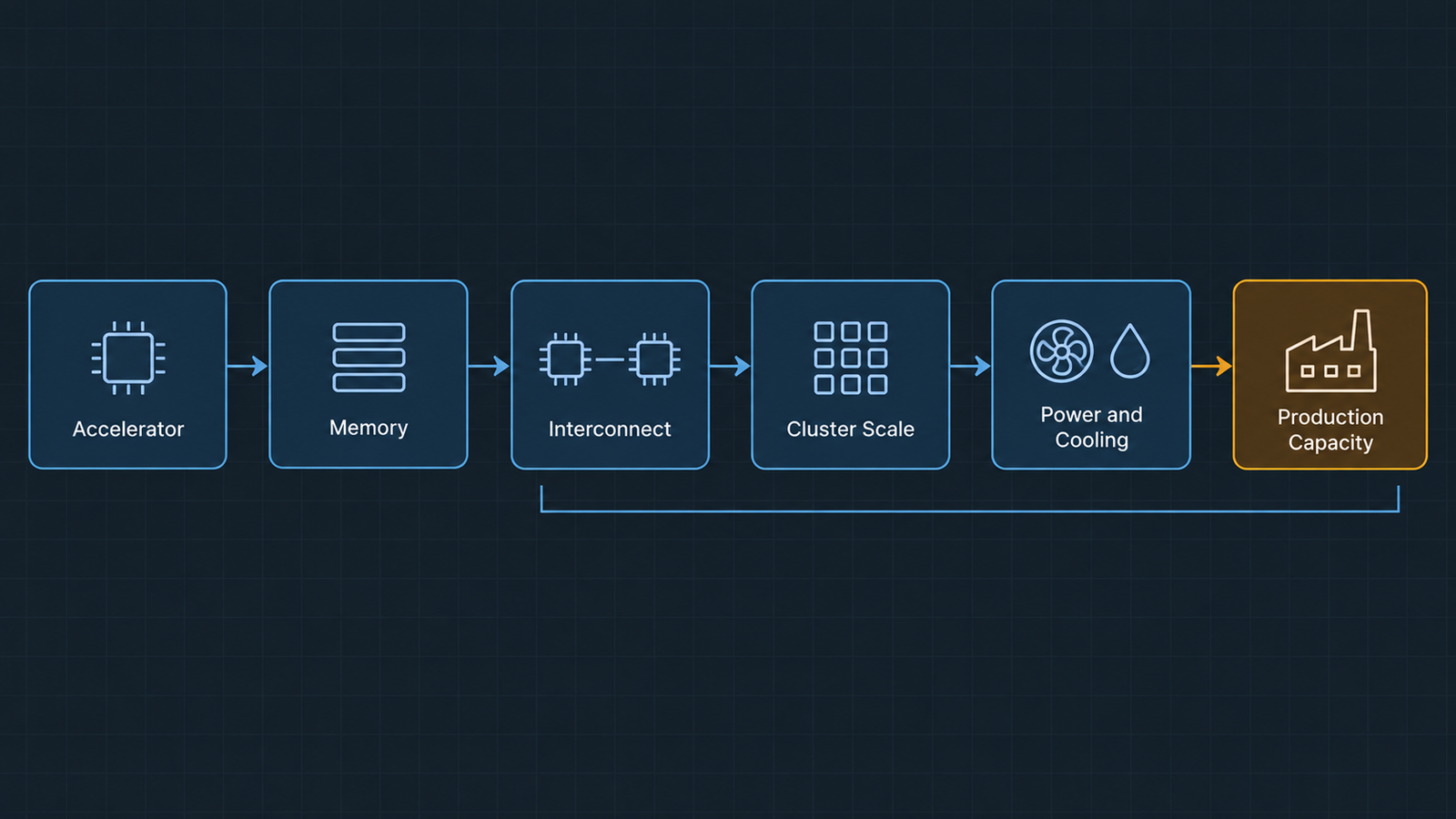
This piece works through the chain from accelerator to memory to interconnect to cluster scale to power to supply, and asks which link actually binds.

Key takeaways
  • The Zhenwu V900 is a training-and-inference accelerator from T-Head, Alibaba’s chip design unit, unveiled at the Apsara Conference in Hangzhou on September 22, 2026, with mass production targeted for Q1 2027.
  • T-Head states 216 GB of memory per card and 1,200 GB/s of inter-chip bandwidth, up from the M890’s 144 GB and 800 GB/s. No FLOPS figure has been published.
  • The claimed 3× performance gain over the M890 is a vendor claim with no disclosed benchmark, workload, precision or power envelope. It cannot be treated as a cross-vendor comparison.
  • Alibaba says clusters can scale to 500,000 cards. At 216 GB each, that would be about 108 PB of aggregate accelerator memory — our calculation, and a design ceiling rather than a deployment.
  • Wu set a target of more than 20 GW of Alibaba Cloud data-centre capacity by 2032, and separately acknowledged that supply shortages currently limit how fast the company can bring compute online.
  • The binding constraint is genuinely unclear from public evidence. Memory supply has the strongest documentary support; power and packaging are close behind.

Quick Navigation


The Zhenwu V900 Announcement Is Bigger Than a Chip Launch

What T-Head presented at Apsara was not a standalone accelerator. It was a stack.

The Zhenwu V900 arrives alongside the ICN Switch interconnect chip, the Panmai smart NIC, the Zhenyue SSD controller and a Panjiu supernode server that packages them together. A later Yitian 750 CPU is designed to speak T-Head’s ICN protocol so the host processor can address the accelerators directly. Alibaba now designs most of the logic silicon in its own AI cluster.

That is the strategically interesting part. Companies build full stacks when the integration between parts is where the performance lives, and when they cannot rely on buying the parts.

The headline specifications, as stated by T-Head:

SpecificationZhenwu M890 (May 2026)Zhenwu V900 (Sep 2026)
Memory per card144 GB216 GB
Inter-chip bandwidth800 GB/s1,200 GB/s
Precision supportFP32 to FP4FP32 to FP4, reworked FP8/FP4 Tensor Core
Supernode scale128 chipsMore than 1,000 chips
Stated cluster ceilingNot stated500,000 cards
Peak throughputNot publishedNot published

Eddie Wu called it the most powerful AI chip in China today and said it delivers about three times the performance of the M890. Take that carefully. Three times what, measured how?

No benchmark has been named. No workload, batch size, precision, software stack, comparison methodology or power envelope has been disclosed. A 3× claim against your own previous generation, using your own harness, is a generational engineering statement, not a standardised result. It cannot be compared against any other vendor’s number, and the absence of a FLOPS figure means there is nothing to normalise against either.

One timing note worth recording: T-Head’s own roadmap from May 2026 placed the V900 in Q3 2027. The chip was unveiled in September 2026 with mass production targeted for Q1 2027. Either the schedule accelerated or the earlier roadmap described a different milestone. Alibaba has not explained the difference.


Start With the 216 GB Number

216 GB per accelerator is the most informative figure on the sheet, and it is worth understanding why capacity earns that position.

For context, NVIDIA’s H200 carries 141 GB of HBM3e. The V900’s 216 GB is more on-package capacity than that part, which several outlets have noted. Capacity is not bandwidth, though, and the comparison stops being useful immediately after that sentence.

Here is what memory capacity per accelerator actually buys during training. Three things compete for it:

  • Parameters. The model weights themselves, plus optimiser state, which for common optimisers runs to several times the parameter memory.
  • Activations. Intermediate results held for the backward pass, scaling with batch size and sequence length.
  • Communication buffers. Space for gradients and shards in flight between devices.

When a model does not fit, you shard it — across tensors, across pipeline stages, across experts. Every shard boundary becomes a communication event. More memory per card means fewer boundaries, which means less traffic on the interconnect, which is why T-Head frames the larger memory as a way to cut model-sharding and data-movement overhead.

Inference has a different profile. Weights sit resident, and the variable cost is the KV cache, which grows linearly with context length and batch size. A card with 216 GB can hold more concurrent long-context sessions before it starts evicting or spilling.

What T-Head has not disclosed is memory bandwidth — the rate at which those 216 GB can be read. For token generation, which is memory-bound, bandwidth governs throughput more directly than capacity does. Several outlets describe the memory as HBM; T-Head’s own sheet says “memory”. Until the generation, stack count and bandwidth are published, the most honest thing to say is that we know how much, not how fast.


What 500,000 Zhenwu V900 Cards Actually Means

The arithmetic first, clearly labelled as ours.

216 GB × 500,000 cards = 108,000,000 GB ≈ 108 PB of aggregate accelerator memory.

That figure is a derived calculation, not a disclosure and not a deployment. Alibaba has not said it has built such a cluster, and nothing in the announcement suggests one exists. The 500,000 number is a stated architectural ceiling for what the ICN Switch fabric is designed to address. Treat 108 PB as what the ceiling would imply if fully populated at the stated per-card capacity.

To make the scale legible: 108 PB is roughly 108,000 terabytes, or about 27 million high-resolution feature films, or enough to hold a few hundred copies of the entire indexed public web in text form. It is a data-centre-scale storage figure, except it is all high-speed memory sitting beside processors.

A second calculation, for the model target Alibaba named. Wu said Alibaba is sizing clusters for future Qwen models in the 5 to 10 trillion parameter range.

10 trillion parameters at FP8 (1 byte each) = about 10 TB just for weights. Optimiser state and activations typically multiply that several times over during training, so call it 30–60 TB of resident memory before any batch data. At 216 GB per card, the weights alone need roughly 46 cards; a realistic training footprint with optimiser state and activations plausibly runs into the high hundreds or low thousands. That is the reason T-Head emphasises supernodes of more than 1,000 chips with unified memory addressing rather than individual card specs.

Third, the honest limit of this kind of arithmetic. Aggregate memory tells you what a cluster could hold. It says nothing about whether the cluster can move data fast enough for that memory to be useful, and nothing about whether 500,000 cards can be manufactured, packaged, powered, cooled and kept running simultaneously.


The Memory Wall

The term describes a simple divergence: arithmetic throughput has improved faster than memory bandwidth for decades, so an increasing share of accelerator time is spent waiting for data rather than computing on it.

Modern AI workloads sit right in that gap. Token generation reads the full weight set for every token produced and is bound by memory bandwidth, not FLOPS. Attention over long contexts reads a KV cache that grows with every token. Training spends much of its time moving gradients and activations rather than multiplying matrices.

Zhenwu V900

This is why more memory per accelerator does not automatically make scaling easier. It changes the shape of the problem rather than removing it:

More memory per card helps withIt does not address
Fewer shards, so fewer communication eventsThe bandwidth to feed the compute units
Longer contexts and larger batches per deviceInterconnect capacity between devices
Fewer devices for a given model sizePower and cooling per rack
Simpler parallelism strategiesWhether the memory can be supplied at volume

The last row is the one that matters most for the V900, and it is where this story stops being about a chip. Every gigabyte of high-bandwidth memory on 500,000 cards has to be manufactured, stacked, bonded and packaged. We looked at the economics of exactly this line in our breakdown of what AI memory actually costs, and the short version is that memory has been the tightest link in the chain through 2026.

One implication is worth naming as analysis rather than fact: a design that leans on large per-card capacity to reduce communication overhead also increases the memory content per unit of compute. That is an elegant engineering trade when memory is available and an expensive one when it is not.


Why 1,200 GB/s Matters

Start with what the number does not tell us.

T-Head states 1,200 GB/s of inter-chip bandwidth. The spec sheet does not clarify whether that is unidirectional or bidirectional aggregate, how many links it is distributed across, or what topology those links form. Those distinctions change the meaning substantially, and nobody outside Alibaba can resolve them from what has been published.

The terms that get conflated, kept separate:

TermWhat it measures
Per-link bandwidthThroughput of a single connection between two devices
Per-chip bandwidthTotal across all of one accelerator’s links, often quoted bidirectionally
Bisection bandwidthThroughput across the worst-case cut that divides the cluster in half
Aggregate cluster bandwidthSum of all links, which almost never reflects achievable performance

The reason to be pedantic: multiplying 1,200 GB/s by 500,000 cards produces a headline figure of 600 PB/s that means essentially nothing. Collective operations are limited by the slowest path through the topology, not by the sum of the links. We are deliberately not performing that multiplication.

What the number does signal is priority. Going from 800 GB/s on the M890 to 1,200 GB/s is a 50% increase in the generation where memory capacity rose 50% as well. The two scaled together, which is consistent with a design aimed at keeping communication from becoming the limiter as supernodes grow from 128 chips to more than 1,000.

Here is why that matters operationally. In distributed training, every step ends with an all-reduce: every device’s gradients must be combined and redistributed. The step cannot finish until the slowest participant finishes. As device counts grow, the time spent in collectives grows relative to the time spent computing, and past a certain point adding accelerators stops adding throughput.

Mixture-of-experts models make this sharper. Expert routing sends each token to a subset of devices, generating all-to-all traffic patterns that are far less forgiving than all-reduce. A model with experts spread across a supernode lives or dies on the fabric.

Agentic inference adds a third pattern: many concurrent long-context sessions, each holding a large KV cache, each needing low latency. That is a memory-and-fabric problem more than a compute one.

So the honest read on 1,200 GB/s is that it is a credible generational improvement in the right dimension, disclosed at a level of detail too coarse to evaluate. A chip that looks strong in isolation can behave very differently when a thousand of them must act as one machine, and the ICN Switch — not the accelerator — is where that behaviour is determined.


Silicon, Memory or Power: Where Is the Real Bottleneck?

The popular answer is memory. It is probably right, but the evidence is more mixed than the confident version suggests, so here is each candidate with what actually supports it.

Silicon

Design capability is no longer the question. T-Head has shipped successive Zhenwu generations and now designs the accelerator, the interconnect switch, the NIC, the SSD controller and the server CPU. That is a full-stack design organisation.

Manufacturing is the open variable. No public information establishes which foundry and process node the V900 uses, what yields look like, or how much advanced packaging capacity is available to stack memory onto it. Advanced packaging is frequently the tighter constraint than the logic wafer itself, and nothing in the announcement addresses it.

Memory

This has the strongest documentary support. US export controls introduced in December 2024 restricted HBM above a specified performance threshold, along with the tooling to produce it, which left Chinese accelerator programmes dependent on domestic supply.

Domestic supply is arriving, slowly. CXMT was reported in September 2026 to have begun limited HBM3E production, with samples in qualification testing at customers including T-Head — a year earlier than most forecasts had projected. Analysts still place CXMT roughly three to five years behind SK hynix, Samsung and Micron on various measures, with low yields and no access to EUV lithography, which reportedly forces about 30% more wafers for the same output.

Two things follow. Domestic HBM exists and is improving faster than expected. It is not yet obviously available at the volume a 500,000-card ambition implies, and “in qualification testing” is not “in supply.”

Power and data centres

The least glamorous and possibly the most binding. Alibaba currently operates an estimated 5–6 GW of capacity by Goldman’s reckoning, adding 1–2 GW a year, against a target of more than 20 GW by 2032. Closing that gap requires more than 2 GW annually, sustained for six years.

Power capacity cannot be iterated annually the way a chip design can. Grid connections, substations, transformers, cooling plant and construction schedules run on multi-year cycles that no amount of engineering talent compresses.

The honest answer

Wu himself provided the most useful data point: he said the industry’s mid-to-long-term demand far outpaces supply capability, and acknowledged that supply shortages are limiting how quickly Alibaba can bring compute online. He did not specify which supply.

Our reading, offered as analysis: memory is the most likely near-term binding constraint through 2027, packaging is a close and under-discussed second, and power becomes the dominant constraint over the 2029–2032 horizon the 20 GW target covers. The evidence supports ranking these as probabilities, not as a settled answer.


What 20 GW Changes

Wu’s exact framing: by 2032, the global data centre capacity operated by Alibaba Cloud will surpass 20 GW.

Precision matters here, because the number is routinely misread. 20 GW of data-centre capacity is not 20 GW of accelerator power draw. Capacity typically describes provisioned electrical capacity for a facility, covering IT load plus cooling, power conversion losses and headroom. Accelerators are a fraction of that, and facilities rarely run at full provisioned load.

What the target actually commits Alibaba to, operationally:

  • Grid connections and generation. 20 GW is utility-scale. Securing interconnection agreements at that magnitude is a regulatory and civil-engineering programme, not a procurement exercise.
  • Construction. Buildings, at a pace of one to two gigawatts of new capacity every year for six years.
  • Cooling. Accelerator racks at current densities increasingly require liquid cooling, which changes building design, not just equipment selection.
  • Power distribution. Substations, transformers, switchgear and busway, all of which have their own multi-year lead times.
  • Utilisation. Provisioned capacity earns nothing until it is filled with hardware that is running jobs.
  • Geographic distribution. “Global” implies capacity outside China, which brings different grids, regulators and equipment supply chains.

The capital implication is substantial. Goldman’s estimate, reported after the conference, puts the required annual capex at roughly RMB 200–300 billion, against a three-year AI and cloud investment plan of RMB 380 billion announced in February 2025 that Alibaba has already indicated it will overshoot. Analysts at Citi and UBS translated the 20 GW target into external cloud revenue of roughly $160–170 billion by the early 2030s.

Treat those as bank models rather than company guidance. Alibaba gave no spending figure alongside the 20 GW target, and Goldman’s starting estimate of 5–6 GW may not measure capacity the same way Alibaba does.

The useful way to read 20 GW is as a statement about sequencing. A company that believes memory or silicon will be its permanent constraint does not commit to a power build-out of that size. Committing to it suggests Alibaba expects the chip supply problem to be solvable on a shorter timescale than the power problem — which is itself a claim about where the bottleneck will sit in five years, not where it sits today.


What Export Controls Change at the Infrastructure Layer

Set the politics aside and look at what restrictions do to an engineering roadmap.

When advanced accelerators and high-bandwidth memory become unavailable through commercial channels, the procurement problem turns into a design problem. Four shifts follow, all visible in what T-Head presented:

  • Vertical integration becomes rational. If you cannot buy the best available parts, integration across parts you control becomes the remaining source of advantage. Designing the accelerator, the switch, the NIC and the CPU to share one protocol is a response to that.
  • Memory efficiency gets prioritised over peak throughput. Native FP8 and FP4 support with reworked Tensor Core arithmetic and MXFP8/MXFP4 scaling formats reduces the bytes per parameter. Lower precision is partly a performance strategy and partly a way to stretch constrained memory.
  • Interconnect substitutes for per-device capability. If individual accelerators cannot match the leading parts, making a thousand of them behave as one machine recovers some of the gap. Unified memory addressing across a supernode is exactly that trade.
  • Software becomes load-bearing. T-Head showcased its SAIL software stack covering training, inference and optimisation. A domestic accelerator without a mature software stack is a paperweight, and this is historically where domestic silicon programmes have struggled most.

The constraint that does not yield to any of this is memory volume. You can design around a bandwidth deficit with better parallelism. You cannot design around not having enough HBM stacks to populate half a million cards, which is why CXMT’s progress matters more to this story than any figure on the V900 spec sheet.

A note on timing, offered without interpretation: the announcement landed days before a scheduled Trump–Xi meeting at which AI and semiconductors were expected to feature. Several outlets made that connection. We have no evidence about intent and are not going to speculate about it.


What We Know About the Zhenwu V900 — and What We Don’t

KnownStatus
Announced September 22, 2026 at Apsara, HangzhouConfirmed
216 GB memory, 1,200 GB/s inter-chip bandwidthVendor-stated
FP32 to FP4 native support, reworked FP8/FP4 Tensor CoreVendor-stated
~3× M890 performanceVendor claim, no methodology
Supernodes of 1,000+ chips, cluster ceiling of 500,000Vendor-stated design capability
Mass production targeted Q1 2027, with Panjiu supernode serverVendor-stated timetable
Not disclosedWhy it matters
Peak throughput at any precisionNo basis for cross-vendor comparison
Memory type, generation and bandwidthBandwidth governs inference throughput
Foundry, process node, die sizeDetermines manufacturable volume
Power consumption per cardSets rack density and the 20 GW arithmetic
Whether 1,200 GB/s is uni- or bidirectionalChanges the figure’s meaning materially
Network topology above the supernodeDetermines behaviour at cluster scale
Memory supplier and secured volumesThe central question for 500,000 cards
Any deployed cluster size to dateThe 500,000 figure is a ceiling, not a build

The Engineering Question Behind the Headline

The Zhenwu V900 is a credible generational step by a design organisation that has shipped several. That is the fair summary of what was announced.

What was not announced is whether the parts Alibaba does not design can be supplied at the scale its ambitions describe. A cluster is not a quantity of chips. It is a system in which memory, fabric, power, cooling, scheduling and fault tolerance all have to hold simultaneously, and the weakest of those determines how much useful compute comes out the other end. At 500,000 devices, component failures become a daily operational routine rather than an exception, and checkpointing strategy starts to matter as much as peak throughput.

The 108 PB figure is a useful way to feel the scale, but read it as a bill of materials rather than a capability. Every one of those gigabytes has to be fabricated, stacked, bonded, mounted, powered and cooled, and export controls have made two of those steps considerably harder for Chinese buyers.

So the question the V900 raises is not whether Alibaba can design a competitive accelerator. It evidently can. The question is whether the memory supply chain, the packaging capacity and the electrical grid can keep pace with a design roadmap that now iterates annually. On current evidence, they cannot all move at that speed — and the V900’s specification sheet, which leads with memory and interconnect and omits FLOPS entirely, reads like a company that already knows it.


Frequently Asked Questions

What is the Zhenwu V900?

A training-and-inference AI accelerator unveiled at Alibaba’s Apsara Conference in Hangzhou on September 22, 2026. It is the successor to the Zhenwu M890 and supports precisions from FP32 down to FP4.

Who developed the Zhenwu V900?

T-Head, Alibaba’s chip design unit, also known as Pingtouge. Alibaba CEO Eddie Wu presented it and described it as the most powerful AI chip in China today.

How much memory does the Zhenwu V900 have?

T-Head states 216 GB per card, up from 144 GB on the M890. The memory generation and bandwidth have not been disclosed, which matters because bandwidth, not capacity, governs token-generation speed.

What is the 1,200 GB/s figure?

T-Head’s stated inter-chip bandwidth, up from 800 GB/s on the M890. The company has not said whether it is unidirectional or bidirectional aggregate, or how it is distributed across links, so it should not be multiplied across devices to estimate cluster performance.

How many V900 cards can an Alibaba cluster support?

Alibaba says a single cluster can scale to 500,000 cards, connected through its in-house ICN Switch. That is a stated design ceiling. No cluster of that size has been announced as deployed.


Keep reading

Anthropic IPO valuation

Anthropic IPO: The $895 Billion Question Behind Its Valuation

Last updated: 9 November 2026. Latest confirmed development: Anthropic’s amended S-1, filed on 2 November, still leaves the share count and the IPO price range …
Claude Opus vs Sonnet

Claude Opus vs Sonnet: What the 2026 Price Gap Actually Buys

Last verified: 8 November 2026. All prices are Anthropic’s standard first-party API rates in US dollars per million tokens. They aren’t Claude Pro or Max …
RSA-1024

Did AI Break RSA? What DeepMind Actually Found
Last verified: 8 November 2026. Both papers are unreviewed working papers, and no outside group has reproduced the results yet. No, AI did not break …
Model Distillation

Model Distillation Explained: When AI Learning Becomes Extraction

Last verified: 7 November 2026. Government and company claims are attributed throughout. None has been tested in court. A support team trains a small, cheap …