LLM Context Window Comparison 2026: Limits and Costs

LLM context window

Specifications and prices checked October 11, 2026 · Prices in USD per million tokens, standard API tier

Short answer: In an LLM context window comparison for 2026, input capacity barely separates the leading models. Every proprietary API checked here accepts about 1 million tokens (1M to 1,050,000), and the two open-weight hosts list 1M or 524,288. Output caps differ more, from 65,536 tokens on Gemini to 128,000 on GPT-6.1 Sol and Claude Opus 5.5. Long-context pricing rules differ most of all: a 300,000-token prompt costs anywhere from $0.06 to $1.20 in input charges.

Three numbers get conflated in most spec sheets. The context window is how much a model can read in one request. The output limit is how much it can write back. The long-context pricing threshold is the prompt size at which the provider starts charging more. A model can have a huge window, a modest output cap and a threshold that doubles your bill well before you get near the window’s edge.

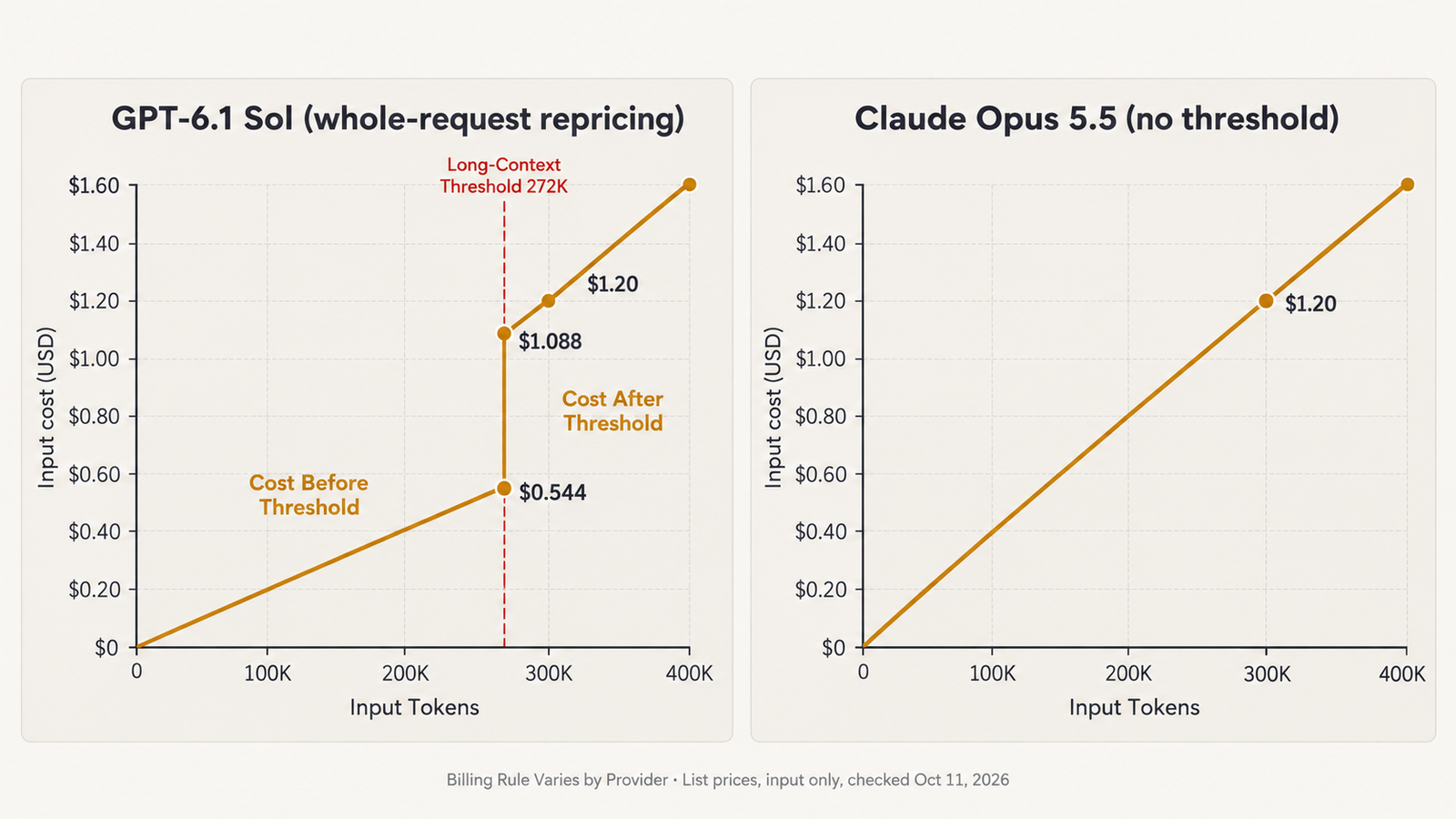
The third number is the one buyers skip. GPT-6.1 Sol charges $2.00 per million input tokens up to 272,000 tokens and $4.00 per million above it, and OpenAI applies the higher rate to the full request. A 270,000-token prompt costs $0.54. A 280,000-token prompt costs $1.12. Ten thousand extra tokens cost 58 cents.

Key Takeaways
  • Context capacity has converged. Every proprietary model checked lists about 1M input tokens, so window size rarely decides a purchase in 2026.
  • Output caps have not converged. Gemini 3.1 Pro and 3.8 Flash cap output at 65,536 tokens, about half of GPT-6.1 Sol’s and Claude Opus 5.5’s 128,000.
  • Three providers reprice by prompt size. OpenAI does it above 272K for the whole request, Google above 200K for Gemini 3.1 Pro, and Anthropic above 100K for Claude Haiku 5.5 only.
  • Claude Opus 5.5 and Sonnet 5.5 have no long-context surcharge. At 300K tokens, Opus 5.5 ($1.20) costs the same as GPT-6.1 Sol and Gemini 3.1 Pro, even though its base rate is twice theirs.
  • Crossing a threshold can cost more than the extra tokens are worth. Just past 272K, a GPT-6.1 Sol prompt more than doubles in price.
  • Caching flattens the comparison. A fully cached 300K prefix costs $0.06 on both GPT-6.1 Sol and Claude Opus 5.5.
  • Open-weight hosting is cheapest per token, but a host’s served context can differ from the model card. Check the endpoint, not the paper.

Quick Navigation


The LLM context window comparison table

All values are taken from official documentation and were checked October 11, 2026. “Threshold” is the prompt size at which input pricing changes. Costs cover input tokens only, with no output, caching, batch discounts or taxes.

Model and versionMax input contextMax outputLong-context thresholdInput belowInput above300K input costAvailabilityDocumentation
GPT-6.1 Sol (gpt-6.1-sol)1,050,000128,000>272K, whole request$2.00$4.00$1.20GA, OpenAI APIModel page
GPT-6 Luna (gpt-6-luna)1,050,000128,000>272K, whole request$0.10$0.20$0.06GA, OpenAI APIModel page
Claude Opus 5.5 (claude-opus-5-5)1M128,000None$4.00n/a$1.20Current, Claude APIModels · Pricing
Claude Sonnet 5.5 (claude-sonnet-5-5)1M128,000None$2.00n/a$0.60CurrentSame as above
Claude Haiku 5.5 (claude-haiku-5-5)1M128,000>100,000$0.10$0.50$0.15CurrentSame as above
Gemini 3.1 Pro (gemini-3.1-pro-preview)1,048,57665,536>200K$2.00$4.00$1.20PreviewModel · Pricing
Gemini 3.8 Flash (gemini-3.8-flash)1,048,57665,536None$0.75 (to Dec 31, 2026; $1.50 from Jan 1, 2027)n/a$0.225StableModel
Gemini 3.5 Flash-Lite (gemini-3.5-flash-lite)1,048,57665,536None$0.30n/a$0.09StableModel
Mistral Large 4 (mistral-large-4)1MNot publicly documentedNone documented$0.68 sale ($1.36 list)n/a$0.204 salePublic Preview, open-weightModel page
Llama 4 Maverick (Together AI)1M per model card; host lists 1,048K and 524,288Not publicly documentedNone documented$0.27n/a$0.081Hosted endpointModel card · Host
Qwen3.8-2.4T-A95B (Together AI)262,144 native; 1M served131,072None documented$2.00n/a$0.60Hosted endpointModel card · Host

Whole-request rules apply where stated. OpenAI says prompts above 272K are “priced at 2x input and cache rates and 1.5x output for the full request.” Anthropic says a Haiku 5.5 request over 100,000 tokens “pays the higher prices,” counting cache reads and writes toward prompt length. Google’s table selects the rate by prompt size (“prompts > 200k tokens”) but does not explicitly say the whole prompt is repriced. This article assumes it is, and that is an interpretation of Google’s wording.

The open-weight rows describe one host’s endpoint, not the model. Qwen3.8’s model card gives 262,144 tokens natively, extensible to about 1M. A 300K request on Together therefore runs in the extended range, where quality can differ from native-length behaviour.

Context window versus output limit

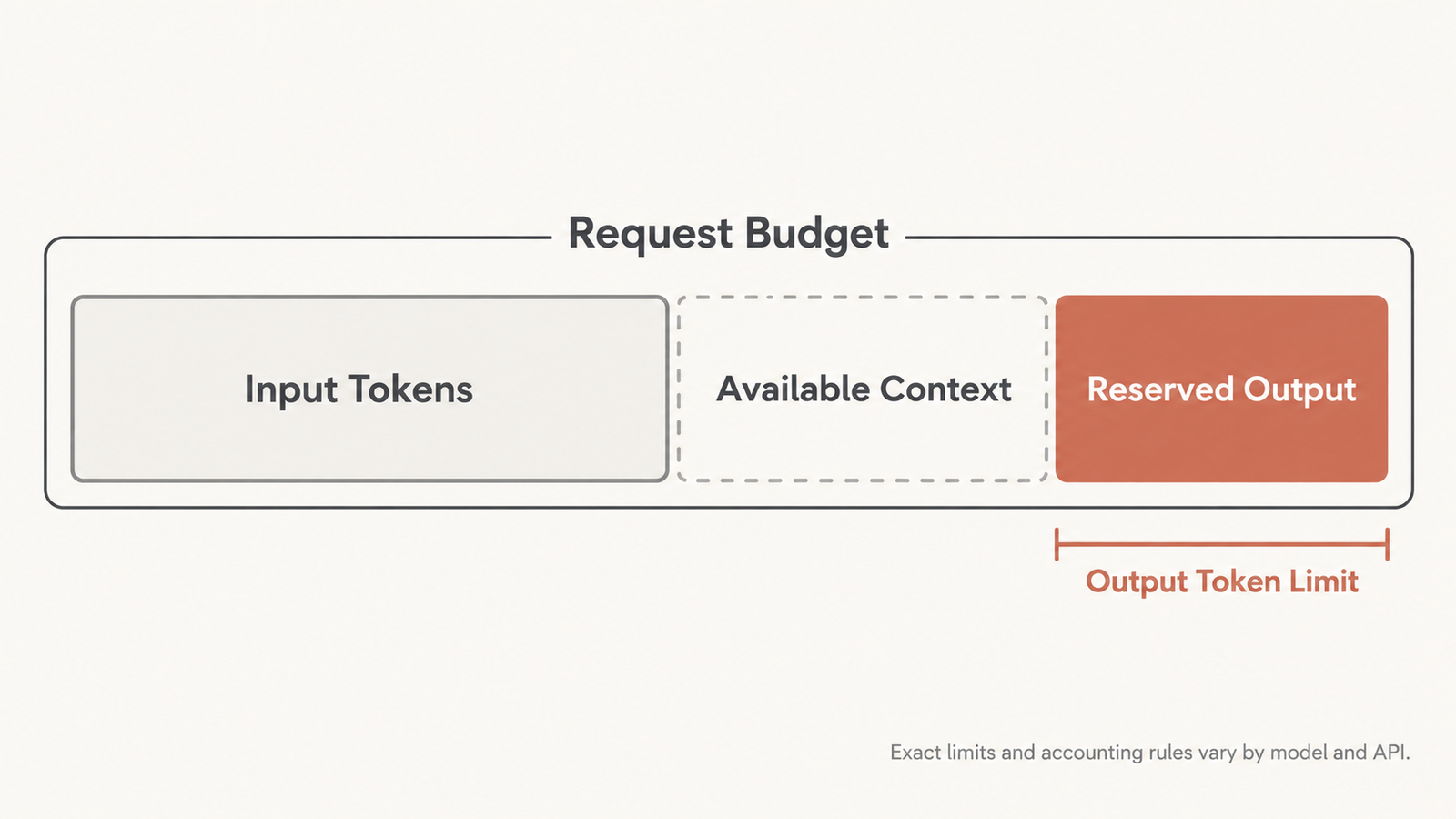
The context window caps what goes in. The output limit caps what comes out in a single response. They are documented separately for every proprietary model here, and they constrain different workloads.

Output limits bind harder than input limits. A model that reads a 400-page contract can only write 65,536 tokens back if it is Gemini 3.1 Pro, or 128,000 if it is GPT-6.1 Sol or Claude Opus 5.5. That is roughly 50,000 versus 100,000 words, before any reasoning tokens. Google bills thinking as output (“output price including thinking tokens”), so whether reasoning also draws on the output cap matters for long reasoning tasks. Check each provider’s documentation for that point, because accounting differs.

Some providers also treat input and output as one shared budget, so a large prompt leaves less room to answer. Qwen’s model card illustrates the general point: it recommends allowing 262,144 tokens for reasoning and 131,072 for the final answer, figures that only make sense if the request budget is planned as a whole.
LLM context window

Where long-context pricing start

Three of the providers checked charge more once a prompt gets long. Each draws the line in a different place and handles it a little differently.

  • OpenAI, 272K, whole request. For GPT-6.1 Sol and GPT-6 Luna, prompts above 272K input tokens pay double the input and cache rates and 1.5 times the output rate, on every token in the request. OpenAI’s pricing page lists the long-context column, and the threshold and the “full request” rule appear on each model page.
  • Google, 200K, by prompt size. Gemini 3.1 Pro charges $2.00 input and $12.00 output for “prompts <= 200k tokens”, and $4.00 and $18.00 for larger prompts. Context caching moves from $0.20 to $0.40. Gemini 3.8 Flash and 3.5 Flash-Lite have no split.
  • Anthropic, 100K, Haiku only. Anthropic’s pricing documentation states that its current models other than Claude Haiku 5.5 “include the full 1M token context window at standard pricing”, adding that “a 900k-token request is billed at the same per-token rate as a 9k-token request.” Haiku 5.5 moves from $0.10 to $0.50 per million input tokens above 100,000 prompt tokens, a fivefold jump, and cache reads count toward that total.

Mistral and the two open-weight hosts publish no threshold.

One ambiguity matters for anyone sizing prompts close to a boundary. Neither OpenAI nor Google says whether “272K” or “200K” means thousands or multiples of 1,024 tokens. The calculations below avoid the gap by testing well clear of either reading.

What a 300K-token request costs

The scenario: one request with 300,000 input tokens, zero output and no caching. It isolates the input-side effect of each pricing rule. These are author calculations from the official prices above, in USD.

Formula, where the provider reprices the whole request once a prompt crosses threshold T:

\text{Input cost} = \frac{N}{1{,}000{,}000} \times \begin{cases} r_{\text{standard}} & N \le T \\ r_{\text{long}} & N > T \end{cases}
Just below and just above each threshold
ModelBelow thresholdCostAbove thresholdCostJump
GPT-6.1 Sol270,000 tokens$0.540280,000 tokens$1.120+$0.58 for 10K more tokens
GPT-6 Luna270,000$0.027280,000$0.056+$0.029
Gemini 3.1 Pro190,000$0.380210,000$0.840+$0.46 for 20K more tokens
Claude Haiku 5.599,000$0.0099101,000$0.05055.1x for 2% more tokens
At 300,000 tokens
ModelRate applied300K input cost
GPT-6.1 Sol$4.00 (long-context)$1.20
Claude Opus 5.5$4.00 (standard)$1.20
Gemini 3.1 Pro (preview)$4.00 (long-context, assumed whole prompt)$1.20
Claude Sonnet 5.5$2.00$0.60
Qwen3.8-2.4T-A95B on Together$2.00$0.60
Gemini 3.8 Flash$0.75 (2026 rate)$0.225
Mistral Large 4 (preview)$0.68 sale / $1.36 list$0.204 / $0.408
Claude Haiku 5.5$0.50 (long-context)$0.15
Gemini 3.5 Flash-Lite$0.30$0.09
Llama 4 Maverick on Together$0.27$0.081
GPT-6 Luna$0.20 (long-context)$0.06

The three-way tie at the top is the central finding. On list prices, Claude Opus 5.5 costs twice as much as GPT-6.1 Sol per input token. At 300K tokens, OpenAI’s threshold has already doubled Sol’s rate and Google’s has doubled Gemini 3.1 Pro’s, while Opus stays flat. All three land at $1.20. Below 200K, Opus costs twice as much as either. Above 272K, the gap disappears.

Separate scenario: adding an 8,000-token answer

Keep the 300K prompt and add 8,000 output tokens. OpenAI’s long-context rule raises Sol’s output rate to $15.00 per million, and Google’s raises Gemini 3.1 Pro’s to $18.00.

  • GPT-6.1 Sol: $1.20 + (8,000 / 1M × $15) = $1.32
  • Gemini 3.1 Pro: $1.20 + (8,000 / 1M × $18) = $1.344
  • Claude Opus 5.5: $1.20 + (8,000 / 1M × $20) = $1.36
  • GPT-6.1 Sol at 270,000 input tokens instead: $0.54 + (8,000 / 1M × $10) = $0.62

Trimming 30,000 tokens from the prompt halves Sol’s bill. For Opus, the same trim saves about 9%.
LLM context window

Context window choices for RAG, coding and agents

  1. RAG pipelines. Retrieval systems control their own prompt size, which makes them the easiest place to exploit a threshold. A pipeline that routinely sends 250,000 to 300,000 tokens to GPT-6.1 Sol is paying the long-context rate on a share of requests that a retrieval cap of about 260,000 would remove. On Claude Opus 5.5 there is no such boundary to manage.
  2. Long-document analysis. Reading a large filing and returning a short summary is the case where big windows pay off most cleanly: input-heavy, output-light. The output cap rarely matters here, and the threshold often decides the bill.
  3. Coding agents. Consider an illustrative repository-aware agent that resends 300,000 tokens of code context on every turn. Without caching, 20 turns on GPT-6.1 Sol cost 20 × $1.20 = $24 in input alone. If the repository context is a stable prefix, OpenAI’s long-context cached rate of $0.20 per million drops each turn’s input to $0.06. That is why caching usually changes these comparisons more than the threshold does.
  4. Multi-agent systems. When several agents each carry a copy of a shared history, every copy is billed separately and pushed toward the threshold on its own. Summarising or pruning shared state before handoff can keep each call below a boundary that the combined history would cross.
  5. Long-running agents. Tool results accumulate. An agent that starts at 50,000 tokens and appends 10,000 per step crosses Gemini 3.1 Pro’s 200K line at step 16 and Sol’s 272K line at step 23. From that point every turn is billed at the higher rate. Compaction policies are cost controls, not just memory management.
  6. Prompt caching. Caching narrows the gap between providers on repeated context. At long-context rates, a fully cached 300K prefix costs $0.06 on GPT-6.1 Sol ($0.20 per million) and $0.06 on Claude Opus 5.5 ($0.20 per million cache hit). UniverseBlend’s earlier analysis of why a 50% price cut doesn’t halve agent bills made the same point for shorter contexts: once cache reads dominate, list-price gaps shrink. Note that Anthropic counts cache reads toward Haiku 5.5’s 100K threshold, and OpenAI doubles cache rates above 272K, so caching does not exempt a request from repricing.
  7. Splitting requests. Two 150,000-token GPT-6.1 Sol calls cost $0.60 in input, half the price of one 300,000-token call. That only works if the task decomposes. Cross-document reasoning does not split cleanly, and any shared instructions are paid twice. For Opus 5.5, splitting saves nothing on price.

A usable context budget is smaller than the advertised window. Rate limits measured in tokens per minute fill faster with long prompts, which UniverseBlend covered in AI API rate limits in 2026. This article makes no latency claims, but longer prompts add processing time before the first token.

A context window checklist before you choose

  • Measure your real prompt-size distribution, including p95, not just the average
  • Find each candidate’s threshold and whether it reprices the whole request
  • Check the output cap against your longest required answer, including reasoning tokens
  • Price the workload with your actual cache-hit rate
  • Confirm the hosted endpoint’s served context for open-weight models, not just the model card
  • Note preview status (Gemini 3.1 Pro, Mistral Large 4) and dated price changes (Gemini 3.8 Flash on January 1, 2027)
  • Check tokens-per-minute limits at your prompt size
  • Test quality at your real context length; a model accepting 1M tokens says nothing about how well it uses them

Conclusion

This LLM context window comparison shows the window itself has stopped being a differentiator. Nearly everything accepts about a million tokens. What separates the models is the output cap, whether the model is still in preview, and above all the pricing rule waiting at 100K, 200K or 272K tokens.

For workloads that sit under 200K tokens, list prices are a fair guide. For workloads that regularly cross 272K, a model with no surcharge can match one with half its base rate, and trimming a prompt by 10% can halve the bill. Price your real prompt distribution against each provider’s rule before trusting the headline number.

Frequently Asked Questions

What is the difference between an LLM context window and an output token limit?

The context window is the maximum input a model accepts in one request. The output limit is the maximum it can generate in one response. As of October 2026, most leading models accept about 1M input tokens, but output caps range from 65,536 (Gemini) to 128,000 (GPT-6.1 Sol, Claude Opus 5.5).

Does a larger context window always mean a better model?

No. Capacity says nothing about how well a model uses long context, and the largest windows now look nearly identical across providers. Output limits, pricing thresholds and quality at your real prompt length matter more.

What happens when a request exceeds the context window?

The API generally rejects it or requires you to shorten the input. Exact error behaviour varies by provider. Applications should count tokens before sending and trim, summarise or split oversized inputs.

How does long-context pricing work?

Some providers charge a higher per-token rate once a prompt passes a set size. In October 2026 that meant 272K for OpenAI’s GPT-6.1 Sol and GPT-6 Luna, 200K for Google’s Gemini 3.1 Pro, and 100K for Anthropic’s Claude Haiku 5.5. Claude Opus 5.5 and Sonnet 5.5 have no surcharge.

Does crossing a pricing threshold reprice the entire request?

For OpenAI, yes: the documentation says the higher rates apply “for the full request.” Anthropic’s Haiku 5.5 rule also applies the higher price to any request over the threshold. Google selects the rate by total prompt size but does not state the whole-request rule as explicitly.

Can prompt caching reduce long-context costs?

Yes, often by more than avoiding a threshold. A fully cached 300K prefix costs $0.06 on GPT-6.1 Sol or Claude Opus 5.5, against $1.20 uncached. Caching does not exempt a request from long-context repricing, though.

How should developers compare proprietary and open-weight models?

Compare the specific hosted endpoint, not the model card. A host may serve a different context length than the paper describes. Qwen3.8’s native 262,144-token context is extended to 1M on Together AI, for example.

What should an AI agent developer measure before choosing a model?

Prompt-size growth per step, the step at which each provider’s threshold is crossed, output needs per turn, cache-hit rate and tokens-per-minute limits. Then test answer quality at the context length the agent actually reaches.


Keep reading

Anthropic IPO valuation

Anthropic IPO: The $895 Billion Question Behind Its Valuation

Last updated: 9 November 2026. Latest confirmed development: Anthropic’s amended S-1, filed on 2 November, still leaves the share count and the IPO price range …
Claude Opus vs Sonnet

Claude Opus vs Sonnet: What the 2026 Price Gap Actually Buys

Last verified: 8 November 2026. All prices are Anthropic’s standard first-party API rates in US dollars per million tokens. They aren’t Claude Pro or Max …
RSA-1024

Did AI Break RSA? What DeepMind Actually Found

Last verified: 8 November 2026. Both papers are unreviewed working papers, and no outside group has reproduced the results yet. No, AI did not break …
Model Distillation

Model Distillation Explained: When AI Learning Becomes Extraction

Last verified: 7 November 2026. Government and company claims are attributed throughout. None has been tested in court. A support team trains a small, cheap …

GPT-6 Sol vs Claude Opus 5.5: What the 50% Cut Misses

GPT-6 Sol vs Claude Opus 5.5

On September 22, 2026, Anthropic cut the price of its flagship Opus tier. Ninety minutes later, OpenAI halved the price of two GPT-6 models. Both announcements led with a percentage.

Percentages are the wrong unit. The invoice is denominated in tasks, and a task is a bundle of cached input, fresh input, output tokens, tool calls, retries and occasional failures that reach production. Change the mix and a 50% token-price cut can produce anything from a 50% saving to almost none.

This is a comparison of GPT-6 Sol vs Claude Opus 5.5 by workload shape rather than by rate card. The short version: the line that decides most agentic bills is the cached-input read, and on that line the two models are now priced identically.

Key takeaways

  • Both models landed on September 22, 2026, about 90 minutes apart. GPT-6 Sol lists at $2/$10 per million input/output tokens; Claude Opus 5.5 at $4/$20.
  • Cache reads are $0.20 per million on both. On cache-heavy agent workloads, the headline 2:1 token-price gap compresses sharply.
  • The two “cheaper” claims use different baselines. OpenAI’s 50% is measured against GPT-5.6 promotional pricing; Anthropic’s 20% is against Opus 5, with the larger 40% figure resting on token efficiency at default settings.
  • Output tokens, not input, dominate reasoning-heavy bills. A model that thinks longer can cost more per task at a lower per-token price.
  • Neither company published a symmetric head-to-head. OpenAI benchmarked Sol against Claude Opus 5 and, where 5.1 numbers were missing, Fable 5, using competitor scores from published reports.
  • Token prices fell while memory prices rose: TrendForce recorded conventional DRAM contract prices up 93–98% quarter over quarter in Q1 2026 before moderating to 13–18% in Q3.
  • The only reliable comparison is your own traffic. Cost per completed task, measured on 50 real inputs, beats any published rate card.

Quick Navigation


GPT-6 Sol vs Claude Opus 5.5: The Numbers Everyone Is Comparing

Here is what each company published, kept in separate categories, because list price, promotional price, batch price and cached price are not interchangeable.

Line item (per 1M tokens)GPT-6 SolClaude Opus 5.5
Input$2.00$4.00
Output$10.00$20.00
Cached input read$0.20$0.20
Cache write (5-min)No separate charge published$5.00
Cache write (1-hour)Not applicable$8.00
Batch50% off$2.00 / $10.00
Fast / premium modeNot offered at this tier$8.00 / $40.00
PredecessorGPT-5.6 Sol at $4 / $20Claude Opus 5 at $5 / $25

OpenAI’s announcement states the reduction plainly: Sol moves from $4/$20 to $2/$10 and Luna from $0.20/$1.20 to $0.10/$0.50, a 50% cut against GPT-5.6 promotional pricing, attributed to caching and inference improvements the company says it is passing on. Cached input-token reads carry a 90% discount, which puts Sol’s cached reads at $0.20.

Anthropic’s Opus 5.5 lists at $4 input and $20 output, down from Opus 5’s $5 and $25, with cache reads falling from $0.50 to $0.20 and five-minute cache writes from $6.25 to $5. Anthropic told reporters the model runs about 40% cheaper than Opus 5 at default settings, combining the 20% token-price cut with fewer tokens consumed per task.

Two caveats before anyone builds a spreadsheet on these numbers. OpenAI’s baseline is a promotional rate, not a long-standing list price, so “50% cheaper” compares against a discount that was already in force. An OpenAI spokesperson told VentureBeat the new rates are permanent rather than promotional; that is a company statement, not something a buyer can verify from outside. And Anthropic’s 40% is a blended claim about workloads, not a line on the rate card — the rate card says 20%.

Verify both against the live pricing pages before you commit a budget. Rate cards move, and the ones above were published on launch day.


Where the GPT-6 Sol vs Claude Opus 5.5 Savings Actually Come From

A price cut can arrive through three different doors, and they behave differently on your invoice.

  • Door one: the per-token rate. This is the headline. It applies uniformly to every token of the relevant class, so a 50% cut here does produce a 50% saving — but only on the portion of the bill made of tokens priced at that rate.
  • Door two: the discount structure. Cached reads, batch processing and long-context surcharges change which rate applies to which tokens. This door moves more money than the first one on most production workloads, and almost nobody reads it.
  • Door three: token efficiency. If a model completes the same task using fewer output tokens, the bill falls without any rate changing. Anthropic leaned on this explicitly, saying Opus 5.5 generates output faster and uses fewer tokens per task. Efficiency claims are the hardest to verify from outside, because they depend on your prompts and your effort settings.

The distinction matters because doors two and three are workload-dependent, while door one is not. Two teams on identical rate cards can see completely different savings.


The Cache Line That Changes the GPT-6 Sol vs Claude Opus 5.5 Math

Cached input reads cost $0.20 per million tokens on both models. That single equality does more to determine competitive cost than the 2:1 gap on list input price, because of what modern agents actually send.

An agent turn is mostly repetition. The system instructions, the tool schemas, the retrieved documents, the repository context and the conversation so far all get resent on every turn. Only the newest user message and the model’s reply are genuinely new. On a long-running agent, cached tokens routinely outnumber fresh ones by an order of magnitude.

Work through what that does to a single turn. Take 100,000 tokens of reused prefix, 5,000 tokens of new input and 1,500 tokens of output. This is a worked example, not a measurement.

ComponentGPT-6 SolClaude Opus 5.5
100,000 cached input$0.0200$0.0200
5,000 fresh input$0.0100$0.0200
1,500 output$0.0150$0.0300
Turn total$0.0450$0.0700

Sol is about 36% cheaper on that turn, not 50%. Now run the same prefix uncached: 105,000 input tokens cost $0.21 on Sol against $0.42 on Opus 5.5, and the full 2:1 ratio returns — along with a bill roughly five times larger on both.

The caching mechanism differs in ways that matter operationally. OpenAI applies caching automatically to eligible reused prefixes within a rolling window and publishes no separate write charge, while giving developers explicit breakpoints, a caching dashboard and a diagnostics tool, plus the ability to change reasoning effort or toggle tools mid-conversation without invalidating the cached prefix. Anthropic charges for cache writes — $5 per million for the five-minute window, $8 for the one-hour window — which means the break-even depends on how many reads each write earns.

That write charge is not a disadvantage so much as a different shape. A prefix written once and read forty times amortizes cheaply. A prefix written once and read twice does not. If your agent rebuilds its context frequently, model the writes explicitly.

The efficiency gains are real on the provider side too. OpenAI says GitHub reported that its caching improvements cut the share of prompt tokens needing fresh processing by more than half, measured across billions of requests. That is a claim about one large customer’s traffic, reported by OpenAI, and it says nothing about what your cache-hit rate will be.


Five Workload Shapes Where GPT-6 Sol vs Claude Opus 5.5 Diverges

Every calculation below is a labelled hypothetical built from published rates. None of it is measured production data, and your token counts will differ.

1. Long-context agentic work

A research or operations agent holding 150,000 tokens of context, running 12 turns, producing 2,000 output tokens per turn. Most input is cached after the first turn.

The cached portion is priced identically on both, so the comparison collapses to output and fresh input. Sol’s advantage is real but roughly a third, not a half. Anthropic’s cache-write charge applies on each rebuild of the prefix; if the agent’s context shifts every few turns, add $0.75 per rebuild on a 150,000-token prefix at the five-minute rate.

2. High-volume classification and extraction

Short inputs, short outputs, millions of requests, little or no reuse. Say 800 input tokens and 120 output tokens per call, 5 million calls a month.

GPT-6 SolClaude Opus 5.5
Input, 4B tokens$8,000$16,000
Output, 600M tokens$6,000$12,000
Monthly total$14,000$28,000

This is the shape where the headline ratio holds exactly, because nothing is cached and nothing is reasoned about at length. It is also the shape where neither of these models is the right answer — GPT-6 Luna at $0.10/$0.50 would run the same volume for roughly $700, and the real question is whether its accuracy clears your threshold.

3. Coding agents with heavy cache reuse

A coding agent maintaining 200,000 tokens of repository context across 30 turns, 1,500 output tokens per turn, cache hit rate above 90%.

Here the bill is dominated by cached reads at $0.20 on both sides, plus output. Sol wins on output price; Opus 5.5 wins if Anthropic’s token-efficiency claim holds on your tasks, because fewer thinking tokens beats a lower price per thinking token. This is precisely the case where the rate card cannot answer the question and a measured test can.

4. One-shot generation

20,000 tokens in, 2,000 out, no reuse. Sol costs $0.06, Opus 5.5 costs $0.12. Clean 2:1, and the absolute numbers are small enough that the choice should probably rest on output quality rather than price.

5. Repeated multi-step agent loops

The shape where estimates go wrong. Ten tool calls per task, each one a model round trip, each carrying the accumulated trace. Costs compound with the square of the loop length as the transcript grows, and a single retried loop can double a task’s cost.

This is also where reasoning-token volume bites. Independent testing reported by Artificial Analysis put Opus 5.5 at the top of its Intelligence Index as of September 22, while consuming roughly 119,000 output tokens per task against about 73,000 for Opus 5 and 27,000 for GPT-6 Astra. Read carefully: that is a cross-model figure from one evaluation suite, not a measurement of your agent. But it illustrates the mechanism — a model that reasons longer can produce a larger bill at a lower per-token rate, and the effort setting you choose moves this number more than the rate card does.

The pattern

GPT-6 Sol vs Claude Opus 5.5
Workload shapeWhere cost concentratesDoes the 2:1 price gap hold?
Long-context agenticCached reads, outputNo, compresses sharply
High-volume extractionFresh input, outputYes
Coding agent, high reuseCached reads, outputNo, and token efficiency may reverse it
One-shot generationFresh input, outputYes
Multi-step loopsOutput, retriesUnpredictable without measurement

Why Infrastructure Costs Tell a Different Story

Token prices halved in September. The inputs to serving those tokens did not.

Memory is the clearest case. TrendForce’s contract-price surveys recorded conventional DRAM rising roughly 93–98% quarter over quarter in Q1 2026, lifting industry revenue 81% to about $97 billion, followed by a further 58–63% in Q2. By Q3 the increase moderated to 13–18% quarter over quarter, with server DRAM undersupplied and suppliers prioritising AI and server allocations. Moderating growth on top of two near-doublings is still a much higher price than a year earlier.

Keep the categories distinct, because they are not substitutes and they do not move together:

CategoryWhat it isWhere it sits
Conventional DRAMStandard DDR5 memoryServer main memory, consumer devices
Server DRAM / RDIMMRegistered modules for serversHost memory beside accelerators
HBMStacked high-bandwidth memoryOn the accelerator package
GPU memoryThe HBM attached to a specific acceleratorHolds weights and KV cache

HBM is allocated separately from conventional DRAM and priced separately, but they compete for the same wafers. TrendForce noted suppliers reallocating capacity toward HBM and server products, which is part of why commodity memory repriced so violently.

So how do providers cut prices into that? Three mechanisms, none of which requires hardware to get cheaper: better utilisation of accelerators already deployed, architectural and serving efficiency improvements, and margin. OpenAI attributes its reduction to caching and inference improvements. That is a credible mechanism and also a commercial decision — Ramp’s lead economist described the two labs as fighting a price war that is driving down both AI prices and their own ability to profit from it.

The useful inference for a buyer: today’s rate card reflects a competitive position, not a cost floor. Build your model so a rate change in either direction does not invalidate it.


Memory Is Becoming Part of the Token Price

Generating tokens is a memory-bound problem, and that is why caching is priced the way it is.

During decoding, the accelerator reads the model weights and the KV cache — the stored attention state for every token in the context — for each token it produces. Arithmetic units sit idle waiting for data. Throughput is governed by how fast bytes move out of HBM, not by peak FLOPS.

That has three consequences for anyone reading a price sheet.

  1. Context length is a memory cost, not just a token cost. KV cache size grows linearly with context. A 200,000-token prefix occupies real HBM for the duration of the request, and that capacity cannot serve anyone else. This is why long-context tiers carry surcharges: reported pricing for Sol applies a 2x input and 1.5x output multiplier above 272,000 input tokens, which is worth confirming against the API docs if your workload runs long.
  2. A cache read is cheap because the expensive part already happened. The prefill computation that built the attention state was paid for on the write. The read reuses stored state, which is closer to a memory-and-storage operation than a compute one. That is the physical reason both vendors landed near $0.20 rather than near their input prices.
  3. Batching is where provider economics live. Serving many requests concurrently amortises the weight reads across more output tokens. Latency-sensitive, low-batch workloads are the expensive ones to serve, which is why batch APIs carry 50% discounts and why fast modes cost double.

None of this changes what you are billed per token. It explains why the structure of the price sheet looks the way it does, and why the cheap line is cheap.


The GPT-6 Sol vs Claude Opus 5.5 Benchmark Comparison Has a Catch

Neither company published a head-to-head against the other’s new model. They could not have: the two launched ninety minutes apart.

OpenAI’s comparisons are mostly cost per task rather than cost per token, which is the right unit, and they name Anthropic repeatedly. On AutomationBench 1.0.6, GPT-6 Sol at xhigh effort scored 33.2% at $0.27 per task, against Claude Opus 5 at max effort on 26.9% at 11.1 times Sol’s cost per task. On DeepSWE v1.1, Sol at max effort scored 68.8%, within 1.1 points of Claude Fable 5’s 69.9% at xhigh, at roughly 80% lower cost per task. On OSWorld 2.0 offline, Sol at xhigh scored 60.5% against Opus 5 at medium on 60.3%, again at about 80% lower cost.

Read OpenAI’s own footnotes before reading the charts. The company states that competitor scores were taken from publicly available reports rather than run in-house, and that Claude Fable 5 scores stood in where Fable 5.1 numbers were unavailable. It also notes that its Fable 5.1 AutomationBench datapoint understates that model’s real cost, because it omits the Opus 5 fallbacks that fired on roughly 40% of tasks.

So the baseline is Claude Opus 5, the model Opus 5.5 replaced. None of those comparisons touch Opus 5.5.

Anthropic’s side has the mirror problem. Its launch table put Opus 5.5 at 66.4% on Terminal-Bench 4.0 against 52.3% for Opus 5 and 57.9% for GPT-6 Astra — a different benchmark, a different generation of competitor, and a different effort configuration.

Three things make these numbers non-comparable:

  • Different baselines. OpenAI measured against Opus 5 and Fable 5; Anthropic measured against Opus 5, Fable 5.1 and GPT-6 Astra.
  • Different effort settings. “xhigh”, “max” and “medium” are not equivalent, and effort drives both score and cost. A comparison at mismatched effort levels is a comparison of two configurations, not two models.
  • Different evaluation suites and versions. AutomationBench 1.0.6, DeepSWE v1.1, OSWorld v2026.08.08 and Terminal-Bench 4.0 measure different things.

Company-reported results are evidence about what a vendor could demonstrate under conditions it chose. Independent head-to-head evaluation is a different category, and at the time of writing the independent picture is thin — Artificial Analysis had run both, placing Opus 5.5 at the top of its Intelligence Index on September 22, at a notably high output-token cost per task.

We are not declaring a winner on this evidence, because the evidence does not support one. What it does support is narrower and more useful: cost per task varies by an order of magnitude across effort settings on the same model, which means your effort configuration is a bigger cost lever than your model choice.


Run the 50-Request GPT-6 Sol vs Claude Opus 5.5 Test

Take 50 representative inputs from your actual traffic — not curated examples, not the ones you already know work — and run them through both models at the effort settings you would ship. Then measure eight things:

  1. Cost per request, broken into cached input, fresh input and output
  2. p95 latency, not mean latency
  3. Output tokens consumed per request
  4. Cache-hit rate and cache-read volume
  5. Retry rate
  6. Failure rate
  7. The split between obvious failures and silent ones
  8. Task completion rate against your own definition of complete

Call this a practical screening experiment. Fifty inputs will not give you statistical confidence, and anyone who tells you otherwise is selling something. What it will give you is the distribution shape: whether one model’s costs cluster tightly while the other’s have a long tail, whether failures announce themselves or slip through, and whether the effort setting you assumed is the right one.

Fifty is enough to catch the things leaderboards structurally cannot show you. Benchmarks report aggregate accuracy on someone else’s task distribution. They do not report what happens when your particular malformed PDF arrives, or how many output tokens your prompt style provokes, or whether the model quietly returns a plausible wrong answer instead of an error.

Run it again after any prompt change. Cache-hit rates are fragile, and a small edit to a system prompt can invalidate a prefix and quietly multiply your input bill.


A Practical Cost Model for GPT-6 Sol vs Claude Opus 5.5 Buyers

Cost per million tokens is not cost per completed business task. Here is the arithmetic that gets you from one to the other.

Cost per request = (cached input tokens × cache-read rate) + (fresh input tokens × input rate) + (cache-write tokens × write rate) + (output tokens × output rate)

Cost per completed task = (cost per request × requests per task × (1 + retry rate)) ÷ task completion rate

The denominator is what most spreadsheets omit. A model that completes 90% of tasks costs you 1.11 times its nominal per-task price, before anyone accounts for the human who handles the other 10%.

Measure these inputs before you model anything:

InputWhy it matters
Input tokens per requestSets the base, and splits into cached and fresh
Cached input tokens per requestThe line priced identically across both models
Cache-hit rateMoves the bill more than the rate card does
Output tokens per requestDominates reasoning-heavy workloads
Requests per taskAgent loops multiply everything upstream
Retry rateAdds cost without adding completions
Task completion rateConverts cost per request into cost per outcome
p95 latencyDetermines whether batch pricing is available to you
Tool-call countEach call is another round trip carrying the transcript

Two structural options are worth testing before you negotiate anything. Batch processing is half price on both platforms and is available to any workload that tolerates delay — reporting, enrichment, overnight classification. And tiering is usually cheaper than choosing: route the easy majority to a small model and reserve the expensive tier for what needs it. GPT-6 Luna at $0.10/$0.50 exists precisely for that split.


Failure Shape: Where Cheap Tokens Get Expensive

Two models can post the same accuracy and impose completely different operational costs, because accuracy is a count and failure is a distribution.

Five failure types, in rough order of how much they cost you:

TypeWhat it looks likeWho absorbs it
Explicit refusal or errorThe call fails visiblyYour retry logic
Partial completionHalf the job, clearly incompleteA human, quickly
Tool-use failureThe agent loops or stalls on a callYour token budget
Plausible but wrong outputConfident, well-formatted, incorrectA reviewer, if you have one
Wrong output reaching a downstream systemNobody notices until laterThe business

The first three are cheap because they are loud. They cost tokens and latency, both of which show up in the metrics you already watch.

The last two are the expensive ones, and their cost has nothing to do with token prices. An incorrect classification that routes a support ticket wrongly costs a few minutes. An incorrect figure in a financial summary that someone acts on costs considerably more. An incorrect medical code creates a billing and compliance problem that surfaces weeks later. An incorrect customer email cannot be recalled. An incorrect code change that passes review reaches production.

Run the arithmetic on a realistic case. A workload processing 100,000 tasks a month at $0.05 per task costs $5,000. A silent error rate of 0.5% produces 500 wrong outputs. If each one costs $50 to detect and remediate — a conservative figure in regulated work — that is $25,000, five times the inference bill. Halving the token price saves $2,500. Halving the silent error rate saves $12,500.

That is the whole argument for measuring failure shape before optimising price.

We are not claiming either model has a particular failure tendency; the published evidence does not support that kind of claim, and failure profiles are heavily prompt-dependent. OpenAI does report that Sol makes about half as many factual mistakes as GPT-5.6 Sol on an internal evaluation, while noting that the evaluation is drawn from conversations users flagged as erroneous and is not representative of typical use. That is a claim about one model against its own predecessor, on a deliberately error-prone set.

What matters for your decision is which failure types your architecture can absorb. If a human reviews every output, plausible-but-wrong is survivable. If the output writes to a ledger, it is not, and you should be paying for whatever reduces it.


What the Price War Actually Changed

Three things changed on September 22, and two things did not.

  • Changed: the floor for frontier-adjacent capability. Work that cost $4 per million input tokens in August costs $2 now on OpenAI’s side, and the Opus tier came down 20%. That is real, and it makes workloads viable that were not.
  • Changed: cache reads became a commodity. At $0.20 on both platforms, the cached-input line is no longer a differentiator. Vendors now compete on hit rates, cache controls and write economics rather than on the read price itself.
  • Changed: the unit of comparison. OpenAI’s own announcement leads with cost per task rather than cost per token. When the seller changes units, the buyer should too.
  • Unchanged: the cost of being wrong. Nothing in either rate card touches remediation.
  • Unchanged: the direction of infrastructure costs. Memory repriced upward through 2026 while token prices fell. Providers are absorbing that gap through efficiency and margin, which means today’s prices reflect a competitive moment rather than a durable cost structure.

The practical conclusion for a buyer comparing GPT-6 Sol vs Claude Opus 5.5 is unglamorous. Instrument your workload, measure cached versus fresh input, measure output tokens at the effort setting you will actually ship, and compute cost per completed task rather than cost per million tokens. The rate card is the least informative document in this decision.


Frequently Asked Questions

Which is cheaper, GPT-6 Sol or Claude Opus 5.5?

On list price, Sol at $2/$10 per million tokens is half of Opus 5.5 at $4/$20. On a cache-heavy agent workload the gap narrows substantially, because cached reads cost $0.20 on both. On any workload, the answer depends on output-token volume at your effort setting.

Do cache reads really cost the same on both?

Yes, at $0.20 per million tokens as of the September 22, 2026 launches. The structures differ: OpenAI applies a 90% cached-read discount automatically within a reuse window and publishes no separate write charge, while Anthropic charges $5 per million for a five-minute cache write and $8 for a one-hour write.

Why doesn’t a 50% price cut halve my bill?

Because only the tokens priced at the cut rate get the discount. Cached reads, batch-processed tokens and long-context surcharges follow different lines, and retries, tool calls and failed tasks add cost that no rate card mentions.

What does cache-hit rate do to cost?

More than almost anything else. Moving 100,000 tokens of prefix from fresh to cached takes that line from $0.20 to $0.02 on Sol, and from $0.40 to $0.02 on Opus 5.5. Small prompt edits can invalidate a prefix and silently reverse the saving.

How should I price long-context workloads?

Count the KV cache, not just the tokens. Long prefixes occupy accelerator memory for the life of the request, which is why surcharges exist above certain thresholds — reported at 2x input and 1.5x output above 272,000 input tokens for Sol. Confirm current thresholds in the API documentation.


Keep reading

Anthropic IPO valuation

Anthropic IPO: The $895 Billion Question Behind Its Valuation

Last updated: 9 November 2026. Latest confirmed development: Anthropic’s amended S-1, filed on 2 November, still leaves the share count and the IPO price range …
Claude Opus vs Sonnet

Claude Opus vs Sonnet: What the 2026 Price Gap Actually Buys

Last verified: 8 November 2026. All prices are Anthropic’s standard first-party API rates in US dollars per million tokens. They aren’t Claude Pro or Max …
RSA-1024

Did AI Break RSA? What DeepMind Actually Found

Last verified: 8 November 2026. Both papers are unreviewed working papers, and no outside group has reproduced the results yet. No, AI did not break …
Model Distillation

Model Distillation Explained: When AI Learning Becomes Extraction

Last verified: 7 November 2026. Government and company claims are attributed throughout. None has been tested in court. A support team trains a small, cheap …