Figure vs Optimus: The Ultimate Battle for AI Robotics

Figure AI vs Optimus

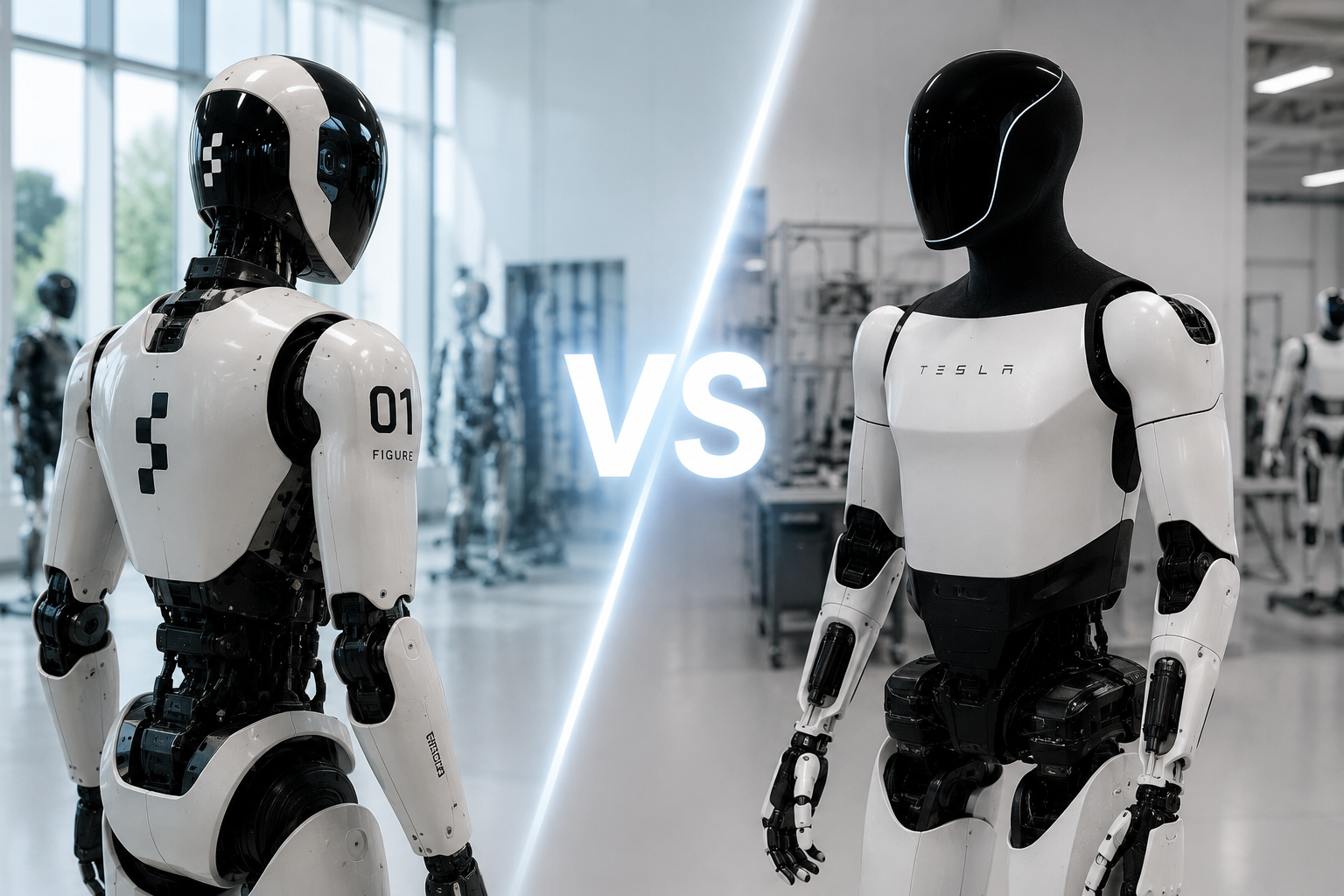
The race to build humanoid robots at scale just split into two distinct lanes. Figure AI vs Optimus is the clearest divergence yet in how companies plan to manufacture humanoids, and the gap is wider than most people realize.

In the Figure AI vs Optimus split, one company embeds itself inside an automotive giant’s existing infrastructure. The other builds everything under its own roof, from the chips up.

Figure AI signed a deal with BMW to deploy robots at its Spartanburg, South Carolina plant. Tesla, meanwhile, quietly retooled sections of its Fremont factory for Optimus production. Figure AI vs Optimus isn’t just two different strategies — it’s two fundamentally different philosophies about how humanoid robotics will scale.

Understanding why Figure AI vs Optimus diverges this sharply matters for investors, engineers, and anyone tracking automation. The timelines, risks, and capital requirements couldn’t be more different.

Why Figure AI vs Optimus Defines the Humanoid Scaling Debate

Humanoid robotics is at a genuine crossroads. Two models are emerging for getting robots from prototype to mass production, and watching Figure AI vs Optimus play out in parallel is genuinely fascinating.

On one side of Figure AI vs Optimus, Figure AI chose the OEM partnership model. It embeds its robots inside existing manufacturing infrastructure. BMW’s Spartanburg plant already produces roughly 1,500 vehicles a day, so Figure doesn’t need to build factories — it needs to prove its robots can work alongside humans in a proven, high-pressure environment.

On the other side of Figure AI vs Optimus, Tesla chose vertical integration. Its approach mirrors what it did with electric vehicles: build the factory, design the chips, write the software, control every step. Fremont has undergone significant retooling for Optimus Gen 3 assembly lines. This playbook is ambitious and expensive, and it either pays off massively or it doesn’t.

Two Models Behind Figure AI vs Optimus

Figure AI vs Optimus scaling timelines look very different as a result. Figure can deploy robots incrementally across BMW’s global network of 31 plants. Tesla must invest billions in dedicated capacity before shipping a single unit externally.

In Figure AI vs Optimus terms, Figure’s capital risk is shared with BMW, while Tesla’s sits entirely on its own balance sheet. The partnership model lets Figure test real-world performance without betting the company on factory construction; Tesla believes owning the entire stack creates long-term advantages that justify the cost.

This isn’t just a manufacturing debate — Figure AI vs Optimus is a bet on which path reaches meaningful production volume first. The answer isn’t obvious, not even close.

Figure AI vs Optimus: Capital and Production Capacity Compared

Numbers tell the real story in the Figure AI vs Optimus comparison. Here’s what each company needs to spend and what they realistically expect to produce.

On Figure’s side of the Figure AI vs Optimus ledger, Figure AI raised $675 million in its Series B at a $2.6 billion valuation. Microsoft, NVIDIA, and Jeff Bezos all participated, which says something about the confidence in the room. That capital funds R&D and initial deployments, not factory construction — BMW absorbs the facility costs directly.

On Tesla’s side of Figure AI vs Optimus, Tesla generated over $8.9 billion in free cash flow in 2023. But dedicating Fremont floor space to Optimus means giving up vehicle production capacity — every square foot used for robots is a square foot not building a Model S, X, or 3, an opportunity cost that doesn’t show up in a press release.

Factor Figure AI (BMW Partnership) Tesla (Fremont In-House)
Estimated initial capex $200–400M (R&D focused) $1–3B (factory retooling)
Production facility cost Borne by BMW Borne by Tesla
Target initial annual units 500–1,000 (2025–2026) 1,000–5,000 (2026–2027)
Long-term annual target 10,000+ across OEM partners 100,000+ (Elon Musk’s stated goal)
Time to first deployment Already started (2024) Late 2025 earliest
Supply chain control Shared with BMW Fully owned
Revenue model Robot-as-a-service + unit sales Unit sales + internal deployment

Figure’s estimated initial capex runs $200 to $400 million, R&D-focused, with BMW covering the facility. Its initial target is 500 to 1,000 units a year by 2025–2026. Longer term, Figure aims for 10,000-plus units across OEM partners, with supply chain control shared with BMW throughout.

Tesla’s estimated initial capex runs $1 to $3 billion for factory retooling, borne entirely by Tesla. Its initial target is 1,000 to 5,000 units a year by 2026–2027. Longer term, Tesla is chasing Musk’s stated goal of 100,000-plus units annually, with supply chain control fully owned in-house.

Revenue models diverge too, another axis of Figure AI vs Optimus worth tracking. Figure blends robot-as-a-service contracts with unit sales, letting BMW pay for uptime rather than hardware alone. Tesla leans on unit sales plus internal deployment, mirroring how it sells cars directly rather than through dealers. Neither model is proven yet at scale.

The capex profiles reveal something most Figure AI vs Optimus coverage glosses over. Figure’s burn rate stays manageable because BMW handles facilities. Tesla’s approach requires massive upfront spending before a single dollar of external revenue materializes.

Unit economics differ too. Figure refines robot design while BMW handles logistics, tooling, and worker training. Tesla has to build all of that internally, from scratch. Tesla’s stated goal of sub-$20,000 units requires manufacturing scale that doesn’t exist yet — current low-volume humanoids run $50,000 to $150,000 per unit, another reminder of how far apart Figure AI vs Optimus economics really are.

Figure AI vs Optimus: Supply Chain Risk, Outsourced vs Owned

This is where the strategies diverge most sharply, and it’s the part most people skip over. Looking at Figure AI vs Optimus through a supply chain lens changes how you think about both bets.

On Figure’s side of Figure AI vs Optimus, BMW runs one of the world’s most sophisticated automotive supply chains. Spartanburg alone sources components from hundreds of Tier 1 and Tier 2 suppliers. Figure benefits from BMW’s purchasing power, logistics networks, and quality control systems — systems that took decades to build.

This isn’t a new pattern in manufacturing. Automakers have outsourced specialized components like brakes, transmissions, and electronics to Tier 1 suppliers for decades. Figure is simply the newest category to slot into that existing relationship.

Figure gains access to BMW’s existing supplier relationships, ISO 9001-certified quality systems, logistics spanning three continents, a trained manufacturing workforce, and proven safety protocols for human-robot collaboration.

But the Figure side of Figure AI vs Optimus has real vulnerabilities too. Figure doesn’t fully control its own destiny. BMW could renegotiate terms, slow deployments, or prioritize vehicle production during a downturn. Figure must also design robots that fit BMW’s manufacturing constraints, not the other way around.

Where Figure AI vs Optimus Diverge on Risk

On Tesla’s side of Figure AI vs Optimus, Tesla controls everything. It designs its own chips through Dojo, makes battery packs in-house, and writes its own software stack. For Optimus, Tesla can optimize every component for cost and performance without negotiating with partners.

That control comes at a price. Tesla must build humanoid-specific supply chains essentially from scratch. Actuators for bipedal robots differ fundamentally from EV motors, and the sensors needed for humanoid manipulation don’t overlap much with autopilot hardware.

The Figure AI vs Optimus risk profile breaks down cleanly:

  • Partner dependency risk: high for Figure, near zero for Tesla
  • Capital intensity risk: low for Figure, very high for Tesla
  • Component sourcing risk: low for Figure (BMW’s network), high for Tesla (new suppliers)
  • Timeline risk: moderate for Figure, high for Tesla (factory delays compound fast)
  • Design flexibility risk: moderate for Figure (BMW constraints), low for Tesla (full control)

Each side of Figure AI vs Optimus trades one set of risks for another. Neither is clearly superior — the question is which risks prove more manageable in practice.

Why Automakers Are Betting on Figure AI vs Optimus Differently

The Figure AI vs Optimus comparison reveals a broader industry trend worth sitting with. Traditional automakers see humanoids as tools. Tesla sees them as products. That distinction explains almost everything else.

The clearest way to frame Figure AI vs Optimus philosophically: BMW doesn’t want to sell robots — it wants robots that make car manufacturing cheaper and more flexible. BMW has invested heavily in factory automation for decades, and humanoid robots are the logical next step, handling tasks fixed automation can’t: moving between workstations, adapting to model changeovers, working in spaces built for humans.

For BMW, Figure’s robots are a means to an end. They cut labor costs in physically demanding tasks like body shop work and internal logistics. BMW doesn’t care who builds the robot — it cares about uptime, reliability, and cost per task hour.

BMW isn’t the only data point in Figure AI vs Optimus. Other automakers are placing similar bets:

  • Mercedes-Benz partnered with Apptronik to test Apollo robots in its plants
  • Hyundai acquired Boston Dynamics and is integrating robots into its operations
  • Toyota Research Institute continues developing humanoid capabilities internally

None of these OEMs are trying to sell robots to consumers. They’re focused on internal deployment first, which creates a fundamentally different incentive structure than Tesla’s. That momentum matters for Figure specifically — every additional automaker signing a similar deal validates the partnership model and hands Figure more real-world data to refine its robots.

On Tesla’s end of Figure AI vs Optimus, Elon Musk has repeatedly said Optimus could become Tesla’s most valuable product. He envisions millions of units doing household tasks, elder care, and industrial work. Tesla isn’t building Optimus primarily to improve its own factories — it’s building Optimus to sell.

That’s a completely different business, and it’s why Tesla needs the Fremont restart. You can’t sell millions of robots through a partner’s factory. This is the sharpest contrast in Figure AI vs Optimus: Figure’s BMW deal gets humanoids into real production faster, while Tesla’s Fremont restart positions Optimus for a far larger addressable market.

Figure AI vs Optimus: Comparing Timelines to Scale

The Figure AI vs Optimus timeline comparison favors Figure in the short term and Tesla in the long term. But “long term” is doing a lot of work in that sentence, and robotics timelines have a long history of slipping.

Figure’s timeline:

  • 2024: Initial deployment of Figure 02 robots at BMW Spartanburg
  • 2025: Expanded deployment across multiple BMW workstations
  • 2026: Potential expansion to additional BMW plants globally
  • 2027–2028: New OEM partnerships, backed by a proven track record

Figure’s advantage in Figure AI vs Optimus is speed. Robots are already working in Spartanburg — that’s not vaporware. Each successful deployment builds the case for broader adoption, and real-world data from BMW helps Figure improve faster than simulation alone.

Tesla’s timeline:

  • 2024: Internal testing of Optimus Gen 2 at Fremont and Giga Texas
  • 2025: Fremont retooling for dedicated Optimus production lines
  • 2026: Limited Gen 3 production run, estimated in the hundreds of units
  • 2027–2028: Scaled production targeting thousands of units annually
  • 2030+: Mass production toward Musk’s stated goal of millions per year

On Tesla’s side of Figure AI vs Optimus, the timeline has already slipped, and it’s worth being honest about that. Musk originally suggested Optimus would be in production by 2025. The Gen 3 ramp has faced delays tied to actuator reliability and software integration. Still, Tesla’s deep pockets provide runway most startups don’t have.

Key risks for Figure:

  • BMW could slow deployments if conditions worsen
  • Proving ROI at Spartanburg is essential before expansion
  • Competition from Apptronik, Agility Robotics, and others for the same OEM deals

Key risks for Tesla:

  • Factory retooling delays compound quickly and expensively
  • Actuator and battery supply constraints remain unresolved
  • Software maturity for unstructured environments is still unsolved
  • Pulling engineering resources from vehicle production carries its own cost

These timelines aren’t fixed. A breakthrough in AI-driven manipulation could speed up either company. A recession could slow both. Figure AI vs Optimus, ultimately, is a bet on which risks show up first.

Conclusion: What Figure AI vs Optimus Means for Robotics

The debate over Figure AI vs Optimus isn’t really about which company builds a better robot. It’s about which manufacturing philosophy wins the race to scale, and those are genuinely different questions.

On one side of Figure AI vs Optimus, Figure chose the partnership path: faster, cheaper, and lower risk near term. BMW provides the factory, supply chain, and workforce; Figure provides the robot. This gets humanoids into real production today, not a demo reel.

On the other side, Tesla chose vertical integration: slower, more expensive, higher risk, but with essentially unlimited upside if it reaches mass production. Owning the entire stack means controlling cost, quality, and margin at scale in ways a partnership never can.

Watch these Figure AI vs Optimus signals over the next 18 months. Does BMW expand Figure’s deployment or quietly scale it back? Can Tesla actually produce hundreds of Optimus units by late 2026? Do other automakers sign deals with Figure? Does Tesla’s cost per unit approach $20,000? And where does investor capital actually flow?

Figure AI vs Optimus may not produce a single winner. Both models could succeed in different segments — Figure dominating industrial deployment through OEM partnerships, Tesla owning consumer and small-business markets through vertical integration. Whichever model wins, the manufacturing playbook that emerges will likely define how every other robotics company approaches scale for the next decade.

FAQ About Figure AI vs Optimus

Which Company Wins the Figure AI vs Optimus Race First?

In the Figure AI vs Optimus race, Figure AI will likely deploy robots in production environments first — it already has units operating at BMW’s Spartanburg plant. Tesla aims for much higher volume over the long run, though. Deployment isn’t the same as mass production: Figure deploys into existing factories, while Tesla plans to build its own capacity for potentially millions of units.

How Much Does a Humanoid Robot Cost in the Figure AI vs Optimus Comparison?

Current estimates put humanoid robots at $50,000 to $150,000 per unit at low volumes. Tesla has stated a target of under $20,000 per Optimus at scale, while Figure hasn’t shared per-unit costs — a real gap in the Figure AI vs Optimus numbers. Costs drop with volume, but that requires runs of tens of thousands of units a year.

Why Did BMW Partner With Figure AI Instead of Building Its Own Robot?

BMW is an automaker, not a robotics company, and that’s central to understanding Figure AI vs Optimus. Building humanoid robots requires deep expertise in bipedal movement, AI-driven manipulation, and real-time perception. Partnering with Figure lets BMW access cutting-edge robotics without pulling R&D resources from its core vehicle business.

What Is Tesla’s Fremont Restart in the Figure AI vs Optimus Story?

Tesla’s Fremont restart is the other half of Figure AI vs Optimus: retooling production space at its Fremont, California factory for Optimus assembly. Tesla is converting floor space previously used for vehicle production into dedicated Optimus manufacturing lines, including new tooling, testing equipment, and assembly stations built specifically for humanoid robot production.

Can Figure AI’s partnership model scale to millions of units?

Probably not through OEM partnerships alone. The partnership model works well for deploying thousands of robots across industrial settings. However, reaching millions of units would likely require Figure to either build its own factories or sign deals with dozens of manufacturing partners at once. Additionally, industrial demand may not support millions of units in the near term — the consumer market could, but Figure hasn’t announced any consumer plans yet. That’s a notable gap worth watching.

Can Figure AI’s Partnership Model Scale to Millions of Units?

Probably not through OEM partnerships alone — a real limit on Figure’s side of Figure AI vs Optimus. The model works well for deploying thousands of robots industrially, but reaching millions would likely require Figure to build its own factories or sign dozens of partnerships at once. The consumer market could support that volume, but Figure hasn’t announced consumer plans.

The Truth About Moonshot’s Rapid Kimi Releases

Kimi K3 vs K2.7

Moonshot AI just shipped its fifth major model in about twelve months. Kimi K3 landed on July 16, 2026 — a 2.8-trillion-parameter system the company calls the largest open-weight model ever built. Five weeks earlier, Kimi K2.7 Code arrived with its own set of bold claims.

Put those two releases side by side and a real question shows up. In the Kimi K3 vs K2.7 story, is Moonshot building toward genuine open-source dominance, or just outrunning its own ability to prove each release actually matters?

K3 didn’t just move developer forums — it moved markets. Nasdaq futures dipped roughly 1.7% and Nvidia slid about 2.4% premarket the morning after launch, as investors briefly questioned whether frontier-level AI performance really requires frontier-level chip spending. That’s not the kind of reaction a “hangover” release usually gets.

This piece walks through what actually changed between K2.7 and K3, how Moonshot’s speed compares to OpenAI, Anthropic, and DeepSeek, and whether shipping this fast is smart strategy or something closer to panic.

Kimi K3 vs K2.7: Why Moonshot’s Launch Reignited the Speed Debate

Moonshot AI was founded in March 2023 by Zhilin Yang, a Tsinghua University alumnus, and is backed by Alibaba. For most of its life, the company has built its reputation on one thing: shipping fast.

Kimi K3 pushed that reputation further than ever. At 2.8 trillion total parameters, it’s roughly 75% larger than DeepSeek’s V4 Pro, previously the biggest widely-used open model. It activates just 16 of 896 experts per token, ships with a 1-million-token context window, native visual understanding, and an always-on “thinking mode” that keeps reasoning switched on by default.

Two architectural innovations sit under the hood: Kimi Delta Attention, a hybrid linear attention mechanism that Moonshot says enables roughly 6.3x faster decoding, and Attention Residuals, a replacement for standard residual connections. Both were previously published as open research, which matters — this wasn’t just a bigger version of the same architecture. It’s a genuine engineering bet.

The timing wasn’t an accident either. K3 landed just ahead of the 2026 World Artificial Intelligence Conference in Shanghai, and multiple outlets framed it as a comeback moment for a company whose market position had reportedly slipped over the previous 18 months as DeepSeek surged. Full model weights are due July 27, 2026, so as of this writing, K3 is technically open-weight pending rather than immediately self-hostable.

Here’s what makes the Kimi K3 vs K2.7 story worth examining closely: K3 arrived just five weeks after Kimi K2.7 Code, itself the fifth major release in the K2 family within a year. That’s an unusually tight gap, even by Moonshot’s own fast-moving standards — and it’s exactly the kind of pace that made last quarter’s K2.7 launch feel more like a footnote than an event.

Kimi K3 vs K2.7: A Timeline of Five Releases in Twelve Months

Reading the K3 announcement in isolation makes Moonshot’s pace look almost inevitable. Reading the full timeline is more revealing.

  • July 2025 — Kimi K2 launches as an open-weight MoE model and immediately posts strong coding benchmark results.
  • September 2025 — Kimi-K2-Instruct-0905 improves coding performance and doubles the context window to 256K tokens.
  • Late 2025 / early 2026 — Kimi K2.5 ships quietly and gets picked up by other labs; Thinking Machines later uses it to generate early post-training data for its Inkling model.
  • April 2026 — Kimi K2.6 becomes the general-purpose flagship and, per Artificial Analysis, ranks as the strongest open-weight model on its intelligence index that month.
  • June 12, 2026 — Kimi K2.7 Code ships as a coding-specialized build on top of K2.6, claiming double-digit gains on Moonshot’s own benchmarks and roughly 30% lower reasoning-token usage.
  • July 16, 2026 — Kimi K3 arrives: 2.8 trillion parameters, native vision, 1-million-token context, and a genuine architectural overhaul.

Five releases, twelve months. Compare that to how rarely OpenAI, Anthropic, or Google DeepMind touch their flagship line, and the Kimi K3 vs K2.7 pattern starts to look less like an anomaly and more like Moonshot’s entire operating model.

Kimi K3 vs K2.7 vs the World: How Moonshot’s Cadence Compares to OpenAI, Anthropic, and DeepSee

Numbers don’t lie about frequency, but they need context. Here’s how Moonshot’s Kimi line stacks up against the other frontier labs on release cadence, as of July 2026:

Company Major Releases (12 Months) Avg. Gap Between Releases Model Type Ecosystem Maturity
Moonshot AI (Kimi) 4–5 (K1.5, K2, K2.7, K3) ~2–3 months MoE, dense Early stage
OpenAI 2–3 (GPT-4o, o1, o3) ~4–6 months Dense, reasoning Mature
Anthropic 2–3 (Claude 3.5, 4) ~4–5 months Dense Growing
DeepSeek 3–4 (V2, V3, R1) ~3–4 months MoE Moderate
Google DeepMind 2–3 (Gemini 1.5, 2.0, 2.5) ~4–6 months Multimodal Mature

The gap is obvious. Moonshot ships a major model roughly every six to ten weeks. Its closest rivals typically wait several months between flagship updates.

That difference used to be the whole “hangover” argument: ship something impressive, then bury it under the next release before anyone finishes evaluating it. The Kimi K3 vs K2.7 comparison complicates that story, though, because K3 isn’t a minor refresh of K2.7 — it’s a different architecture, a different scale class, and a genuine leap rather than a patch.

Anthropic’s approach still offers the clearest contrast. Claude Fable 5, Anthropic’s current top-tier public model, sits behind a more selective rollout, and Anthropic has kept its most capable system, Claude Mythos 5, restricted to a small number of organizations under its Project Glasswing program rather than shipping it broadly. That’s the opposite instinct from Moonshot’s open-and-fast approach: restrict access first, prove reliability, expand later.

Moonshot’s own framing of K3 was notably measured. The company said that while overall performance still trails Claude Fable 5 and GPT-5.6 Sol, K3 “demonstrated frontier-level performance” across its evaluation suite and “consistently outperformed other tested models.” That’s a nuanced position — not the best model in the world, but competitive enough to matter, at a very different price point.

Kimi K3 vs K2.7: Are the Benchmark Gains Real or Just Bigger Numbers?

Every fast-shipping lab faces the same skepticism: are the benchmark improvements real, or just numbers picked to look good in a press release? The Kimi K3 vs K2.7 comparison gives two very different answers.

K2.7 Code’s benchmark story was almost entirely self-reported. Moonshot published gains of roughly 21.8% on its own Kimi Code Bench v2, 11% on Program Bench, and 31.5% on MLS Bench Lite, alongside a 30% cut in reasoning-token usage. Multiple outlets covering the release flagged the same caveat: none of those figures came from SWE-bench Verified, Terminal-Bench, or any independent leaderboard. At launch, there was no third-party confirmation at all.

K3 tells a different story. Within hours of release, independent trackers had already weighed in

  • K3 jumped from #18 to #1 on the Frontend Code Arena leaderboard in a single release — a 17-place move that overtook Claude Fable 5 on that specific benchmark.
  • Analyst Nathan Lambert described the release as Moonshot “executing on scaling the known areas,” rather than chasing one flashy metric the way some fast-follow releases do.

That said, independent scrutiny also surfaced a real weak spot: coverage of Artificial Analysis’s hallucination-focused AA-Omniscience Index noted that K3’s score improved partly because the index weights accuracy gains more heavily than hallucination increases — meaning K3 answers more confidently, but also gets more of those confident answers wrong. That’s the kind of detail a self-reported benchmark sheet would never volunteer.

The honest read: K2.7 Code looked like an efficiency patch, sized correctly for what it was — a coding-specialized model built to run cheaper, not to redefine the frontier. K3 looks like the release Moonshot was actually building toward. The pace didn’t slow down, but the substance mostly caught up, hallucination trade-offs included.

Does Speed Convert to Loyalty? What Kimi K3 Means for Retention

Fast releases only matter if people actually stick around to use them. Kimi’s adoption numbers suggest the hangover narrative doesn’t tell the whole story.

The Kimi chatbot has more than 36 million monthly active users, and Moonshot’s models have quietly been adopted well beyond its own consumer app:

  • Cursor used Kimi to help build Composer 2, its AI coding agent.
  • DoorDash’s CTO said the company delegates lower-level engineering work to Kimi K2.6.
  • Thinking Machines used Kimi K2.5 to generate early post-training data for its Inkling model.

None of that reads like developer fatigue. It reads like real production trust building quietly in the background, model after model, while the headlines focused on whichever release was newest.

At the same time, not every reaction to K3 has been about the model itself. Some coverage of the launch framed the pushback around U.S.-China competitive politics as much as technical merit — a reminder that not all of the noise around Kimi K3 vs K2.7 is actually about Kimi K3 vs K2.7.

That split is worth sitting with. The pace genuinely does create integration churn: API compatibility shifts, benchmark suites change, and teams that built tooling around K2.7 Code may need real rework before K3 fits cleanly into the same workflows. But the enterprise adoption already happening — Cursor, DoorDash, Thinking Machines — suggests serious teams tolerate that churn when the underlying model earns its keep. Speed hasn’t stopped serious users from showing up. It’s just made the onboarding curve steeper.

Conclusion: Should You Build on Kimi K3 vs K2.7 Right Now?

Here’s where this gets useful instead of just theoretical.

If you’re already running production workloads on K2.7 Code: stay put for now. It’s fully available, weights have been on Hugging Face since June 12, and at $0.95/$4.00 per million input/output tokens, it’s dramatically cheaper than K3’s $3/$15 pricing. Migrate only once K3’s weights are actually live on July 27 and you’ve tested your own workflows against it directly.

If you’re evaluating Kimi for the first time: wait for the July 27 weight release before committing to self-hosting. The API is live now if you want to test capability, but “open-weight pending” isn’t the same as production-ready for teams that need to self-host.

If you’re chasing frontier general capability, long context, or multimodal input: K3 is the one to watch. The 1-million-token context window and native vision put it in a different category from K2.7 Code, which was purpose-built for coding and agent workflows specifically.

If you’re an investor or competitor watching from outside: ignore the release cadence itself and watch two numbers instead — independent benchmark rankings (which validated K3 within hours) and actual enterprise adoption (Cursor, DoorDash, Thinking Machines), not download spikes at launch.

The Kimi K3 vs K2.7 pace will keep generating headlines. Whether it keeps generating trust depends on whether K3’s fast third-party validation becomes the new normal for Moonshot, or the exception.

FAQ: Kimi K3 vs K2.7 and Moonshot’s Release Pace

What is Kimi K3?

Kimi K3 is Moonshot AI’s flagship large language model, released July 16, 2026. It’s a 2.8-trillion-parameter Mixture-of-Experts model with a 1-million-token context window, native visual understanding, and always-on reasoning, built around two new architectural components: Kimi Delta Attention and Attention Residuals.

How is Kimi K3 different from Kimi K2.7 Code?

Kimi K2.7 Code, released June 12, 2026, is a coding-specialized model built on top of K2.6, aimed at long-horizon software engineering tasks. Kimi K3 is a much larger general-purpose flagship with a different architecture, native vision, and a far bigger context window. In the Kimi K3 vs K2.7 comparison, K2.7 is the specialist and K3 is the generalist.

Is Kimi K3 open source?

Kimi K3 is open-weight: Moonshot plans to release the full model weights publicly under a Modified MIT license. At launch on July 16, only the API was available; full weights are scheduled for July 27, 2026

How much does Kimi K3 cost to use?

Kimi K3 is priced at roughly $3 per million input tokens and $15 per million output tokens through Moonshot’s API — more expensive than DeepSeek V4 or GLM-5.2, but significantly cheaper than Claude Fable 5.

Does Kimi K3 beat Claude and GPT models?

Not outright. Moonshot itself has said K3 trails Claude Fable 5 and GPT-5.6 Sol on overall performance, while topping the Frontend Code Arena leaderboard and scoring competitively on Artificial Analysis’s Intelligence Index. Independent trackers place it in the top few models on most composite indexes, alongside a notably lower cost-per-task than several proprietary rivals.

Should developers switch to Kimi K3 right away?

Not urgently. Teams already using K2.7 Code should wait for K3’s full weight release on July 27 and test it against their own workflows before migrating, especially given the price difference between the two models.

The Full Truth About Microsoft Meta Capex

Microsoft Meta AI capex

Wall Street loves a big number. Right now, one Microsoft Meta AI capex figure is dominating every analyst briefing and investor call this earnings season.

But most coverage is missing the metric that actually tells you something useful. Everyone fixates on headline capital expenditure. The real story lives two layers deeper — in cost-per-token inference and datacenter utilization rates.

These two metrics reveal whether massive AI spending is producing cheaper, faster intelligence, or just burning cash impressively. Before going further, let’s set the headline figure aside and look at what the Microsoft Meta AI capex numbers actually mean once you dig past the press release.

Key Takeaways on Microsoft Meta AI Capex
  • Headline Microsoft Meta AI capex figures — over $80 billion for Microsoft, $60–65 billion for Meta — don’t measure efficiency on their own.
  • Cost-per-token inference is the real unit economics behind Microsoft Meta AI capex spending.
  • Datacenter utilization above 70–85% can matter more than billions in extra capex.
  • AMD’s MI300X packs more memory per chip than Nvidia’s H100, changing the Microsoft Meta AI capex hardware math.
  • The pricing gap between frontier and open-source models runs as high as 167X — the real stress test of whether Microsoft Meta AI capex spending is working.

Why the Headline Microsoft Meta AI Capex Number Misleads Investors

Microsoft reportedly plans to spend over $80 billion on AI infrastructure in fiscal year 2025. Meta’s capex guidance sits in the $60 to $65 billion range. Both numbers grab headlines, but they don’t tell the whole story.

Raw capex tells you nothing about efficiency. A company could spend $100 billion and get genuinely poor returns. Another could spend $30 billion and dominate inference economics. Across multiple tech cycles, the biggest spender rarely wins on unit economics.

Bloomberg reports that hyperscaler capex has grown roughly 60% year-over-year. Inference costs, meanwhile, have dropped sharply over the same period. That disconnect is the real Microsoft Meta AI capex story.

Consider two hypothetical companies, each spending $5 billion on identical GPU clusters. Company A runs at 80% utilization serving a mix of enterprise and internal products. Company B runs at 45% utilization serving one internal application with lumpy demand. After a year, Company A processes roughly 78% more tokens per dollar of capex — without spending an extra cent.

The Three Factors Behind Real Microsoft Meta AI Capex Performance

The difference comes down to three factors. First, what hardware they buy: Nvidia H100s, AMD MI300X accelerators, or custom silicon. Second, how efficiently they use it, measured by datacenter utilization. Third, what output they generate, measured by cost per token of inference.

When you hear about a Microsoft Meta AI capex number, the real question is simple: what’s the cost per unit of useful AI output? That’s the metric separating smart spending from vanity spending.

Cost-Per-Token-Inference Is the Real Microsoft Meta AI Capex Metric

Cost-per-token inference measures how much it costs to generate a single token of AI output — the unit economics of intelligence. One token is roughly four characters of text, and billions move through these systems every day.

This matters because the entire AI business model depends on inference becoming cheap enough to embed everywhere. Training a model is a one-time cost. Inference happens billions of times a day, every day, forever. The company with the lowest inference cost wins, full stop.

This metric connects Microsoft Meta AI capex spending directly to revenue potential. Microsoft serves inference through Azure OpenAI Service, GitHub Copilot, and Bing. Meta serves inference through Instagram recommendations, WhatsApp AI, and Llama-based products. Both need inference costs below a specific threshold to make these products profitable at scale.

Here’s a concrete way to see that threshold. GitHub Copilot charges roughly $10 per user per month. If the inference cost to power each user’s suggestions exceeds $4 a month, the product’s margin collapses before Microsoft covers a dollar of sales or marketing. Shaving that cost from $4 to $2 doesn’t just improve margins — it decides whether the product works at mass-market pricing at all.

OpenAI API pricing page shows how fast inference pricing has fallen. GPT-4 Turbo costs a fraction of what GPT-4 cost at launch, and that compression reflects real hardware and software efficiency gains — exactly what Microsoft Meta AI capex spending is supposed to deliver.

So when analysts discuss the one Microsoft Meta AI capex number, they should really ask how much cost-per-token inference dropped this quarter. A 30% reduction in inference cost matters more than a $10 billion capex increase.

Neither company publishes exact internal cost-per-token figures, but you can estimate them: divide total inference-related capex by estimated token throughput. Track that ratio across four or five quarters, and the trend becomes readable even from public data.

Nvidia H100 vs AMD MI300X vs Custom Silicon in the Microsoft Meta AI Capex Race

Not all AI chips deliver equal value, and Microsoft Meta AI capex depends heavily on hardware choices.

Metric Nvidia H100 AMD MI300X Custom Silicon (Meta MTIA / Microsoft Maia)
Estimated unit cost $25,000–$40,000 $10,000–$15,000 $5,000–$10,000 (estimated)
HBM memory 80 GB HBM3 192 GB HBM3 Varies by design
Inference throughput High Competitive for large models Optimized for specific workloads
Power consumption (TDP) 700W 750W Typically lower
Software ecosystem CUDA (dominant) ROCm (improving) Proprietary
Availability Constrained More available Internal only
Best for General AI workloads Memory-heavy models High-volume, narrow tasks

Nvidia’s H100 costs an estimated $25,000 to $40,000 per unit, carries 80 GB of HBM3 memory, and runs on the dominant CUDA ecosystem, though availability stays constrained. AMD’s MI300X costs roughly $10,000 to $15,000, offers 192 GB of HBM3, and runs on the improving ROCm ecosystem with better availability. Custom silicon like Meta’s MTIA or Microsoft’s Maia is estimated at $5,000 to $10,000, with specs that vary by design and stay internal-only.

The MI300X’s memory advantage matters enormously for large language model inference, where model weights must fit inside GPU memory. AMD’s official MI300X page highlights that 192 GB HBM3 advantage directly.

Serving a 70-billion-parameter model in 16-bit precision takes roughly 140 GB of GPU memory. A single H100, at 80 GB, can’t hold that model alone — you need at least two chips working together, adding interconnect overhead. A single MI300X, at 192 GB, can hold the entire model on its own, simplifying the serving architecture and often reducing latency. At Meta and Microsoft’s scale, that simplification lowers cost per token directly.

Why Memory Determines Microsoft Meta AI Capex ROI

Microsoft’s approach is diversified. It buys Nvidia GPUs in massive quantities while developing Maia 100, its own custom accelerator. This hedges supply risk and can lower blended cost per token — a structural advantage that doesn’t show up in headline Microsoft Meta AI capex figures.

Meta leans harder into custom silicon. Its MTIA chip targets the recommendation and ranking workloads behind its core ad business. That specificity lets Meta optimize silicon for narrow tasks instead of buying general-purpose GPUs at a premium.

Both companies are also buying Nvidia’s B200 and GB200 chips, which promise 2 to 4X inference gains over the H100. Still, custom silicon remains the long-term cost play for anyone running at hyperscale.

The ROI picture breaks down simply. Nvidia H100 offers the fastest deployment and broadest flexibility at the highest cost. AMD MI300X offers better memory economics and lower acquisition cost. Custom silicon offers the lowest long-term cost per token, at the highest upfront R&D investment and narrowest use case.

When evaluating Microsoft Meta AI capex, watch the hardware mix. A shift toward custom silicon signals confidence in sustained, high-volume inference demand — worth more than any single quarter’s spending figure.

Datacenter Utilization: The Multiplier Behind Microsoft Meta AI Capex

You can buy the best chips in the world, but running datacenters at low utilization burns money fast. This overlooked multiplier sits quietly behind every Microsoft Meta AI capex report.

Utilization rate measures the percentage of time GPU resources actively process workloads. Top-tier hyperscalers run at 70 to 85% utilization. Average cloud providers run 50 to 65%. Enterprise on-premises deployments often run just 20 to 40%.

Utilization directly impacts effective cost per token. A datacenter with 10,000 H100 GPUs at 80% utilization processes roughly 4X more tokens per dollar than the same facility at 20%. Fixed costs — power, cooling, real estate, staff — don’t change with utilization, so higher utilization sharply improves unit economics without another dollar spent.

One technique both companies use is batching inference requests. Instead of processing each query the moment it arrives, the system queues a small batch and processes them together, filling more of the chip’s parallel capacity per pass. The tradeoff is a few milliseconds of added latency for meaningfully better throughput per dollar.

Microsoft has a structural advantage here. Azure serves thousands of enterprise customers alongside Microsoft’s own products, and that diversity smooths utilization curves — when Copilot demand dips, API customers fill the gap.

Meta faces a different challenge. Its infrastructure mainly serves internal products, so utilization depends heavily on user engagement patterns. Meta’s advantage is workload predictability: it knows exactly what its models need and can right-size infrastructure precisely, including scheduling non-urgent jobs during off-peak hours.

Power availability is increasingly constraining utilization for everyone. Both companies are investing in nuclear, solar, and natural gas power sources to address it. The U.S. Department of Energy has formally acknowledged the growing overlap between AI infrastructure and energy policy.

The bottom line: a 10-percentage-point utilization improvement can matter more than billions in additional Microsoft Meta AI capex spending.

The 167X Pricing Gap Inside Microsoft Meta AI Capex Spending

Here’s a number that should stop you cold: frontier models like GPT-4o can cost 167 times more per token than efficient open-source alternatives running on optimized infrastructure. That gap is the ultimate stress test of whether Microsoft Meta AI capex spending is actually working.

Model tier Approximate cost per million tokens (output) Relative cost
Frontier proprietary (e.g., GPT-4) $15–$60 167X
Mid-tier proprietary (e.g., GPT-4o mini) $0.60–$2.00 7X
Open-source optimized (e.g., Llama 3.1 70B on custom silicon) $0.10–$0.35 1X

Frontier proprietary models like GPT-4 run $15 to $60 per million output tokens, about 167 times the cheapest tier. Mid-tier proprietary models like GPT-4o mini run $0.60 to $2.00, about 7 times the baseline. Open-source models like Llama 3.1 70B on custom silicon run $0.10 to $0.35 — the baseline itself.

Microsoft monetizes inference through premium Azure pricing. Meta gives Llama away free and monetizes through advertising instead. Both need inference costs to fall, but for structurally opposite reasons: Microsoft to protect margins while competing on price, Meta because inference is a cost center rather than revenue.

The direction of Microsoft Meta AI capex spending shows where each company expects to compete on this spectrum. Microsoft’s Nvidia purchases support frontier model serving at the top. Meta’s custom silicon investments target the bottom of the cost curve deliberately.

This gap is shrinking fast, and that compression is the real story behind Microsoft Meta AI capex headlines. Every quarter, inference gets cheaper. Faster compression means faster returns on capex. Slower compression means billions in spending sit idle longer than the market expects.

Watch third-party API pricing from providers like Together AI, Fireworks AI, and Groq, who compete aggressively on open-source inference cost. When their prices drop, hardware efficiency gains are flowing to the market. When Microsoft or OpenAI cut Azure AI pricing afterward, it confirms those same gains have reached frontier infrastructure.

A simple way to track this: compare capex growth to inference cost reduction. If capex grows 50% and inference costs drop 60%, that’s productive spending. If capex grows 50% and costs drop only 10%, something isn’t working, no matter how polished the earnings commentary sounds.

Conclusion: What Microsoft Meta AI Capex Numbers Really Tell You

The Microsoft Meta AI capex conversation shouldn’t focus on headline spending. It should focus on cost-per-token inference and datacenter utilization, because these metrics reveal whether trillion-dollar investments translate into cheaper, more accessible AI, or just impressive press releases.

Here’s what to actually do next. Watch for inference cost disclosures during earnings calls — any mention of cost-per-token trends signals real operational progress, not just spending ambition. Track the hardware mix, since shifts toward custom silicon like Maia or MTIA indicate long-term confidence in sustained inference demand.

Monitor utilization commentary too. Even vague references to “improved datacenter efficiency” hint at meaningful gains. Compare capex growth to pricing changes by cross-referencing Azure AI pricing updates with capex announcements. And follow the 167X pricing gap — as it closes, it confirms Microsoft Meta AI capex spending is genuinely working.

Next time you see coverage of Microsoft Meta AI capex, look past the billions. Look at the tokens. That’s where the real story has always been.

FAQ About Microsoft Meta AI Capex

What Is Cost-Per-Token-Inference and Why Does It Matter for Microsoft Meta AI Capex?

Cost-per-token inference measures how much it costs to generate one token of AI output, roughly four characters of text. It matters because Microsoft and Meta both serve billions of inference requests daily, so fractions of a cent compound into enormous differences. Lower cost per token means higher margins for Azure AI. For Meta, it means cheaper AI recommendations across Instagram, Facebook, and WhatsApp, where inference is a cost center, not revenue.

How Does the One Microsoft Meta AI Capex Number Differ From Total Capex?

Total capex includes offices, non-AI infrastructure, and general IT. The one Microsoft Meta AI capex number that matters is AI-specific spending: GPUs, custom accelerators, AI-optimized datacenters, and related power infrastructure. Analyst estimates suggest 60 to 80% of current hyperscaler capex targets AI workloads specifically. That AI-specific figure, paired with utilization data, is what actually reveals spending efficiency.

Which Chip Offers the Best ROI in the Microsoft Meta AI Capex Race?

It depends on the workload. Nvidia’s H100 offers the broadest software compatibility through CUDA, a real ecosystem advantage. AMD’s MI300X provides more memory at lower cost, making it attractive for large-model inference where memory constraints matter. Custom silicon like MTIA or Maia delivers the lowest long-term cost per token for specific, high-volume workloads, but requires years of R&D and only pays off at massive scale.

What Datacenter Utilization Rate Should Investors Watch in Microsoft Meta AI Capex Reports?

Industry benchmarks suggest 70 to 85% utilization is strong for hyperscale datacenters. Below 50%, fixed costs dominate and effective cost per token rises sharply. Utilization consistently above 90% can also signal insufficient headroom for demand spikes. Microsoft’s diversified Azure customer base helps maintain higher average utilization, while Meta achieves efficiency through workload predictability instead.

How Does the 167X Pricing Gap Affect Microsoft Meta AI Capex Decisions?

The 167X gap creates real strategic tension. Companies investing in frontier models need premium pricing to justify that capex. Companies optimizing for open-source inference need rock-bottom costs to make the economics work. As the gap narrows, pressure on frontier model providers intensifies. Both Microsoft and Meta hedge this risk by investing across the spectrum, from Nvidia’s latest GPUs to proprietary accelerators.

When Will Microsoft and Meta’s AI Capex Spending Become Profitable?
There’s no single date, since profitability depends on how fast inference costs keep falling relative to revenue growth. Microsoft’s Azure AI services already show margin improvement as cost-per-token drops, suggesting parts of its Microsoft Meta AI capex investment are paying off now. Meta’s payoff looks different, since it monetizes through engagement and ad revenue rather than direct API pricing. Watch the ratio of capex growth to inference cost reduction each quarter — that trend, more than any single earnings call, will show when the spending truly turns profitable.

The Surprising Reason Yale Made a Bold Bet on GPT-4

Yale AI governance framework

Yale built an AI governance framework around a single model’s risk profile, and that choice says more about where enterprise AI is heading than any benchmark leaderboard ever could. This wasn’t about which model scored highest on MMLU or HumanEval. It was almost stubbornly about risk.

Most organizations still chase capability metrics. Yale chased controllability instead, and that one decision is quietly reshaping how major institutions think about AI adoption.

So which model anchored the whole thing? OpenAI’s GPT-4 — not because it beat the competition on academic tests, but because its risk profile was the most thoroughly documented and governable model available at the time Yale made its decision. That distinction is worth sitting with, because it’s the whole argument in miniature: Yale’s AI governance framework wasn’t built to find the smartest model. It was built to find the one the university could actually explain to a regulator, a faculty senate, and a worried parent, all at once.

Why Yale Built Its AI Governance Framework Around One Model

Yale’s Information Technology Services department walked into 2023 facing a problem every large institution knows well. Faculty wanted generative AI tools. Researchers wanted them. Administrators wanted them too. Nobody had a playbook for deploying them safely inside a research university.

The stakes weren’t abstract. Yale handles protected health information, student records under FERPA, federally funded research data, and sensitive intellectual property. A single data leak could trigger regulatory action, loss of federal funding, or both at once. Picture a graduate researcher who pastes de-identified clinical trial notes into a public-facing AI tool: even without names attached, the combination of diagnosis codes, treatment timelines, and institutional identifiers could count as a HIPAA-reportable event. That kind of exposure doesn’t need malicious intent. It just needs a user who didn’t know where the line was.

That’s why Yale’s AI governance framework didn’t start with a capability comparison. It started with a risk taxonomy, mapping every AI use case against four categories: data sensitivity, output criticality, regulatory exposure, and vendor accountability — in plain terms, what information touches the model, whether a human reviews the output, which compliance rules apply, and whether the institution can audit the provider if something breaks.

Framework First, Model Second

GPT-4 won not on raw power but on auditability, contractual flexibility, and documented safety testing. This mirrors a broader trend that’s been building for a couple of years: governance-driven procurement is replacing benchmark-driven procurement at scale. Organizations aren’t asking “which model is smartest?” anymore. They’re asking “which model won’t get us sued?” and “which model can we actually explain to a regulator?” Yale’s AI governance framework answers both questions at once, which is exactly why other institutions are studying it as a template.

How Yale’s AI Governance Framework Replaces Benchmark Shopping

For years, the AI industry ran on what amounts to benchmark shopping. Teams compared models on standardized tests, picked the highest scorer, and shipped it. It’s a clean process, and a dangerously incomplete one.

Benchmarks measure capability. They don’t measure liability. They don’t capture how a model behaves when fed sensitive data, generates something harmful, or confidently hallucinates in a high-stakes context. That gap between benchmark performance and real-world risk behavior is consistently what bites organizations. A legal team that deploys a top-scoring model to help with contract review may not discover until a dispute arises that the model was fabricating case citations with total confidence — a failure mode no leaderboard score would ever have flagged.

Yale’s AI governance framework rests on one core insight: benchmarks are necessary but nowhere near sufficient.

Criteria Benchmark Shopping Risk Profiling (Yale’s Approach)
Primary metric Accuracy scores Risk exposure level
Data handling Rarely evaluated Central to decision
Compliance alignment Afterthought Prerequisite
Vendor transparency Optional Mandatory
Human oversight requirements Undefined Tiered by use case
Procurement timeline Weeks Months
Ongoing monitoring Ad hoc Systematic

Benchmark shopping treats accuracy scores as the primary metric, rarely evaluates data handling, treats compliance as an afterthought, makes vendor transparency optional, leaves human oversight undefined, moves through procurement in weeks, and checks model behavior only ad hoc. Yale’s AI governance framework flips every one of those defaults: risk exposure is the primary metric, data handling sits at the center of the decision, compliance is a prerequisite, vendor transparency is mandatory, human oversight is tiered by use case, procurement takes months, and monitoring runs systematically.

The difference is structural, not cosmetic. Yale’s model also creates a repeatable process, which might be the real advantage. When a new model hits the market, it doesn’t automatically replace the incumbent — it enters the same risk evaluation pipeline, full stop.

Model capabilities converge more than vendors want to admit. GPT-4, Claude 3.5, and Gemini Ultra perform similarly on most academic benchmarks. Their risk profiles, though, diverge sharply on data retention policies, training data transparency, and contractual liability terms. That divergence is where the real decision lives. One vendor might retain user inputs for model improvement by default, burying the opt-out in enterprise settings. Another might offer a zero-retention guarantee as a standard contract term. That difference never shows up on a benchmark leaderboard, and it’s the one that matters most to a compliance officer.

Stanford’s Human-Centered AI Institute has documented a similar pattern: institutions are increasingly weighting governance factors over raw performance. Yale’s AI governance framework simply got there early.

Inside Yale’s AI Governance Framework: The Four Risk Tiers

Let’s get specific, since abstraction only carries an argument so far. Yale’s AI governance framework runs across four concrete tiers, and understanding them is what makes the model replicable elsewhere.

  1. Tier one covers low-risk use cases: brainstorming, drafting non-sensitive communications, summarizing publicly available research. Faculty and staff can access approved tools with minimal oversight, as long as no protected data ever enters the model — that’s the hard line. A professor drafting a conference abstract or a staff member writing talking points for a public event both sit comfortably here.
  2. Tier two covers moderate-risk use cases: internal documents, non-classified research data, student-facing content. Human review is mandatory before any output reaches its audience, and data must be anonymized before submission. A department administrator drafting a summary of internal survey results, for example, would strip out respondent details first, then review the output before circulating it.
  3. Tier three covers high-risk use cases — FERPA-protected records, protected health information, federally funded research data. These require formal approval, dedicated infrastructure, and contractual guarantees from the vendor, not just suggestions. A researcher analyzing grant-funded clinical data would need written authorization, a signed data processing agreement, and a documented review protocol before any AI tool touches that dataset.

Tier four is simply prohibited: automated grading without human review, autonomous decisions on admissions, anything touching classified research. Organizations skip defining this tier explicitly more often than you’d think, and without a written prohibition, individual departments tend to fill the gap with optimism rather than caution.

Vendor Requirements Built Into Yale’s AI Governance Framework

Beyond the four tiers, Yale’s AI governance framework includes operational requirements that don’t get enough attention. Vendor data processing agreements must state that user inputs aren’t used for model training. Incident response protocols define exactly what happens when a model produces harmful or inaccurate outputs. Regular audits check whether actual usage matches approved use cases, not just whether policies exist on paper. Training requirements make sure users understand the boundaries before they touch the tools, and sunset clauses trigger automatic re-evaluation whenever vendor terms change.

This tiered structure is exactly why Yale’s AI governance framework centers on one model rather than an open marketplace. Managing risk across multiple vendors, each with different data policies and safety profiles, multiplies complexity fast. One additional vendor doesn’t just double the governance workload — it adds cross-vendor comparisons, inconsistent audit trails, and the real risk that users route sensitive tasks through whichever tool has the least friction. Still, the framework isn’t permanently locked to GPT-4. Anthropic’s Claude and Google’s Gemini are reportedly moving through the same risk evaluation pipeline right now. The model may change. The methodology won’t.

The Regulatory Pressure Behind Yale’s AI Governance Framework

Yale didn’t build this in a vacuum. Regulatory pressure is growing, and institutions without governance structures are building up legal exposure faster than most of them realize.

California’s AB 489, introduced in early 2024, proposes transparency requirements for AI systems used in education. It hasn’t passed yet, but its existence signals clear legislative intent, and it won’t be the last proposal of its kind. The National Institute of Standards and Technology released its AI Risk Management Framework specifically to help organizations build governance structures like Yale’s, which tells you something about where federal thinking is headed.

The Department of Justice has also set up an AI task force focused on algorithmic discrimination and fraud. That task force has signaled that “we deployed the best-performing model” won’t hold up as a legal defense if the model causes harm — a fact that should make any general counsel uncomfortable. If an AI tool used in a hiring-adjacent process produces outputs that disparately impact a protected class, the institution’s defense can’t simply be “the model scored 92 on the MMLU.” Regulators want process documentation, not performance certificates.

Yale’s AI governance framework maps cleanly onto this reality. Risk profiling creates documentation:

  • If regulators come knocking, Yale can show a systematic, defensible decision-making process rather than a gut call.
  • Tiered access limits liability, since not every user reaches every capability, shrinking the attack surface for compliance violations.
  • Vendor agreements shift responsibility, so the AI provider shares accountability for data handling failures instead of leaving Yale to absorb it alone.
  • Audit trails prove diligence, showing the institution didn’t just write policies — it enforced them.

Yale’s AI governance framework exists precisely because the regulatory environment demands it. Benchmark scores don’t hold up in court. Governance documentation does. The European Union’s AI Act is pushing American institutions toward similar frameworks ahead of time, too, and because Yale works with international researchers and partners, EU compliance isn’t optional.

How to Build Your Own Yale-Style AI Governance Framework

You don’t need Yale’s budget to do this. The principles scale down well, though you do need genuine institutional commitment to put risk ahead of capability — that part can’t be faked.

Six Steps to Replicate Yale’s AI Governance Framework

Step one: map your data. Before evaluating a single AI model, catalog every type of data your organization handles and classify each by sensitivity. Skip this step and everything downstream gets shaky. A community college might discover during this exercise that its admissions office handles more sensitive data than IT ever formally tracked — Social Security numbers in legacy forms, mental health disclosures in financial aid applications, immigration status buried in enrollment records.

Step two: define your risk tiers. Adopt something close to Yale’s four-tier structure, then customize the boundaries for your regulatory environment. A healthcare organization’s tiers will look different from a financial services firm’s, and that’s fine. What matters is writing the definitions down explicitly, getting legal sign-off, and communicating them before deployment starts, not after the first incident.

Step three: evaluate vendors on governance first. Build a scoring rubric that weights data handling, contractual terms, and transparency above benchmark performance. Ask whether the vendor retains user inputs for training, whether you can audit the model independently, what happens to your data if the vendor gets acquired, whether it carries cyber liability insurance, and how it handles government data requests.

Step four: start with one model. This is the most counterintuitive step and the most important one. Organizations want options, understandably, but Yale’s AI governance framework centers on a single model precisely because single-vendor governance is dramatically simpler to set up, monitor, and enforce. Optionality is a liability until your framework matures. You may occasionally hit a task where a different model performs better — accept that cost. The governance simplicity you gain is worth more than marginal capability gains across a fragmented vendor landscape.

Step five: build sunset and review triggers. Your chosen model won’t stay optimal forever, so build automatic review periods — quarterly or biannually — directly into the framework, and trigger reviews whenever a vendor changes its terms, not just on a calendar schedule.

Step six: train your users. Governance frameworks fail without user education, full stop. Yale requires training before granting access, and your organization should too, with specifics about what’s prohibited, not just what’s encouraged. A thirty-minute onboarding module walking users through real tier violations changes behavior more than a ten-page policy document nobody reads past the first paragraph.

MIT’s AI Risk Repository offers a solid, free catalog of AI risks that maps directly onto tier-definition work, and it’s a good starting point for building your own Yale-style AI governance framework from scratch.

Conclusion: What Yale’s AI Governance Framework Means for You

Yale built an AI governance framework around one model’s risk profile, and that decision is a genuine blueprint for any organization wrestling with AI adoption right now. The insight isn’t really about GPT-4 specifically. It’s about the methodology: risk profiling before capability scoring, governance before deployment, documentation before experimentation.

A few next steps worth taking:

  1. Audit your current AI usage and identify every tool and model in active use across your organization, including the unofficial ones.
  2. Classify your data and map sensitivity levels before evaluating any new AI vendor.
  3. Build a risk tier system using Yale’s four-tier model as your starting template.
  4. Evaluate vendors on governance, weighting data handling and contractual terms above benchmark scores.
  5. Start with one model to simplify your governance burden
  6. Review the NIST AI Risk Management Framework as your compliance baseline before anything else.

Benchmark shopping isn’t over, but it’s no longer sufficient on its own, and it was never a substitute for governance. Yale’s AI governance framework exists because responsible AI adoption actually requires this kind of structure. The question isn’t whether your organization will need something similar. It’s whether you build it proactively, or reactively, after something goes wrong.

FAQ About Yale’s AI Governance Framework

Why Did Yale’s AI Governance Framework Choose GPT-4 Over Claude or Gemini?

Yale selected GPT-4 mainly because its risk profile was the most thoroughly documented at the time of evaluation. OpenAI’s safety testing documentation, contractual flexibility on data handling, and willingness to negotiate enterprise terms all matched Yale’s governance requirements. This wasn’t a permanent choice — Yale’s AI governance framework is explicitly designed to allow model transitions as competitors mature their own governance offerings.

Does Yale’s AI Governance Framework Mean Benchmarks Don’t Matter?

Not at all. Benchmarks still matter for establishing baseline capability, but Yale’s AI governance framework treats them as necessary and not sufficient — a model has to clear a capability threshold to be worth considering. Once multiple models clear that bar, risk profiling becomes the deciding factor. Benchmarks are the qualifying round; governance is the final selection.

Can Smaller Organizations Replicate Yale’s AI Governance Framework?

Yes. The core principles behind Yale’s AI governance framework — data classification, risk tiering, vendor evaluation, and user training — scale to any organization size. You don’t need a dedicated governance team to start, but you do need executive commitment and a willingness to put risk management ahead of speed. Even a two-person startup handling customer data should classify that data first.

How Does Yale’s AI Governance Framework Handle New Models Entering the Market?

Yale’s AI governance framework includes built-in review triggers rather than relying on anyone remembering to check. When a new model launches or a vendor changes its terms, Yale’s governance team evaluates the change against established risk criteria, and quarterly reviews keep the framework current regardless of external events.

What Role Does FERPA Play in Yale’s AI Governance Framework?

FERPA, the Family Educational Rights and Privacy Act, is one of the hardest constraints in Yale’s AI governance framework. It governs how educational institutions handle student records, and it has real teeth. Any AI tool that might process student data has to meet FERPA’s strict requirements around access, storage, and sharing, which is why Yale’s tier system restricts student data to high-risk tiers with mandatory human oversight.

How Does Yale’s AI Governance Framework Relate to California’s AB 489?

Yale’s AI governance framework anticipates emerging legislation like AB 489 by building compliance-ready documentation before any legal mandate forces the issue. AB 489 hasn’t passed yet, but Yale’s tiered structure already meets or exceeds most proposed requirements around transparency, human oversight, and data handling. That’s precisely why Yale built its AI governance framework around one model instead of improvising.

AMD’s New 2nm Venice EPYC Could Be Nvidia’s Biggest Challenge

AMD's New 2nm Venice EPYC Could Be Nvidia's Biggest Challenge

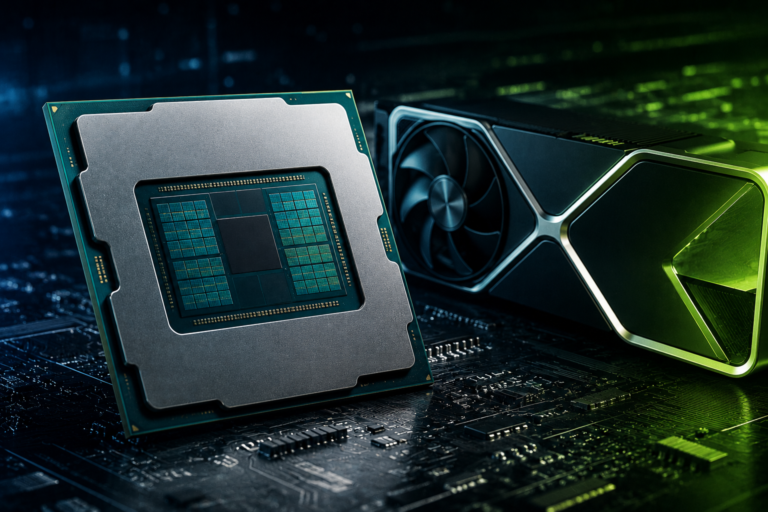
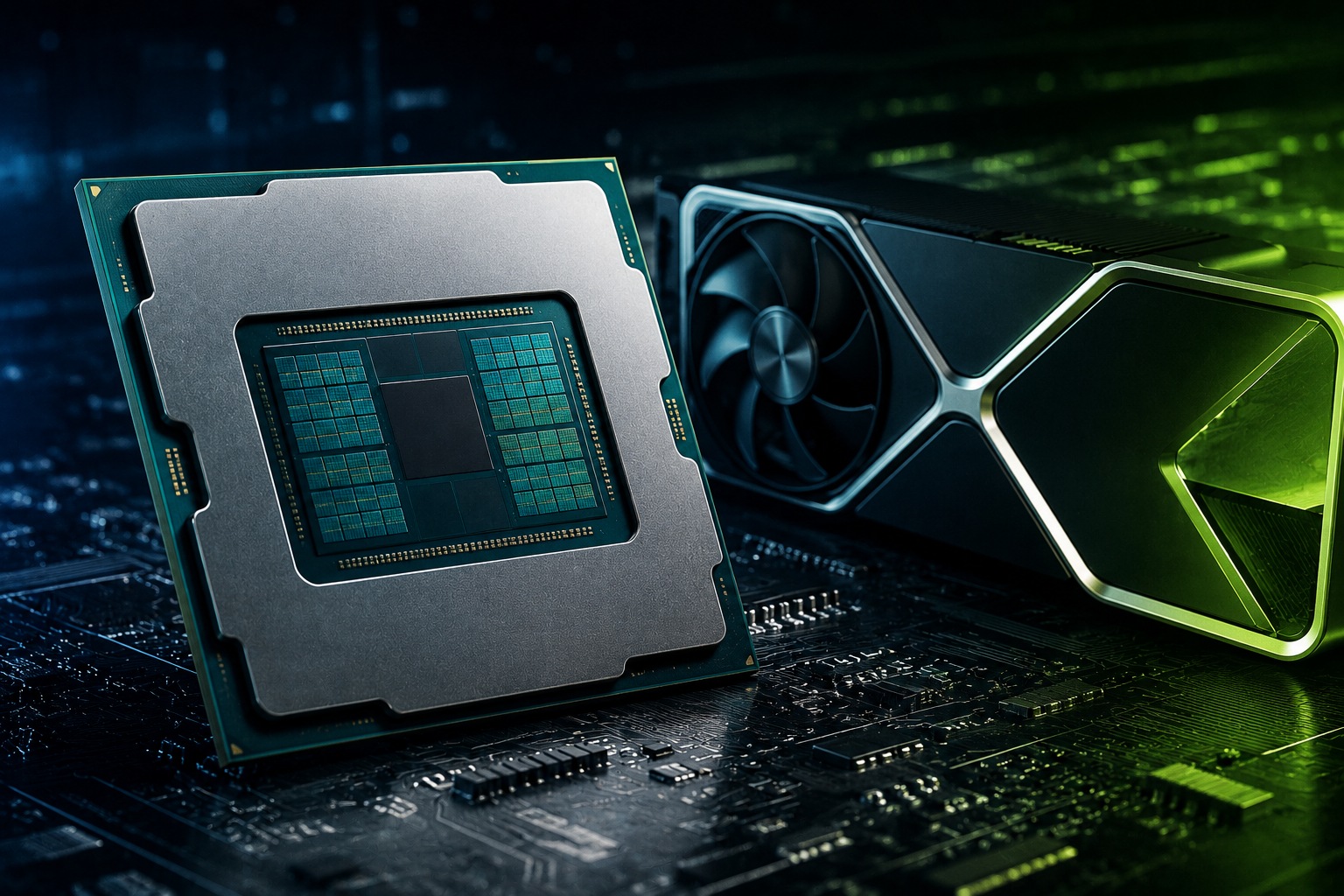
AMD Venice EPYC just beat Nvidia to the most advanced chip-making process on the planet, and the reaction online has been a strange mix of genuine excitement and “wait, why does this matter again?” The next-generation EPYC server processor, codenamed Venice, is set to ship on TSMC’s 2nm node — a first for any major data center chip. Nvidia’s Rubin GPU architecture, by contrast, isn’t expected on 2nm until sometime in 2026.

So does a 2nm CPU actually dent Nvidia’s GPU business? It depends entirely on what you’re running. AMD Venice EPYC isn’t going to replace an H200 cluster for training a 70-billion-parameter model. But for a surprising share of enterprise workloads, AMD Venice EPYC hitting 2nm before Nvidia changes the math on cost and power. Here’s where the line between “CPU territory” and “GPU territory” actually sits today.

Why AMD Venice EPYC Hitting 2nm Actually Matters

Process node leadership sounds like bragging rights until you translate it into power efficiency and transistor density. TSMC’s N2 node is expected to deliver 10 to 15% faster performance at the same power draw, or roughly 25 to 30% lower power at the same speed. Multiply either number across a few thousand server racks and it stops being a rounding error.

Here’s the concrete version: a hyperscaler running 10,000 EPYC servers could retire 2,500 to 3,000 of them and keep the same total throughput — or keep every server running and cut the power bill by close to a quarter. At current power and cooling costs, that math gets attention fast.

AMD Venice EPYC is expected to pack up to 256 Zen 6 cores per socket, double the current Turin generation. The chip also brings CXL 3.0 memory expansion and DDR6 support, both of which open up memory bandwidth well beyond what’s available today. AMD’s EPYC line has climbed steadily since Naples, but this generation looks like the biggest jump yet.

What AMD Venice EPYC Means for Memory-Heavy Workloads

That core count and memory bandwidth combination matters most for a specific category of software: real-time databases, search indexing, and analytics pipelines. Picture a financial services firm running fraud-scoring models across millions of transactions a day — that workload depends on memory bandwidth and core count, not GPU-style parallel math. It’s exactly the kind of job AMD Venice EPYC was built for.

Nvidia’s current H200 runs on TSMC’s 4nm process, and the Blackwell B200 sits on a custom 4NP node. Nvidia’s first 2nm chips, under the Rubin name, aren’t due until late 2026. That gives AMD roughly a 12 to 18 month process advantage, which is close to forever in data center procurement terms. Budgets get approved and architecture decisions get locked in on timelines exactly this long.

AMD Venice EPYC vs Nvidia H200: A Real Cost Comparison

Total cost of ownership tells the real story here. Not every workload justifies an eight-GPU node priced north of $250,000 — though plenty of workloads do. Whether AMD Venice EPYC hitting 2nm matters for your infrastructure comes down to your specific workload mix, and it’s easy to get this wrong in either direction.

Workload Type Venice EPYC (2-Socket) Nvidia H200 (8-GPU Node) TCO Winner Performance Edge
PostgreSQL / MySQL databases ~$18,000 ~$250,000 EPYC by 13x EPYC: 3x throughput/dollar
Elasticsearch / search indexing ~$18,000 ~$250,000 EPYC by 13x EPYC: 5x efficiency
LLM fine-tuning (70B+ params) ~$18,000 ~$250,000 H200 by 40x H200: 40x faster training
LLM inference (batch) ~$18,000 ~$250,000 Depends on scale H200: 8x at high batch
LLM inference (single query) ~$18,000 ~$250,000 EPYC competitive EPYC: 70% of H200 speed
Video transcoding ~$18,000 ~$250,000 EPYC by 10x EPYC: comparable speed
Web serving / microservices ~$18,000 ~$250,000 EPYC by 13x EPYC: better latency
Computer vision training ~$18,000 ~$250,000 H200 by 25x H200: 25x faster epochs

A dual-socket AMD Venice EPYC server is projected to cost around $18,000, against roughly $250,000 for a fully loaded eight-GPU H200 node. For workloads that don’t need GPU-style parallelism, that gap is close to 13x. PostgreSQL and MySQL databases run about 3x the throughput per dollar on AMD Venice EPYC. Elasticsearch and search indexing see roughly 5x the efficiency. Video transcoding lands at around 10x the cost advantage with comparable speed, and web serving or microservices workloads come in at roughly 13x cheaper with noticeably better latency.

Put another way: the same $250,000 that buys one H200 node buys about thirteen dual-socket AMD Venice EPYC servers. A mid-sized e-commerce company running Elasticsearch for product search has no real reason to put that workload on GPU nodes — thirteen AMD Venice EPYC boxes handling search at five times the efficiency is a different infrastructure philosophy entirely.

Where AMD Venice EPYC Still Loses to Nvidia’s H200

None of that changes the training math. Fine-tuning a model with 70 billion or more parameters still favors the H200 by something like 40x, and computer vision training runs roughly 25x faster on GPUs. A 70-billion-parameter model that trains in three days across 256 H200 GPUs would take months on CPU cores alone. Anyone telling you AMD Venice EPYC changes that equation is selling you something.

Inference is genuinely more contested. According to Andreessen Horowitz’s compute spending analysis, inference already makes up more than 60% of total AI compute spend, and that share keeps climbing as models move from research into production. At low batch sizes, AMD Venice EPYC’s 256 cores handle a meaningful chunk of that workload efficiently. At high batch sizes, the H200 still wins by roughly 8x.

A rough rule holds up in practice: if a job runs for more than a few hours at a stretch, use GPUs. If you’re serving a model to live users at low latency, benchmark AMD Venice EPYC before assuming you need a GPU.

Where AMD Venice EPYC Wins the Inference Battle

Inference is where the AMD Venice EPYC 2nm advantage matters most, and the reasons go deeper than most coverage lets on.

CPU inference has already improved a lot. Earlier EPYC generations handle INT8 and BF16 inference workloads reasonably well, and Venice adds AVX-512 extensions built specifically for AI inference. Combine that with 256 cores of parallelism and you get real throughput without GPU overhead. Benchmark your own model before assuming anything, though the trend clearly favors CPUs for these jobs.

Five Places AMD Venice EPYC Has the Edge
  1. Low-latency, single-query inference is the clearest case. A chatbot serving one user at a time doesn’t need GPU batch processing. A support bot handling sequential conversations is a textbook example: requests arrive one at a time, so a GPU sitting mostly idle between them is pure waste. AMD Venice EPYC handles that pattern with lower tail latency and real cost savings.
  2. Small models are another strong fit. Anything under seven billion parameters runs efficiently on a high-core-count chip, and DDR6 bandwidth removes the memory bottleneck that held back earlier CPU generations.
  3. Retrieval-augmented generation pipelines fit well too, since they combine database lookups with model inference in the same request. AMD Venice EPYC handles both stages natively, while GPU setups need expensive data transfers between them. If your pipeline spends 60% of its time on retrieval anyway, putting everything on one CPU server removes a whole category of latency.
  4. Edge inference at scale is a fourth case worth naming. Retail locations, branch offices, and manufacturing floors often can’t support the power and cooling a GPU needs. A 700-watt card simply isn’t an option there, and AMD Venice EPYC’s efficiency at 2nm makes CPU-only edge deployment genuinely realistic.
  5. Quantized model serving rounds out the list. INT4 and INT8 quantization is now standard practice for production deployment, and the AVX-512 extensions in AMD Venice EPYC handle those formats well. A quantized Llama 3 8B model running on a 256-core AMD Venice EPYC box is a realistic production setup today, not a future promise.
Where GPUs Still Beat AMD Venice EPYC on Inference

Batch inference handling hundreds of simultaneous requests still favors GPUs, along with vision models processing high-resolution images and anything past 30 billion parameters. Any workload leaning on FP16 or FP8 matrix math at scale belongs on a GPU, full stop.

The MLPerf benchmark suite from MLCommons shows this split consistently. GPUs win throughput benchmarks by a wide margin, but CPUs hold their own on latency-sensitive, single-stream work. AMD Venice EPYC at 2nm should widen that CPU competitiveness further, before you even factor in the price difference.

Why Enterprises Are Diversifying Beyond Nvidia With AMD Venice EPYC

Nvidia’s dominance carries real supply chain risk. The company reportedly holds a backlog worth well over a trillion dollars for data center GPUs, with lead times running 6 to 12 months. That means enterprises often can’t get GPUs even when the budget is ready to spend.

Picture the common version of this: a team gets budget approval in Q1, places a GPU order, and watches delivery slip to Q4 while the product roadmap doesn’t move. Infrastructure teams everywhere have lived this scenario for two years, with little improvement.

That supply constraint is a big part of why AMD Venice EPYC hitting 2nm before Nvidia matters right now. Enterprises need alternatives, and building infrastructure around one vendor’s GPU supply is the kind of lock-in that should worry any procurement team.

Three Workload Tiers, and Where AMD Venice EPYC Fits

Smart infrastructure planning tends to split into three tiers. Tier one is GPU-essential: LLM training, vision model training, and large-scale batch inference, running on Nvidia H200/B200 or AMD’s own Instinct MI300X. Tier two is GPU-optional: medium-sized model inference, recommendation systems, and feature engineering, where AMD Venice EPYC handles the job cost-effectively. Tier three is CPU-optimal: databases, search, web serving, analytics, and small-model inference, where AMD Venice EPYC dominates outright.

Most enterprise workloads sit in tiers two and three. Gartner’s research puts more than 70% of enterprise compute spending toward traditional workloads that never touch a GPU, and infrastructure audits generally back that number up.

CXL 3.0 support lets a fleet of AMD Venice EPYC servers pool memory dynamically. A cluster could share 12TB of CXL-attached memory and allocate it based on active workloads, something GPU nodes don’t offer today. DDR6 roughly doubles the memory bandwidth of current DDR5 systems, which matters a lot for database and analytics work.

Practical Steps Before AMD Venice EPYC Ships

Power efficiency closes the argument. An H200 GPU draws 700 watts, and an eight-GPU node pulls past 10 kilowatts total. An AMD Venice EPYC server handling equivalent non-ML work might draw around 600 watts. In a power-constrained facility, that difference decides how many workloads actually fit — some colocation facilities are already turning away GPU-heavy customers because they can’t provision enough power per rack.

Three things are worth doing now, before AMD Venice EPYC actually ships. Move your top five CPU-optimal workloads off GPU instances today, freeing up capacity for jobs that actually need it. Benchmark ONNX Runtime and llama.cpp on your smallest production models to build a real baseline. Then negotiate GPU contracts with 90-day renewal windows instead of multi-year commitments, so you keep room to shift spend once AMD Venice EPYC ships.

How AMD Venice EPYC Stacks Up Against Intel and Nvidia

AMD isn’t only fighting Nvidia here. Intel’s Clearwater Forest Xeon processors are aimed at the same data center market, and while Intel has struggled with process delays, its disaggregated chiplet approach mirrors AMD’s own strategy. This is a three-way race, and the competition is pushing all three companies to move faster.

AMD still holds real advantages. Its chiplet design, refined across several EPYC generations, scales to high core counts better than Intel has managed — AMD Venice EPYC reportedly uses up to 16 compute chiplets on a single package, a density Intel hasn’t matched. That approach also gives AMD a yield advantage: a defect that would kill a monolithic die only damages one small chiplet, keeping manufacturing costs in check even at 2nm, where defect rates run higher.

AMD’s dual-track lineup helps its pitch too. The company sells both AMD Venice EPYC CPUs and Instinct MI300X GPUs, so it can offer a complete server solution — Venice for general workloads, MI300X for AI training, one vendor covering both chip types. That’s a genuinely appealing pitch to a procurement committee already frustrated with Nvidia’s lead times and pricing leverage.

AMD’s ROCm software stack has matured a lot too. PyTorch and TensorFlow now support AMD GPUs natively, lowering the switching cost away from Nvidia’s CUDA ecosystem. CUDA still leads on library depth, but the gap is closing faster than most people give it credit for.

The bigger market dynamics favor AMD as well. Hyperscalers like Microsoft, Google, and Meta are actively spreading their chip spending across multiple vendors, and they have the buying power to demand real alternatives. AMD Venice EPYC at 2nm gives them a strong reason to grow AMD’s share of their server fleets, right when the biggest buyers in the world are shopping for options.

Conclusion: Does AMD Venice EPYC Matter for Your Infrastructure?

So, does AMD Venice EPYC hitting 2nm before Nvidia matter for your infrastructure decisions? Yes — with a few caveats worth keeping in mind.

AMD Venice EPYC won’t replace H200 GPUs for training large AI models, and that was never really the point. Most enterprise workloads aren’t AI training at all — they’re databases, search engines, web applications, analytics pipelines, and a growing share of AI inference. For that category of work, a 256-core chip at 2nm delivers better performance per dollar and per watt than any GPU on the market, before factoring in GPU availability.

A few next steps worth taking now:

  1. Sort every application into GPU-essential, GPU-optional, and CPU-optimal buckets, regardless of AMD Venice EPYC’s timeline.
  2. Calculate real total cost of ownership, including power and cooling, since GPU nodes run 10 to 13x more than CPU servers for non-ML work.
  3. Start evaluation cycles now on current EPYC Turin hardware, and test CPU inference using ONNX Runtime or PyTorch’s CPU backend — the cost savings tend to surprise people.
  4. Diversify vendor strategy rather than betting everything on Nvidia GPU availability.

For most enterprise workloads, the answer is clear: AMD Venice EPYC hitting 2nm matters enormously, and the teams that act on it early will end up running leaner infrastructure than the ones still reaching for GPU instances.

FAQ: Your AMD Venice EPYC Questions Answered

Will AMD Venice EPYC Ship Before Nvidia’s 2nm GPUs?

Based on current roadmaps, yes. AMD Venice EPYC is expected in late 2025 or early 2026 on TSMC’s N2 node, while Nvidia’s Rubin architecture — its first 2nm GPU — isn’t expected until late 2026. That puts AMD roughly 12 to 18 months ahead in the data center. Roadmaps shift, but the gap looks wide enough to hold.

Can AMD Venice EPYC Replace GPUs for AI Inference?

It depends on model size and latency needs. Models under 7 billion parameters run well on AMD Venice EPYC’s high core count, and single-query, low-latency inference is another strong spot. Large batch inference and models past 30 billion parameters still favor GPUs by a wide margin, so benchmark your specific use case first.

How Many Cores Does AMD Venice EPYC Have?

AMD Venice EPYC is expected to offer up to 256 Zen 6 cores per socket, double the 128-core maximum on the current Turin generation. Each core also benefits from 2nm efficiency and clock speed gains. That “up to” is doing real work here, so wait for shipping silicon before locking in architecture decisions.

What Memory Technologies Does AMD Venice EPYC Support?

AMD Venice EPYC supports DDR6 memory, roughly doubling bandwidth versus current DDR5 systems, plus CXL 3.0 for disaggregated memory pooling. Together, those two features make AMD Venice EPYC well suited to memory-heavy work like databases and in-memory analytics — a combination GPU nodes can’t really replicate today.

Is AMD Venice EPYC a Real Threat to Nvidia?

For GPU-centric AI training, not really — Nvidia’s parallel processing advantage stays unchallenged there. But for the broader data center market, including databases, web serving, search, and CPU-based inference, AMD Venice EPYC’s 2nm lead creates real competitive pressure on infrastructure spending. That “broader market” happens to be most of the market.

How Does AMD Venice EPYC Compare to Intel’s Xeon Roadmap?

AMD Venice EPYC holds a significant process advantage over Intel’s Clearwater Forest Xeon chips, since Intel still relies on its own foundry processes, which trail TSMC’s leading nodes. AMD’s chiplet design also scales to higher core counts more efficiently. Intel is investing heavily to close that gap, but AMD Venice EPYC’s 2nm lead is substantial for now.

OpenAI Sanctions: The Full Truth About What Actually Matters

OpenAI Sanctions: The Full Truth About What Actually Matters

Three weeks into active proceedings, Judge Sidney Stein’s courtroom decisions in the OpenAI sanctions motion are sending signals that could reshape how every AI company handles training data going forward. This isn’t just another copyright dispute buried in a docket somewhere — it’s a bellwether, and the tech industry is watching every filing with an intensity that hasn’t been seen since the early DMCA battles decades ago.

The New York Times’ sanctions motion against OpenAI centers on a specific, technical question: did OpenAI adequately preserve and disclose records of the data it used to train its models? But the real story runs deeper than that single procedural question. Judge Stein’s prior rulings in intellectual property disputes offer a genuine roadmap for predicting where this landmark case might land, and reading the headlines alone isn’t enough to understand what’s actually happening. This piece walks through Stein’s judicial history, what the early signals from the sanctions motion suggest, how the case is already reshaping AI licensing deals industry-wide, the full timeline of rulings so far, the possible outcomes still on the table, and what all of this means well beyond the courtroom itself.

Judge Stein’s Track Record and the OpenAI Sanctions Motion

Judge Sidney Stein has served on the Southern District of New York bench since 1995, appointed by President Clinton, which means he’s brought nearly three decades of complex litigation experience to cases that would make most judges sweat. His docket has included some genuinely consequential technology and intellectual property disputes over the years — not just the flashy headline cases, but the technical, grinding IP fights that actually set lasting precedent.

A few of his prior rulings are worth examining closely for what they suggest about the OpenAI sanctions motion.

  • In Capitol Records v. MP3tunes back in 2014, Stein tackled DMCA safe harbor protections for a digital music locker service and ruled that willful blindness to infringement could void those protections entirely — a precedent that matters enormously for how the OpenAI case might play out.
  • In his handling of the Penguin Random House v. Simon & Schuster merger review, primarily an antitrust matter, Stein showed genuine fluency with publishing industry economics rather than treating it as unfamiliar territory.
  • And across multiple patent disputes in the Southern District, his rulings have consistently favored detailed technical evidence over broad, sweeping claims — nobody walks into his courtroom successfully with hand-waving arguments.

The early record on the OpenAI sanctions motion reveals patterns that line up closely with Stein’s history. He doesn’t tolerate procedural gamesmanship, not even a little, and his sanctions decisions in prior cases have been swift, firm, and occasionally brutal toward parties he views as cutting corners. His approach to discovery disputes is telling too — he’s historically granted broad discovery requests in IP cases, which for OpenAI specifically could mean forced disclosure of training data details it would strongly prefer to keep confidential. That’s a genuinely uncomfortable scenario for any AI company guarding proprietary datasets, and it’s reportedly the outcome that keeps several AI startup lawyers up at night right now.

His 2014 MP3tunes ruling also established that tech companies can’t simply claim ignorance about copyrighted material sitting inside their own systems. The parallel to large language model training isn’t subtle at all — it’s close to a straight line from that ruling to the core question at the heart of the current OpenAI sanctions motion.

Early Signals From the OpenAI Sanctions Motion Hearings

Three weeks in, several procedural decisions have already dropped, and they’re genuinely revealing. Judge Stein is taking The New York Times’ evidence preservation claims seriously — more seriously than many observers expected this early in the proceedings.

A few specific signals stand out from the early hearings on the OpenAI sanctions motion. Discovery scope looks set to be broad:

  1. Stein’s questions during early hearings show he wants complete documentation of OpenAI’s training processes, not summaries and not cherry-picked samples.
  2. Fair use arguments appear to be facing real headwinds too, with his pointed questions about commercial benefit suggesting genuine skepticism toward OpenAI’s transformative use defense.
  3. And sanctions threats are carrying real weight — his willingness to entertain a sanctions motion this early in the case signals he won’t tolerate what he views as obstruction, full stop.

Fair use still remains the central battleground underneath all of this procedural activity. The U.S. Copyright Office outlines four factors for fair use analysis, and Stein’s prior rulings suggest he weighs the fourth factor — market impact — most heavily of the four. That’s pattern recognition across his case history, not a guess, and it’s genuinely uncomfortable news for OpenAI’s defense. The New York Times can point to clear market harm, since ChatGPT can reproduce article content in ways that potentially cut into subscription revenue directly. OpenAI’s legal team will still argue that AI-generated outputs are sufficiently transformative to qualify for fair use protection, and that argument isn’t unreasonable on its face — it’s just fighting an uphill battle specifically in Stein’s courtroom given his track record.

One procedural choice from the OpenAI sanctions motion hasn’t gotten much attention but is worth flagging directly: Stein hasn’t consolidated the sanctions motion with the broader case timeline. That separation suggests he views the alleged discovery violations as independently serious, not simply a bargaining chip inside a bigger fight. This mirrors how he handled discovery disputes in Capitol Records, where he separated procedural misconduct from substantive legal questions in a way that led to faster accountability for bad-faith behavior — the parallel between that case and the current OpenAI sanctions motion is almost exact.

How the OpenAI Sanctions Motion Is Reshaping AI Licensing

The courtroom drama isn’t happening in a vacuum. AI companies are actively scrambling to secure licensing deals before judicial precedent forces their hand, and some of those deals are landing at genuinely eye-watering prices. The connection between the OpenAI sanctions motion and this recent wave of licensing activity is direct and consequential, not coincidental.

Getty Images provides the clearest parallel example here. After filing its own lawsuit against Stability AI, Getty simultaneously moved toward licensing deals with AI companies — a dual strategy of litigating and licensing at the same time that’s become something close to the industry playbook. It’s a genuinely smart approach once you see the incentives clearly.

Company Pre-Lawsuit Strategy Post-Lawsuit Strategy Key Licensing Partners
OpenAI Scraped freely Aggressive licensing AP, Axel Springer, Le Monde
Google DeepMind Internal datasets + scraping Publisher partnerships Reddit, various news orgs
Stability AI Open training approach Forced licensing negotiations Shutterstock, Getty
Anthropic Curated training data Proactive licensing Multiple publishers
Meta AI Open-source approach Mixed strategy Limited public deals

OpenAI’s own licensing deal with the Associated Press came after the NYT lawsuit was filed, and that timing isn’t coincidental — it reads as reactive, a direct response to the legal exposure the OpenAI sanctions motion and the broader case have made visible. Every ruling in Stein’s courtroom is speeding up licensing conversations across the industry, whether the companies involved actually want to have those conversations or not.

The OpenAI sanctions motion also connects to broader regulatory trends worth tracking in parallel. The European Union’s AI Act already requires transparency about training data on the legislative side. Stein’s discovery rulings could effectively create similar requirements through case law right here in the US, with no congressional vote required at all. The sanctions motion specifically asks whether OpenAI adequately preserved and disclosed its training data records — and if Stein rules that OpenAI’s documentation was insufficient, it creates a de facto industry standard overnight. Every AI company would need meaningfully better record-keeping practices going forward, and “we didn’t know we had to” won’t function as an acceptable excuse after a ruling like that.

A Timeline of the OpenAI Sanctions Motion and Key Rulings

Understanding where things stand right now requires knowing how the case got here, and the full chronology matters more than most coverage of the OpenAI sanctions motion tends to acknowledge.

The New York Times filed suit against OpenAI and Microsoft in December 2023, alleging systematic copyright infringement through a complaint that was detailed and specific rather than a rushed filing. Initial motions to dismiss followed in January through March 2024, with Stein allowing the case to proceed on most claims — the first real signal about his judicial instincts on the underlying dispute. Discovery began in spring 2024, with both sides exchanging initial document productions and friction starting almost immediately. By summer 2024, the Times had raised concerns about OpenAI’s discovery compliance specifically, and things grew noticeably tense. The formal sanctions motion followed in late 2024, alleging OpenAI failed to preserve relevant evidence. Stein began hearing arguments on that motion in early 2025, putting the case at roughly three weeks into active sanctions proceedings today.

Stein’s decision to deny OpenAI’s motion to dismiss most claims was the first genuine signal about his judicial instincts on this case specifically — he found the Times’ allegations strong enough to survive initial scrutiny, which isn’t a ruling on the underlying merits but is telling nonetheless about how seriously he’s treating the case.

His scheduling decisions reveal his priorities in ways that don’t always make headlines either. By separating the sanctions motion from the broader trial timeline, Stein created space for real accountability without derailing the larger case — an approach that closely mirrors his handling of similar procedural issues in his own prior rulings, and a deliberate choice rather than an accident. The OpenAI sanctions motion also benefits from comparison against other AI copyright cases moving through the courts right now. The Authors Guild lawsuit against OpenAI covers similar ground, and although that case has a different judge, Stein’s rulings will inevitably cast a shadow over it — that’s simply how influential Southern District decisions tend to function across related cases.

Notably, Stein hasn’t shown any inclination to wait for legislative action on any of this. Some judges handling tech cases effectively punt difficult questions to Congress, but Stein appears ready to apply existing copyright law to AI training directly, right now. That’s a significant philosophical choice with real practical consequences for every company watching the OpenAI sanctions motion unfold.

What Each Outcome of the OpenAI Sanctions Motion Means for Trial

The sanctions motion isn’t the main event in this case, but it shapes everything that follows from here. Several possible outcomes remain on the table, and each carries meaningfully different implications for the full trial ahead.

Sanctions granted with adverse inference would be the most damaging outcome for OpenAI by a wide margin. If Stein rules that OpenAI destroyed or failed to preserve relevant evidence, he could instruct the jury to assume the missing evidence was unfavorable to OpenAI specifically. That would be genuinely devastating for OpenAI’s defense, and settlement pressure would increase dramatically — likely into nine-figure territory given the scale of the underlying dispute.

Sanctions granted with monetary penalties only would sting without fundamentally changing trial dynamics on its own. It would still signal judicial displeasure in a very public way, though, and that matters considerably for jury perception heading into trial.

Sanctions denied entirely would mean the Times loses a procedural weapon, while the substantive copyright claims remain fully intact regardless. A denial on the sanctions motion specifically wouldn’t necessarily mean Stein is sympathetic to OpenAI on the underlying merits — that distinction is worth keeping in mind if this scenario plays out.

Partial sanctions with additional discovery is arguably the most likely outcome based on the signals so far, and it fits Stein’s historical playbook closely. He could order supplemental discovery while imposing limited sanctions — a middle path that isn’t a clean win for either side. Stein could alternatively defer ruling entirely and fold the sanctions issues directly into trial, though that’s less likely given how deliberately he’s kept the sanctions motion procedurally separate so far.

The stakes here extend well beyond this single case, too. Similarly situated AI companies — Anthropic, Google, Meta — are watching every filing in the OpenAI sanctions motion closely. A strong sanctions ruling creates precedent that could affect every AI training data dispute in the Southern District and well beyond it, which is exactly how federal district court influence tends to spread in practice.

The Broader Industry Impact of the OpenAI Sanctions Motion

The OpenAI sanctions motion doesn’t just matter for lawyers billing by the hour. It matters directly for product managers, AI engineers, and startup founders making real decisions today, based on where this case appears to be heading.

A few practical consequences are already emerging as a direct result.

  • Companies are investing heavily in training data documentation, with tools like Hugging Face’s dataset cards becoming compliance necessities rather than optional niceties — a real, non-trivial infrastructure investment for many AI teams.
  • Licensing budgets are also expanding fast: AI companies that spent close to zero on content licensing two years ago now allocate millions annually, and that cost gets passed somewhere down the line.
  • Smaller AI startups face genuinely existential risk here too, since they simply can’t afford the licensing deals that OpenAI and Google can negotiate — which means the current legal climate may end up entrenching incumbents, a troubling outcome that doesn’t get nearly enough attention in most coverage.
  • And publisher leverage keeps growing with every development in the case, since every unfavorable ruling for OpenAI increases the bargaining power of content creators across the board.

The insurance implications here are significant and genuinely underreported too. AI companies are finding it harder to secure errors and omissions coverage, and insurers are watching the OpenAI sanctions motion closely to set their own risk models going forward. Brokers describe the current E&O market for AI companies as “complicated” — broker-speak for expensive and increasingly restrictive.

This case also affects open-source AI development in ways that haven’t fully landed publicly yet. If courts establish that training on copyrighted material requires licensing as a matter of law, open-source projects built on datasets like Common Crawl face serious legal questions of their own. The entire legal foundation underneath many open models could become genuinely questionable almost overnight, depending on how the OpenAI sanctions motion and the broader case ultimately resolve.

Conclusion: Final Thoughts on the OpenAI Sanctions Motion

The OpenAI sanctions motion reveals a judge who takes evidence preservation seriously and isn’t afraid to hold a powerful, well-funded tech company accountable. Judge Stein’s track record in IP cases consistently favors thorough discovery and penalizes procedural shortcuts, and nothing in the first three weeks of this proceeding suggests he’s changing that approach now that the stakes are this high.

A few practical next steps worth acting on:

  1. Monitor PACER filings weekly, since the sanctions ruling could drop at any point in the coming weeks and media summaries are often a day late and a nuance short of the actual filing.
  2. Review your own AI training data practices if you’re building AI products, and document everything now — Stein’s rulings are creating de facto industry standards whether or not your company is anywhere near his courtroom.
  3. Watch the licensing market closely too, since every judicial signal from this case moves licensing prices, and content creators are better served negotiating proactively rather than waiting for more certainty that may never fully arrive.
  4. Track the parallel cases as well — the Authors Guild suit, Getty v. Stability AI, and others will all be shaped by Stein’s decisions here, and they aren’t really separate stories.
  5. And prepare for regulatory follow-through, since congressional interest in AI copyright keeps growing, and court rulings historically tend to speed up legislative action rather than substitute for it.

The OpenAI sanctions motion isn’t legal theater playing out for its own sake. It’s quietly becoming the foundation for how AI companies will operate for the next decade, and few legal proceedings have felt this consequential this early in their timeline.

FAQ About the OpenAI Sanctions Motion

What is the OpenAI sanctions motion actually about?

The motion alleges that OpenAI failed to properly preserve evidence related to its training data practices. The New York Times claims OpenAI didn’t maintain adequate records of which copyrighted content was used to train its models, and the motion specifically asks Judge Stein to penalize OpenAI for these alleged preservation failures. Penalties could range from monetary fines to adverse inference instructions at trial — and the latter would be genuinely devastating to OpenAI’s defense.

Why does the OpenAI sanctions motion matter for the broader AI industry?

This proceeding sets precedent for how courts handle AI training data disputes going forward, and it reveals judicial attitudes toward evidence preservation that every company in the space needs to understand. Every AI company using copyrighted training data is watching these rulings closely, since the outcome will shape licensing negotiations, compliance practices, and investment decisions across the entire sector — not just for the two parties directly in the room.

Who is Judge Sidney Stein, and what’s his track record on similar cases?

Judge Sidney Stein has served on the U.S. District Court for the Southern District of New York since 1995, appointed by President Clinton. His IP case history includes the significant Capitol Records v. MP3tunes ruling, which established important standards around willful blindness and safe harbor protections. His broader track record shows a consistent preference for broad discovery, strict evidence preservation standards, and a genuine willingness to impose sanctions for procedural violations.

How does the OpenAI sanctions motion connect to licensing deals like Getty’s?

The NYT lawsuit directly accelerated the broader AI licensing market. After seeing the legal risks this case highlighted, companies like OpenAI moved quickly to sign licensing agreements with content publishers. Getty Images similarly pursued both litigation and licensing simultaneously, turning legal pressure into real negotiating leverage. The OpenAI sanctions motion continues to increase publisher bargaining power in these negotiations with every unfavorable signal it produces for OpenAI specifically.

What are the possible outcomes of the OpenAI sanctions motion?

Four primary scenarios exist. Sanctions could be granted with adverse inference instructions — the most damaging outcome for OpenAI by a wide margin. Monetary penalties alone could be imposed instead, which stings without fundamentally shifting trial dynamics on their own. The motion could be denied entirely, removing a procedural weapon from the Times’ arsenal while leaving the substantive claims intact. Or, based on current signals, Stein may order partial sanctions alongside additional discovery requirements — arguably the most likely outcome given his history.

When will Judge Stein actually rule on the sanctions motion?

No firm date has been set publicly. Based on the pace of proceedings so far and typical federal court timelines, a decision could come within weeks to a few months. Stein’s history suggests he doesn’t let procedural rulings drag on unnecessarily — he tends to move. Anyone following the case closely should monitor PACER for real-time filing updates rather than waiting on media coverage, which often trails the actual docket by a day or more.

Tesla Optimus: The Full Truth About What Actually Happened

Tesla Optimus: The Full Truth About What Actually Happened

Optimus Gen 3 production was supposed to start this week. It didn’t — and the reasons go a lot deeper than most coverage bothers to explain. Tesla’s humanoid robot program has hit another delay, and while it’s tempting to treat this as just another Musk timeline slipping, the underlying story is bigger than one company’s ambitions. It’s a semiconductor story, a supply-chain story, and a competitive pressure story all layered on top of each other.

Understanding why Optimus Gen 3 keeps missing its dates actually tells you something genuinely useful about the entire AI hardware ecosystem right now, not just Tesla’s robotics division. This piece walks through the real reasons behind the delay, how it connects directly to the same chip bottleneck squeezing Nvidia and Intel, how competitors like Figure AI and Boston Dynamics are using this window to their advantage, the supply-chain failure modes unique to humanoid robots specifically, and the concrete signals worth watching instead of the next announcement.

Why Optimus Gen 3 Production Keeps Missing Its Targets

Tesla has been announcing ambitious production goals for Optimus throughout 2024 and into 2025, with Musk projecting thousands of units working inside Tesla factories by now. The gap between that announcement and the current reality keeps widening, and it’s a pattern that becomes recognizable the longer you watch it play out.

A handful of interconnected factors explain why Optimus Gen 3 keeps slipping.

  • Custom silicon shortages sit near the top — Tesla’s Full Self-Driving chip and its next-generation variants compete for the same advanced packaging capacity at TSMC that essentially every AI company on the planet is currently fighting over.
  • Actuator manufacturing complexity adds another layer, since humanoid robots need dozens of precision actuators, and each one demands tight tolerances that simply don’t scale easily, no matter how skilled the engineering team behind them is.
  • Software readiness matters just as much as hardware — the physical robot means nothing without reliable autonomy software, and Tesla’s end-to-end neural network approach still struggles with genuinely new environments, a bigger problem in practice than any demo suggests.
  • And safety certification gaps remain real, since no regulatory framework yet fully exists for humanoid robots working directly alongside humans in factory settings.

Tesla’s vertical integration strategy — building most components in-house rather than outsourcing — creates bottlenecks that traditional contract manufacturing would likely sidestep entirely. Tesla insists this approach pays off at scale eventually, but that bet hasn’t paid off yet for Optimus Gen 3 specifically, and the timeline reflects it.

The pattern at this point is almost predictable. Musk sets an aggressive date, engineers work furiously toward it, the date passes quietly, and a new date takes its place. Tesla originally suggested Optimus would be doing useful factory work by the end of 2024, then quietly shifted that language to “limited production” in early 2025, and the goalposts have kept moving since. Optimus Gen 3 production was supposed to start this week specifically, but hardware startups almost never hit their first production timeline — even the genuinely great ones.

A useful comparison here is SpaceX’s early Starship schedule. Musk announced an orbital test for 2020; it didn’t actually happen until 2023. The program still succeeded in the end, but only after the team stopped treating Musk’s public dates as literal engineering targets and started treating them as aspirational pressure instead. The Optimus Gen 3 team appears to be living through that exact same dynamic right now.

How the Chip Shortage Is Delaying Optimus Gen 3

You can’t fully understand the Optimus Gen 3 delay without understanding the underlying chip supply chain, because this connects directly to both the Nvidia GPU backlog and Intel’s 18A process struggles — it’s all the same underlying constraint wearing different hats across different companies.

The core problem is straightforward once you see it: every advanced AI system, whether it’s a data center GPU, an autonomous vehicle, or a humanoid robot, needs chips built on the latest process nodes, and exactly two foundries in the world can manufacture at 3nm and below — TSMC and Samsung. That’s the entire list.

Optimus Gen 3 requires multiple custom chips working together:

  • a main inference processor for real-time decision-making,
  • motor controllers for each of its 28-plus actuators,
  • sensor fusion chips for combining camera, lidar, and tactile data,
  • and communication modules for fleet coordination.

Every one of those chip types needs its own wafer allocation, and each also needs advanced packaging — the same CoWoS capacity that Nvidia consumes at massive scale for its H100 and B200 GPUs. Nvidia is not a small customer in that queue.

The ripple effect plays out predictably:

  • Nvidia books massive CoWoS capacity months in advance,
  • Apple locks in priority allocation for iPhone processors,
  • Tesla’s robotics division competes for whatever capacity remains after that, and smaller orders get pushed back repeatedly as a result.

TSMC’s CoWoS capacity was so constrained in 2024 that even well-funded AI chip startups reported 12-to-18-month lead times just for packaging slots. Optimus Gen 3, still in pre-production, sits well below Nvidia and Apple in TSMC’s customer priority queue — there’s no polite way to phrase it, Tesla simply isn’t TSMC’s most important phone call right now.

This is a major piece of the actual answer whenever people ask why Optimus Gen 3 production was supposed to start this week and didn’t: Tesla can’t yet secure enough advanced silicon at the volumes a real production ramp requires. It mirrors what happened with the Cybertruck, where 4680 battery cell production couldn’t scale fast enough to meet demand. Optimus Gen 3 faces its own version of that same component-scaling wall, just built from chips instead of batteries. The practical takeaway for anyone tracking this closely: watch TSMC’s quarterly capacity announcements as a leading indicator for Optimus Gen 3 production readiness, not Tesla’s own press releases.

Why Figure AI and Boston Dynamics Are Outpacing Optimus Gen 3

Tesla isn’t building humanoid robots in a vacuum, and competitors are making serious, tangible progress that makes every week of Optimus Gen 3 delay more costly than the last.

Figure AI raised over $675 million in a single funding round, and its Figure 02 robot already performs real warehouse tasks, with BMW deploying Figure robots inside its Spartanburg, South Carolina plant. That’s actual work happening in an actual facility, not a demo stage — Figure 02 handles parts bin tasks on the assembly line, picking components, transferring them between stations, and flagging anomalies along the way. It’s not glamorous work, but it’s exactly the kind of repetitive, structured task that proves a robot can function reliably outside a controlled lab environment.

Boston Dynamics brings decades of locomotion expertise that Optimus Gen 3 simply can’t match yet. Its Atlas platform moved from hydraulic to fully electric actuation, and it’s demonstrated manipulation capabilities Optimus hasn’t publicly matched — Atlas can recover from unexpected shoves, navigate cluttered floors, and handle objects with a dexterity built from years of iterative real-world testing rather than simulation alone. Agility Robotics, meanwhile, ships its Digit robot directly to Amazon warehouses, where it’s already doing genuine work with no caveats attached.

Feature Tesla Optimus Gen 3 Figure 02 Boston Dynamics Atlas Agility Digit
Production status Pre-production Limited deployment R&D / demos Pilot production
Degrees of freedom 28+ (claimed) 16+ 28+ 16
Manipulation capability Demo-stage Warehouse-ready Advanced demos Warehouse-ready
AI approach End-to-end neural net Foundation models + OpenAI Model-based + learning Reinforcement learning
Factory partnerships Tesla internal only BMW Hyundai Amazon
Estimated unit cost $20,000–$25,000 (target) Undisclosed Undisclosed ~$250,000 (lease model)
Locomotion maturity Moderate Moderate Industry-leading Strong

Tesla’s biggest advantage over this field — cost — only actually matters once real scale is reached, and scale requires production that hasn’t arrived yet. Every week Optimus Gen 3 slips lets competitors lock in manufacturing partnerships and customer relationships that will be hard to unwind later. A company like BMW or Amazon that’s already integrated a competitor’s robot into its workflow has a strong operational reason not to switch, even if Tesla eventually ships a cheaper unit down the road.

Figure AI’s collaboration with OpenAI also gives it access to frontier language models for task understanding, while Tesla’s approach relies entirely on internal AI development for Optimus Gen 3. That’s a genuine strength if Tesla’s internal work pans out, and a real vulnerability if it falls behind the pace competitors are setting with outside partnerships. Which one it turns out to be is still an open question.

The Supply Chain Problems Unique to Optimus Gen 3

Building humanoid robots at scale introduces failure modes that simply don’t exist in car manufacturing, and even though Tesla carries deep automotive supply-chain expertise, robotics presents fundamentally different challenges that don’t get nearly enough attention in most coverage of Optimus Gen 3.

Actuator supply is the single biggest bottleneck. A single Optimus Gen 3 unit needs 28 or more actuators — electric motors with built-in gearboxes, encoders, and controllers — each of which must meet specific torque, speed, and precision requirements. These aren’t off-the-shelf components you can simply order more of on short notice.

A handful of specific supply-chain failure modes stand out. Harmonic drive shortages top the list: these precision gear reducers are essential for robot joints, only a handful of companies make them globally (including Harmonic Drive Systems in Japan), and lead times stretch to 6–12 months. If Tesla wants to build 10,000 Optimus Gen 3 units, it needs roughly 280,000 harmonic drives — an order that alone would strain current global supplier capacity. Force-torque sensor availability is another constraint, since each hand and foot needs multi-axis force sensing that has to be small, durable, and extremely accurate, with a genuinely short supplier list to source from. Battery thermal management adds its own difficulty, since a humanoid robot generates heat very differently than a car — the battery pack sits in the torso, surrounded by actuators that also generate heat, making thermal runaway a genuinely tricky engineering problem without an obvious cooling solution that doesn’t also add weight and cut into range.

Cable routing complexity is easy to underestimate too: running power and data cables through moving joints without fatigue failure is harder than it sounds, and automotive wiring harness suppliers don’t typically solve this specific problem, since it’s a different discipline entirely. And finally, there’s the robot’s exterior skin and protective covering — it needs to be flexible enough to be safe around humans, tough enough for factory work, and easy to service, and no established supply chain exists for that yet at all.

When people ask what actually went wrong with Optimus Gen 3’s promised start date, the honest answer isn’t any single thing — it’s dozens of component-level challenges compounding simultaneously. Tesla’s insistence on vertical integration means solving all of them at once internally, where traditional robotics companies like Boston Dynamics instead partner with specialist suppliers for exactly these problems. That ambition is admirable, but it’s also slow, and the current Optimus Gen 3 timeline reflects that tradeoff directly — vertical integration can eventually produce better margins and tighter quality control, but it front-loads enormous engineering cost and time, and Tesla is paying that cost right now in real delays.

What to Watch Before Optimus Gen 3 Actually Ships

Forget Musk’s social media posts. Here are the concrete signals that will actually tell you whether Optimus Gen 3 is approaching real production readiness, since boring indicators are consistently more reliable than flashy ones in hardware.

In the near term, over roughly the next three months, watch for supplier contract announcements — Tesla signing deals with actuator or sensor manufacturers, which sometimes surface through public filings and are worth more than any single tweet. Job postings matter too: Tesla’s careers page shows where the company is actually investing, and a surge in manufacturing engineer postings specifically for the Optimus program signals genuine production preparation rather than R&D theater. Look specifically for roles in process engineering, quality assurance, and supply-chain management — the unglamorous jobs that only appear once a real production line is actually being built. Factory floor sightings occasionally leak too, through employee or visitor photos; look for dedicated Optimus Gen 3 assembly lines, not just R&D labs with a few robots standing around.

Medium-term, over the next three to nine months, safety certification filings are worth tracking — Tesla will need to work with OSHA and potentially UL Solutions on workplace safety standards, and these filings are often public and a strong sign real deployment is genuinely close. Internal deployment numbers matter too, since Tesla has said Optimus will work in its own factories first; credible reports of robots doing real tasks, not just demos, matter enormously here. Component cost disclosures during earnings calls are worth watching as well — any mention of per-unit cost approaching the $20,000–$25,000 target signals real manufacturing maturity.

Longer-term, over nine to eighteen months, third-party customer announcements are the clearest signal of all — when Tesla starts actually selling or leasing Optimus Gen 3 to outside companies, production has genuinely arrived. Regulatory framework development matters too, since government agencies creating humanoid robot workplace standards suggests the industry expects real deployments soon. And competitor response is worth watching closely — if Figure AI or Boston Dynamics suddenly speeds up their own timelines, it likely means Tesla is closer than skeptics currently think.

The single most reliable signal across all of this is genuinely boring: consistent, incremental progress backed by third-party verification, not flashy demo videos or ambitious social posts. A useful habit is setting a quarterly calendar reminder to check Tesla’s job postings, TSMC’s capacity commentary, and any OSHA or UL filings related to autonomous industrial robots — fifteen minutes every three months will tell you more than following the daily news cycle around Optimus Gen 3 ever will. What matters more than any single missed date is whether the underlying manufacturing readiness indicators are trending in the right direction, and right now, that picture is genuinely mixed.

Conclusion: Final Thoughts on Optimus Gen 3 and What Comes Next

The delay isn’t surprising on its own, and it isn’t even particularly alarming in isolation — hardware production timelines slip, and that’s genuinely normal across the industry. What actually matters is the pattern and the underlying causes behind Optimus Gen 3’s repeated delays, and those deserve honest scrutiny rather than either blind optimism or reflexive dismissal.

The semiconductor bottleneck here is real and affects every AI hardware company trying to ship something physical right now, not just Tesla. The supply-chain challenges specific to humanoid robots are genuinely new territory — nobody has solved these problems at real scale before. And the competitive pressure from Figure AI, Boston Dynamics, and Agility Robotics grows every quarter Optimus Gen 3 stays delayed. Still, Tesla’s cost targets, if actually achievable, could change the entire equation on their own — a $20,000 humanoid robot is a fundamentally different product than a $250,000 leased unit, opening up markets that don’t currently exist, from mid-sized manufacturers to logistics companies that could never justify enterprise robotics pricing at today’s rates.

Practical next steps worth taking:

  • Track the underlying signals, not the promises — use the timeline framework above to assess real progress, and revisit it regularly rather than reacting to each new headline.
  • Watch the chip supply chain closely, since TSMC’s advanced packaging capacity directly limits Optimus Gen 3 production, and quarterly TSMC earnings reports are where the real story tends to surface.
  • Monitor competitor deployments too — Figure 02 at BMW and Digit at Amazon have already set the real-world benchmark that Optimus Gen 3 needs to match or beat to matter in this market.
  • And follow safety regulation developments, since OSHA and international standards bodies will ultimately shape when and how humanoid robots can realistically work alongside people at all.

Bookmark this, revisit the tracker in ninety days, and compare reality against whatever new promises surface between now and then. The truth about Optimus Gen 3 always shows up in the supply chain eventually, well before it shows up in a press release.

FAQ About Optimus Gen 3 and Tesla’s Robot Delays

Why was Optimus Gen 3 production supposed to start this week?

Tesla set aggressive internal timelines for Optimus Gen 3 throughout late 2024 and early 2025, with Musk publicly referencing production-ready units by mid-2025. Those timelines assumed semiconductor availability, actuator supply-chain readiness, and software maturity that simply haven’t arrived on schedule. The underlying pattern holds regardless: Tesla consistently sets aspirational dates and then quietly adjusts them once reality catches up.

How do chip shortages specifically affect Optimus Gen 3 production?

Optimus Gen 3 requires multiple custom chips for inference, motor control, and sensor fusion, and all of them compete for the same advanced manufacturing capacity at TSMC that Nvidia, Apple, and other major companies rely on. Tesla’s relatively smaller chip orders get lower priority than billion-dollar customers — that’s simply how foundry allocation works in practice. Advanced packaging capacity, specifically CoWoS, remains the single tightest bottleneck in the entire semiconductor industry right now.

Is Figure AI actually ahead of Tesla in real-world humanoid robot deployment?

In terms of real factory deployment, yes, and it’s not particularly close at the moment. Figure AI has robots operating inside BMW’s manufacturing facility, and Agility Robotics has Digit units working in Amazon warehouses. Optimus Gen 3 has only been shown in controlled settings and inside Tesla’s own facilities so far. Tesla’s cost targets and manufacturing scale ambitions could still leapfrog competitors if production eventually ramps as planned — that’s the underlying bet Tesla is making.

What makes humanoid robot manufacturing genuinely harder than car manufacturing?

Several factors combine to create real, new difficulty. Humanoid robots need precision actuators with harmonic drives that have very few global suppliers. Cable routing through moving joints, force-torque sensing in hands and feet, and flexible safety coverings all require components that simply don’t exist in existing automotive supply chains. Tesla carries deep manufacturing expertise generally, but robotics introduces fundamentally different engineering constraints that experience alone doesn’t automatically solve.

When will Optimus Gen 3 realistically enter real production?

Based on current supply-chain indicators and competitor timelines, limited production of Optimus Gen 3 likely won’t begin before late 2025 at the earliest, with meaningful volume — hundreds or thousands of units — probably extending into 2026. “Production” also means different things depending on who’s using the word: building 10 robots for demos is a completely different challenge than making 1,000 units monthly, and that distinction matters enormously when evaluating any announcement.

How does the Optimus Gen 3 delay connect to Nvidia’s GPU backlog?

Both problems share the exact same root cause: insufficient advanced semiconductor packaging capacity at TSMC. Nvidia’s massive demand for CoWoS packaging consumes capacity that other companies, including Tesla, also need for programs like Optimus Gen 3. Intel’s 18A process delays add further pressure to the broader chip ecosystem on top of that. Until global advanced packaging capacity expands significantly, every AI hardware program faces this same fundamental constraint, regardless of how strong the underlying technology actually is.

Claude Mythos: The Full Truth About What Actually Matters

Claude Mythos: The Full Truth About What Actually Matters

When Treasury Secretary Scott Bessent flew to Tokyo last month and sat down with Anthropic executives alongside officials from Japan’s three biggest banks, that wasn’t a courtesy call. It was a statement. Japan’s megabanks getting access to Claude Mythos has almost nothing to do with software licensing and everything to do with power — economic, geopolitical, and increasingly, financial.

AI isn’t just a tech product anymore. It’s becoming critical financial infrastructure, and the US government is now treating it that way in public. The banks in that Tokyo meeting were Mitsubishi UFJ Financial Group, Sumitomo Mitsui Financial Group, and Mizuho Financial Group — combined, they manage over $7 trillion in assets. When institutions at that scale adopt a single AI model with a Treasury Secretary personally in the room, it’s worth paying close attention. This piece walks through what Claude Mythos actually brings to Japanese banking, how its tiered access model works, the regulatory pressure shaping the deal from three continents at once, and what it all signals about where AI is heading as global financial infrastructure.

Why Claude Mythos in Japan Is a Geopolitical Power Play

This deal didn’t happen in a vacuum. For months, the US and Japan have been tightening their economic alliance, specifically around reducing dependence on Chinese technology in critical sectors, and finance sits near the top of that list. Japan’s megabanks adopting Claude Mythos is the clearest signal yet that frontier AI models have moved from enterprise software into instruments of foreign policy. Bessent’s presence in that room wasn’t ceremonial — it was strategic, and that distinction matters enormously for how this deal should actually be read.

The competitive backdrop is worth sitting with. China’s largest banks already run domestically built AI, with tools like Baidu’s ERNIE and Alibaba’s Tongyi Qianwen powering financial analysis across Chinese institutions today. Meanwhile, the European Union’s AI Act has created enough regulatory friction to meaningfully slow enterprise AI adoption across European banks. Japan choosing an American AI partner sends a loud market signal that other allied nations will hear clearly and likely act on themselves.

The Bank of Japan has also been studying AI use in financial systems since 2023, and its published reports specifically stress the need for “trusted AI partnerships” with allied nations. Claude Mythos — Anthropic’s frontier model built for enterprise-grade reasoning — fits that framing almost precisely. That language around “allied AI” was present in BOJ reports well before this deal ever surfaced publicly, which suggests the groundwork here was laid deliberately rather than opportunistically.

A few specific reasons explain why the Treasury Secretary was actually in that room:

  • reinforcing the US-Japan economic alliance against Chinese tech expansion,
  • securing American AI companies’ footholds in Asia’s largest financial markets,
  • coordinating regulatory frameworks between US and Japanese financial authorities,
  • and making explicit that AI infrastructure deals now carry real national security weight.

This mirrors historical patterns the US government has run before, in semiconductors and telecommunications over previous decades. Claude Mythos landing in Japan’s banking sector is simply the latest chapter — arguably the highest-stakes one yet.

What Claude Mythos Actually Brings to Japanese Banking

Claude Mythos isn’t a chatbot upgrade. It’s a reasoning engine built for complex, high-stakes decisions — exactly what trillion-dollar banks actually need. The gap between a general-purpose AI tool and one genuinely built for regulated industries is real, and Anthropic designed Mythos specifically for environments where being wrong carries serious consequences.

The model features enhanced constitutional AI safeguards, a context window exceeding 200,000 tokens, and multi-step reasoning capable of holding a genuinely complex problem in focus across an entire analysis. For banking specifically, that translates into several concrete operational advantages, each worth walking through honestly, limitations included.

On risk assessment and credit analysis, Japanese megabanks process millions of loan applications annually, and Claude Mythos can analyze borrower profiles, market conditions, and regulatory requirements simultaneously rather than sequentially. Traditional systems take days to do the same analysis; Mythos-powered systems could compress that significantly, though the integration work required to get there is substantial and won’t happen overnight.

On regulatory compliance automation, Japan’s Financial Services Agency enforces strict reporting requirements, and these banks operate across dozens of jurisdictions with different rules layered on top of each other. Claude Mythos can read regulatory documents, flag compliance gaps, and generate audit-ready reports — a genuine step change if it performs as advertised at real scale.

On fraud detection and anti-money laundering, MUFG alone processes billions of transactions monthly, which makes pattern recognition at scale essential rather than optional. The genuinely useful part is that Claude Mythos can explain why a given transaction looks suspicious, which Japanese banking law specifically requires and which most anomaly detection tools simply can’t do.

On cross-border transaction optimization, these banks move enormous trade flows between Asia, North America, and Europe, and currency risk management along with trade finance documentation are near-perfect use cases for advanced AI reasoning — high complexity, high volume, and a high cost for any error.

Feature Claude Mythos (Enterprise) GPT-4 Enterprise Domestic Japanese AI Tools
Constitutional AI safeguards Built-in Partial Limited
Financial regulatory training Specialized modules General purpose Japan-specific only
Multi-jurisdiction compliance Yes Yes No
Extended context window 200K+ tokens 128K tokens Varies widely
Explainable reasoning Strong Moderate Weak
US Treasury coordination Yes No No
Data sovereignty options Configurable Configurable Local only

That table tells the story efficiently. The combination of technical capability and direct government backing is genuinely unique, which is exactly why Japan’s megabanks choosing Claude Mythos is more significant than simply picking a vendor off a shortlist.

The Two-Tier Claude Mythos Access Model Explained

Something the press coverage has mostly glossed over: not every institution gets the same version of Claude Mythos. Anthropic is following a tiered distribution pattern that’s emerging across the broader AI industry, similar in shape to how other labs have structured premium enterprise access. Japan’s megabanks getting Claude Mythos represents the top tier specifically — customized deployments, dedicated support, and crucially, real input into how the model develops its financial reasoning capabilities going forward. Smaller banks and fintech companies will likely access a different, more limited version later. This is not a wide-open rollout by any measure.

Does that two-tier approach raise legitimate questions? Absolutely. But it makes sense from both a business and regulatory perspective, and it’s probably the right call for the moment the industry is in.

  1. Regulatory requirements differ significantly by institution size — systemically important banks face far stricter oversight, and their AI tools need matching rigor to satisfy it.
  2. Data sensitivity scales with assets under management, meaning trillion-dollar institutions genuinely can’t run the same setup as a regional credit union.
  3. Customization also demands real resources, since training a model like Claude Mythos on institution-specific data requires significant investment from both sides of the deal.
  4. And government coordination requires trust that simply doesn’t scale to every small bank adopting AI — nor should it need to.

This structure mirrors how the Federal Reserve already regulates financial institutions more broadly: large banks face different rules than community banks, and AI access appears to be following that same established logic. While the specific licensing terms remain confidential, sources suggest Anthropic’s megabank contracts include data-handling provisions that go well beyond standard enterprise agreements — which, given what’s actually at stake here, shouldn’t surprise anyone paying attention.

Regulatory Pressure Shaping the Claude Mythos Deal

Japan’s megabanks getting Claude Mythos access is a story being shaped by regulators on three continents simultaneously, and that’s not an exaggeration.

The American regulatory picture is moving quickly. Illinois has been notably aggressive on AI governance in financial services, and any AI system used by banks operating there needs to meet specific transparency standards. Japan’s megabanks all maintain significant US operations, so they need Claude Mythos to satisfy American regulators as well as Japanese ones — and that dual requirement genuinely pushed them toward Anthropic’s model over domestic alternatives.

California’s proposed regulations go even further, requiring financial institutions to disclose when AI systems influence lending decisions directly. Anthropic reportedly built Claude Mythos with explainability features partly in response to exactly these kinds of emerging requirements — the regulatory pressure and the product design here are explicitly linked, which is a more interesting detail than most coverage of this deal has acknowledged.

Japan’s own regulatory framework matters just as much. The Financial Services Agency published updated AI governance guidelines in early 2025, stressing “human-in-the-loop” requirements for any consequential financial decision. Claude Mythos’s constitutional AI framework aligns well with that philosophy — the model flags uncertainty and defers to human judgment on borderline cases, which is precisely what the FSA wants to see in practice.

Meanwhile, the Bank for International Settlements has been actively calling for international standards on AI in finance. If two of the world’s largest banking systems adopt the same platform with coordinated oversight before any formal standard-setting process wraps up, that creates a working de facto standard ahead of the official one — a significant strategic advantage that doesn’t look accidental at all. Several specific regulatory requirements are driving the deal directly:

  • explainable AI mandates in both US and Japanese law,
  • data residency requirements for financial information,
  • systemic risk monitoring across connected institutions,
  • anti-discrimination testing for AI-driven lending decisions,
  • and cross-border data transfer agreements under existing trade frameworks.

How Claude Mythos Positions the US Against China and the EU

The geopolitical side of this deal is the part that will likely matter most in ten years. Three major blocs are actively competing to define how AI works in global finance, and the US just scored a meaningful win with Claude Mythos landing at Japan’s megabanks — though it’s still early innings in a much longer competition.

China’s approach is straightforward: Chinese megabanks use domestically developed AI, full stop, with the government effectively mandating this for financial institutions. China’s AI models also operate under different ethical frameworks and data governance rules entirely, which is already creating a split global system that’s only going to deepen over time.

The EU’s challenge is different, and arguably more interesting to watch. The European Union’s AI Act classifies most financial AI applications as “high-risk,” triggering extensive compliance requirements before any deployment can even begin. European banks are consequently falling behind their American and Asian counterparts — not because they lack access to good models like Claude Mythos, but because the regulatory friction itself is genuinely slowing them down. People at European financial institutions have voiced real frustration about this gap, and it’s a legitimate one.

Factor US (Anthropic/Claude Mythos) China (Domestic AI) EU (Various Providers)
Government support for exports Active (Treasury involvement) Active (mandated domestic use) Passive
Regulatory flexibility Moderate Low (state-controlled) Low (AI Act constraints)
Allied nation adoption Growing (Japan, likely others) Limited to Belt & Road partners Mostly internal
Financial sector specialization High High Moderate
Transparency standards Strong Opaque Very strong but slow

America’s real advantage here is the combination of commercial AI capability plus direct government diplomatic support. That pairing is what’s building an AI ecosystem spanning allied nations — something neither China nor the EU has managed to replicate yet. This deal also creates real dependencies, and Washington clearly knows it: Japan’s banking system becomes partly reliant on American AI infrastructure, which reads as a feature rather than a bug from a strategic alliance standpoint. Other allied nations are watching closely too, and Australian, South Korean, and British financial institutions may well pursue similar Claude Mythos-style arrangements of their own. The Japan deal effectively sets the playbook for what comes next.

What Claude Mythos Signals About AI as Financial Infrastructure

If someone asked when AI crossed a genuine threshold in finance, this is the moment worth pointing to. A US Treasury Secretary flew to Tokyo specifically for an AI deal. Japan’s megabanks getting Claude Mythos access is that moment — the point where the technology officially became infrastructure, alongside things like SWIFT, undersea cables, and the dollar itself.

Financial infrastructure traditionally meant payment systems and communication networks. Now it includes the reasoning engines that analyze risk, detect fraud, and allocate capital, and Claude Mythos is joining that category directly. Once something gets classified as infrastructure, the rules governing it change fundamentally, and a few pillars support that argument specifically here.

  • Systemic importance is the first: if Japan’s three largest banks all depend on the same model, that model becomes systemically important on its own, and disruptions to Claude Mythos could ripple across global markets in ways that are genuinely hard to model in advance.
  • Regulatory integration is the second — as regulators build oversight frameworks around specific AI systems, those systems become embedded in the regulatory structure itself, which makes them very hard to replace later.
  • Network effects matter too: when major institutions adopt the same platform, counterparties face real pressure to follow suit or risk expensive, slow-to-fix compatibility problems.
  • And national security classification is the fourth pillar — the Treasury Secretary’s direct involvement strongly suggests the US government is already viewing this through a national security lens, whether or not that’s been stated explicitly in public.

The US Department of the Treasury published a 2024 report specifically calling for “strategic coordination with allied nations on AI adoption in systemically important financial institutions.” This deal delivers on that recommendation almost exactly, which answers a fairly obvious question about whether this was planned in advance. Some critics worry about concentration risk here, and that concern is legitimate and worth taking seriously rather than dismissing. Proponents argue that coordinated adoption is actually safer than fragmented deployment, since a shared platform means shared oversight, shared standards, and shared accountability across the institutions using it. AI infrastructure in finance is becoming as essential as electricity — you can’t run a modern bank without it, and that reality is arriving faster than most people expected even a year ago.

Conclusion: Final Thoughts on Claude Mythos and Global Finance

Japan’s megabanks getting Claude Mythos access is a watershed moment for global finance and technology alike, and that’s not a phrase worth using lightly. This isn’t really a software deal at all — it’s a strategic alignment between the world’s largest economy and its third-largest, mediated directly by artificial intelligence. The Treasury Secretary’s presence confirmed what many people had already suspected: AI has become critical financial infrastructure, worthy of diplomatic attention and national security consideration at the highest levels. The deal also places American AI technology at the center of allied nations’ banking systems, a competitive advantage over both China and the EU that will likely grow rather than shrink over time.

A few things worth watching next:

  • regulatory developments from both the Fed and the Bank of Japan, which will likely publish updated AI governance frameworks in direct response to this deal;
  • expansion to other allied nations, with South Korea, Australia, and the UK the probable next targets for similar Claude Mythos-style arrangements;
  • competitive responses from OpenAI, Google DeepMind, and Chinese AI companies, all of whom will likely pursue their own financial sector partnerships more aggressively now that this deal has landed;
  • formal infrastructure classification, since any government designation of AI systems as critical financial infrastructure would change how they’re regulated fundamentally;
  • and performance data, since the first public reports on how Claude Mythos actually performs inside Japanese banking operations should surface within 12 to 18 months — that’s the real test of whether this bet pays off as intended.

Japan’s megabanks choosing Claude Mythos is a story every technology professional, investor, and policymaker should be following closely. The decisions made in that Tokyo meeting room will likely shape global finance for decades, and we’re still only in the early chapters of how this plays out.

FAQ About Claude Mythos and Japan’s Megabanks

Why was the US Treasury Secretary personally involved in an AI licensing deal?

The Treasury Secretary’s involvement signals that AI in banking has reached the level of critical infrastructure. The US government views allied nations’ adoption of American AI technology, specifically Claude Mythos in this case, as a matter of economic security and strategic competition with China. Treasury coordinates financial regulatory frameworks internationally, which makes the Secretary’s presence both symbolic and genuinely functional — not simply a photo opportunity.

What actually makes Claude Mythos different from standard Claude models?

Claude Mythos is Anthropic’s frontier enterprise model designed specifically for high-stakes reasoning tasks. It features enhanced constitutional AI safeguards, extended context windows exceeding 200,000 tokens, and specialized modules built for regulated industries. It also includes explainability features that satisfy emerging regulatory requirements in both the US and Japan simultaneously — a level of customization and institutional support standard Claude models don’t offer, and one that matters enormously in regulated industries.

Which Japanese banks are actually getting access to Claude Mythos?

The three megabanks involved are Mitsubishi UFJ Financial Group, Sumitomo Mitsui Financial Group, and Mizuho Financial Group. Together, they manage over $7 trillion in combined assets and lead Japanese banking with significant global operations. Smaller Japanese banks may receive access to a different Claude tier later, since this is explicitly a top-tier rollout first.

How does this deal affect competition with Chinese AI in finance?

China’s largest banks already use domestically built AI systems from companies like Baidu and Alibaba. Japan choosing Claude Mythos as its American AI partner meaningfully strengthens the US-allied technology ecosystem and creates a potential template for other allied nations to follow. The deal effectively draws a line between American-aligned and Chinese-aligned financial AI infrastructure globally, and that line is likely to matter more over time, not less.

What regulatory frameworks actually govern AI use in Japanese banking?

Japan’s Financial Services Agency published updated AI governance guidelines in early 2025, stressing human oversight and transparency, requiring “human-in-the-loop” processes for consequential financial decisions. Japanese banks operating in the US must also comply with emerging American regulations from states like Illinois and California. Claude Mythos’s design addresses both regulatory environments at once, which is a significant part of why it won this deal over competing options.

Could this deal create systemic risk if all three megabanks rely on the same AI?

This is a legitimate concern worth taking seriously rather than dismissing quickly. Proponents argue that coordinated adoption with shared oversight is safer than fragmented deployment of different AI systems with no common standards between them. Both the Bank of Japan and the Federal Reserve have published research supporting standardized AI frameworks for systemically important institutions. The banks may also configure Claude Mythos differently enough internally to reduce single-point-of-failure risk — but that’s something regulators will need to actually verify over time, not simply assume.

AI Capex Warning: The Truth About What Actually Matters

AI Capex Warning: The Truth About What Actually Matters

AI Capex: Microsoft, Meta, Apple, and Amazon are reporting earnings this week, and between the four of them, roughly $725 billion in AI capital expenditure needs to justify itself, fast. Investors aren’t just clapping for revenue beats anymore. They want receipts — proof that hundreds of billions poured into GPU clusters, custom chips, and half-built data centers are actually moving the needle rather than just generating impressive press releases.

This earnings season genuinely feels different. All four tech giants are simultaneously defending the largest corporate infrastructure buildout in history, and each one measures AI capex returns through a completely different lens, which makes any clean comparison genuinely difficult. This piece builds a framework for cutting through that noise: how each company justifies its AI capex, where inference costs are actually heading, whether more spending is translating into meaningfully better models, and what the real warning signs would look like if this entire bet doesn’t pay off the way everyone’s currently assuming.

How $725B in AI Capex Actually Breaks Down

The scale here is genuinely hard to sit with, even for people who follow this space closely. Across fiscal 2024 and projected 2025 budgets, these four companies have committed roughly $725 billion combined to AI-related capital expenditure — data center construction, GPU purchases, custom silicon, and networking infrastructure, the entire stack from the ground up. Every one of these companies’ spending trajectories has accelerated sharply over just the last 12 months.

Here’s where each stands individually.

  • Microsoft guided approximately $80 billion in AI capex for fiscal 2025, nearly double its fiscal 2023 spending in just two years.
  • Meta raised its 2025 guidance to $60–65 billion, up from an already-elevated $37 billion in 2024.
  • Amazon committed over $100 billion in 2025 capex, with AWS infrastructure consuming the lion’s share of that total.
  • Apple, by contrast, historically spends far less on raw compute but has quietly ramped up R&D spending on Apple Intelligence and on-device AI models instead.

Raw numbers don’t tell the whole story on their own, though. Revenue per AI capex dollar is one of the more useful lenses for actually comparing these companies. Microsoft generates roughly $2.40 in cloud revenue for every dollar of capex spent. Amazon’s ratio sits closer to $1.80, reflecting AWS’s lower-margin infrastructure business model. Meta’s ratio is harder to calculate cleanly, since its AI spending supports advertising rather than direct cloud sales — you can’t just divide one number by another and call it settled.

Apple’s approach is fundamentally different from the other three in a way that’s easy to overlook. Its AI capex focuses on device-side inference rather than cloud-scale training, which means Apple measures returns through device upgrade cycles and services revenue instead of raw compute throughput. It’s a quieter bet than what Microsoft, Meta, and Amazon are making — but potentially a smarter one if it plays out the way Apple is clearly hoping it will.

Inference Cost Per Token: The AI Capex Metric That Matters Most

Here’s the thing that gets lost in most coverage of this earnings season: when you look past the headline capex numbers, the real story increasingly comes down to inference economics. Training a frontier model is a one-time cost. Serving it to billions of users every single day is the ongoing expense that will actually determine who wins this entire race, and it’s the number that matters more than any single quarter’s AI capex figure.

Inference cost per token has dropped dramatically over the past 18 months, faster than most analysts predicted. Several forces are compounding at once here.

  1. Hardware improvements matter enormously — Nvidia’s H200 and B200 GPUs deliver two to four times better inference throughput per watt compared to the previous A100 generation.
  2. Model distillation helps too, with companies training smaller, faster models that approximate frontier quality at a fraction of the compute cost.
  3. Quantization techniques, running models at lower numerical precision like INT8 or INT4 instead of FP16, cut memory and compute requirements significantly on their own.
  4. And custom silicon — Amazon’s Trainium2, Google’s TPUs, Microsoft’s Maia chips — reduces dependence on Nvidia’s pricing power across the board.

OpenAI’s own API pricing history makes this trend concrete in a way abstract percentages don’t. GPT-4’s input token cost dropped from $30 per million tokens at launch to $2.50 for GPT-4o mini — a 92% reduction in roughly 18 months. That’s the kind of number that makes an entire industry’s AI capex bet look either brilliant or terrifying, depending on which side of the falling price curve you’re sitting on.

Meta’s open-source strategy with its Llama models creates a genuinely different cost dynamic worth understanding separately. By releasing model weights publicly, Meta effectively shifts inference costs onto the broader ecosystem rather than bearing them alone. That doesn’t reduce Meta’s own training capex, but it does generate goodwill, attract developer talent, and improve Meta’s own advertising models through community feedback loops it doesn’t have to fully fund itself. The real kicker is that Meta gets better models partly on someone else’s dime, which is a genuinely clever wrinkle in how its AI capex actually pays off.

The bottom line here is straightforward even if the mechanics aren’t: inference costs are falling fast, but total inference spending is still rising, because usage is growing even faster than costs are dropping. Every cost reduction unlocks new use cases, which drives more demand right back. The floor keeps dropping and the ceiling keeps rising at the same time.

How Microsoft, Meta, Amazon, and Apple Measure AI Capex Returns

As these four companies report this week on their combined AI capex, their return metrics diverge sharply enough that a genuine apples-to-apples comparison is close to impossible. Here’s how each one frames its own AI payoff.

Microsoft ties its AI capex returns directly to Azure consumption growth, and CEO Satya Nadella has hammered this point on every earnings call for two years running. The company tracks Azure AI services revenue run rate, GitHub Copilot subscriber count (now exceeding 1.8 million paid subscribers), Microsoft 365 Copilot enterprise seat adoption, and AI-driven Azure consumption per customer. Microsoft benefits from a genuine flywheel here — more Azure AI usage justifies more AI capex, which improves model hosting capability, which attracts more customers in turn, and the data so far backs up that cycle.

Meta’s AI spending serves one singular purpose: improving ad targeting and content recommendation, full stop. It measures returns through revenue per ad impression across Facebook and Instagram, Reels engagement driven by AI recommendation algorithms, advertiser return on ad spend improvements, and time spent on platform as a proxy for recommendation quality. Meta’s real advantage is direct attribution — every improvement in its recommendation models translates into measurable ad revenue gains almost immediately, which is why Meta can justify enormous AI capex despite lacking a cloud business like Microsoft’s to point to.

Amazon measures AI capex returns primarily through AWS: AI services annual revenue run rate reportedly exceeding $10 billion, Bedrock API usage growth, Trainium and Inferentia custom chip adoption rates, and overall AWS operating margin trends. Amazon also deploys AI extensively across its retail operations — warehouse robotics, demand forecasting, delivery route optimization — applications that reduce costs rather than generate direct revenue, which makes clean ROI calculations genuinely messier than Microsoft’s or Meta’s more direct stories.

Apple’s AI capex return metrics are the most indirect of the four, and arguably the most interesting to watch long-term: iPhone upgrade rates following Apple Intelligence features, Siri usage frequency and task completion rates, services revenue growth tied to AI features, and developer adoption of Core ML and Apple Intelligence APIs. Much like its privacy positioning, Apple treats AI as a product differentiator rather than a standalone revenue stream. Its absolute AI capex is smaller than the other three, but it could prove more capital-efficient per dollar spent if it drives meaningful upgrade cycles the way Apple is clearly betting it will.

Company Primary AI Metric Estimated 2025 AI Capex Revenue Attribution Model
Microsoft Azure AI consumption ~$80B Direct cloud revenue
Meta Ad revenue per impression ~$60–65B Advertising efficiency
Amazon AWS AI services bookings ~$100B+ Cloud revenue + cost savings
Apple Device upgrade cycles ~$15–20B (est.) Hardware + services bundle

Does AI Capex Actually Buy Better Models?

A critical question sits underneath all of this earnings-season spending: does more compute actually produce meaningfully better AI? The honest answer is that it’s complicated, and it’s getting more complicated by the quarter.

Scaling laws still hold, mostly. Research from Epoch AI shows model performance keeps improving with more training compute, but the rate of improvement is slowing noticeably — doubling compute now yields roughly 10–15% improvement on standard benchmarks, down from the 20–30% improvements seen back in 2022–2023. That deceleration is real, and it directly complicates the simple story of “more AI capex equals proportionally better models.”

A few important caveats apply on top of that trend.

  • Benchmark saturation is a real issue — models are hitting ceiling effects on older benchmarks like MMLU, while newer benchmarks like GPQA and ARC-AGI-2 show considerably more headroom, which is where the interesting signal actually lives now.
  • Post-training gains matter too — reinforcement learning from human feedback and chain-of-thought reasoning are delivering real performance gains without proportional increases in AI capex.
  • And data quality is increasingly outweighing data quantity — curating higher-quality training data produces better results than simply scaling dataset size further, and notably, that’s a labor cost more than a compute cost.

The relationship between AI capex and model quality isn’t linear, in other words. Companies that spend smarter, not just more, will see disproportionate returns going forward — which isn’t a comfortable message for the companies currently writing the biggest checks in history.

Inference-time compute is an emerging factor that’s arguably underpriced in most analyst models right now. Systems that spend more compute during inference to reason through hard problems shift the entire value equation. Rather than pouring billions into ever-larger training runs, companies can instead invest AI capex into inference infrastructure that makes existing models perform better on genuinely hard tasks. There’s also a real argument that architectural innovation may matter more than raw compute for the next generation of capability gains — meaning the company with the strongest research team, not necessarily the biggest GPU cluster, could end up winning the next round entirely.

For anyone tracking this from the outside, a few practical signals are worth watching:

  • diminishing returns in benchmark performance relative to AI capex growth,
  • inference cost per token as a leading indicator of capital efficiency,
  • custom chip adoption rates as a signal of long-term cost structure improvement,
  • and revenue per GPU hour rather than just raw GPU count.

What Happens If AI Capex Returns Don’t Materialize

Optimism dominates the current AI narrative, but $725 billion in combined AI capex carries real risk, and this week’s earnings calls will get scrutinized specifically on whether spending is outpacing revenue generation.

Historical precedent isn’t entirely reassuring here. The telecom industry spent over $500 billion on fiber optic infrastructure in the late 1990s, and much of that capacity sat dark for years afterward. The internet eventually justified the investment, but many of the companies that actually built the infrastructure went bankrupt before ever seeing the payoff themselves. That’s worth keeping in the back of your mind when evaluating today’s AI capex numbers.

Several factors do make the current AI buildout meaningfully different, though. There’s immediate revenue generation involved — unlike speculative fiber builds, AI infrastructure is already generating tens of billions annually through cloud services right now, not hypothetically someday. There are multiple simultaneous use cases too — AI compute serves training, inference, scientific research, and enterprise automation all at once, where fiber primarily served a single use case. And unit costs keep falling, since each hardware generation delivers more performance per dollar, improving the return on facilities that are already built and running.

The real risk here isn’t binary, though — it’s not a question of whether AI capex generates returns at all, because it clearly does already. The actual question is whether $725 billion generates enough returns to justify the opportunity cost, since that same money could otherwise fund buybacks, dividends, acquisitions, or other investments entirely. That opportunity cost calculation is what will ultimately define how this story reads in five years.

A handful of warning signs are worth watching closely from here: AI capex growth significantly outpacing AI revenue growth for more than two consecutive quarters, rising depreciation expenses compressing operating margins, customer concentration risk where a few large AI customers drive most incremental revenue, and inventory buildups of older GPU generations as newer chips keep arriving faster than the old ones can be absorbed.

Conclusion: Final Thoughts on the AI Capex Bet

The $725 billion in combined AI capex from Microsoft, Meta, Amazon, and Apple represents both the largest corporate infrastructure bet in history and a defining test of capital allocation discipline. Each company measures returns differently, and each is making a fundamentally different wager about where AI value ultimately ends up landing.

The evidence so far is cautiously encouraging. Inference costs are falling rapidly. AI revenue is growing at triple-digit rates for the cloud providers specifically. Model performance keeps improving, even at a decelerating pace. Custom silicon investments from Amazon and Microsoft should meaningfully improve cost structures over the next 12 to 24 months as those chips scale into wider deployment.

A few things worth tracking going forward:

  • Compare each company’s AI revenue growth rate against its AI capex growth rate — the gap tells you whether spending is actually productive.
  • Watch inference cost per token trends quarterly, since that single metric captures hardware efficiency, model optimization, and competitive positioning all at once.
  • Keep an eye on custom chip adoption, since companies reducing their Nvidia dependence will likely have structurally better margins long-term.
  • Monitor open-source model quality relative to proprietary models — if the gap narrows, Meta’s strategy looks smarter in hindsight; if it widens, Microsoft’s OpenAI partnership does.
  • And don’t discount Apple’s quieter approach — on-device AI could prove the most capital-efficient strategy of the four if it drives the upgrade cycles Apple is clearly betting on.

This isn’t really a story about spending anymore. It’s a story about whether the largest companies on Earth can convert an unprecedented, coordinated AI capex bet into a genuinely sustainable competitive advantage — and this week’s earnings calls will offer the clearest evidence yet of how that bet is actually playing out.

FAQ About AI Capex and Big Tech Earnings

How much are these four companies actually spending on AI capex in 2025?

Combined, Microsoft, Meta, Amazon, and Apple are projected to spend approximately $725 billion on AI-related capital expenditure across fiscal 2024 and 2025. Microsoft leads with roughly $80 billion in fiscal 2025 guidance. Amazon follows with over $100 billion. Meta has guided $60–65 billion. Apple’s AI-specific spending is harder to isolate but likely falls in the $15–20 billion range once R&D and infrastructure are combined.

What does all this AI capex actually pay for?

AI capital expenditure covers several major categories. Data center construction represents the largest share — land, buildings, cooling systems, and power infrastructure. GPU and custom chip purchases come next, followed by networking equipment including the high-speed interconnects between servers. Companies are also increasingly investing in power generation agreements directly, sometimes building dedicated substations or negotiating nuclear power contracts to secure reliable electricity for AI workloads specifically.

Why are inference costs falling so quickly relative to AI capex spending?

Inference costs are dropping due to several compounding factors hitting at once: newer GPU architectures delivering more computation per watt, model distillation producing smaller models that approximate larger ones, quantization reducing numerical precision requirements, and custom chips from Amazon and Microsoft offering lower per-token costs than Nvidia GPUs for specific workloads. Altogether, these improvements have cut API pricing by over 90% for comparable model quality since early 2023.

Which company has the best return on its AI capex?

That depends entirely on how you define return, and no single company dominates across every metric. Meta arguably has the most direct attribution, since every AI improvement maps to measurable advertising revenue almost immediately. Microsoft benefits from high-margin Azure AI services with strong revenue visibility. Amazon generates returns through both AWS revenue and internal cost savings across its retail operations. Apple captures returns indirectly through device sales and services. The “winner” genuinely changes depending on which specific metric you prioritize.

Could all this AI capex spending lead to a bubble?

The comparison to the 1990s telecom bubble comes up often but isn’t a perfect fit. Unlike speculative fiber builds, AI infrastructure generates immediate, measurable revenue — cloud AI services are already a multi-billion-dollar business for Microsoft, Amazon, and Google right now. That said, the risk of overbuilding is real: if AI revenue growth slows while AI capex keeps accelerating, margins could compress meaningfully. Today’s tech giants also have far more diversified revenue streams and stronger balance sheets than the telecom companies of the late 1990s, which meaningfully reduces bankruptcy risk even in a slower-growth scenario.

How should investors evaluate AI capex during earnings calls?

Focus on a handful of specific data points: compare each company’s AI revenue growth rate against its AI capex growth rate, ask about inference cost per token trends, monitor customer adoption metrics like Azure AI consumption or AWS Bedrock usage, track operating margin trends to see whether AI-related depreciation is compressing profitability, and — often overlooked — listen for any guidance on when management expects AI investments to become self-funding through generated revenue. That last answer tends to reveal a lot about internal confidence levels.

Warning: The Truth About Getty’s AI Deals Actually Pay

Getty Images sued Stability AI in January 2023, accusing the company of scraping millions of copyrighted photos without permission. Then, in a move that surprised almost everyone watching, Getty turned around and started signing AI licensing deals of its own. That whiplash — plaintiff one year, partner the next — did more than resolve one company’s legal dilemma. It exposed the actual economics of AI training data, and gave every creator, publisher, and rights holder a real number to point to instead of a vague sense that something unfair was happening.

Once Getty flipped from suing to licensing, the conversation shifted fast. The question stopped being whether AI companies should pay for training data and became how much. The deals that followed created something close to a template, and photographers, musicians, and writers have been studying it closely ever since. This piece breaks down what these AI licensing arrangements actually pay, how the money splits between companies and individual creators, which deal structures genuinely favor creators, and what the current legal landscape means for anyone trying to get paid fairly as this market keeps evolving.

How Getty Went From Lawsuit to AI Licensing Partner

Getty didn’t flip its position overnight, and the path it took actually makes a lot of sense once you trace it step by step.

The original lawsuit against Stability AI alleged the company copied over 12 million images without permission. Some of the AI-generated outputs even reproduced Getty’s watermark — a detail that made the source of the training data essentially impossible to dispute, and the kind of evidence that tends to make defense lawyers nervous.

While that case worked through the courts, Getty was quietly building its own alternative strategy. By late 2023, it launched a partnership with Nvidia to build a commercially safe image generator, trained exclusively on Getty’s own licensed library, giving enterprise customers actual legal certainty rather than exposure to a future lawsuit. Not long after, Getty announced additional AI licensing deals with other companies, including a reported collaboration with Anthropic around training data.

The pivot made clear business sense once you look at the incentives. Litigation is expensive and slow. Licensing generates immediate, predictable revenue. Getty also recognized that AI wasn’t going away regardless of how any single lawsuit turned out, so monetizing its roughly 500-million-image library directly was a smarter long-term play than chasing every individual infringement case one at a time.

The Getty model established a few structural pieces that have since become common across the industry: bulk licensing fees paid upfront by AI companies for access to an entire image library, revenue sharing when AI-generated outputs incorporate licensed content, contributor royalties flowing back to the photographers who created the original images, and usage tiers that scale pricing based on model size and commercial application. Once Getty’s approach worked, other content companies took notice almost immediately. The industry-wide question shifted from “should we license our content at all?” to “what’s the right price for it?” — a far more interesting negotiation to actually be sitting in.

How AI Licensing Deals Actually Pay: The Revenue Models

The economics behind AI licensing remain surprisingly opaque as an industry, but enough details have leaked through public filings, creator reports, and industry analysis to sketch a realistic picture. Fair warning: some of these numbers are going to be frustrating if you’re an individual creator hoping for a bigger check.

Per-token or per-image pricing is the common model for text-based content. OpenAI reportedly pays publishers based on the volume of content actually used in training. The Associated Press confirmed a licensing deal with OpenAI back in 2023, though exact per-token rates weren’t disclosed publicly. Industry estimates put rates somewhere between $0.001 and $0.01 per 1,000 tokens for high-quality editorial content — a number that sounds tiny because it is, unless the archive behind it is genuinely enormous.

Flat annual licensing fees represent a different approach entirely. These deals typically range from $1 million to $50 million a year, depending on the size and exclusivity of the underlying content library. Major news publishers have reportedly negotiated fees in the $5 million to $20 million range with leading AI companies — real money at the organizational level, considerably less meaningful to the individual journalist whose articles are actually inside that dataset.

Revenue-sharing models split ongoing income generated by AI products built on the licensed data. Getty’s own arrangement reportedly includes a contributor royalty component, though the exact percentage hasn’t been made public.

Here’s how the primary AI licensing structures compare:

Model How It Works Best For Estimated Creator Share
Per-token/per-image Payment based on volume of content ingested Large content libraries 15–30% of licensing fee
Flat annual fee Fixed yearly payment for access Exclusive or premium content Varies by contract
Revenue sharing Percentage of AI product revenue High-traffic, high-value content 5–20% of attributed revenue
Hybrid Upfront fee plus ongoing royalties Enterprise partnerships Negotiated case by case

Importantly, individual creators rarely negotiate directly with AI companies. Instead, they earn through intermediaries like Getty, stock platforms, or publishers. Therefore, the creator’s actual payout is a fraction of the headline deal value — and that gap is worth keeping in mind every time you see a breathless announcement about a nine-figure licensing agreement.

Real AI Licensing Payouts in Photography, Music, and Text

Understanding what these AI licensing deals actually pay requires looking well beyond Getty specifically, since similar arrangements are emerging across creative industries with dramatically different numbers.

Photography payouts through Getty and comparable platforms have historically ranged from 15% to 45% of each individual license sale for contributors, depending on exclusivity terms. For AI training licenses specifically, contributors reportedly receive a share of the bulk fee proportional to how many of their images were actually used. In practice, individual payouts have been modest — some photographers report supplemental AI-related income of just $50 to $500 annually. That tracks with what creators say privately: it’s beer money, not rent money.

Music licensing through AI training deals has moved more aggressively on pricing, and the industry has been considerably more organized about it. Universal Music Group pulled its catalog from unauthorized AI training entirely and began negotiating directly with AI companies instead. Music licensing for AI training typically commands higher per-unit rates than images or text, driven by stronger existing copyright protections and decades-old royalty tracking infrastructure. Estimates suggest rates of $0.005 to $0.05 per track used in training, with catalog-wide deals reaching tens of millions annually for major labels.

Text and journalism licensing has produced some of the largest headline numbers. Several major publishers struck deals with OpenAI and other AI companies, while The New York Times famously chose litigation instead of a licensing deal. Reported text-licensing figures break down roughly like this: small publishers land $1 million to $5 million annually, mid-tier publishers land $5 million to $15 million annually, and major publishers land $10 million to $50 million or more annually. These figures represent organizational income, though — individual journalists and writers typically don’t see a direct cut. Their compensation still comes through existing salary or freelance contracts, full stop.

The gap between enterprise-level AI licensing deals and individual creator payments is enormous across every category. A photographer contributing to Getty might earn a few hundred dollars a year from AI licensing, while Getty itself collects millions. A staff writer at a licensed publication receives their normal paycheck, not a slice of the AI deal their employer signed. That disparity is central to understanding what Getty’s shift from lawsuit to licensing actually reshaped — a new revenue category for the industry, without necessarily enriching the people who made the underlying content.

Which AI Licensing Structures Favor Creators vs. Enterprises

Not every AI licensing framework treats creators the same way, and the specific structure of a deal largely determines whether individual artists see any real benefit or whether the money simply pools at the corporate level.

Enterprise-favorable structures tend to center on flat annual fees paid to large content aggregators. Getty, stock photo platforms, and publishing companies collect these payments and then distribute portions to contributors — but contributors often have little to no visibility into how their specific content was used or valued in the process, and the aggregator typically takes its own cut first, sometimes 50% or more, before anything reaches the creator.

Creator-favorable AI licensing structures, by contrast, tend to include a few consistent elements: transparent attribution that tracks which specific works were actually used in training, per-use royalties tied to real usage rather than a flat aggregate fee, opt-in mechanisms where creators choose to participate rather than being included by default, minimum payment guarantees regardless of usage volume, and audit rights that let a creator verify reported usage actually matches real usage.

Some emerging platforms are trying to cut intermediaries out of the picture entirely. Spawning AI, for example, built tools that let creators directly set permissions for their own work — opting in, opting out, or negotiating terms without a middleman. Adoption is still limited, but the model represents a genuine shift toward creator agency in a market that’s mostly run through aggregators today.

Nvidia’s partnership model offers a slightly different structure worth understanding too. Its deals with content providers like Getty and Shutterstock involve building custom AI models for enterprise clients, with creators whose images train those models receiving royalties through the stock platform — incremental payments layered on top of existing licensing income rather than replacing it.

The honest reality check: individual creators with small portfolios have almost no leverage in AI licensing negotiations on their own. The deals that pay meaningful money require either massive content libraries or exclusive, high-value work. Most independent creators end up better served by collective licensing arrangements — negotiated by guilds, unions, or industry associations — than by trying to negotiate solo against a multi-billion-dollar AI company. That’s not defeatism. It’s just how leverage actually works in a market this lopsided.

Getty’s swing from plaintiff to partner reflects a broader legal evolution that’s still very much in motion, and the outcomes of several pending cases will shape what AI companies are actually required to pay for training data going forward.

A handful of developments are worth tracking closely. Getty v. Stability AI remains unresolved in some jurisdictions and could set meaningful precedent for damages when AI companies train on copyrighted images without permission. The New York Times v. OpenAI case is a high-profile fight that could fundamentally redefine fair use in the context of AI training. Multiple class action suits have been filed on behalf of authors, artists, and programmers whose work was allegedly scraped without consent. And the EU AI Act now requires transparency about training data sources — legislation that’s likely to ripple well beyond Europe’s own borders.

The U.S. Copyright Office has also been studying AI and copyright issues directly, with guidance expected that could meaningfully shape licensing norms going forward. No definitive ruling has yet established mandatory licensing for AI training data anywhere, but the legal pressure alone has already changed corporate behavior in a real, measurable way.

Settlements are effectively driving de facto pricing across the industry right now. Because AI companies are increasingly choosing to license rather than litigate, they’re implicitly acknowledging that training on copyrighted content carries real legal risk. Each new AI licensing deal establishes something close to a market rate that influences the negotiations that follow it — imperfect price discovery, but functionally the mechanism the industry has right now.

There’s also a specific dynamic worth understanding: legal uncertainty actually benefits content owners in one important way, because AI companies will pay a real premium for legal certainty. A clean, properly licensed dataset is worth more than a scraped one, simply because it eliminates litigation risk entirely. That “legal premium” is precisely why Getty’s licensed library commands higher prices than equivalent unlicensed image collections — and it’s a dynamic that savvy content owners are actively leaning into.

How Creators Can Maximize Their AI Licensing Income

Given where the market currently sits, individual creators need practical strategies, not just interesting background on how Getty got here.

Register your copyrights. In the United States, copyright registration through the U.S. Copyright Office is essential for pursuing statutory damages if your work turns up in an unauthorized training set. Without registration, legal options shrink considerably, and registered works are also easier to track and attribute accurately in AI training datasets. This one’s a genuine no-brainer, and yet plenty of working photographers and writers still skip it.

Choose platforms with real AI licensing programs. Not every stock photo, music, or writing platform has actually negotiated AI deals. Prioritize the ones that clearly disclose their AI licensing arrangements, pay contributors a defined share of AI licensing revenue, offer opt-in rather than opt-out participation, and provide transparent reporting on AI-related usage rather than vague annual summaries.

Build a large, distinctive portfolio. AI licensing economics reward volume — that’s just the current reality of the market. A photographer with 10,000 high-quality images on Getty will earn meaningfully more from AI licensing than one with 50 images. A musician with hundreds of tracks across multiple genres has considerably more licensing potential than one with a handful of songs. It’s not glamorous advice, but it’s accurate.

Join collective licensing organizations. Writers’ guilds, photographers’ associations, and music rights organizations are increasingly negotiating AI licensing terms on behalf of their members, and these collective agreements typically secure meaningfully better rates than individuals can achieve alone. There’s genuine strength in numbers when the other side of the table is a company with a multi-billion-dollar valuation.

Monitor your work’s usage. Tools like reverse image search, content identification services, and platforms like Spawning AI can help track whether your work has appeared in an AI training dataset. Documenting unauthorized usage meaningfully strengthens your position in future licensing negotiations or legal claims.

Negotiate AI-specific clauses in new contracts. If you’re signing with a publisher, stock platform, or label, explicitly address AI training rights up front. Don’t assume existing licensing language covers AI usage automatically — it often doesn’t, and that ambiguity rarely resolves in the creator’s favor after the fact. Adding specific AI clauses now protects your position as this market keeps maturing around you.

Conclusion: Final Thoughts on AI Licensing and Creator Pay

Getty’s shift from lawsuit to licensing partner illustrates a genuine turning point in creative economics. What began as a straightforward copyright infringement case has grown into an entirely new revenue category for content creators and platforms alike, and the ripple effects are already visible across photography, music, and journalism.

The current reality, though, is deeply uneven. Enterprise content owners — companies like Getty, major publishers, and music labels — capture the overwhelming majority of AI licensing revenue, while individual creators receive modest supplemental payments at best. The framework for genuinely fairer compensation is still being built, through legal precedent, regulatory action, and growing competition among AI companies that are increasingly hungry for clean, properly licensed training data.

Practical next steps for creators: register your copyrights, choose platforms that actually participate in AI licensing programs, build real volume in your portfolio, and join collective organizations that negotiate on your behalf rather than going it alone. Stay informed about the legal developments moving through the courts right now, since this market is shifting faster than most people realize, and the rates being set today are shaping what gets paid tomorrow.

The AI licensing market is still young. Rates will change, new deal structures will emerge, and several pending lawsuits will eventually produce decisions that reshape the entire landscape. But the precedent Getty set — suing, then licensing, then actually building a viable revenue path out of litigation — is now permanent. Creators who position themselves strategically today are the ones most likely to benefit as this market keeps maturing around them.

FAQ About AI Licensing Deals

How much do individual photographers actually earn from Getty’s AI licensing deals?

Individual payouts remain modest, sometimes frustratingly so. Reports suggest supplemental payments ranging from $50 to $500 annually for most contributors, though photographers with large, exclusive portfolios may earn more. Getty distributes a portion of its AI licensing revenue based on how many of a contributor’s images were included in training datasets — the exact percentage split hasn’t been publicly disclosed, but it likely mirrors Getty’s standard contributor rates of 15% to 45%.

Did Getty actually settle its lawsuit against Stability AI?

As of the latest public information, Getty’s case against Stability AI hasn’t been fully resolved in every jurisdiction — Getty filed suits in both the U.S. and the U.K. Meanwhile, Getty has separately pursued AI licensing deals with other companies, including reported partnerships with Nvidia and Anthropic. The litigation and licensing tracks are running in parallel: Getty is suing unauthorized users while simultaneously licensing to willing partners. It’s an unusual two-track strategy, but it’s working for them.

What’s the actual difference between per-token and flat-fee AI licensing?

Per-token licensing charges AI companies based on the volume of content consumed during training, which works well for text and scales naturally with usage. Flat-fee licensing involves a fixed annual payment for library access regardless of actual usage volume — predictable, but potentially undervalued if usage turns out heavier than expected. Hybrid models combine an upfront fee with ongoing royalties tied to the AI product’s commercial success, and those tend to be the most creator-friendly structure when you can actually get one.

Can individual creators negotiate directly with AI companies like OpenAI?

Technically, yes. Practically, it’s extremely difficult. AI companies generally prefer dealing with large content aggregators, since negotiating individually with millions of creators isn’t scalable on their end. Most individual creators access AI licensing revenue through intermediary platforms like Getty, Shutterstock, or a publisher instead. Some creators use tools like Spawning AI to set permissions directly, though direct monetization through those tools remains limited — worth trying if you have a large, distinctive body of work, but not something to rely on as a primary strategy yet.

Which creative industry earns the most from AI licensing deals overall?

Text and journalism licensing currently commands the largest total deal values, with major publishers reportedly securing $10 million to $50 million-plus annually. The music industry commands higher per-unit rates, though, thanks to stronger copyright protections and decades of existing royalty infrastructure. Photography sits somewhere in between — bulk AI licensing deals generate significant revenue for platforms like Getty, but relatively small payouts flow down to individual photographers. These rankings could shift meaningfully as pending legal cases resolve.

Are AI licensing deals replacing traditional content licensing revenue?

Not yet, and probably not anytime soon. AI licensing currently represents supplemental income rather than a wholesale replacement — stock photo sales, music streaming royalties, and publishing revenue still dwarf AI training fees for most individual creators. That said, AI licensing is growing quickly, and some industry analysts expect it to become a significant revenue stream within five to ten years. Treat it as an additional income channel for now, not a reason to restructure your entire business around it.