GPT Sol Warning: The Truth About AI Pricing

GPT Sol Warning: The Truth About AI Pricing

When OpenAI shipped GPT-5.6, codenamed “GPT Sol,” most of the coverage focused on benchmark scores. That missed the bigger story. What Sol actually locked in wasn’t a reasoning breakthrough — it was a pricing structure. Free users get a capable but throttled version of the model. Paying subscribers get premium inference, faster responses, and the features everyone actually wants to use. That split isn’t a minor pricing tweak. It’s an architectural decision, and it’s now the template every major AI lab is quietly copying.

The ripple effects are already visible. Anthropic’s Claude follows a strikingly similar structure. Google’s Gemini does too, wrapped in slightly different bundling. Even smaller labs racing to keep up are adopting variations of the same idea. This piece breaks down exactly how the GPT Sol model works, why it’s spreading across the entire industry so fast, what the actual revenue numbers look like across labs, and what all of this means if you’re a developer, an enterprise buyer, or just someone trying to figure out whether the free tier of any given AI product is actually worth using.

How the GPT Sol Two-Tier System Actually Works

To understand why competitors are copying this approach, it helps to see exactly how OpenAI structured it. GPT Sol’s access splits into tiers with real, meaningful capability gaps — not just marketing-page differences.

Free tier users get a base version of GPT Sol. It handles everyday tasks reasonably well, but runs on standard inference — slower processing, reduced reasoning depth, shorter context windows. Image generation is limited, and advanced tools like deep research stay locked behind the paywall entirely.

ChatGPT Plus and Pro subscribers unlock what OpenAI calls “premium inference.” In practice, that means longer context windows — up to a million tokens on the Pro tier — priority access during peak demand, extended reasoning modes with more “thinking” time, full access to deep research, code interpreter, and canvas tools, and meaningfully higher rate limits across every modality.

The gap between tiers is deliberate. Free users see what GPT Sol is capable of in principle. Paid users experience what it’s actually optimal at. To make that concrete: a free-tier user asking Sol to analyze a lengthy legal contract will hit context-window limits mid-document and get a response with noticeably shallower reasoning. A Pro subscriber running the exact same document gets the full million-token window, extended thinking time, and output that actually cites specific clauses. Same model name, meaningfully different result. That gap is the entire engine behind conversion.

OpenAI reportedly sees conversion rates between 8% and 12% moving users from free to paid GPT Sol access. Reporting has also put OpenAI past 150,000 business customers, with average revenue per user climbing steadily. At $200 a month, the Pro tier represents a significant jump over the $20 Plus tier — a 10x price increase that people are, evidently, willing to pay. None of this is accidental. It’s a carefully engineered funnel, and it’s become the reference point every other lab is now building against.

Why Every Lab Is Copying the GPT Sol Playbook

Anthropic watched OpenAI’s tiered rollout closely, and its Claude model now follows a strikingly similar structure. Free Claude users get Sonnet-level capability, while paying Claude Pro subscribers unlock Opus-tier reasoning, longer conversations, and priority access — the same shape as GPT Sol’s tiering, applied to a different product line.

Google’s Gemini ecosystem mirrors the pattern too, though the bundling makes direct comparisons genuinely confusing. Free Gemini users get the standard model through Google’s existing products. Gemini Advanced subscribers unlock Ultra-tier capability, deeper Workspace integration, and expanded context windows.

A few reasons explain why this exact structure has become so compelling to every lab building a frontier model. It solves the distribution problem — free tiers create massive user bases, and OpenAI reportedly has over 200 million weekly active users on GPT Sol alone, scale that attracts developers, enterprises, and press attention all at once. It funds enormous compute costs, since training and running frontier models runs into the billions, and tiered pricing ensures heavy users effectively subsidize their own usage. It creates real competitive moats, because once users build workflows around premium features, switching costs rise sharply — a marketing team that spends three months building a content pipeline around Sol’s canvas tools and code interpreter isn’t migrating to a competitor on a whim, and that friction is worth more to OpenAI than almost any individual feature on its own. And it generates benchmark-relevant data, since more users feeding more usage patterns back into the system accelerates future model improvement cycles.

The industry has converged on this shape with remarkable speed. Even emerging players like Mistral and Cohere have adopted variations of the same GPT Sol-style tiering. Anthropic’s reported $1.5 billion legal settlement with authors adds another layer to the picture too — content licensing costs are enormous, and tiered revenue helps labs recoup those investments. The GPT Sol model isn’t just about user experience at this point. It’s become a matter of financial survival for every lab trying to stay in the frontier-model race.

GPT Sol vs. Claude vs. Gemini: Comparing the Numbers

The real story behind GPT Sol’s influence lives in the actual numbers. Labs guard exact figures closely, but public filings, investor presentations, and credible reporting paint a reasonably clear picture of how the three biggest players compare.

Metric OpenAI (Sol) Anthropic (Claude) Google (Gemini)
Free tier users (estimated) 200M+ weekly 30M+ monthly 350M+ monthly
Paid tier conversion rate 8–12% 5–8% 3–6%
Entry paid tier price $20/month $20/month $20/month
Premium tier price $200/month $100/month (Team) $20/month (bundled)
Estimated ARPU (paid users) $28–35/month $22–28/month $18–22/month
Enterprise tier available Yes Yes Yes

A few patterns stand out. GPT Sol leads in both conversion rate and average revenue per user, and first-mover advantage explains a meaningful chunk of that gap. Google’s lower conversion rate is a bit misleading on its own, though — its massive free user base, driven by Gemini’s integration into Search, Gmail, and Docs, means even a 3% conversion produces enormous revenue at scale. Google also bundles Gemini Advanced with Google One AI Premium, which makes direct ARPU comparisons genuinely tricky rather than apples-to-apples.

Anthropic sits in an interesting middle position, with conversion rates climbing steadily, particularly among developers and enterprise customers. Its usage-based API pricing complements the subscription tiers in a hybrid approach that adds a meaningful revenue layer on top of the base subscription — a developer building a customer-support chatbot might pay a flat Claude Pro subscription for their own research and prototyping, then layer usage-based API costs on top for actual production traffic. That combination lets Anthropic capture value at both the individual and application layer simultaneously, a structure GPT Sol’s more straightforward consumer tiering doesn’t fully replicate.

The core insight holds across all three companies, though: this tiering approach works because it aligns incentives cleanly. Users get real value at every tier, labs get both data and revenue, and investors get growth metrics they can point to. It’s not a coincidence that the same basic shape shows up everywhere — it’s simply the model that works.

How GPT Sol’s Pricing Distorts Benchmarks and Model Adoption

Here’s where the GPT Sol structure gets genuinely uncomfortable. It doesn’t just affect revenue — it changes how models compete on benchmarks and how users actually evaluate them in practice.

Because OpenAI publishes GPT Sol benchmarks reflecting premium-tier performance, and the free tier runs a meaningfully different inference setup, free users never actually experience the numbers shown in those benchmark charts. That gap is what industry observers call “benchmark shopping” — labs showcasing evaluation contexts that flatter their best-case scenario rather than the typical user’s actual experience.

This distortion matters for a few concrete reasons. Users make purchasing decisions based on published benchmarks — if GPT Sol tops a chart on MMLU or HumanEval, users reasonably assume they’ll get that performance, but free-tier users won’t. Competing labs face pressure to match premium-tier benchmark numbers, which drives an arms race in inference compute rather than pure training quality. And enterprise buyers specifically need clearer, tier-matched comparisons — a CTO evaluating Claude against GPT Sol needs numbers from equivalent access levels, not marketing headlines.

A concrete example makes the distortion tangible: a startup evaluating GPT Sol for automated code review might run a quick free-tier test, see adequate but unremarkable results, and conclude the model isn’t worth the investment. Meanwhile, a competing team running the identical evaluation on a Pro trial gets extended reasoning, higher rate limits, and noticeably sharper output. Both teams are technically evaluating “Sol,” but they’re not evaluating the same product at all — and that asymmetry quietly distorts purchasing decisions across the industry every day.

The tiered structure also creates an adoption funnel that reinforces market position over time: a user tries the free GPT Sol tier for basic tasks, hits a limitation like a rate limit or context window ceiling, upgrades to Plus for $20 a month, builds real workflows around the premium features, and eventually becomes locked in through habit and integration rather than active choice. It’s the exact same funnel SaaS companies like Slack, Dropbox, and Zoom perfected a decade ago — GPT Sol just applies proven SaaS economics to AI inference, and so far, it’s working just as well in this context as it did in that one.

What GPT Sol’s Tiers Mean for Developers and Enterprises

GPT Sol’s tiered access affects different groups in genuinely different ways.

For individual developers, the value proposition is fairly clear once you understand the tradeoffs. Free tiers work well for experimentation and learning, but production workloads need paid access — trying to run a customer-facing application on GPT Sol’s free tier is a recipe for frustrated users hitting invisible limits. A useful sequencing tip: use the free tier aggressively during prototyping to validate your core logic, then switch to a paid API tier only once you’ve confirmed the use case actually works. That order of operations can save real money during early-stage development.

For enterprise buyers, the tiered structure introduces genuine complexity worth naming directly. Evaluate GPT Sol — or any comparable model — at the tier you’ll actually use in production, not the tier featured in a sales demo. Volume discounts and enterprise agreements vary significantly between labs. Data privacy guarantees often differ meaningfully between free and paid tiers. SLA commitments typically only apply to paid tiers, which matters a great deal if uptime is business-critical. There’s also a real tradeoff in longer enterprise contracts: a 12-month enterprise deal might save 20% over monthly Plus subscriptions, but it also locks a company in before the next model generation ships — given how fast this space moves, that’s a genuine consideration rather than a footnote.

For everyday users, GPT Sol’s tiering raises a fairness question worth sitting with honestly: is it reasonable that the best AI reasoning available sits behind a $200-a-month paywall? OpenAI’s counterargument is that the free GPT Sol tier is still more capable than any model available two years ago, and that’s true. But the gap between free and premium keeps widening rather than narrowing, and that trend is worth watching closely.

There’s also an underdiscussed safety dimension here. Premium-tier GPT Sol access, with extended reasoning capabilities, undergoes additional safety testing — but the economic incentive simultaneously pushes labs to make premium features as impressive as possible, creating real tension between capability and caution. Some argue the tiered model actually improves safety on balance: revenue from paid tiers funds safety research, free tiers expose the model to diverse usage patterns that surface edge cases, and rate limits on free access naturally constrain potential misuse. Both sides of that argument have real merit, and the industry hasn’t resolved the tension either way.

Where GPT Sol Pricing Goes From Here

Looking ahead, the basic GPT Sol shape — free versus paid, standard versus premium inference — seems settled as a structural approach, but the specifics are moving fast, and the next 18 months look genuinely unpredictable for AI pricing broadly.

Price compression is coming. Competition will likely push entry-level paid tiers below $20 a month over time. Google already bundles Gemini Advanced with existing subscriptions, and Meta’s open-weight Llama models undercut the entire paid-tier concept for certain use cases. That pressure means labs will increasingly need to differentiate on features rather than raw capability numbers alone.

API pricing is likely to keep splitting further from consumer pricing. Open-source alternatives are multiplying across platforms like the Hugging Face model hub, and labs will probably keep offering consumer subscriptions and developer APIs as genuinely separate products with distinct pricing logic, widening the gap between those two tracks over time.

Vertical-specific tiers are also likely to emerge. Expect medical, legal, and financial versions of GPT Sol-style models with specialized capabilities and pricing that isn’t anchored to the familiar $20/$200 consumer range at all. A HIPAA-compliant medical reasoning tier with audit logging and EHR integrations could plausibly command $500 or more per seat per month, and enterprise health systems would likely pay it without much hesitation if the liability protection is genuinely solid.

Bundling will keep intensifying too. Microsoft folds OpenAI models into Copilot, Google folds Gemini into Workspace, and Apple integrates multiple models into Apple Intelligence. The standalone subscription model may gradually give way to platform bundling — good news for consumers who already pay for those platforms, and a real challenge for labs trying to preserve a direct relationship with their users rather than becoming an invisible layer inside someone else’s product.

Through all of that, the core template holds: two tiers, meaningful capability gaps, a conversion funnel, and ongoing revenue optimization. Every lab building a frontier model is converging on some version of this. GPT Sol didn’t invent the idea, but it’s become the reference point everyone else is measured against.

Conclusion: Final Thoughts on GPT Sol and AI Pricing

GPT Sol’s two-tier structure has moved from a single lab’s pricing strategy to an industry-wide standard in remarkably little time. Anthropic, Google, and a growing list of smaller labs have all adopted their own variations of it. The economics are simply too compelling to ignore at this point, and the pattern is close to universal across every serious frontier-model lab.

For everyday users, the practical takeaway is straightforward: evaluate any model, including GPT Sol, at the tier you’ll actually use, don’t trust benchmarks that reflect premium inference if you’re planning to stay on a free plan, and budget accordingly. The best AI capability isn’t free right now, and it won’t be anytime soon.

For developers and enterprise buyers, it’s worth auditing current AI spending against actual usage patterns. Plenty of teams pay for premium tiers they don’t fully use, while others try to stretch free tiers well past their practical limits. Finding the right tier matters as much as finding the right model.

Watch how the GPT Sol template evolves over the coming year — price compression, vertical specialization, and platform bundling will all reshape the picture considerably. The labs that run this model most effectively will capture the most value, and the users who understand its mechanics will end up making the smartest purchasing decisions. Pricing strategy sounds boring right up until it’s the thing quietly deciding who actually gets access to the most capable AI on the market.

FAQ About GPT Sol’s Two-Tier Model

What exactly is the GPT Sol two-tier access model?

It’s OpenAI’s pricing and access structure for GPT-5.6 “Sol,” splitting users into free and paid tiers with meaningful capability differences. Free users get standard inference and limited features, while paid users unlock premium inference, longer context windows, and advanced tools. This basic structure has become the reference point other AI labs are now building their own pricing around.

How much does premium GPT Sol access cost compared to competitors?

ChatGPT Plus runs $20 a month, and the Pro tier runs $200 a month. Anthropic’s Claude Pro matches the $20 entry point. Google bundles Gemini Advanced at $20 a month through Google One AI Premium. Enterprise pricing varies significantly across all three and typically requires direct negotiation — always ask about volume discounts before signing anything.

Why are all the major AI labs adopting the same pricing structure as GPT Sol?

This shape solves several problems at once: it builds large free user bases for data collection and brand visibility, generates revenue to cover massive compute costs, and creates switching costs that retain paying customers over time. It’s also proven SaaS economics applied to a new category — Slack and Dropbox worked this out over a decade ago, and no lab has found a meaningfully better alternative yet.

Do free-tier GPT Sol benchmarks actually match premium-tier performance?

No, and this is a distinction a lot of users miss. Published benchmarks typically reflect premium-tier inference settings, while free-tier users experience lower reasoning depth, shorter context windows, and slower responses. Evaluate any model at the tier you actually plan to use — marketing benchmarks based on the premium tier can be genuinely misleading if you’re planning to run on free access.

How does Anthropic’s author settlement connect to tiered pricing like GPT Sol’s?

Anthropic’s reported $1.5 billion settlement with authors represents a massive content licensing cost, and tiered pricing helps recoup expenses like that — revenue from paid Claude subscribers funds both operational costs and legal obligations. Other labs face similar licensing pressure. The GPT Sol-style tiering model partly exists because training data was never free, and those costs land somewhere in the pricing structure eventually.

Will open-source models disrupt the GPT Sol-style tiering approach?

Open-source models from Meta’s Llama and others apply real competitive pressure, but they don’t eliminate the tiered template entirely. Running open-source models still requires compute infrastructure, and most users prefer managed services over self-hosting regardless of cost. The GPT Sol model is more likely to adapt through lower prices and better features than to disappear — open-source alternatives mostly affect the API and developer market rather than consumer subscriptions.

Tesla Optimus Warning: The Truth About Its Delays

Tesla Optimus Warning: The Truth About Its Delays

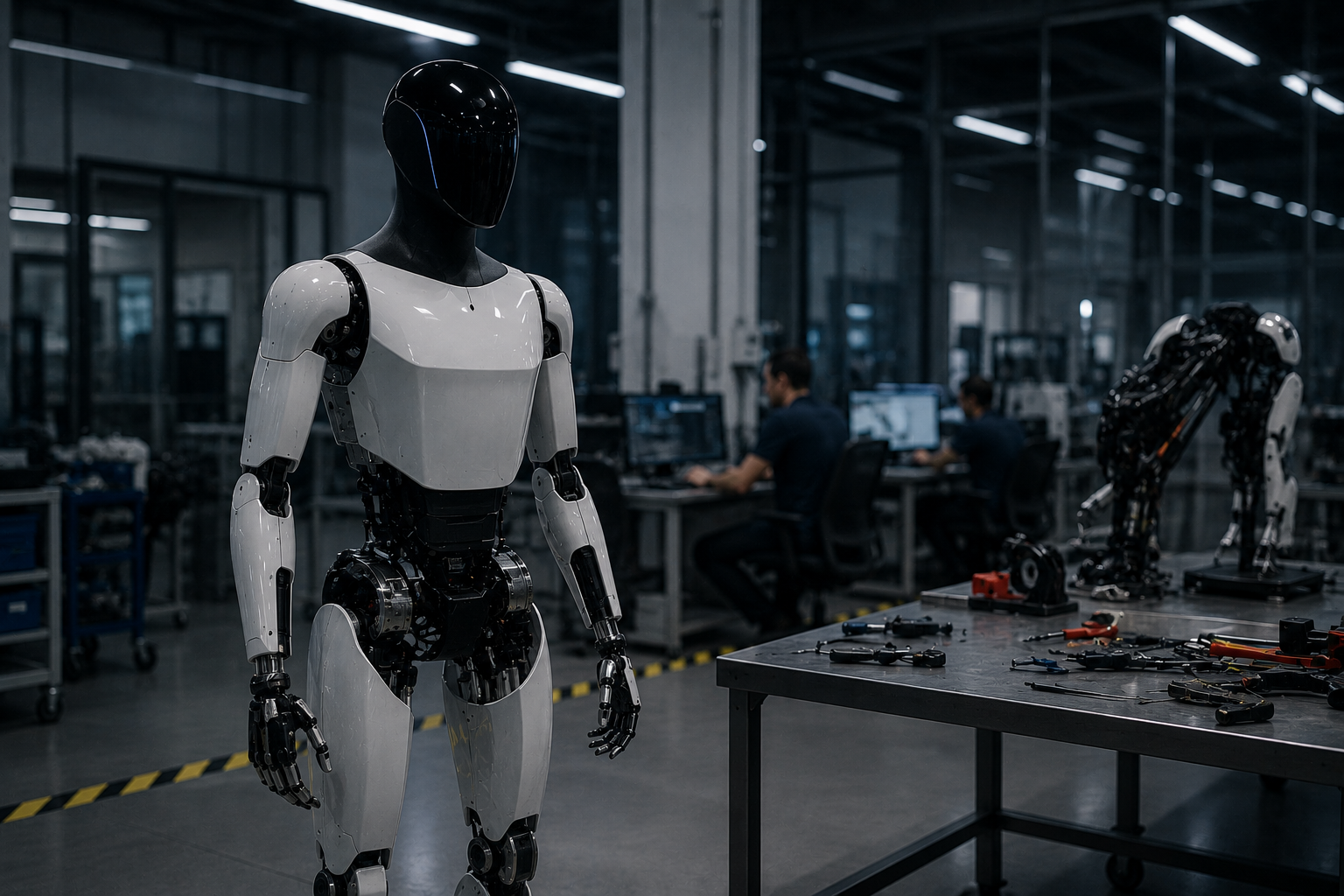
Elon Musk said Tesla would be selling humanoid robots to outside customers by 2025. That hasn’t happened, and every recent earnings call has leaned on the same phrase to explain why: “low volume.” It sounds like routine corporate hedging. It isn’t. In hardware manufacturing, that phrase is code for deep, unresolved production problems — and understanding what’s actually going on with Tesla Optimus matters well beyond Tesla shareholders. It’s a preview of what the entire “robots as capital expenditure” trend is actually going to look like in practice.

This piece walks through why the Tesla Optimus Gen 3 ramp keeps slipping, what “low volume” really means on a factory floor, how Tesla’s timeline stacks up against every other serious humanoid robotics program, the specific supply chain and engineering barriers nobody’s talking about on earnings calls, and what all of this means if you’re trying to evaluate humanoid robotics as an investment thesis rather than a demo reel.

Why Tesla Optimus Gen 3 Production Keeps Slipping

Musk first unveiled the concept behind Tesla Optimus back in August 2021, predicting production-ready robots within a few years and telling investors Tesla would begin selling units externally by 2025. Neither of those things has materialized on schedule.

The goalposts have shifted repeatedly and predictably. In August 2021, Musk announced the “Tesla Bot” at AI Day and promised a working prototype within a year. By September 2022, a stumbling early prototype walked onstage, and Musk started talking about “millions” of eventual units. December 2023 brought a smoother-walking Gen 2 demo, with claims that production could start in 2025. Early 2025 saw the Gen 3 design announced, with internal production still described as “low volume” testing. By mid-2025, the timeline had shifted again, pushing meaningful production into late 2025 or beyond.

Every delay in the Tesla Optimus program follows the same shape: a bold public commitment gets quietly replaced by vaguer language a few months later. Analysts have started treating Tesla Optimus timelines the same way they treat Tesla’s Full Self-Driving timelines — aspirational rather than operational, useful as a direction but not as a date.

Tesla’s own definition of “production” has drifted too. Early on, it meant robots actually working inside Tesla factories. Now it more often means small internal test batches. The gap between a polished demo and an actually deployed robot hasn’t closed — if anything, it’s widened, because the demo only has to survive a controlled stage with known lighting and a safety handler standing just out of frame. A production Tesla Optimus unit destined for a real factory floor has to handle unexpected obstacles, inconsistent surface friction, and partial slips, and recover from all of it without supervision, repeatedly, across a full shift. Those are fundamentally different engineering problems, and no amount of demo polish bridges the gap between them. In hardware, the demo is always the easy part — shipping is where a company finds out what it actually built.

What “Low Volume” Really Means for Tesla Optimus Manufacturing

When most people hear “low volume,” they picture a small, deliberate batch. In manufacturing, the phrase carries much heavier baggage, and for Tesla Optimus specifically, it usually points to one or more of the following problems.

Yield issues. Components aren’t passing quality checks at acceptable rates. For a humanoid robot, that means actuators, sensors, or structural parts failing testing before they ever reach assembly. Even a 10% failure rate on a single critical actuator becomes catastrophic at scale — if Tesla needed 10,000 finished Tesla Optimus units and one actuator type had a 10% defect rate, the company would need to source and test parts for roughly 11,000 units just to ship 10,000. That math compounds across every distinct component in the robot’s body.

Supply chain gaps. Critical parts don’t yet have reliable suppliers at real scale. Tesla designs much of Optimus in-house, but the custom actuators and specialized sensors involved often depend on niche vendors, and some components may still be hand-assembled — a process that simply doesn’t scale and introduces unit-to-unit variability that makes software calibration significantly harder, since every individual robot behaves slightly differently right out of the box.

Cost barriers. Musk has targeted a price point of $20,000 to $30,000 per Tesla Optimus unit. At today’s low volumes, actual per-unit cost is likely many times higher. Manufacturing economics only improve with scale, but scale isn’t achievable until yield and supply chain problems are solved first — which is exactly the loop nobody addresses on an earnings call.

Integration complexity. A humanoid robot isn’t really one product — it’s dozens of subsystems that all have to work together flawlessly at once. The hands alone contain dozens of actuators and sensors. If a hand’s force sensors report slightly stale data mid-grip, the robot can crush a component it was meant to handle gently. Catching and eliminating that entire class of failure across thousands of units takes a level of systems integration maturity that takes years to build, not months.

There’s also a structural signal worth watching: “low volume” for Tesla Optimus often means the production line itself isn’t finalized yet. Tesla may still be iterating on tooling, fixtures, and assembly sequences. One practical way to track this from the outside is watching Tesla’s job postings for roles like “manufacturing process engineer — robotics” or “tooling design lead — Optimus.” A spike in those listings usually signals the production line is being actively redesigned, not ramped up. That’s normal for early-stage hardware, but it directly contradicts any suggestion that mass production of Tesla Optimus is right around the corner.

The core reason Tesla Optimus keeps slipping schedule after schedule comes down to one simple fact: hardware manufacturing at this level of complexity doesn’t compress the way software timelines sometimes can. You can’t sprint through physics.

How Tesla Optimus Stacks Up Against Other Humanoid Robots

Tesla isn’t the only company building humanoid robots, and the competitive landscape offers a genuinely useful benchmark for how aggressive — and arguably unrealistic — Tesla’s public commitments around Optimus have actually been.

Company Robot Name First Prototype Production Status (Mid 2025) Estimated Unit Cost
Tesla Optimus Gen 3 2022 Low-volume internal testing $20K–$30K (target)
Boston Dynamics Atlas (Electric) 2024 (electric version) R&D / limited commercial pilots Not publicly disclosed
Figure AI Figure 02 2024 Pre-production partnerships Not publicly disclosed
Agility Robotics Digit 2019 (early version) Small-batch commercial shipments ~$250K+ estimated
Sanctuary AI Phoenix 2023 Prototype stage Not publicly disclosed

A few things stand out from this comparison. Nobody in the industry is at real mass production yet. Agility Robotics is arguably furthest along commercially, having shipped Digit units to partners like Amazon, but even Agility is operating at very small volumes. Boston Dynamics has decades of robotics experience and still hasn’t mass-produced its electric Atlas — a company with that much runway not having cracked the problem says something meaningful about how hard it actually is, not about a lack of ambition.

Tesla’s cost targets for Optimus are also aggressive relative to everyone else in the field. Agility’s Digit reportedly costs over $250,000 per unit at current volumes, while Tesla is targeting $20,000 to $30,000 — an order-of-magnitude gap that requires manufacturing breakthroughs nobody has publicly demonstrated yet. That’s not pessimism, just arithmetic. For context, the automotive industry spent decades refining stamping, welding, and paint processes before achieving the per-unit economics that make a $30,000 car possible. Humanoid robotics, including Tesla Optimus, is roughly at the hand-built prototype stage of that same journey.

Experience gaps matter too. Boston Dynamics has been building robots since 1992. Tesla only started its robotics program in 2021. Tesla brings genuine automotive manufacturing expertise to the table, but humanoid robotics involves fundamentally different engineering challenges — actuator design, balance control, and dexterous manipulation don’t transfer directly from car assembly, and assuming they would is arguably where a lot of the early optimism around Tesla Optimus went wrong.

Figure AI is worth watching closely here too. It’s attracted significant investment and secured a partnership with BMW for factory deployment, and even Figure openly acknowledges that real production scale remains years away. The entire humanoid robotics industry faces the same fundamental bottlenecks Tesla does with Optimus — which means Tesla Optimus running behind schedule isn’t some unusual failure. It’s the industry norm. What’s actually unusual is how confidently Tesla has marketed timelines that no competitor has come close to hitting either.

The Supply Chain Barriers Standing Between Tesla Optimus and Mass Production

Most coverage of Tesla Optimus focuses on AI capability questions — can it fold laundry, can it walk smoothly. Those are legitimate questions, but they obscure the much harder underlying problem: manufacturing.

Actuators are the core bottleneck. A humanoid robot needs dozens of actuators — the motors that create movement at each joint — and every one of them has to be compact, powerful, efficient, and affordable all at once. Tesla has designed custom actuators for Optimus, but custom components are inherently harder to produce at scale than off-the-shelf parts. There’s a real tradeoff hiding here too: high-torque actuators that give a robot meaningful lifting capability tend to run hotter and wear out faster, while lower-torque actuators that last longer limit what the robot can actually do. Tesla hasn’t publicly said where Optimus Gen 3 lands on that curve, which itself suggests the design isn’t fully locked yet.

Sensor integration creates cascading failures. Tesla Optimus uses cameras, force sensors, and inertial measurement units throughout its body, sourced from different suppliers with different quality standards. When one sensor type develops yield problems, it can stall entire production runs. Early smartphone makers faced a similar multi-supplier coordination problem, but a phone with a slightly underperforming camera still ships fine. A humanoid robot with a degraded force sensor in its wrist can damage property or injure someone standing nearby — the tolerance for variability here is categorically lower than in consumer electronics.

Battery and thermal management add real complexity. Optimus has to carry its own power supply while managing heat generated by dozens of motors packed into a human-sized frame. Tesla’s EV battery expertise genuinely helps here, but the form factor of a humanoid body creates thermal challenges a car never faces — motors packed tightly into a torso or limb generate concentrated heat that’s difficult to dissipate. In practice, that likely means a Tesla Optimus unit running a demanding task cycle, like repeatedly lifting and placing parts, may need to throttle output after sustained use to avoid thermal damage — directly limiting productivity in exactly the factory settings Tesla is targeting.

Software and hardware have to evolve together, which slows everything down. Unlike a car, where the mechanical platform is largely finalized before software refinement begins, a humanoid robot’s software and hardware develop in lockstep. A concrete example: Tesla’s AI team discovers the robot’s balance-recovery algorithm performs better with faster feedback from the ankle actuators. Implementing that requires a hardware revision, which resets supplier qualification timelines, which delays the next round of software testing. Each one of these cycles can cost weeks or months, and Tesla Optimus has to go through many of them before a design is truly final.

On top of all that, Tesla faces an internal resource competition most outside observers don’t account for. The Optimus team competes for engineering talent and budget against the automotive division, the energy division, and the Full Self-Driving team. Musk has repeatedly said Optimus will become Tesla’s single most valuable product long-term, but publicly available hiring and organizational data doesn’t yet show resource allocation matching that stated priority.

Each of these barriers reinforces the others. You can’t solve cost without scale. You can’t achieve scale without reliable supply chains. You can’t build reliable supply chains without a finalized design. And you can’t finalize a design without extensive low-volume testing first. It’s a closed loop — and right now, Tesla Optimus is still inside it.

What Tesla Optimus Delays Mean for the Robotics Capex Cycle

The delays in the Tesla Optimus program matter well beyond Tesla itself. They say something important about the broader idea of companies treating humanoid robots as capital expenditure — buying robots the way they’d buy machinery, instead of hiring workers.

That capex cycle hasn’t actually started yet. For robots to genuinely replace or meaningfully augment human labor at scale, they need to be affordable, reliable, and available — and none of those three conditions exist today for Tesla Optimus or any of its competitors. Traditional industrial robots from companies like FANUC and ABB, by contrast, have been deployed successfully for decades precisely because they meet all three criteria for narrow, structured tasks. A FANUC welding arm does one thing, in a fixed position, on a known part geometry, running 24 hours a day with predictable maintenance intervals. That’s the reliability bar a general-purpose humanoid robot still has to clear, across a far wider range of tasks and environments.

Investor expectations are running well ahead of that reality. Tesla’s market valuation already includes a significant premium tied to Optimus’s future potential, and analysts at major banks have modeled scenarios where Optimus generates hundreds of billions in revenue down the line. Those models generally assume manufacturing timelines that keep slipping in practice. If Tesla Optimus production stays in “low volume” through 2026, those revenue projections need real revision — arguably overdue revision. Anyone evaluating those models is better off asking directly what unit-production assumption is baked in for each year; if the answer is tens of thousands of units before 2027, that assumption deserves serious skepticism given everything the industry has actually demonstrated so far.

Safety certification adds another timeline layer that runs in parallel rather than waiting its turn. Before Tesla Optimus or any humanoid robot can work alongside humans in a factory or home, it needs formal safety certification. ISO standards — specifically ISO 10218 and ISO/TS 15066 — govern robot safety in industrial settings today, but humanoid robots introduce new safety considerations those existing standards don’t fully address yet. Developing and certifying against updated standards takes years on its own, independent of manufacturing progress. In the EU, CE marking requirements for machinery add another compliance layer before commercial deployment; in the U.S., OSHA’s general duty clause means employers deploying robots like Optimus alongside human workers carry liability exposure most legal and insurance frameworks haven’t fully priced in yet.

Even if Tesla solved every manufacturing problem tomorrow, regulatory and safety certification timelines would still add years before Tesla Optimus could be deployed commercially at any real scale. Platforms aiming to speed up safety validation exist, but the underlying process remains inherently slow. The long-term vision behind Tesla Optimus is genuinely compelling — but the near-term reality calls for patience measured in years, not quarters.

Conclusion: Final Thoughts on Tesla Optimus and What Comes Next

The delays hitting Tesla Optimus aren’t surprising, and they aren’t unique to Tesla — they reveal fundamental truths about hardware manufacturing at the frontier of robotics that apply to every company in this space. “Low volume” means unresolved yield problems, immature supply chains, and per-unit costs far above target, and every humanoid robot company faces the same underlying barriers. Tesla’s specific challenge is that its public commitments have consistently outpaced what the physics of manufacturing actually allows.

A few practical takeaways worth holding onto: don’t anchor expectations to Musk’s stated timelines — track actual reported unit counts instead, and treat dates as aspirational until Tesla reports something concrete. Watch supply chain signals like supplier contracts and hiring patterns at Tesla’s robotics facilities, since they tend to reveal more than earnings call rhetoric. Compare Tesla Optimus against the rest of the industry rather than in isolation — if no humanoid robot company reaches real mass production by late 2026, the entire capex cycle thesis needs recalibrating, not just Tesla’s piece of it. Keep an eye on safety standards development too, since ISO working groups and national safety bodies will shape deployment timelines as much as manufacturing readiness will. And track internal deployment separately from external sales — Tesla running Optimus units inside its own factories is a real milestone, but it’s a different business entirely from selling robots commercially, and the two shouldn’t be treated as interchangeable evidence.

The humanoid robotics shift itself is real, and Tesla Optimus is a genuine part of that story. But it’s arriving on hardware timelines, not software timelines — and hardware, as the Tesla Optimus program keeps demonstrating, doesn’t care about press releases.

FAQ About Tesla Optimus and the Delayed Ramp

Why is the Tesla Optimus Gen 3 ramp behind schedule?

The delays stem from several overlapping manufacturing challenges. Custom actuators have yield issues at scale, and supply chains for specialized sensors and components remain immature. Per-unit cost at current volumes far exceeds Tesla’s $20,000–$30,000 target. These problems are interconnected — solving one often exposes or worsens another. The fundamental issue is that building a humanoid robot at automotive scale is genuinely unprecedented as a manufacturing challenge.

What does “low volume” actually mean in Tesla’s Optimus updates?

It’s manufacturing terminology for production runs that haven’t achieved economies of scale. Specifically, it signals that the production line isn’t finalized, component yields sit below acceptable thresholds, or assembly still requires significant manual work. It doesn’t mean Tesla is choosing to build few units — it means the company can’t yet build many reliably or affordably.

How does Tesla Optimus compare to competitors like Boston Dynamics and Figure AI?

No humanoid robot company has reached true mass production as of mid-2025. Boston Dynamics has the deepest robotics experience but hasn’t mass-produced its electric Atlas. Figure AI has secured real manufacturing partnerships but remains in pre-production. Agility Robotics has shipped small numbers of Digit robots commercially. Tesla’s public timeline for Optimus is aggressive relative to all of them, especially given that Tesla only entered robotics in 2021.

Will Tesla Optimus actually cost $20,000 to $30,000?

That target requires production scale that doesn’t exist yet. At today’s low volumes, per-unit costs are likely many times higher — for comparison, Agility Robotics’ Digit reportedly costs over $250,000 per unit. Tesla’s automotive manufacturing expertise could eventually drive Optimus costs down significantly, but only after the yield, supply chain, and design-finalization problems currently causing delays are actually solved.

What safety certifications does Tesla Optimus need before commercial deployment?
Humanoid robots working near humans generally need to meet evolving industrial safety standards, including frameworks like ISO 10218 and ISO/TS 15066, along with region-specific requirements like CE marking in the EU. Because existing standards were written with more limited industrial robots in mind, regulators are still working out how they apply to general-purpose humanoid robots like Optimus — a process that runs on its own multi-year timeline, independent of how quickly Tesla solves manufacturing.

Intel 18A Warning: The Truth About Musk’s Chip Gambit

Intel 18A Explained: Can It Power Musk's Bet Against Nvidia?

Nvidia has owned the AI chip market for years now, and nobody’s come close to seriously threatening that position. That might be starting to change — not because of a flashy new GPU, but because of a manufacturing process node and a bet nobody was fully expecting: Elon Musk’s xAI reportedly committing to build custom AI silicon at Intel’s upcoming mega-fab in Ohio, running on a process called Intel 18A.

It’s an audacious pairing. Musk wants out from under Nvidia’s pricing power and allocation decisions. Intel wants a marquee customer to prove its foundry business can compete again. Both bets rest on the same unproven foundation: whether Intel 18A can actually deliver leading-edge chips on schedule, after nearly a decade of the company falling behind on process technology.

This piece digs into what Intel 18A actually is, what the Ohio facility is trying to become, how it stacks up against TSMC’s dominant node, and whether Musk’s custom silicon plan has any realistic shot at loosening Nvidia’s grip before the rest of the industry moves on without them.

Why Intel 18A Is the Foundation of Musk’s Chip Gambit

Intel 18A is the company’s moonshot process node, and it’s betting on two breakthrough technologies landing at the same time: RibbonFET,

Intel’s version of a gate-all-around transistor, and PowerVia, which moves power delivery to the back side of the wafer. No other foundry has attempted to introduce both innovations in a single node jump. That’s either visionary engineering or a reckless amount of risk stacked into one bet — possibly both.

RibbonFET replaces the aging FinFET transistor design that’s powered chips for over a decade. Picture the gate wrapping completely around the channel instead of just draping over three sides of it — that gives engineers far more precise control over the electrical current flowing through each transistor. The result is chips that can switch faster while leaking less power, and the efficiency gains here are more meaningful than they sound on a marketing slide.

PowerVia solves a different problem. Traditional chip designs route both power and data signals on the same side of the wafer, which gets cramped as transistor counts climb into the billions. PowerVia moves power delivery to the backside instead, freeing up more room for signal routing on top. That translates into roughly 6% better performance and meaningfully improved signal integrity — numbers that sound modest until you’re talking about a chip with tens of billions of transistors switching simultaneously.

For Musk’s chip gambit specifically, these Intel 18A innovations matter enormously. AI training chips are famously power-hungry — Nvidia’s H100 alone draws 700 watts under load. Any efficiency gain at the transistor level compounds across billions of transistors packed onto a single die. If Intel 18A delivers on its architectural promises, it could give xAI’s custom silicon a real edge. That’s a big “if,” though.

Intel’s recent track record on node transitions has been genuinely rough. The company got stuck on 14nm for years, and its 10nm node — later rebranded Intel 7 — arrived years behind schedule. New foundry leadership has restructured the division since then, but skepticism about Intel 18A’s ability to hit its targets remains entirely warranted given the history.

Inside the Terafab: Where Intel 18A Chips Will Actually Get Made

Intel’s Ohio Terafab isn’t just another factory — it’s designed to become the largest semiconductor manufacturing site on the planet, and it’s where Intel 18A production is meant to scale to a level that could actually matter to the broader industry. The campus in New Albany, Ohio, could eventually house eight fabrication plants, with two currently under construction.

The scale of investment here is genuinely staggering: over $100 billion in total planned spending, up to $8.5 billion in direct CHIPS Act grants from the federal government, an additional $11 billion in federal loans, thousands of construction and permanent jobs, and first production targeted for the 2025–2026 window.

This isn’t just a subsidy program — it’s a national security strategy built around Intel 18A succeeding. The U.S. currently produces roughly 12% of the world’s semiconductors, down sharply from 37% in the 1990s, and virtually none of the world’s most advanced chips are manufactured on American soil today. Taiwan’s TSMC makes over 90% of the planet’s leading-edge processors. That concentration is precisely why an Intel 18A Terafab reaching real volume production is treated as a matter of genuine national interest rather than just a corporate turnaround story.

The CHIPS Act money comes with real strings attached. Intel has to hit specific milestones, and missing them puts future disbursements at risk. The company also can’t use the funds for stock buybacks or dividends — a reasonable guardrail given how these situations have played out elsewhere.

A realistic Intel 18A timeline breaks down roughly like this: late 2025 brings the first test chips and early production wafers, the first half of 2026 should see initial volume production for lead customers, the back half of 2026 into 2027 is when high-volume manufacturing should ramp, and full Terafab capacity for external foundry customers likely doesn’t arrive until 2027 at the earliest. Building a fab typically takes three to four years on its own, and qualifying a brand-new process node adds another 12 to 18 months on top of that. Intel is attempting both simultaneously, which means any slip in construction or yield improvement could push meaningful Intel 18A output into 2028 — and in this industry, slips happen more often than announcements admit.

TSMC N3 vs. Intel 18A: The Benchmark Intel Has to Beat

To judge whether Intel 18A can genuinely dent Nvidia’s position, you have to understand exactly what it’s up against. TSMC’s N3 family is

the current gold standard in semiconductor manufacturing, and right now, it isn’t close.

TSMC’s 3nm node — spanning N3E, N3P, and N3X — already powers Apple’s latest chips and will underpin Nvidia’s next-generation Rubin architecture too. TSMC has been refining this node since 2022, with mature yields, a proven supply chain, and design tools its customers have battle-tested for years. Intel, by comparison, is asking customers to commit to a node that hasn’t shipped a single commercial chip yet. That’s a genuinely tough sell regardless of the architectural story behind it.

Feature Intel 18A TSMC N3P TSMC N2 (2025–2026)
Transistor type RibbonFET (GAA) FinFET Nanosheet (GAA)
Backside power Yes (PowerVia) No Yes (planned)
Density (MTr/mm²) ~250 (estimated) ~290 ~300+ (estimated)
EUV layers Multiple Multiple Multiple
Volume production 2026 (target) 2024 (shipping) Late 2025–2026
Yield maturity Unproven Mature Early
U.S. manufacturing Yes (Ohio) Arizona fab (limited) No

A couple of things jump out from this comparison. TSMC’s N3P is already shipping in volume, while Intel 18A remains a target rather than a shipped product. More importantly, TSMC’s upcoming N2 node is also adopting gate-all-around transistors and backside power delivery — meaning whatever architectural edge Intel 18A currently holds on paper is temporary. The window for that advantage to matter is narrower than the headlines suggest.

Intel does hold one real trump card, though: location. TSMC’s Arizona fab has faced repeated delays and will initially produce older N4 chips rather than anything leading-edge. That means Intel’s Ohio Terafab, running Intel 18A, could plausibly be the only facility producing genuinely leading-edge chips on American soil by 2027. For customers worried about geopolitical risk — and Musk clearly is — that geography matters enormously, sometimes more than raw performance numbers on a spec sheet.

Musk’s xAI Bet on Intel 18A vs. Nvidia’s Ecosystem

Musk’s interest in pairing xAI with Intel foundry services isn’t random — it’s strategic, and it follows a pattern that’s played out at other companies before. xAI currently trains its Grok models entirely on Nvidia GPUs, and that dependency is both expensive and limiting. Big AI players tend to eventually want to own their own silicon, and this looks like the same instinct showing up again.

A few concrete reasons are driving the push toward Intel 18A specifically: cost control, since Nvidia’s H100 GPUs sell for $25,000 to $40,000 each and xAI’s Memphis data center reportedly houses roughly 100,000 of them; supply independence, since Nvidia allocates its GPUs based on its own priorities and Musk has publicly complained about availability constraints; architecture optimization, since general-purpose GPUs waste silicon on features AI training doesn’t actually need, while custom application-specific chips can be leaner and faster for narrower workloads; and vertical integration, a strategy that’s genuinely worked for Musk before at both Tesla and SpaceX.

Building custom AI chips from scratch, though, is extraordinarily difficult. Google spent years and billions developing its TPU, and Amazon built Trainium — and both companies already had massive internal chip design teams before they started. xAI is comparatively young in this space, and the learning curve involved in a project like this is real. The graveyard of failed custom AI chip programs across the industry is well-populated.

There’s also a software problem sitting underneath all of this. Nvidia’s dominance isn’t just about hardware — it’s about CUDA, the software ecosystem that millions of developers already know how to use. Moving away from CUDA means rewriting code, retraining engineering teams, and absorbing short-term productivity losses. Musk’s chip gambit needs a viable software stack running on Intel 18A, not just competitive silicon. You can build the best chip in the world and still lose if nobody wants to write code for it.

Timing adds another wrinkle. Even if xAI finalizes a chip design today and Intel manufactures it on 18A by late 2026, Nvidia isn’t standing still in the meantime. Nvidia’s Blackwell architecture is already shipping, and its Rubin platform arrives in 2026. By 2027, Nvidia will likely be well into its next generation after that. xAI’s custom chip would need to leapfrog a moving target — historically one of the hardest things to pull off in this entire industry. The honest read: Intel 18A supporting Musk’s chip gambit against Nvidia is possible, but it’s an extremely difficult path that requires nearly flawless execution on both the manufacturing and software sides at once.

Yield, Economics, and Whether Intel 18A Can Actually Scale

Process node transitions aren’t just about clever transistor design — they’re about yield, the percentage of functional chips that actually come off a given wafer. And yield is where Intel 18A’s ambitions face their harshest, least forgiving test.

Here’s why it matters so much: a 300mm silicon wafer costs roughly the same to process regardless of how many good chips come off it. At 90% yield, a fab gets 90 sellable chips per 100 die sites. At 50% yield, that drops to 50 — and the cost per chip nearly doubles. For AI accelerators with massive die sizes, often 600 to 800 square millimeters, yield problems become genuinely catastrophic to the economics.

TSMC achieves yields above 80% on mature N3 wafers today. Intel 18A’s actual yields remain largely unknown outside the company. Early reports suggest Intel has produced functional test chips, which is a genuinely encouraging sign, but moving from functional samples to high-yield volume production typically takes 12 to 24 months — and the semiconductor industry has a long history of companies confusing those two very different milestones.

The broader economics of foundry competition are brutal on their own. A single leading-edge fab costs $15 to $20 billion to build. Equipment lead times from ASML, the sole supplier of EUV lithography machines, stretch 18 months or longer. Each EUV machine costs roughly $350 million, and a fab needs dozens of them. Breakeven requires sustained high utilization sustained over many years, not just a successful launch quarter.

Intel also has to convince enough outside customers to actually fill Terafab’s capacity once Intel 18A is ready. TSMC’s foundry business serves hundreds of customers — Apple, AMD, Nvidia, Qualcomm, MediaTek, and many more. Intel Foundry Services currently has a much thinner external customer list. Microsoft, the Department of Defense, and now potentially xAI are signed up, but that’s still a narrow base. A thin customer base means thin margins, which means less capital available to reinvest in yield improvement — a genuinely nasty cycle to break out of.

There’s also a chicken-and-egg problem baked into all of this. Customers won’t commit real volume to Intel 18A until yields are proven, but yields don’t improve without volume production running through the line. TSMC worked through this exact problem over three decades. Intel is trying to solve it in roughly three years. Those aren’t remotely equivalent challenges. Intel Foundry reported operating losses exceeding $7 billion in 2024, while TSMC posted record profits and kept expanding capacity in the same period. The gap between them isn’t just technical anymore — it’s financial, and financial gaps tend to compound rather than close on their own.

Can Intel 18A Deliver U.S. Foundry Independence by 2027?

The boldest claim wrapped up in Intel’s Ohio bet is that the United States can achieve meaningful semiconductor independence, with Intel 18A as the technological foundation making it possible. It’s worth being honest about that claim rather than repeating the optimistic version usually heard at a congressional hearing.

The case for it actually happening: the CHIPS Act provides unprecedented government support, Intel’s Ohio site is genuinely under active construction rather than still on paper, national security urgency has created rare bipartisan political backing, multiple companies including Intel, TSMC, and Samsung are all building U.S. fabs simultaneously, and the Department of Commerce has accelerated funding disbursements to keep projects moving.

The case against it: TSMC’s Arizona fab is already delayed and will produce older nodes rather than anything leading-edge, Samsung’s Texas fab has struggled with yield issues of its own, the U.S. genuinely lacks a trained workforce for semiconductor manufacturing at this scale, chemical and material supply chains remain heavily concentrated in Asia, and leading-edge chip design tools still depend on global collaboration that doesn’t stop at any one country’s border.

“Independence” here doesn’t mean making every chip domestically — it means having enough domestic capacity for the applications that matter most: defense, AI, telecommunications. Under that narrower, more realistic definition, 2027 is ambitious but not impossible, and this distinction gets lost in most of the public debate around it.

If Intel 18A reaches real volume production at the Terafab by 2027, it would represent the most advanced chip manufacturing facility in the Western Hemisphere — strategically valuable on its own, regardless of whether it ever matches TSMC’s total throughput. Having a credible domestic alternative also changes the negotiating dynamic with TSMC, even for companies that never actually switch providers. For Musk specifically, domestic manufacturing cuts real geopolitical risk. A Chinese blockade of Taiwan, however unlikely anyone considers it today, would devastate global chip supply overnight. A U.S.-based alternative running Intel 18A isn’t just smart business in that scenario — it’s insurance, and insurance is worth paying for even when you’re hoping you never need to use it.

Conclusion: Final Thoughts on Intel 18A and the Nvidia Challenge

Intel 18A and Musk’s chip gambit together represent the most consequential challenge to Nvidia’s AI chip dominance the industry has seen in years. But the odds remain steep. Intel has to deliver a genuine breakthrough process node, ramp an enormous new factory, and attract enough outside customers to make the underlying economics work — all while TSMC keeps extending its own lead in the meantime.

A realistic read: Intel 18A likely won’t meaningfully dent Nvidia’s dominance before 2028 at the earliest. Custom xAI silicon built on Intel 18A could become genuinely competitive for specific workloads, but it won’t replace CUDA overnight, and Nvidia’s roadmap has never paused for a competitor’s timeline.

What’s worth watching going forward: Intel 18A yield data as it emerges in late 2025 is the single most important signal to track. xAI chip tape-out announcements would confirm Intel Foundry as the actual manufacturer. CHIPS Act milestone payments are worth watching too — delays there signal real trouble. TSMC’s N2 ramp timeline matters because Intel’s architectural window closes once N2 reaches volume. And Nvidia’s Rubin benchmarks set the actual target that any Musk-backed chip running on Intel 18A would need to beat.

Ultimately, neither Intel 18A nor Musk’s chip gambit is about winning tomorrow. They’re about building real options for 2028 and beyond. If Intel executes, the U.S. gets a credible domestic alternative to TSMC. If Musk’s custom silicon delivers, xAI escapes Nvidia’s pricing power. Neither outcome is guaranteed — but both are genuinely worth attempting, and the industry’s history is full of bets that looked too ambitious right up until they reshaped everything.

FAQ About Intel 18A and Musk’s Chip Gambit

What is Intel 18A, exactly?

Intel 18A is the company’s upcoming leading-edge manufacturing process, combining RibbonFET gate-all-around transistors with PowerVia backside power delivery. Together, these technologies promise better performance and power efficiency than the FinFET designs used today. Intel is targeting volume production sometime in 2026.

How does Intel 18A actually connect to Musk’s chip gambit?

xAI reportedly plans to manufacture custom AI training chips at Intel’s Ohio Terafab, running on the Intel 18A process. The two bets are interdependent — Musk needs Intel’s advanced manufacturing to work as promised, and Intel needs a high-profile customer like xAI to justify its enormous foundry investment. Both sides benefit if Intel 18A actually delivers competitive performance on schedule.

Can Intel 18A realistically compete with TSMC’s N3?

On paper, Intel 18A offers real architectural advantages through backside power delivery. But TSMC’s N3 is already shipping in high volume with mature, proven yields. Intel 18A has to demonstrate comparable density, yield, and reliability before customers commit to switching. TSMC’s upcoming N2 node also adopts similar gate-all-around technology, which could neutralize much of Intel’s current architectural edge.

What role does the CHIPS Act play in Intel 18A and the Terafab?

The CHIPS and Science Act provides Intel with up to $8.5 billion in direct grants and $11 billion in loans, offsetting the enormous cost of building leading-edge fabs on U.S. soil. The funding comes tied to specific performance milestones, and Intel has to show real progress to receive the full disbursement amounts.

Will Musk’s custom chips actually replace Nvidia GPUs for AI training?

Not in the near term. Custom application-specific chips can outperform general-purpose GPUs on narrow, specific workloads, but Nvidia’s CUDA software ecosystem creates enormous switching costs across the industry. xAI would need to build out alternative software tools and convince AI researchers to actually adopt them. Realistically, Intel 18A-based custom chips are more likely to supplement Nvidia GPUs than fully replace them anytime soon.

When will Intel’s Ohio Terafab actually start producing chips?

Intel is targeting initial Intel 18A production in late 2025, with volume manufacturing ramping through 2026. Full Terafab capacity likely won’t come online until 2027 or later, since construction delays, equipment installation timelines, and yield optimization could all push meaningful output further out. The most realistic window for genuinely high-volume Intel 18A production sits somewhere between late 2026 and mid-2027.

AI Discrimination Warning: The Truth About Illinois Law

AI Discrimination Warning: The Truth About Illinois Law

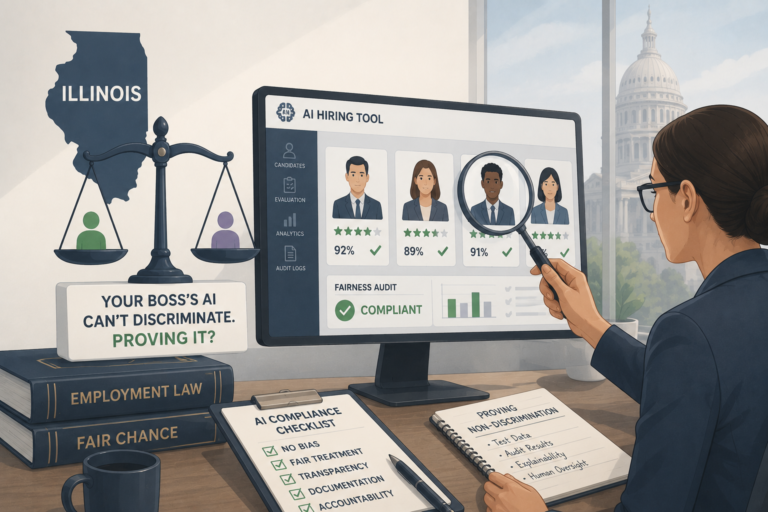
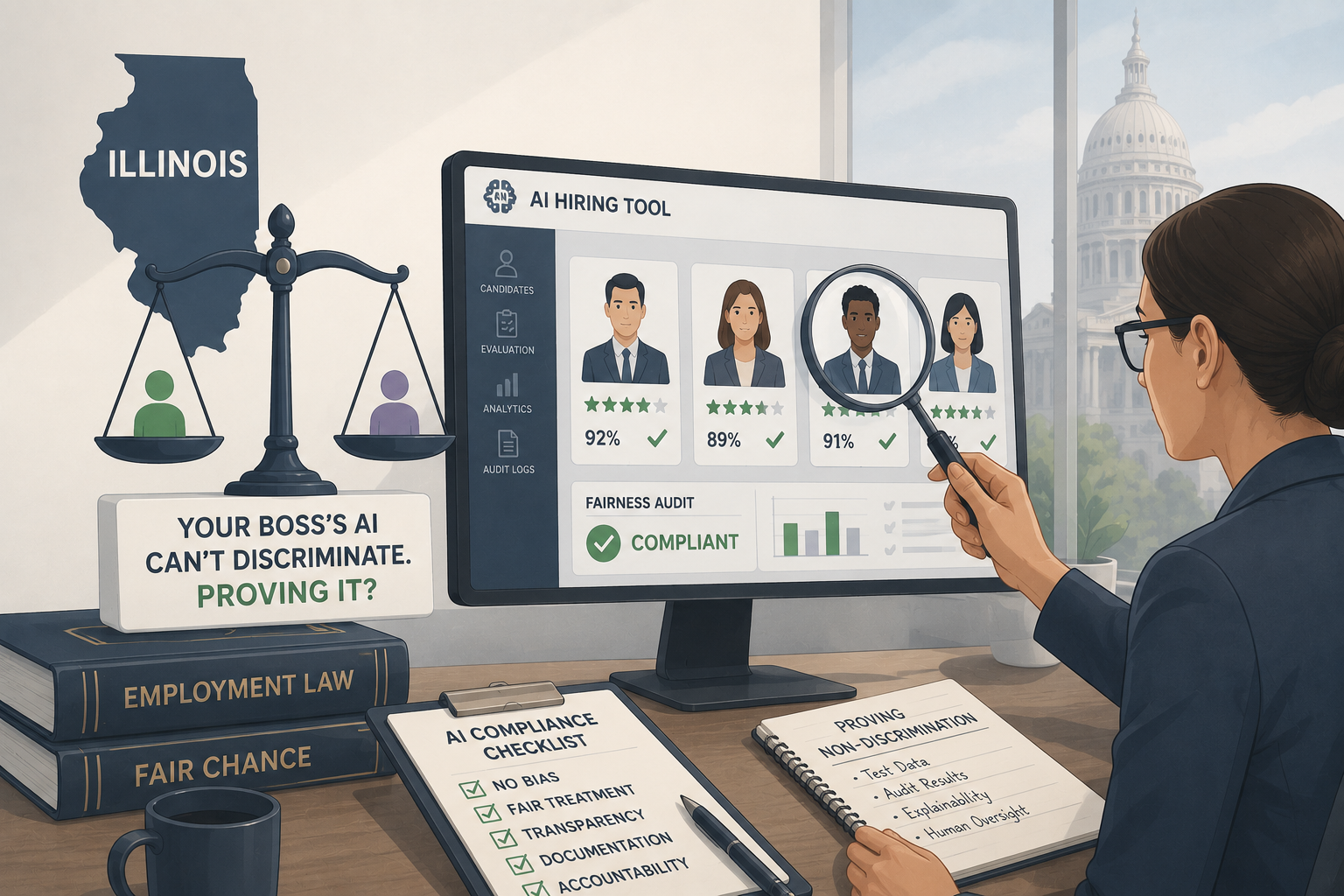
Illinois passed a law saying an employer’s AI can’t discriminate against candidates or employees. That part is straightforward. What isn’t straightforward is what comes next: how does a company actually prove its AI discrimination risk is under control, when the law itself never spells out the test?

The amendments to the Illinois Human Rights Act now explicitly cover automated decision-making in employment — screening resumes, scoring interviews, ranking candidates, flagging people for promotion. But the statute creates a real legal obligation without handing employers a step-by-step playbook for proving they’ve met it. That gap between “you must not discriminate” and “here’s exactly how you demonstrate that” is where most companies are currently stuck.

So HR and legal teams are left asking a genuinely hard question: how do you prove a machine isn’t biased? The honest answer involves audit frameworks, third-party testing, and documentation that can survive actual scrutiny — not a vendor’s word that their tool is “bias-free.” This piece skips the general regulatory overview and goes straight to implementation: which bias detection methods hold up, which auditors are worth hiring, what your documentation trail needs to include, and what real case outcomes look like when companies get AI discrimination compliance right — and badly wrong.

Why Proving You’ve Avoided AI Discrimination in Illinois Is So Hard

Illinois didn’t just prohibit discriminatory AI outcomes. It created an accountability gap, because the law tells employers what result they must avoid without telling them exactly how to demonstrate they’ve avoided it. There’s no specified testing method written into the statute and no defined acceptable bias threshold — the legislative text stays quiet on both, and that silence is the whole problem.

That ambiguity is the core challenge behind every AI discrimination compliance effort in the state right now. Employers have to prove a negative — that their AI isn’t producing discriminatory outcomes — without a standardized measuring stick handed to them. In practice, most organizations are borrowing audit frameworks from other jurisdictions and adapting federal guidelines just to have something to stand on.

A few specific features of the Illinois law make AI discrimination exposure especially tricky to manage:

  • No safe harbor provision. Good-faith effort alone doesn’t protect you if the actual outcome turns out to be discriminatory.
  • Broad scope. The law reaches recruiting, hiring, promotions, and terminations — not just the hiring stage most companies assume it’s limited to.
  • Private right of action. Employees can sue directly rather than relying solely on agency enforcement, which meaningfully raises the stakes.
  • Intersectional analysis expected. Regulators want bias testing across multiple protected categories at once, not evaluated one at a time in isolation.

The burden of proof effectively sits with the employer here. Saying your AI is fair isn’t enough — you need documented evidence. Avoiding AI discrimination in Illinois means having audit processes that are repeatable and defensible, not a verbal assurance that “we ran some internal checks.” That phrase alone won’t hold up if a complaint ever gets filed.

Bias Detection Methods That Actually Catch AI Discrimination

Not every bias test carries the same weight. Some only catch surface-level issues. Others dig into the structural patterns that a simple pass/fail metric misses completely, and the difference matters enormously when you’re trying to prove you’ve avoided AI discrimination rather than just hoping you have.

Audit reports that actually hold up under scrutiny tend to combine several methodologies rather than relying on one supposedly definitive test. Here’s what’s proven effective in practice:

Disparate impact analysis is still the starting point, rooted in the EEOC’s Uniform Guidelines on Employee Selection Procedures.

The four-fifths rule gives you a baseline: if a protected group’s selection rate falls below 80% of the highest-performing group’s rate, that’s treated as a presumption of adverse impact. But the four-fifths rule alone isn’t sufficient proof against AI discrimination — a lot of HR teams stop here and shouldn’t.

Beyond that baseline, a genuinely thorough approach layers in:

  1. Statistical parity testing — comparing selection rates across demographic groups at every decision stage, from resume screening through interview invitations to final offers, since bias can enter at any single stage.
  2. Equalized odds analysis — checking whether the AI’s true-positive and false-positive rates stay consistent across groups. A tool can hire qualified candidates from one group while rejecting equally qualified candidates from another, and the overall numbers can still look fine on the surface.
  3. Counterfactual fairness testing — changing a candidate’s demographic attributes while holding qualifications constant, then checking whether the AI’s recommendation shifts. If it does, that’s a real signal of AI discrimination worth investigating immediately.
  4. Feature importance auditing — examining which input variables actually drive the AI’s decisions. Proxy variables like zip code or university name can smuggle in racial or socioeconomic bias without anyone building the system intending that outcome.
  5. Longitudinal outcome tracking — since bias can emerge over time as models drift, quarterly retesting catches AI discrimination that a single one-time audit would completely miss.

No single method catches every form of AI discrimination on its own. A solid audit combines at least three of these approaches together. NIST’s AI Risk Management Framework offers a genuinely useful structure for organizing these tests into a coherent program, and since it’s free, there’s not much excuse for skipping it as a starting point.

Third-Party Auditors Who Can Verify You’ve Avoided AI Discrimination

Proving you’ve avoided AI discrimination often means bringing in outside experts, because internal teams face a real conflict of interest — not from bad faith, but because it’s genuinely hard to audit your own work objectively. Third-party auditors add credibility and catch blind spots your own team has stopped noticing.

The market for this kind of AI bias auditing has matured quickly. Here’s how the major players stack up:

Vendor/Tool Type Key Strength Limitation Approximate Cost
ORCAA (O’Neil Risk Consulting) Full-service audit firm Deep statistical expertise; led NYC Local Law 144 audits Higher cost; longer timelines $50K–$200K per audit
Holistic AI Platform + consulting Automated bias scanning with human review Less customization for niche models $30K–$100K annually
Credo AI Governance platform Policy-to-evidence mapping; board-ready reports Requires internal technical capacity SaaS pricing varies
IBM AI Fairness 360 Open-source toolkit Free; extensive algorithm library Requires data science team to implement Free
Google What-If Tool Open-source visualization Excellent for exploratory analysis Not a compliance-grade audit tool Free
Aequitas (UChicago) Open-source toolkit Designed for public-sector decision systems Limited commercial support Free

Budget shapes this decision a lot. Smaller companies often start with open-source tools like IBM’s AI Fairness 360 and escalate to a full-service auditor once the stakes climb. Larger enterprises typically need the documentation rigor that firms like ORCAA or Holistic AI provide out of the gate. The gap between “we ran a free toolkit once” and “we engaged a qualified third-party auditor” is exactly the gap that tends to matter most if AI discrimination litigation ever arrives.

The auditor you choose directly affects legal defensibility. Courts and regulators simply give more weight to independent, third-party assessments — that’s just the reality of how these cases get evaluated. Auditors with real experience in employment law, not just general data science, tend to produce reports that hold up better under actual scrutiny.

Before signing with anyone, it’s worth confirming a few things: ask for sample audit reports up front, verify the auditor’s experience is specific to employment AI rather than general machine learning, make sure they test for every Illinois-protected category (immigration status gets missed surprisingly often), and confirm they’ll deliver litigation-ready documentation rather than a summary slide deck.

Documentation That Proves You Took AI Discrimination Seriously

Even a genuinely fair AI system can create serious legal exposure without the paperwork to back it up. That’s a frustrating reality, but it’s the one companies actually operate under. Avoiding AI discrimination in practice, in front of a court or the Illinois Department of Human Rights, requires a documentation trail that connects policy to actual practice — not just policy to good intentions.

A solid documentation package should include:

  • Model cards — a standardized description of what the AI does, what data trained it, and its known limitations.
  • Bias audit reports — dated, signed assessments from qualified auditors covering every protected category, not a partial sample.
  • Impact assessments — pre-deployment analyses predicting potential AI discrimination effects before the tool ever goes live.
  • Notice records — proof that candidates and employees were actually told AI was involved in decisions affecting them.
  • Remediation logs — records of identified bias issues and the specific steps taken to fix them, not just an acknowledgment that a problem existed.
  • Vendor contracts — agreements that include anti-discrimination warranties and audit rights. If a vendor won’t sign one, that itself is worth paying attention to.
  • Training records — evidence that HR staff actually understand the tools they’re using and where those tools fall short.

A growing number of companies are building dedicated AI governance repositories to hold all of this in one place. Platforms like Credo AI and OneTrust are built specifically for this kind of centralized compliance record-keeping, and they’re worth a serious look if your documentation is currently scattered across inboxes and shared drives.

Retention matters too. Employment records in Illinois generally need to be kept for at least five years, and AI audit documentation should follow the same timeline — longer if litigation seems likely.

Here’s the part that trips companies up most: documentation has to be contemporaneous. Records created after a complaint lands look defensive and reactive. Records built proactively, before anything goes wrong, look responsible and systematic. That distinction alone can shape how an AI discrimination case actually plays out.

Real Cases: Companies That Passed and Failed AI Discrimination Audits

Real examples show the gap between theory and practice better than any framework document can. Illinois-specific case law is still limited given how recent the law is, but parallel enforcement actions and voluntary audits already offer genuinely useful lessons about what proving you’ve avoided AI discrimination looks like in practice.

Case 1 — a staffing platform’s proactive audit (passed). A national staffing company operating in Illinois hired ORCAA to audit its resume-screening algorithm ahead of the law’s enforcement date. The audit found the model was disproportionately filtering out candidates with employment gaps — a pattern that correlated strongly with gender and disability status. The company retrained the model, removed gap length as a feature entirely, and documented the process from start to finish. When a candidate later filed a complaint, the company produced its full audit trail, and the complaint was dismissed. That’s the outcome proactive AI discrimination compliance actually buys a company.

Case 2 — a mid-size retailer’s chatbot screening failure. A retailer used an AI chatbot to screen candidates, scoring them partly on response speed and vocabulary complexity — which sounds neutral until you sit with it for a moment. An internal review triggered by employee complaints found non-native English speakers scoring significantly lower across the board. The company had no documentation of the AI’s decision logic and had never run bias testing before deployment. The resulting settlement exceeded $400,000 in combined legal fees and remediation costs — an expensive way to learn what proactive auditing would have caught for a fraction of that.

Case 3 — NYC’s Local Law 144 as an early preview. New York City’s Local Law 144 already requires annual bias audits of automated employment tools, and several companies failed their first audits because they only tested for race and gender, ignoring age, disability, and other categories. Illinois’s protected-class list is broader, which means companies simply copying an NYC audit playbook are likely to fall short of what Illinois actually requires — a false sense of security that’s more dangerous than having no audit at all.

A few patterns repeat across every one of these cases: proactive auditing before complaints arise is dramatically cheaper than defending after the fact, documentation quality often matters as much as the audit results themselves, testing too narrow a set of protected categories creates false confidence rather than real compliance, and a vendor’s claim of a “bias-free” tool never substitutes for independent verification — no matter how confident the sales pitch sounds.

Your AI Discrimination Compliance Checklist

Turning all of this into something usable takes structure. This checklist pulls the audit frameworks, documentation requirements, and case-study lessons above into a practical sequence rather than a list to skim and forget.

Pre-deployment phase:

  • Inventory every AI tool used in employment decisions — recruiting, screening, interviewing, promotion, termination
  • Obtain model cards or technical documentation from each AI vendor; push back if they won’t provide them
  • Conduct a pre-deployment impact assessment for each tool
  • Confirm vendor contracts include anti-discrimination warranties and audit cooperation clauses
  • Set up a notice protocol informing candidates and employees when AI is involved in decisions about them

Audit phase:

  • Select a qualified third-party auditor with employment law experience, not just data science credentials
  • Test for disparate impact across every Illinois-protected category — race, color, religion, sex, national origin, ancestry, age, disability, marital status, sexual orientation, military status, and immigration status
  • Apply at least three bias detection methodologies, at minimum statistical parity, equalized odds, and counterfactual fairness
  • Document every finding, including passing results — they matter as evidence too
  • Build specific remediation plans for any disparities identified

Ongoing compliance phase:

  • Schedule quarterly bias retesting to catch model drift before it becomes a liability
  • Maintain a centralized AI governance repository holding every audit artifact
  • Train HR staff annually on AI tool limitations and escalation procedures
  • Monitor regulatory updates from the Illinois Department of Human Rights — this area is moving fast
  • Retain all documentation for a minimum of five years

Avoiding AI discrimination in Illinois isn’t a one-time project you close out and file away. It’s a continuous program, and companies that treat auditing as a checkbox exercise are the ones who end up exposed once enforcement actually ramps up.

Conclusion: Final Thoughts on AI Discrimination in Illinois

Illinois has made its position clear: an employer’s AI cannot produce discriminatory outcomes, and good intentions alone won’t prove otherwise. Demonstrating real compliance takes structured audit frameworks, credible third-party validation, and documentation solid enough to survive scrutiny — not a vendor’s assurance or an internal check nobody wrote down. The companies handling this well treat AI discrimination prevention as an ongoing operational commitment, not something they scramble to address after a complaint lands.

Your next steps, in order: this week, inventory every AI tool touching an employment decision anywhere in your organization — the number is usually higher than people expect. This month, request model cards and bias testing data from every vendor; if they can’t produce them, treat that as a red flag worth acting on. This quarter, bring in a qualified third-party auditor to run baseline bias testing across every Illinois-protected category. And on an ongoing basis, build a governance repository, schedule quarterly retests, and train your HR team annually rather than once and done.

The regulatory environment here is only going to get stricter. Companies that build solid AI discrimination audit programs now will have a genuine advantage — legally and reputationally — over the ones scrambling to catch up later. The cost of prevention is a fraction of the cost of remediation, and that’s not an exaggeration once you’ve seen what a reactive settlement actually costs.

FAQ About AI Discrimination Compliance

What AI tools does the Illinois anti-discrimination law actually cover?

Any automated decision-making tool used in an employment context — resume screeners, chatbot interviewers, video analysis software, predictive performance tools, and promotion algorithms all fall under it. It applies regardless of whether the employer built the tool in-house or bought it from a vendor, so “our vendor said it was compliant” isn’t a defense on its own. Illinois’s AI discrimination protections apply equally to proprietary and third-party systems.

How often should companies test their AI hiring tools for bias?

Quarterly retesting is best practice at minimum. AI models drift as they process new data over time, and that drift can introduce AI discrimination risk that wasn’t present at launch. Applicant pools and workforce demographics also shift seasonally in ways that affect outcomes. Annual audits, like the ones required under NYC’s Local Law 144, are a floor, not a ceiling — companies operating in Illinois should aim to exceed that baseline.

Can free tools like IBM AI Fairness 360 satisfy Illinois’s compliance requirements on their own?

They’re a strong starting point for internal analysis and genuinely useful for ongoing monitoring, but they typically don’t produce the litigation-ready documentation regulators and courts expect to see. Most legal advisors recommend using open-source tools for continuous monitoring while still engaging a third-party auditor for the formal compliance assessment. That combination balances cost efficiency against real legal defensibility.

What happens if an audit actually finds AI discrimination in a hiring tool?

Finding it during an audit isn’t automatically a legal violation on its own — what matters most is what the company does next. Document the finding clearly, build specific remediation steps, retest after changes are made, and keep records of the entire process. Ignoring or burying an audit finding, on the other hand, creates significant legal liability, and courts do notice the difference. Proactive remediation actually strengthens a company’s position, which feels counterintuitive but holds up consistently in practice.

Does Illinois require notifying candidates about AI use?

Yes. The Illinois Artificial Intelligence Video Interview Act already requires notice and consent for AI-analyzed video interviews, and the broader anti-discrimination framework reinforces that same transparency expectation across the board. Companies should inform candidates whenever AI plays a material role in a decision about them, and written notice with a clear opt-out is the safer approach — verbal notice leaves too much ambiguity if a dispute arises later.

How does Illinois’s law differ from New York City’s Local Law 144?

Illinois covers a broader set of protected categories, including immigration status and military status, which NYC’s framework doesn’t emphasize as heavily. Illinois also allows private lawsuits from affected individuals, while NYC leans mainly on agency enforcement and civil penalties. And Illinois’s law reaches further along the employment lifecycle — beyond hiring into promotions and terminations. Companies already navigating both laws can generally build one unified audit framework strict enough to satisfy the tougher requirements of each.

Agentic Ransomware Warning: The Truth About JadePuffer

Agentic Ransomware Warning: The Truth About JadePuffer

Six months ago, a piece of malware called JadePuffer showed up and made security teams rethink what ransomware could actually do. It didn’t just run through a fixed checklist the way ransomware always had. It made decisions — picking targets, choosing which files mattered most, adjusting its own behavior when it sensed it was being watched. That was the birth of agentic ransomware as a real, deployed threat instead of a conference-talk hypothetical.

Half a year later, JadePuffer isn’t alone anymore. A handful of successor strains have shown up, each one taking JadePuffer’s core idea and pushing it somewhere new — faster, sneakier, or aimed at infrastructure JadePuffer never touched. The question security teams are asking now isn’t whether agentic ransomware is a real problem. That’s settled. The question is whether JadePuffer was the worst of it, or just the first draft.

This piece walks through what’s actually changed over six months of incident reports and forensic write-ups, what agentic ransomware looks like today compared to when JadePuffer first appeared, and — most importantly — what defenders can actually do about it.

What Is Agentic Ransomware, and Why Did JadePuffer Change Everything?

Old-school ransomware behaves like a script. It runs the same sequence of steps on every machine it lands on, regardless of what it actually finds there. Agentic ransomware throws that model out. It reasons about its environment, sets its own sub-goals, and adjusts its plan as it goes — closer to a human operator working through a network by hand than a piece of automated malware.

JadePuffer was the strain that proved this wasn’t just theoretical. It could identify which systems were actually worth encrypting first, choose its own path for moving laterally through a network, and shift its encryption priorities on the fly based on what it found. None of that was scripted in advance. It was decided in real time.

That shift changed the math for attackers in a big way. Groups no longer needed a skilled operator steering every intrusion by hand — the agentic ransomware itself could handle reconnaissance and escalation on its own. That meant campaigns could scale up and hit more victims simultaneously, without a proportional increase in skilled labor on the attacker’s side.

A few specific capabilities made JadePuffer’s version of agentic ransomware genuinely different from what came before:

  • Autonomous lateral movement, built on credential harvesting and live network mapping
  • Adaptive encryption scheduling that went after databases and backup servers before touching individual endpoints
  • Behavior changes the moment it detected endpoint detection and response (EDR) tools running
  • Ransom notes generated automatically and tailored to a victim’s actual revenue data

Frameworks like MITRE ATT&CK, which were built around mapping human operator actions, had to be updated to account for autonomous decision-making happening inside a single piece of malware. That’s not a minor technical footnote — it’s a sign of how much agentic ransomware forced the entire field to rethink its assumptions.

To be fair, the original JadePuffer wasn’t flawless. Its decision-making component sometimes made poor escalation calls, and researchers managed to partially reverse-engineer its encryption key exchange within a few weeks of its appearance. Those cracks gave defenders some early wins. But as the next section shows, that breathing room didn’t last.

The Agentic Ransomware Family Tree: Variants That Followed JadePuffer

Six months in, JadePuffer is still the reference point every new agentic ransomware strain gets measured against. At least four distinct successors have shown up since, each one built to fix a specific weakness in the original.

CoralWraith (first spotted February 2025) split JadePuffer’s single decision-making agent into a modular, multi-agent setup — one component for reconnaissance, one for lateral movement, one for encryption. That separation makes this strain of agentic ransomware noticeably harder to detect, since defenders are effectively chasing three different behavioral signatures instead of one.

VoltSerpent (first spotted March 2025) optimized almost entirely for speed. Where JadePuffer took an estimated four-plus hours to fully encrypt a network, VoltSerpent cuts that down to under 90 minutes by pre-staging encrypted payloads in memory and triggering simultaneous writes across every mapped share at once. That’s not a small tweak — it’s a meaningfully faster category of agentic ransomware.

NimbusLock (first spotted March 2025) took agentic ransomware somewhere JadePuffer never went: cloud-native environments. Instead of focusing on on-premises Active Directory networks, it adapted its decision logic for AWS IAM role escalation and cross-account pivoting. A lot of SaaS companies had assumed they were low-priority ransomware targets. NimbusLock ended that assumption.

OnyxHarvest (first spotted April 2025) paired agentic ransomware with large-scale data theft. Before encrypting anything, it classifies sensitive files and builds a curated leak package designed to maximize pressure on the victim — and it specifically knows which documents would trigger mandatory breach-notification laws, using that knowledge as direct leverage.

There’s also a less encouraging trend underneath all of this: underground forums are now openly trading “agentic kits” — modular components that let lower-skilled operators assemble their own custom agentic ransomware without needing to build one from scratch. The barrier to entry for this threat class keeps dropping, which is exactly the wrong direction for defenders.

Put together, the pattern is hard to miss. JadePuffer wasn’t the worst-case version of agentic ransomware. It was the proof of concept everyone else has been iterating on since.

Agentic Ransomware by the Numbers: Comparing the Strains

Numbers make the shift concrete. Here’s how JadePuffer and its four main successors compare across the metrics that actually matter to a security team dealing with an active incident.

Attribute JadePuffer CoralWraith VoltSerpent NimbusLock OnyxHarvest
Architecture Single agent Multi-agent Single agent Cloud-native agent Dual-purpose agent
Primary target On-prem AD networks Hybrid environments SMB file shares AWS/Azure tenants Data-rich enterprises
Avg. time to encrypt ~4.2 hours ~3.5 hours ~1.4 hours ~2.8 hours ~5+ hours (exfil first)
Avg. remediation time 18–22 days 20–28 days 14–18 days 25–35 days 30–40 days
EDR evasion Behavioral pivoting Signature splitting Memory-only staging API abuse Process hollowing
Ransom demand range $500K–$5M $750K–$8M $300K–$3M $1M–$10M $2M–$15M
Known victim count 40+ 15+ 25+ 10+ 8+

A few things stand out immediately. Remediation timelines for agentic ransomware are trending longer, not shorter, across the family as a whole. VoltSerpent encrypts the fastest, but its cleanup is comparatively simple since it skips data theft entirely. OnyxHarvest and NimbusLock, on the other hand, create genuinely painful remediation situations — cloud intrusions require rotating credentials across dozens of connected services, and data exfiltration adds regulatory and legal complexity on top of the technical cleanup.

Victim profiles are widening fast, too. JadePuffer mostly hit mid-market manufacturing and healthcare organizations. The successor strains have pushed into financial services, higher education, and government contractors — and NimbusLock’s cloud focus in particular has pulled SaaS companies into the blast radius, despite many of them assuming agentic ransomware wasn’t really their problem.

Ransom demands across the whole agentic ransomware family have roughly doubled compared to six months ago. That’s not a coincidence — these strains gather financial intelligence on their victims automatically and calibrate demands to what a given organization can actually afford to pay, which makes the whole extortion process far more efficient from the attacker’s side.

Federal agencies have taken notice. CISA has issued multiple advisories specifically addressing these variants, and the FBI’s Internet Crime Complaint Center has updated its ransomware guidance to account for agentic behaviors — a strong signal about how seriously this threat class is being treated at a national level.

Why Agentic Ransomware Still Traces Back to JadePuffer

With newer, faster, nastier strains circulating, it’s fair to ask why JadePuffer still comes up in nearly every conversation about agentic ransomware. The answer is influence, not raw danger. JadePuffer didn’t just carry out an attack — it established a playbook that every strain after it has followed in some form.

Three specific paradigms trace directly back to JadePuffer’s original design.

Goal-oriented autonomy. Before JadePuffer, ransomware didn’t decide anything — it executed a fixed script regardless of context. JadePuffer introduced actual decision-making: evaluating network layout, weighing which targets mattered most, and adapting mid-attack. Every successor has expanded on that same idea. CoralWraith’s multi-agent structure, for instance, lets separate components make independent decisions simultaneously — a direct evolution of the single-agent reasoning JadePuffer introduced.

Anti-detection intelligence. JadePuffer didn’t just try to slip past security tools — it recognized specific products and changed tactics accordingly, shifting from file-based to memory-based behavior against certain EDR platforms and throttling its own network scanning against others to avoid tripping anomaly alerts. The strains that followed pushed this further still. VoltSerpent can identify and disable specific EDR kernel drivers outright. OnyxHarvest times its data theft to blend into normal business-hours network traffic. This isn’t simple evasion anymore — it’s closer to counter-intelligence.

Victim intelligence gathering. JadePuffer scraped financial data from public filings and internal documents to calibrate its ransom demands, which made negotiations brutally efficient from the attacker’s side. OnyxHarvest has taken that idea even further, classifying stolen data by regulatory sensitivity so it knows exactly which files would trigger mandatory breach notifications — and uses that as direct leverage at the negotiating table.

These aren’t just isolated technical tricks. Together, they represent a real strategic shift in how ransomware operations are designed. Modern agentic ransomware doesn’t just encrypt files — it reasons about the environment it’s in, and that’s precisely what makes it so hard to catch with tools built for scripted threats.

Most security operations centers still lean heavily on signature-based detection layered with behavioral analytics — solid tools against malware that behaves the same way every time. Against agentic ransomware that rewrites its own approach mid-attack, those same tools are often a full step behind. Closing that gap is the central challenge facing defenders right now.

How to Defend Against Agentic Ransomware Today

Understanding how agentic ransomware evolved matters, but security teams need concrete countermeasures, not just background context. Based on six months of incident response data, a handful of strategies have consistently proven effective against this threat class.

Microsegmentation stops lateral movement cold. Agentic ransomware thrives on flat networks, since unrestricted movement between subnets is exactly what its autonomous pathfinding is built to exploit. Microsegmentation genuinely frustrates that decision-making process. Organizations with zero-trust network segmentation already in place before an attack saw dwell times measured in hours rather than days. NIST’s Zero Trust Architecture guidelines are a solid starting point if your organization hasn’t begun this work yet.

Deception technology exploits a real weakness in agentic decision-making. These systems trust the environmental data they collect — feed them false data, and they make bad decisions. Several organizations reported that deploying decoy Active Directory objects caused JadePuffer-family variants to waste hours chasing dead ends. Deception platforms built specifically around credential-based lures tend to deliver the most consistent results against agentic ransomware specifically, rather than more generic honeypot setups.

Immutable backups remain the last real line of defense. Every agentic ransomware strain examined here prioritizes destroying backups above almost everything else. Air-gapped, immutable backup systems consistently separated organizations that recovered within days from those that paid a ransom and still spent weeks rebuilding. The 3-2-1-1 approach — three copies, two media types, one offsite, one immutable — held up best across the incident data. Just make sure immutability is actually tested through quarterly restoration drills, not treated as a checkbox in a configuration file.

A practical checklist for security teams working through this right now:

  1. Audit network segmentation and eliminate flat network zones within 30 days
  2. Deploy deception technology across at least 15% of network assets
  3. Verify backup immutability through actual quarterly restoration tests
  4. Implement privileged access management with just-in-time elevation
  5. Run tabletop exercises modeling agentic ransomware scenarios specifically
  6. Monitor for anomalous credential usage patterns, not just known indicators of compromise
  7. Build a relationship with a ransomware response firm before you need one
  8. Review cyber insurance policies for agentic AI exclusion clauses — these are showing up more often than most organizations realize

Threat intelligence sharing has also moved from “nice to have” to genuinely critical. Organizations participating in Information Sharing and Analysis Centers are getting early warning indicators that can provide hours of advance notice before a new agentic ransomware variant hits their specific sector — and against a strain that can fully encrypt an environment in 90 minutes, those hours matter enormously.

No defense against agentic ransomware is airtight. But layered strategies dramatically reduce the odds of a catastrophic outcome. The realistic goal isn’t an impenetrable network — it’s making your environment expensive enough that an agentic threat’s own cost-benefit reasoning steers it toward an easier target.

Conclusion: Final Thoughts on Agentic Ransomware

JadePuffer turned ransomware from a scripted nuisance into an adaptive, reasoning threat, and everything that’s followed — CoralWraith, VoltSerpent, NimbusLock, OnyxHarvest — has built directly on that foundation. Threat actors are iterating faster than most security teams can keep pace with, and that gap between prepared and unprepared organizations keeps widening.

The organizations weathering agentic ransomware attacks best aren’t doing anything exotic. They’ve invested in microsegmentation, deception technology, and genuinely immutable backups, and they treat this threat class as a fundamentally different problem rather than a faster version of the ransomware they’ve dealt with for years. That mindset shift matters as much as any individual tool on the list.

Concrete next steps: assess your organization’s exposure to agentic ransomware techniques within the next two weeks, not next quarter. Treat network segmentation and backup immutability as your two highest-impact investments. Subscribe to CISA and sector-specific ISAC alerts for early warning on new strains. And brief your executive leadership now — the budget decisions made around agentic ransomware today will shape how the next six months play out.

FAQ About Agentic Ransomware

What actually makes agentic ransomware different from traditional ransomware?

Traditional ransomware runs a pre-programmed script no matter what environment it lands in. Agentic ransomware uses AI-driven reasoning to adapt in real time — evaluating network layout, picking high-value targets on its own, and changing behavior when it senses security tools nearby. It reacts instead of just executing, which is exactly what makes it so much harder to catch with conventional detection.

Is JadePuffer still being actively deployed?

Yes, though less frequently than when it first appeared. Newer strains like CoralWraith and VoltSerpent have become more popular among attackers seeking upgraded capabilities. That said, JadePuffer’s original codebase still shows up in attacks against organizations running older on-premises infrastructure, and modified versions continue circulating on underground forums. It hasn’t been retired.

How long does recovery from agentic ransomware typically take?

It varies significantly by strain and by how prepared the victim organization was beforehand. JadePuffer incidents average 18–22 days for full remediation. Cloud-focused strains like NimbusLock can stretch to 25–35 days because of the credential rotation involved. OnyxHarvest, with its added data-theft component, often runs 30–40 days or longer. Organizations with tested, immutable backups consistently recover faster — sometimes within a week.

Can endpoint detection and response tools stop agentic ransomware on their own?

Not reliably. Agentic ransomware is specifically built to work around EDR weaknesses — JadePuffer changed its behavior based on which EDR product it detected, and VoltSerpent can disable certain EDR kernel drivers outright. Meaningful protection against this threat class requires layering EDR together with network segmentation, deception technology, and behavioral analytics rather than leaning on any single tool.

Should an organization pay the ransom if hit by agentic ransomware?

Law enforcement, including the FBI, consistently advises against it, and the last six months of incident data backs that up. Payment funds further development of these tools, doesn’t guarantee data recovery, and doesn’t prevent repeat targeting. Some organizations that paid OnyxHarvest’s demands still had their stolen data leaked afterward. Prevention and tested backups matter far more than any decision made mid-incident.

Which industries face the highest risk from agentic ransomware right now?

JadePuffer initially concentrated on manufacturing and healthcare. Six months later, the target list has expanded deliberately into financial services, higher education, government contractors, and cloud-native SaaS companies. Small and mid-market organizations face particular risk, since they often lack dedicated security operations teams and tend to run flatter, less-segmented networks — precisely the conditions agentic ransomware is built to exploit.

3 AI Browser Agents Tested: The Shocking Truth

AI Browser Agents Are Secretly Killing Your Tabs

Count your open tabs right now. Go ahead, look. If you’re anything like most people online today, you’ve got somewhere north of fifteen sitting there, each one a tiny unfinished decision waiting for your attention. That’s not a personal failing — it’s just how the web has worked for thirty years. But a new category of software is starting to make that whole model feel outdated, and it’s called AI browser agents.

Claude, Comet, and Atlas are three of the biggest names pushing this shift. Each one promises to take a plain-English instruction and carry out a multi-step web task on your behalf — comparing prices, filling out forms, booking a trip, pulling data off a dashboard — without you touching a single tab. But “promises to” and “actually does, reliably and cheaply” are two very different things, and most write-ups on this topic stop at the marketing copy. This one doesn’t. Below, you’ll find real timed benchmarks, honest failure-mode breakdowns, actual cost-per-task numbers, and a framework for picking the AI browser agent that fits your workflow instead of someone else’s.

What Are AI Browser Agents, Really?

At the simplest level, AI browser agents are systems that can open websites, read what’s on the page, click the right buttons, type into the right fields, and stitch all of that into a finished task — without a human steering every single click. Instead of you flipping between twelve tabs to compare flight prices, you type one instruction and the agent does the flipping for you.

That sounds straightforward. The engineering behind it is not, and the three tools in this comparison prove it by taking almost completely different roads to the same destination.

Claude, built by Anthropic, approaches the browser through vision — it takes screenshots, reasons about what it sees, and decides where to click next. That gives it a real edge on messy, judgment-heavy work, like pulling together research from several sources that don’t agree with each other.

Comet takes the opposite approach. Rather than “looking” at a page the way a human would, it reaches directly into the page’s underlying code — the DOM, or Document Object Model — to find and manipulate elements. That’s a big part of why it feels so fast on structured, repetitive tasks like form-filling.

Atlas is built for a different problem entirely: scale. It’s designed to run several browsing tasks in parallel, treating each one like its own virtual tab running independently. Where Claude and Comet mostly do one thing well, Atlas is optimized to do several things at once.

Three different bets. Three different sets of trade-offs. And none of them are marketing claims you should take at face value — which is exactly why the next section exists.

AI Browser Agents Benchmarked: Claude vs. Comet vs. Atlas

Numbers beat opinions, so here’s what happened when each of these AI browser agents was timed against the same five real-world workflows:

  • comparing prices across several shopping sites,
  • synthesizing research from multiple sources,
  • submitting a multi-page form,
  • extracting data from separate dashboards, and booking a flight, hotel, and rental car in one sequence.
  • Every task was first timed being done manually, then handed to each agent under the same conditions.
Task Manual (tabs) Claude Comet Atlas
Price comparison 8 min 12 sec 3 min 45 sec 2 min 10 sec 2 min 30 sec
Research synthesis 14 min 30 sec 5 min 20 sec 7 min 50 sec 6 min 15 sec
Form submission 6 min 45 sec 4 min 30 sec 1 min 55 sec 3 min 10 sec
Data extraction 11 min 20 sec 6 min 10 sec 3 min 40 sec 2 min 55 sec
Booking workflow 18 min 15 sec 9 min 40 sec 8 min 20 sec 7 min 05 sec

A few patterns jump out immediately. Atlas pulled ahead on the most complicated, multi-site workflow — booking three separate services in sequence — largely because its parallel execution lets it work on more than one leg of the trip at a time. Comet dominated anything structured and repetitive; form filling and data extraction are exactly the kind of clean, predictable tasks that reward direct DOM access. Claude, meanwhile, won on research synthesis, where the task wasn’t just “go fast” but “judge which sources are actually worth trusting.”

Across the board, every one of these AI browser agents cut manual completion time by at least 40%, and some tasks saw reductions above 70%. That’s not a marginal improvement — that’s the kind of gap that changes how you’d plan a workday.

There’s a deeper number hiding underneath the stopwatch data, too. Constant task-switching between browser tabs eats a surprisingly large chunk of a person’s productive time, according to research published by the American Psychological Association. AI browser agents don’t just save minutes on the clock — they cut down on the mental toggling that quietly drains focus throughout the day, which is a benefit that never shows up in a simple timing table.

Where AI Browser Agents Break Down

Speed is only half the story. If an AI browser agent finishes a task fast but gets it wrong, you haven’t actually saved anything — you’ve just moved the work to the cleanup phase. And these three tools fail in genuinely different ways, which matters more than their headline error rates.

Claude’s weak points show up around perception. It can misread content that loads in after the initial page render, occasionally misjudges where a button actually sits on a visually busy page, and — like essentially every agent on the market — struggles hard with CAPTCHAs and two-factor prompts. Across tested workflows, roughly 12–15% of its steps needed a human to step in.

Comet’s weak points are structural. It runs into trouble on sites built with heavy JavaScript frameworks that obscure the underlying DOM, handles clean layouts beautifully but stumbles on unconventional ones, and can’t really reason through a vague instruction like “find the best option” — it needs clearer direction than that. Its correction rate ran lower, around 8–10% of steps.

Atlas’s weak points center on coordination. Running several actions in parallel occasionally causes race conditions, where two simultaneous steps conflict with each other. It also carries more setup latency than the simpler tools, and its enterprise-oriented pricing puts it out of reach for a lot of individual users. Its error rate landed around 10–12% of steps.

None of these AI browser agents has reached anything close to zero-error automation, and it’s worth being honest about that instead of pretending otherwise. What matters more than the raw percentage is the type of failure each tool tends toward. Claude fails on perception. Comet fails on interpretation. Atlas fails on coordination. The right question isn’t “which one has the lowest error rate” — it’s “which failure mode can I actually tolerate in my specific workflow.”

The True Cost of AI Browser Agents

Performance differences are one thing. Cost differences are where this comparison gets genuinely uncomfortable, because AI browser agents don’t just vary in how well they work — they vary by an order of magnitude in what they cost to run.

That cost comes down to a few factors: how many model tokens a task burns through, how many separate API calls get made (which multiplies fast with parallel execution), and how each platform structures its pricing tier.

Task type Claude Comet Atlas
Simple (form fill) $0.03–0.08 $0.01–0.03 $0.15–0.25
Medium (price comparison) $0.12–0.20 $0.05–0.10 $0.20–0.35
Complex (booking workflow) $0.35–0.60 $0.15–0.30 $0.40–0.70

Here’s the trap a lot of side-by-side comparisons fall into: they quote the vendor’s best-case number. Comet might get shown off completing a sub-second form fill. Atlas might get demoed doing a lightning-fast parallel booking. But once you factor in retries, error corrections, and the token overhead of a real task, actual costs climb — sometimes by a lot.

The model underneath each agent matters here too. Claude runs on Anthropic’s own models end-to-end. Comet is more flexible and can be pointed at different large language models, including options from OpenAI, depending on what you need. Atlas sits on top of a proprietary orchestration layer built over commercial models. That flexibility built into Comet is genuinely underrated — it means you can chase cost efficiency as the underlying model market shifts, instead of being locked to one vendor’s pricing.

The cheapest AI browser agent on paper isn’t always the cheapest one in practice. If Claude nails a research task in a single attempt while Comet needs three tries to get there, Claude actually wins on total cost despite a higher per-token price. On the flip side, for high-volume, repetitive extraction work, Comet’s lower base cost compounds into real savings at scale. Broader industry pricing trends — tracked in reports like Stanford HAI AI Index Report — suggest model costs are falling generally, which should help all three tools over time, even as they keep specializing in different directions.

AI Browser Agents and Your Mental Bandwidth

There’s a piece of this story the stopwatch and the spreadsheet both miss: what all those open tabs are doing to your head.

Every tab left open is an unfinished thought your brain quietly keeps tabs on — no pun intended. Research from the Nielsen Norman Group has connected heavy tab usage with decision fatigue and measurably worse task performance. The average knowledge worker switches between apps and tabs dozens of times an hour, and most people never sit down and actually count it.

This is where AI browser agents earn their keep in a way that’s hard to put a dollar figure on. They cut the context-switching cost of remembering where you left off three tabs ago. They reduce decision paralysis, since the agent just follows the instruction instead of getting sidetracked by an unrelated banner ad or a “you might also like” rabbit hole. They cut information overload by extracting only what you asked for instead of dumping an entire page in front of you. And they remove the coordination cost of running a multi-step task yourself, one browser window at a time.

Claude tends to shine hardest here, since its reasoning ability is built for exactly the kind of ambiguous, judgment-heavy work that drains focus over a long day. Comet and Atlas offer a different flavor of relief — Comet strips out the tedium of repetitive clicking, Atlas strips out the headache of juggling several workflows at once. Different AI browser agents, different kinds of mental weight lifted.

Tabs were designed around the idea that people are good at multitasking. Most of us aren’t. AI browser agents don’t multitask the way you do — they just execute, one instruction at a time, without needing to hold the whole picture in working memory the way a person does.

Choosing the Right AI Browser Agent for You

So which one should you actually install? It genuinely depends on the shape of your workflow, not on which tool has the flashiest demo video.

Reach for Claude if:

  • Your tasks lean on judgment and reasoning — research, comparison, synthesis
  • You’re pulling together unstructured information from several different sources
  • You’re already inside the Anthropic ecosystem
  • You can accept a higher per-task cost in exchange for better accuracy on complex work

Reach for Comet if:

  • Your tasks are structured and repetitive — forms, data entry, extraction
  • Cost-per-task at high volume is your priority
  • You want the flexibility to swap the underlying language model
  • Raw speed on routine tasks matters more to you than deep reasoning

Reach for Atlas if:

  • You’re running parallel workflows across multiple sites at once
  • You’re operating at an enterprise scale with team-level coordination needs
  • Audit trails and compliance features are non-negotiable
  • Budget isn’t the primary constraint

It’s also worth saying: a lot of people don’t pick just one. A hybrid setup — Claude for research-heavy work, Comet for high-volume extraction — is probably the smartest configuration for most knowledge workers right now, and as this space matures, mixing and matching different AI browser agents will likely only get easier.

A practical way to start: pick your single most time-consuming weekly task, time yourself doing it manually (be honest about interruptions), run that same task through one agent, and compare. Track errors, not just speed. Factor in your own hourly rate when you calculate the “true” cost. And don’t scale up until you’ve actually confirmed the agent handles your specific edge cases — that last step is the one people skip most often, and it’s the one that matters most.

Conclusion: Final Thoughts on AI Browser Agents

Claude, Comet, and Atlas represent three genuinely different bets on how to automate the browser. Claude bets on reasoning. Comet bets on speed and structure. Atlas bets on orchestration at scale. None of them wins outright, and any comparison that claims one is universally “best” is skipping the part where trade-offs actually exist.

What the data does show is consistent: AI browser agents cut time spent on common workflows by 40% to 70%. Error rates still sit in the 8–15% range, so human oversight isn’t optional yet. Cost-per-task swings by an order of magnitude depending on task complexity and which model sits underneath. And the cognitive-load benefits — the ones that never show up cleanly in a benchmark table — may end up mattering more than any single speed number.

If you’re deciding whether to try one, the tab bar isn’t going away this week. But between the time savings, the mental bandwidth freed up, and how quickly these tools are improving, AI browser agents are making a genuinely strong case that your fifteen open tabs don’t have to be your problem to manage anymore.

Your next steps: count how many tabs you actually average in a typical week and which workflow eats the most time. Run a one-week trial with whichever AI browser agent best matches that workflow. Track three things — time saved, errors hit, and total cost. Then revisit the decision every few months, because this category is moving fast enough that today’s answer may not be next quarter’s.

FAQ About AI Browser Agents

How are AI browser agents different from regular browser extensions?

Extensions add features to your existing browsing — blocking ads, saving passwords, that kind of thing. AI browser agents go further: they actively visit sites, click, type, and make decisions across multiple websites on their own. They’re not enhancing your browsing session; for certain tasks, they’re replacing the need for you to browse at all.

Is it safe to use AI browser agents with passwords or financial data?

It depends heavily on the specific tool and how it’s configured. Some agents process data through cloud infrastructure with enterprise security standards; others can run more locally, keeping data closer to your own machine. Regardless of the vendor’s claims, it’s worth checking the actual security documentation yourself before giving any AI browser agent unrestricted access to a banking or healthcare portal.

Can AI browser agents get past CAPTCHAs or two-factor authentication?

Generally, no — and this is one of the most consistent limitations across Claude, Comet, and Atlas alike. CAPTCHAs exist specifically to block automated access, so struggling with them is by design, not a bug. Two-factor authentication typically needs a human to step in and complete that one step manually.

What happens when an AI browser agent makes a mistake mid-task?

It depends on the tool. Some agents are built to recognize uncertainty and flag the issue rather than push through blindly. Others retry the failed step automatically. Some can roll back to an earlier checkpoint in a multi-step workflow. Whatever the recovery method, it’s a good habit to review any completed automated workflow before acting on the results.

Are AI browser agents cheaper than hiring a virtual assistant?

cally so. A complex multi-site booking workflow might cost well under a dollar with an AI browser agent versus a much higher hourly-rate cost with a human assistant. Where humans still win is judgment calls, relationship management, and genuinely unexpected situations an agent hasn’t been trained to handle.

Do AI browser agents work on any website?

Mostly, yes, though performance varies. Sites with clean, standard structure tend to work best across the board. Visually complex or heavily dynamic pages can trip up some agents more than others. Sites with aggressive anti-bot protections — airline booking engines, government portals — remain the toughest cases, which is frustrating, since those are often exactly the sites where automation would save the most time.

The Shocking $1.5B AI Copyright Fight Splitting Big Tech

The Shocking $1.5B AI Copyright Fight Splitting Big Tech

Two years ago, Anthropic and OpenAI were fighting the exact same war. Authors, publishers, and newsrooms accused both companies of scraping books and articles into their training data without asking anyone’s permission — or writing anyone a check. By the middle of 2026, that shared battlefield has split into two completely different stories.

Anthropic’s AI copyright settlement — a record $1.5 billion deal with authors and publishers — is sitting one signature away from final court approval. OpenAI, meanwhile, just got accused in a federal filing of lying about its own ability to search its training data, and is now fighting off a sanctions motion from The New York Times and a dozen other newsrooms.

One company paid its way out. The other is digging in for a fight that could shape AI copyright law for the next decade. Here’s what’s actually happening in both cases, what each strategy is costing, and what it means if you’re building an AI product without a spare billion dollars lying around.

What’s Actually Happening in the Anthropic vs OpenAI Story

Strip away the legal jargon, and both cases start the same way. Sometime around 2023 and 2024, authors and news organizations discovered that leading AI labs had trained their models on copyrighted material — in some cases legally licensed, in other cases, according to court filings, pulled straight from pirate book repositories. Lawsuits followed almost immediately.

What’s changed is how each company chose to respond once the pressure got serious. Anthropic’s AI copyright settlement path led it into mediation, then a $1.5 billion agreement, then nearly a year of court procedure to get that agreement finalized. OpenAI took the opposite road: refuse to settle, argue fair use, and let the discovery process play out — a decision that’s now producing headlines about hidden evidence and demands for sanctions.

Neither approach is obviously “the smart one.” They’re both bets, just on different tables. Anthropic bet that certainty was worth $1.5 billion. OpenAI is betting that a courtroom win is worth years of legal exposure and a bruising discovery fight. Let’s look at each in detail.

Inside Anthropic’s $1.5 Billion AI Copyright Settlement

The case, known as Bartz v. Anthropic, began with three nonfiction authors — including writer Charles Graeber — and eventually covered roughly 482,460 books. More than 506,000 potential claimants, representing 99.5% of the eligible works, received direct notice of the settlement.

Here’s the detail that gets lost in most coverage:

  • Anthropic didn’t actually lose the argument that AI training itself can be fair use.
  • The presiding judge, William Alsup, ruled for the three named plaintiffs that training a model on legally acquired books was transformative and protected.
  • What Anthropic lost — and what this AI copyright settlement is actually resolving — is the separate claim that it illegally acquired hundreds of thousands of books in the first place, by downloading them from shadow libraries like Library Genesis and Pirate Library Mirror.
  • Training on stolen copies isn’t the same legal question as training on purchased ones, and that distinction is likely to outlive this case.

The claim numbers are unusual for a class action. Typical claim rates hover around 10%. This settlement pulled in a 91.3% claim rate — 440,490 of the 482,460 eligible works — after a late surge before the March 30, 2026 deadline. That high participation means each claimant’s share landed closer to the original estimate of roughly $3,000 per work rather than the larger payout some had projected earlier in the year, once you back out attorneys’ fees (plaintiffs’ counsel requested 20–25% of the fund), administrative costs, and a reserve for future expenses.

Anthropic isn’t paying all $1.5 billion at once. It already deposited an initial $300 million into escrow, owes another $300 million within five days of final approval, and will pay the remaining $900 million in two $450 million installments tied to the anniversaries of the settlement’s preliminary approval. Beyond the money, Anthropic must destroy the pirated files it downloaded within 30 days of final judgment and formally certify that none of the pirated datasets were used to train any commercially released model.

As for timing: the final approval hearing happened on May 14, 2026, but the judge didn’t rule from the bench. Additional briefing followed, and as of the most recent public filings, no signed final order had been entered yet. The settlement’s own administrators have floated payments beginning as early as August 2026, though the Authors Guild has suggested late fall is more realistic once appeals windows are accounted for.

It’s also worth keeping this AI copyright settlement in perspective. Anthropic is reportedly valued near $965 billion as it prepares for a possible public listing. A $1.5 billion settlement is real money, but relative to that valuation, it’s closer to a rounding error than an existential threat — which tells you something about why Anthropic was willing to write the check in the first place.

Why OpenAI Is Skipping an AI Copyright Settlement of Its Own

OpenAI’s legal exposure started with The New York Times and Microsoft in 2023, then grew to include the Daily News, the Center for Investigative Reporting, and Ziff Davis (CNET’s parent company) in 2024. Rather than negotiate its own AI copyright settlement, OpenAI chose to fight on fair use grounds — arguing that training on publicly available text is transformative and doesn’t meaningfully harm the market for the original work.

That strategy just took a serious hit. On July 9, 2026, the NYT-led coalition filed a motion in Manhattan federal court asking the judge to sanction OpenAI for what they called a “deliberate and systemic effort to obstruct discovery.” The core allegation: for roughly two years, OpenAI told the court and the plaintiffs it lacked the tools to search its training data and ChatGPT output logs for copyrighted material — while, according to a February 2026 deposition of OpenAI privacy engineer Vinnie Monaco, it had already built exactly those tools. The newsrooms say OpenAI had assembled an internal database of about 78 million de-identified ChatGPT conversations, along with a detection tool nicknamed “Project Giraffe” that used a bloom filter to flag regurgitated content — built shortly after the lawsuit was filed, not after discovery required it.

The plaintiffs also allege OpenAI negotiated down an original request for 120 million chat logs to a sample of just 20 million, and are now asking the court to bar OpenAI from relying on that reduced sample, treat substantial regurgitation of their content as an established fact, and force OpenAI to cover the legal costs of chasing down the evidence. OpenAI has pushed back hard, with a spokesperson accusing the Times of trying to invade user privacy as its underlying case “weakens.” Separately, OpenAI has appealed a court order requiring it to retain consumer ChatGPT logs indefinitely, calling that demand a privacy overreach in its own right.

None of this comes cheap for either side. The Times alone has disclosed more than $28 million in litigation costs fighting AI companies, including $4.2 million in the first quarter of 2026 — and that’s before counting OpenAI’s own legal spend, engineering hours pulled into discovery, and executive time spent on depositions. It’s also not OpenAI’s only front: a separate December 2025 suit from journalists including John Carreyrou and Philip Shishkin named OpenAI alongside Meta, Google, Anthropic, xAI, and Perplexity over alleged book piracy, meaning OpenAI is defending several overlapping copyright arguments at once rather than resolving them with one AI copyright settlement.

Settlement vs. Lawsuit: What Each Strategy Actually Costs

Factor Anthropic (Settlement) OpenAI (Litigation)
Upfront cost ~$1.5 billion in licensing ~$100M+ in legal fees (estimated)
Ongoing obligations Annual licensing renewals likely None if fair use wins
Risk of injunction Eliminated Significant if court rules against
Timeline to resolution Immediate 2–5 years minimum
Precedent impact Confirms licensing model Could establish fair use for AI
Reputational effect Positive with creators Negative with creators, positive with investors

The hidden costs cut in different directions. Litigation drags in engineering time for data audits, executive time for depositions, and — as OpenAI is discovering — real reputational damage when a discovery dispute turns into a story about an AI copyright settlement you refused to make and evidence you allegedly hid instead. Settlement carries its own quieter costs: installment obligations stretching into 2027, a certification process publishers will likely point to in future negotiations, and pricing pressure that tends to land, eventually, on customers.

The most useful thing to come out of the Anthropic case isn’t the dollar figure — it’s the legal framework underneath it. Judge Alsup’s ruling effectively separated two questions that had been treated as one: is training on copyrighted text fair use, and did you acquire that text legally in the first place? Anthropic won the first question and settled the second.

That split matters enormously for how the next wave of AI copyright settlement conversations will go. If courts keep treating “how you got the data” as the more decisive question, then a company with clean, licensed, or purchased training data has a real shot at a fair use defense — while a company that scraped shadow libraries or pirated content doesn’t get to hide behind “but the output is transformative.” OpenAI’s discovery fight adds a second wrinkle: even a strong fair use argument on the merits can be undermined if a court decides you misrepresented what you could search or what you deleted. A judge inclined to punish that behavior doesn’t need to rule on fair use at all to make a company’s life very difficult.

If OpenAI loses the sanctions fight and the underlying case eventually breaks against it, its position starts looking a lot like Anthropic’s a year ago — needing an AI copyright settlement anyway, just later, more expensively, and with discovery-misconduct penalties stacked on top of the base liability.

Should Smaller AI Startups Pursue an AI Copyright Settlement of Their Own?

Most companies building AI products don’t have $1.5 billion for licensing or $28 million for a single plaintiff’s legal fees, let alone their own. So what should smaller labs actually take from this?

Start with data provenance, not legal theory. The Anthropic case suggests that how you acquired your training data will matter more than clever arguments about what the model does with it afterward. If your dataset includes material pulled from shadow libraries, scraped without licenses, or acquired through gray-market means, “transformative use” isn’t going to save you the way it might for a company with clean sourcing.

Practical moves worth making now: audit exactly what’s in your training corpus and document it properly, because “we didn’t track it” is a terrible answer to a subpoena. Prioritize licensing for the highest-risk categories — fiction, journalism, and academic publishing — rather than trying to license everything. Watch how the OpenAI sanctions ruling lands, since it will signal how seriously courts take transparency claims about training data and logs going forward. And consider collective licensing arrangements; the Anthropic settlement essentially built a template — including a class structure, a per-work valuation, and a claims process — that smaller consortiums could plausibly adapt.

Anthropic’s early AI copyright settlement isn’t just a legal outcome — it’s a business asset. A company that can tell enterprise customers “our training data is licensed and our pirated-source certification is a matter of public record” has a genuine selling point in procurement conversations where legal exposure is increasingly a line item. That’s especially true as enterprise buyers, particularly in regulated industries, start asking AI vendors directly about training data provenance before signing contracts.

OpenAI’s calculation runs the other way. It trains on a vastly larger volume of data than Anthropic, so a full licensing program would cost far more than $1.5 billion — plausibly an order of magnitude more. A courtroom win on fair use, even a narrow one, would preserve a permanent cost advantage over every company that already paid to license its data. That’s a rational bet for a company at OpenAI’s scale, even accounting for the reputational cost of a sanctions fight playing out in public. Both strategies make sense from inside each company’s own risk model; they just optimize for different things.

Conclusion

On the Anthropic side, expect a signed final approval order at some point in the second half of 2026, followed by the first wave of payments to claimants — the settlement’s own administrators have pointed to August 2026 as an early estimate, though appeals or further objections could push that later.

On the OpenAI side, the sanctions motion filed on July 9, 2026 needs a ruling before the underlying fair use case can move much further. If the court agrees that OpenAI misrepresented its capabilities during discovery, expect financial penalties, evidentiary restrictions on OpenAI’s own data samples, and a weaker negotiating position heading into any future settlement talks. Layered on top of that is the separate December 2025 suit from journalists spanning OpenAI, Meta, Google, Anthropic, xAI, and Perplexity — a reminder that this fight extends well past any single company or plaintiff.

Anthropic and OpenAI started this fight from the same place and ended up running two completely different experiments in how AI companies manage copyright risk. Anthropic’s AI copyright settlement bought certainty, a defensible provenance story, and a clean exit from a piracy claim it was always going to lose — while preserving a real legal win on the fair use question itself. OpenAI is betting that fighting all the way through, discovery scars and all, is worth more than writing a check, because a courtroom victory would apply industry-wide and permanently.

Neither bet is finished playing out. But the framework emerging from these cases — that acquisition method matters more than end use, and that discovery conduct can sink a strong legal argument on its own — is going to shape how every AI company, large or small, thinks about training data for years to come.

FAQ

Why did Anthropic pay $1.5 billion to avoid author lawsuits?

Anthropic calculated that licensing costs were lower than litigation risk. Specifically, the company faced potential injunctions, massive damages, and serious reputational harm. By paying up front, Anthropic paid billion authors wouldn’t sue, securing clean legal rights to train its Claude models without ongoing legal exposure. The decision also aligned neatly with Anthropic’s brand positioning as a responsible AI company — and that alignment was almost certainly intentional.

Will the outcome of these cases affect smaller AI companies?

Absolutely. If courts establish that AI training requires licensing, smaller companies will face significant costs they may not be able to afford. Conversely, a fair use victory would level the playing field considerably. Meanwhile, smaller labs should monitor the NYT v. OpenAI case closely and consider targeted licensing for their highest-risk training data — don’t wait for the verdict to start thinking about this.

What should content creators do to protect their work from AI training?

Content creators should register their copyrights with the U.S. Copyright Office, which meaningfully strengthens legal claims. They should also consider joining organizations like the Authors Guild that negotiate collective licensing deals on members’ behalf. Furthermore, creators can use robots.txt directives and opt-out mechanisms offered by some AI companies — though the legal force of those mechanisms is still being tested. Notably, understanding why Anthropic paid billion authors wouldn’t sue helps creators recognize exactly how much leverage they actually have in these negotiations.

Warning: How UBTECH’s Robot Now Faces US Regulators

UBTECH's emotion-aware robot

UBTECH’s $17,600 emotion-aware companion robot landed in China with surprisingly little regulatory friction. The Walker S2, equipped with facial recognition and emotional analysis, sailed through domestic approvals like a novelty gadget. But what happens when it crosses the Pacific?

That question is keeping robotics lawyers up at night. It should keep UBTECH’s product team up too. American regulators don’t just ask “does it work?” They ask “could it harm vulnerable people?” For a robot that claims to read human emotions, that answer gets complicated fast.

This isn’t happening in a vacuum, either. Companies like Agility Robotics and NVIDIA have already shown how US compliance reshapes robotics business models from the ground up. UBTECH’s emotion-aware robot faces a gauntlet that could double its price tag, or push its US launch back by years.

The FDA Problem: Why UBTECH’s Emotion-Aware Robot Looks Like a Medical Device

The Food and Drug Administration doesn’t regulate robots. It regulates medical devices. That distinction matters enormously for UBTECH’s emotion-aware robot, and it’s a trap I’ve watched foreign companies stumble into repeatedly.

Where the classification risk actually sits

If UBTECH suggests the Walker S2 can detect depression, anxiety, or cognitive decline, the FDA would classify it as a medical device almost immediately. It could fall under Class II or even Class III device categories, and Class III requires full premarket approval, which is as brutal as it sounds.

A few things would trigger FDA jurisdiction:

  • marketing materials mentioning mental health monitoring,
  • claims about detecting emotional distress in elderly users,
  • any suggestion the robot supplements clinical care,
  • or integration with health data platforms and electronic health records.

China’s National Medical Products Administration never raised these concerns. Chinese regulators treated the Walker S2 as consumer electronics — no clinical trials, no premarket notification, no equivalent to America’s 510(k) pathway required. Must’ve been a smooth morning at that approvals office.

Why the “intended use” trap is so easy to fall into

So UBTECH faces a binary choice for the US market: strip all health-adjacent language from marketing, or spend $5 million to $15 million on FDA clearance. Neither option is cheap, and neither is fast. Companies almost always underestimate both.

The “intended use” trap catches many foreign robotics companies off guard. The FDA doesn’t just read official marketing copy. It monitors social media, press releases, and even investor presentations. One careless slide mentioning “wellness monitoring” could trigger scrutiny, because the agency casts a remarkably wide net.

The FDA has also grown more aggressive about software-as-a-medical-device enforcement. A robot analyzing facial expressions to infer emotional states sits squarely in that gray zone. The agency’s Digital Health Center of Excellence has published guidance making clear that emotion-detection algorithms could qualify as clinical decision support tools, a designation with real teeth.

FTC Scrutiny: Does UBTECH’s Emotion-Aware Robot Actually Work?

The FTC would approach UBTECH’s emotion-aware robot from a different angle entirely. Does the emotion recognition actually work? And if not, is charging $17,600 for it deceptive? The science, it turns out, is shakier than the marketing implies.

Why “AI washing” has become a real enforcement target

This isn’t hypothetical. The FTC has already acted against companies making unsubstantiated AI claims. In 2023, the agency warned businesses about “AI washing,” exaggerating what algorithms can actually do. Emotion recognition technology specifically has a troubled track record, and regulators have noticed.

A few concerns stand out.

  1. Can the robot reliably distinguish emotions across different demographics, ages, and cultural backgrounds?
  2. Does UBTECH hold peer-reviewed evidence supporting its accuracy rates?
  3. Does the $17,600 price reflect genuine capability, or does it exploit consumer misunderstanding of AI?
  4. And is the robot marketed toward elderly users or children who can’t properly evaluate its claims?

The FTC’s enforcement philosophy has shifted meaningfully in recent years. Commissioner Alvaro Bedoya has publicly questioned whether emotion recognition technology works at all, and the scientific consensus backs his skepticism. A landmark 2019 meta-analysis by the Association for Psychological Science found that facial expressions don’t reliably map to internal emotional states. That’s not a minor caveat. That’s the foundation of the entire product feature in question.

What happened to Amazon and Microsoft’s own emotion-reading tools

UBTECH isn’t alone in this predicament, either. Amazon retired its Rekognition emotion-detection feature, and Microsoft removed emotion-reading capabilities from its Azure Face API. These weren’t voluntary decisions made out of goodwill. They reflected growing regulatory pressure that became impossible to ignore.

The cost of FTC compliance goes beyond legal fees. UBTECH would need independent validation studies, revised marketing materials, and possibly prominent disclaimers about the limits of emotion detection. Chinese regulators never required any of this substantiation. UBTECH could market emotion awareness as a feature without proving it meets any particular standard. That gap is striking, and it’s worth sitting with.

California’s AB 489 and the State-Level Patchwork Facing UBTECH’s Robot

State-level AI legislation adds another layer of complexity for UBTECH’s emotion-aware robot. California’s approach is particularly relevant, and particularly unforgiving.

Why biometric data changes the compliance math

AB 489 specifically targets AI-generated content disclosures, but California’s broader framework carries real implications here too. The state’s Consumer Privacy Act and its amendments treat biometric data, including facial geometry used for emotion detection, as sensitive personal information. There’s no wiggle room there.

California law would require explicit opt-in consent before collecting facial expression data, clear disclosure of how emotion data gets stored and shared, the right for consumers to delete all collected emotional analysis data, and restrictions on selling that data to third parties.

Illinois’s Biometric Information Privacy Act would apply too, and BIPA has real claws. It requires written consent before collecting biometric identifiers, and it includes a private right of action, meaning individual consumers can sue directly without waiting for a state attorney general to act. Companies have paid hundreds of millions in BIPA settlements. This is the one that keeps compliance teams awake at night.

Fifty states, fifty different answers

China requires only limited biometric consent, has no meaningful private right of action, doesn’t classify emotion data as sensitive, and enforces violations administratively. California requires consent under the CCPA, allows limited private action, classifies emotion data as sensitive, and fines up to $7,500 per violation. Illinois goes further still, with full private right of action under BIPA and fines between $1,000 and $5,000 per violation. Texas sits somewhere in between, with consent required under its own biometric law but a private right of action limited to the attorney general, and fines up to $25,000 per violation.

So UBTECH can’t just comply with one set of rules. It needs a strategy for every state where it sells, which is a problem Chinese domestic sales never presented. Colorado, Connecticut, Virginia, and several other states have enacted their own AI and privacy laws too, each with slightly different requirements. Compliance attorneys describe this patchwork as a “full employment act for lawyers,” and a fifty-state compliance strategy could easily exceed $2 million annually, a significant burden even on a $17,600 consumer product.

Regulatory Dimension China California Illinois Texas
Biometric consent required Limited Yes (CCPA) Yes (BIPA) Yes (CUBI)
Private right of action No Limited Yes Yes (AG only)
Emotion data classified as sensitive No Yes Yes Unclear
Mandatory data deletion rights Limited Yes Yes No
Penalties for violations Administrative Up to $7,500/violation $1,000–$5,000/violation $25,000/violation
Child-specific protections Basic Extensive (COPPA+) Via BIPA Limited

What Agility Robotics and NVIDIA Teach UBTECH’s Emotion-Aware Robot About US Compliance

UBTECH’s emotion-aware robot isn’t entering an empty market. Other robotics companies have already worked through US regulatory requirements, and their experiences are genuinely instructive, sometimes painfully so.

Two very different lessons from two different companies

Agility Robotics’ planned public offering through a SPAC showed how US securities rules intersect with robotics in unexpected ways. The SEC required detailed risk disclosures about regulatory uncertainty, forcing Agility to put a number on compliance costs that hadn’t yet materialized. The company disclosed that regulatory changes could make its business model unviable in certain markets, not exactly the language investors want to read. This matters directly for UBTECH, because any US public markets play or partnership with a US-listed firm would trigger similar disclosure requirements.

NVIDIA’s safety stack offers a more constructive lesson. Because US customers demanded rigorous safety validation, NVIDIA built Isaac Sim and its robotics safety framework specifically to help companies meet US and EU standards. The platform includes tools for testing robot behavior in simulated environments before deployment, and NVIDIA invested heavily in this infrastructure because American buyers required it, not out of generosity.

Why companion robots face a harder road than industrial ones

Agility reportedly spent 18 to 24 months on safety certification alone. NVIDIA built an entire software division around compliance tooling. Boston Dynamics maintains a dedicated regulatory affairs team of more than 15 people. UBTECH would need comparable investment for US operations.

These companies primarily make industrial robots, though, and companion robots face even stricter scrutiny. That distinction matters more than people realize. A warehouse robot that malfunctions damages goods. A companion robot that misreads emotions could cause real psychological harm to an elderly person living alone. Regulators treat these risks very differently, and they’re right to.

The timeline implications are severe. Agility’s US regulatory journey took roughly two years. For UBTECH’s emotion-aware robot, with its emotion-detection claims and consumer-facing use case, three to four years seems realistic — years during which competitors establish market presence and customer loyalty.

The Hidden Cost of Bringing UBTECH’s Emotion-Aware Robot to America

UBTECH’s robot is already expensive at $17,600. US regulatory compliance would push that price significantly higher, and the math here is uncomfortable.

Adding up the compliance bill

  • FDA consultation and potential clearance could run $500,000 to $15 million depending on classification.
  • FTC substantiation studies could cost $200,000 to $2 million for independent validation.
  • A fifty-state privacy compliance strategy needs $1.5 to $3 million in initial setup, plus $500,000 or more annually.
  • Safety certification through organizations like Underwriters Laboratories adds $100,000 to $500,000.
  • Legal and regulatory affairs staffing runs $800,000 to $1.5 million a year.
  • Insurance and liability coverage adds another $200,000 to $1 million annually.
  • And ongoing monitoring and compliance updates add $300,000 or more every year on top of that.

The total first-year cost could realistically reach $10 to $20 million. Spread across a limited production run, that adds thousands to each unit’s price. A $17,600 robot could easily become a $25,000 to $30,000 robot, which is a very different conversation with consumers.

Why skipping compliance isn’t actually an option

There’s an opportunity cost too, one that rarely shows up in these calculations. Engineers working on compliance documentation aren’t building new features. Lawyers reviewing marketing copy slow down product launches. Every dollar spent on regulation is a dollar not spent on R&D, and in a fast-moving category like companion robotics, that gap compounds quickly.

Still, skipping compliance isn’t a real option. Penalties for selling an unregistered medical device start at $15,000 per violation. FTC fines can reach millions. BIPA settlements have exceeded $600 million for a single company. “Hope regulators don’t notice” has never been a winning market-entry strategy.

The competitive disadvantage is real, too. Chinese robotics companies can move faster domestically, test emotion-detection algorithms on larger populations without consent frameworks, and market health-adjacent features without substantiation requirements. By the time UBTECH’s emotion-aware robot clears US regulatory hurdles, Chinese competitors may be two full product generations ahead.

But US regulatory approval carries its own market value worth emphasizing. It signals safety and reliability to global buyers, and European, Japanese, and Australian regulators often accept US certifications as baseline evidence. So a US-approved product can command premium pricing worldwide, partially offsetting the compliance burden. It’s not a perfect trade-off, but it’s a real one.

Conclusion: Where This Leaves UBTECH’s US Launch Plans

UBTECH’s emotion-aware robot represents a genuine collision between Chinese innovation speed and American regulatory caution. The Walker S2 launched in China with minimal friction. Bringing it to the US is a fundamentally different challenge, one involving the FDA, the FTC, a patchwork of state biometric laws, and compliance costs that could reshape the product’s entire economics.

The FDA would scrutinize health claims. The FTC would demand proof that emotion detection actually works. State laws from California to Illinois would impose biometric consent requirements. Each layer adds cost, time, and complexity, and they don’t stack neatly.

A few things are worth taking away.

  • Robotics startups entering the US should budget 30 to 50% of first-year revenue for compliance.
  • Investors should factor two-to-four-year regulatory timelines into robotics valuations.
  • Consumers should treat emotion-detection claims skeptically until independent validation exists.
  • And policymakers should ask whether the current patchwork approach actually serves public safety or mostly just creates barriers to entry.

The regulatory gap between China and the US isn’t closing. If anything, it’s widening. UBTECH’s emotion-aware robot will either adapt to American requirements or remain a product US consumers can only watch from afar. Either way, the story says something real about how different societies balance innovation against protection, a tension that isn’t going away anytime soon.

Frequently Asked Questions About UBTECH’s Emotion-Aware Robot

Will UBTECH’s $17,600 emotion-aware robot be available in the United States?

UBTECH hasn’t announced a firm US launch date. Given the regulatory hurdles outlined here, a release would likely require two to four years of compliance work, addressing FDA, FTC, and state-level requirements before selling directly to American consumers. UBTECH could also partner with a US distributor that handles regulatory affairs, though that adds its own complications.

Does the emotion-detection technology in UBTECH’s robot actually work?

The scientific evidence is genuinely contested. A major review by the Association for Psychological Science found that facial expressions don’t reliably indicate internal emotional states, a significant problem for a product built around that premise. UBTECH hasn’t published peer-reviewed validation studies for its specific implementation, so consumers should approach emotion-awareness claims with healthy skepticism, regardless of how polished the demo looks.

How would the FDA classify an emotion-aware companion robot?

Classification depends entirely on marketing claims and intended use. If UBTECH positions the robot purely as entertainment, the FDA likely wouldn’t intervene. But any suggestion that it monitors mental health, detects depression, or supplements clinical care could trigger Class II medical device classification, requiring at minimum a 510(k) premarket notification. One stray phrase in a press release can shift that calculus entirely.

What privacy risks does UBTECH’s emotion-aware robot pose?

The robot continuously collects facial expression data, voice patterns, and behavioral information. In the US, that qualifies as biometric information under several state laws. Risks include unauthorized data sharing, inadequate security leading to breaches, and surveillance concerns most buyers won’t think to ask about. US privacy laws would require explicit consent, data minimization, and deletion rights that Chinese regulations simply don’t mandate.

How does the regulatory burden compare between the US and China for robotics companies?

China’s environment for consumer robotics is significantly less restrictive, and that gap is growing rather than shrinking. Chinese companies face fewer premarket requirements, less substantiation burden for AI claims, and no state-by-state compliance patchwork. China also lacks a private right of action equivalent to Illinois’s BIPA, meaning Chinese consumers can’t individually sue over biometric violations the way American consumers can — a structural difference with real consequences for how companies design and market their products.

Could US regulatory requirements actually benefit consumers considering this robot?

Absolutely, and this point is underrated. US regulations would force UBTECH to prove its emotion-detection claims actually work, require transparent data practices and meaningful consent, and ensure the robot meets safety standards for home use with vulnerable populations. These requirements raise prices and delay availability, but they also protect consumers from spending $17,600 on technology that might not deliver on its promises. For a product this expensive, aimed at people who may be elderly or emotionally vulnerable, that oversight seems more than justified. It seems necessary.

The Truth About Nvidia’s Trillion-Dollar Backlog

Nvidia's trillion-dollar backlog

Nvidia’s trillion-dollar backlog versus its trillion-dollar stock slide is one of the most confusing stories I’ve watched play out on Wall Street in a decade of covering tech. The company is sitting on historic, unprecedented demand for its AI chips. And yet its stock has shed over a trillion dollars in market value during sharp drawdowns. How can both things be true at once?

The answer involves supply chains, geopolitics, investor psychology, and macro forces all pulling in opposite directions at the same time. Understanding this tension matters for anyone watching the AI infrastructure buildout unfold in real time, not just for academics.

Why Nvidia’s Trillion-Dollar Backlog Keeps Growing

I’ve tracked semiconductor order books for years. I’ve genuinely never seen anything like this.

Where the demand is coming from

Nvidia’s backlog has ballooned to historic proportions. Every major cloud provider — Microsoft, Amazon, Google, Meta, and Oracle — wants its GPUs. The Blackwell architecture specifically has driven demand to levels CEO Jensen Huang himself calls “insane.” That’s not marketing. The numbers back it up.

A few forces are fueling this.

  • AI training demand keeps roughly doubling every six months, a pace showing no sign of breaking.
  • Sovereign nations are building their own national AI compute clusters, which genuinely surprised me when I first dug into it.
  • Enterprise customers are racing to deploy inference workloads before competitors get there first.
  • The structural shift from general-purpose CPUs to accelerated computing isn’t a trend anymore — it’s a ratchet that doesn’t turn back.

According to Nvidia’s investor relations page, the company reported $44.1 billion in Q4 FY2025 revenue, beating expectations by a wide margin. But demand still outstrips supply significantly, and that gap isn’t closing quickly. Hyperscalers have also publicly committed hundreds of billions in capital spending for AI infrastructure — Microsoft alone signaled over $80 billion in data center spending for fiscal 2025. So Nvidia’s order pipeline extends well into 2026 and beyond. This isn’t a one-quarter story.

The sovereign AI angle

Saudi Arabia’s HUMAIN initiative and the UAE’s G42 have both signed agreements to build national AI infrastructure at a scale that would have seemed implausible three years ago. France, Japan, and India have announced similar programs, each treating GPU access the way a prior generation treated oil reserves — a strategic national asset.

This is the backlog side of Nvidia’s story. Orders are real, contracts are signed, and revenue visibility is arguably stronger than any semiconductor company has ever had. So why does the stock tell a completely different story?

The Stock Slide Behind Nvidia’s Trillion-Dollar Backlog

Between mid-2024 and early 2025, Nvidia’s market cap swung wildly. I mean genuinely wildly.

How bad the drawdowns got

At its peak, the company briefly topped $3.5 trillion in market value. Then came drawdowns that erased over a trillion dollars in shareholder value, sometimes in just a matter of weeks. If you were holding a large position through those moves, it was stomach-churning.

A few things drove the decline.

  • Nvidia was trading at extreme forward price-to-earnings multiples, so even modest guidance misses triggered brutal selloffs.
  • New US export controls and retaliatory tariffs added real uncertainty.
  • Hedge funds and institutional investors periodically de-risk concentrated AI positions too, and when they move, they tend to move together.
  • Rising rates, inflation concerns, and recession fears also weigh disproportionately on growth stocks — higher discount rates crush long-duration assets.
  • And then DeepSeek happened: a Chinese AI lab showed competitive model performance using fewer GPUs, briefly shaking the “infinite demand” thesis.

What the DeepSeek episode actually revealed

To put that episode in perspective, Nvidia shed roughly $600 billion in market cap in a single trading session in January 2025, one of the largest single-day value destructions in stock market history. But the underlying business hadn’t changed. No contracts were cancelled. What changed was a narrative, and narratives can move faster than any fundamental can keep up with.

None of these factors actually changed Nvidia’s revenue trajectory. The company kept beating estimates quarter after quarter. Bloomberg has reported that algorithmic trading amplifies these moves considerably, since momentum reverses sharply and quant funds sell in waves, producing price action that looks catastrophic on a chart but doesn’t reflect real deterioration in the business. Think of the stock price as a speedboat and the backlog as a supertanker. The speedboat can reverse in seconds. The supertanker takes miles to turn.

Supply Chains and Geopolitics That Split the Backlog From the Stock

Understanding Nvidia’s trillion-dollar backlog against its stock price means looking at forces that sit in the messy space between the order book and the ticker symbol. Most retail investors skip this part. They shouldn’t.

Why chips ordered today don’t ship today

Supply-side constraints remain severe. Nvidia relies heavily on TSMC for fabrication, and TSMC’s advanced packaging capacity, specifically its CoWoS technology, has been a persistent bottleneck that doesn’t get enough mainstream attention. TSMC is expanding aggressively, but new capacity takes 18 to 24 months to come online.

Here’s how that plays out. A hyperscaler might sign a purchase agreement for 50,000 Blackwell GPUs in Q1, but CoWoS constraints mean those chips don’t ship until Q3 or Q4. The backlog number is real. The revenue recognition gets delayed. Analysts who model revenue on a straight-line basis from order announcements consistently get burned by this timing gap, and when their estimates miss, the stock sells off even though nothing actually went wrong.

Where geopolitics adds another layer

Geopolitical risk adds real complexity too. The Taiwan Strait remains a genuine flashpoint, and any escalation between China and Taiwan could theoretically disrupt Nvidia’s supply chain overnight. Investors price this tail risk into the stock even though the probability stays low. It’s uncomfortable to sit with, not irrational.

Export controls create a different problem. The US government has progressively restricted which chips Nvidia can sell to China. The H20, a China-specific variant, faced new licensing requirements in early 2025, and according to Reuters, these restrictions could cost Nvidia billions in annual revenue.

Here’s the paradox: export controls shrink Nvidia’s addressable market, but they don’t shrink its backlog from Western customers. So the backlog grows while the stock declines on geopolitical headlines. Tariff uncertainty compounds this further, since broad proposals targeting semiconductor imports create margin pressure even when Nvidia doesn’t manufacture in the affected countries directly, because its supply chain partners do. These tariff concerns affect sentiment far more than actual near-term earnings, but sentiment is what moves stock prices day to day.

AI training demand pushes the backlog up strongly and helps the stock long term. TSMC’s capacity constraints don’t cancel orders, just delay them, but hurt the stock through revenue-timing risk. Export controls hurt the backlog slightly but hurt the stock much more. Tariff escalation barely touches the backlog but hits the stock hard. Rate hikes don’t touch the backlog at all but compress the stock’s valuation. DeepSeek-style efficiency gains could hurt the backlog long term but hit the stock sharply short term. Sovereign AI buildouts help both. And algorithmic trading amplifies stock moves in both directions without touching the backlog at all.

That pattern explains why the backlog and the stock slide can happen at the same time. The backlog responds to real demand. The stock responds to fear, uncertainty, and discount rate math — a completely different set of inputs.

Factor Impact on Backlog Impact on Stock Price
AI training demand surge Strong positive Positive (long-term)
TSMC capacity constraints Neutral (delays, not cancellations) Negative (revenue timing risk)
U.S.-China export controls Slightly negative Strongly negative
Tariff escalation Minimal Strongly negative
Interest rate hikes None Negative (valuation compression)
DeepSeek-style efficiency gains Potentially negative long-term Sharply negative short-term
Sovereign AI buildouts Strong positive Positive
Algorithmic trading momentum None Amplifies both directions

How Infrastructure Bottlenecks Shape Both Sides of the Story

Nvidia doesn’t just sell chips. It sells into an ecosystem that needs power, cooling, networking, and data center construction to actually function. Bottlenecks anywhere in that chain affect both the backlog narrative and the stock narrative, just in opposite directions, and this dynamic is chronically underappreciated.

Why chips can ship but still sit idle

Power availability is the newest constraint. Data centers running thousands of Blackwell GPUs consume enormous amounts of electricity, and in many regions, utilities can’t deliver enough capacity fast enough. The EIA projects data center electricity consumption could double by 2030. That means chips might ship on schedule, but customers can’t always plug them in right away, creating a gap where demand is real but deployment lags.

Northern Virginia, the densest data center market in the world, has faced power moratoriums that pushed hyperscalers toward alternative locations like central Texas, the Midwest, and rural Wyoming. When a hyperscaler can’t take delivery because a building isn’t powered yet, that creates the kind of “digestion” optics that spook investors, even though the underlying order was never cancelled.

Networking has to keep pace too. Nvidia’s InfiniBand and Ethernet solutions, delivered through its Mellanox acquisition, help address this, but deploying 100,000-GPU clusters still requires months of integration work regardless, creating a lag between chip delivery and revenue recognition.

Cooling is another underappreciated constraint. Blackwell’s power density is high enough that traditional air cooling isn’t sufficient at scale, so liquid cooling has to be designed into facilities from the ground up, and retrofitting existing data centers is expensive and slow. Some customers have pushed delivery timelines specifically because their cooling buildout fell behind, not because demand softened.

Why the same bottlenecks help one number and hurt the other

For the backlog, infrastructure bottlenecks are actually supportive, counterintuitively. Customers order early precisely because they know deployment takes time, and they’d rather have chips sitting in a warehouse than lose their place in the queue. So the backlog stays elevated even when deployments slow down.

For the stock, though, the same bottlenecks create uncertainty. Analysts worry about “digestion periods,” quarters where customers absorb existing inventory before placing new orders. Nvidia hasn’t experienced a true digestion pause yet, but the fear of one hangs persistently over the stock like a cloud that never quite breaks. Real-world physics — power grids, cooling systems, construction timelines — constrains how fast demand converts into deployed capacity. Wall Street, meanwhile, prices stocks on forward expectations that assume smoother execution than reality ever actually allows.

What Smart Investors Watch to Navigate Nvidia’s Trillion-Dollar Backlog Gap

Making sense of Nvidia’s trillion-dollar backlog against its stock swings needs a clear framework, not gut instinct or cable news headlines. Here’s what experienced technology investors actually track.

Signals that reveal backlog health

  • Hyperscaler capex guidance during earnings calls matters, and it’s worth watching SEC EDGAR filings for details that don’t make headlines.
  • TSMC’s advanced packaging capacity expansion announcements matter too.
  • So do sovereign AI fund commitments from governments worldwide, a genuinely underrated signal.
  • And Nvidia’s own “remaining performance obligations” metric, buried in quarterly reports, is one of the most useful numbers in the whole filing.

Signals that reveal stock direction

Federal Reserve interest rate decisions and forward guidance move things fast. US-China trade policy developments can move the stock 10% overnight. Options market positioning, especially put-call ratios and implied volatility, offers another read. And semiconductor sector ETF flows show where broader sentiment is heading.

Jensen Huang’s own language is worth watching closely too. He tends to signal backlog shifts through specific phrasing, and his word choices matter more than most CEOs’ prepared remarks. When he uses phrases like “different supply-demand dynamic,” that’s worth noting. When he says something like “we are supply-constrained across the board,” that’s a reliable signal the backlog isn’t at risk of cancellation. It’s a queue management problem, not a demand problem, even though those two situations can look identical on a stock chart.

A practical approach for individual investors

  1. Don’t conflate backlog strength with stock momentum, since they operate on different timescales.
  2. Use drawdowns as a chance to check fundamentals, not a reason to panic-sell.
  3. Monitor geopolitical developments weekly, since export control changes can move the stock dramatically overnight.
  4. Take competitive threats seriously too — AMD’s MI300X and custom chips from Google and Amazon are real alternatives, not vaporware, although switching costs stay genuinely high since CUDA’s software ecosystem took fifteen years to build and no competitor has matched it yet.
  5. Size positions appropriately, since Nvidia’s volatility means even a correct long-term thesis can cause real short-term pain.
  6. And distinguish a narrative shock from a fundamental shock: DeepSeek was a narrative shock, while a hyperscaler actually cancelling a major contract would be a fundamental shock, and the two demand completely different responses.

The gap between Nvidia’s trillion-dollar backlog and its stock price tends to narrow over time, but “over time” can mean twelve to eighteen months of uncomfortable holding. Strong backlogs eventually convert to revenue, and revenue growth eventually supports higher stock prices. The real question is always timing, and how much turbulence you can realistically handle along the way.

Conclusion: Where This Leaves Investors

Nvidia’s trillion-dollar backlog against its trillion-dollar stock slide isn’t a contradiction. It’s two different systems responding to two completely different sets of inputs. The backlog reflects genuine, structural demand for AI compute. The stock reflects macro uncertainty, geopolitical risk, valuation math, and investor psychology. They’re measuring different things.

That distinction is actionable, not just intellectually interesting. If you believe the AI infrastructure buildout is a multi-decade trend, and the evidence strongly suggests it is, backlog strength matters more than quarterly stock swings. If you’re a short-term trader instead, sentiment and headlines drive your returns far more than order books do.

A few concrete habits help either way:

  • Track Nvidia’s quarterly “remaining performance obligations” as your backlog barometer
  • Monitor TSMC’s monthly revenue reports for early supply-side signals
  • Set price alerts rather than watching the ticker daily
    • Revisit this backlog-versus-stock framework every earnings cycle, since the inputs shift each time.

The trillion-dollar backlog is real. The trillion-dollar stock slide was real too. Both will likely happen again. The task isn’t to pick one narrative and defend it. It’s to understand why they coexist and position yourself accordingly.

Frequently Asked Questions About Nvidia’s Trillion-Dollar Backlog

Why does Nvidia’s stock drop even when its backlog is growing?

Stock prices reflect future expectations, not current orders. The gap exists because investors price in risks like export controls, tariffs, and valuation compression, none of which show up in the order book. Algorithmic trading can amplify downward moves well beyond what fundamentals justify.

How large is Nvidia’s current backlog?

Nvidia doesn’t publish a single official “backlog” figure, but its remaining performance obligations suggest demand extends at least 12 to 18 months ahead. Analysts estimate the effective backlog, including informal hyperscaler commitments, could exceed $200 billion, though exact figures vary by how you define committed versus tentative orders.

Could the backlog shrink if AI demand slows?

Yes, although current indicators don’t suggest an imminent slowdown. DeepSeek showed that efficiency breakthroughs could reduce GPU requirements per workload, a legitimate long-term risk. Historically, though, efficiency gains in computing have increased total demand rather than decreased it — a pattern called Jevons’ paradox. Fuel-efficient cars didn’t reduce gasoline consumption last century; they made driving more accessible, and total consumption rose. Cheaper AI inference may unlock new categories of application the same way.

How do US export controls affect Nvidia’s business?

Export controls restrict which chips Nvidia can sell to China and other countries of concern. The Department of Commerce has progressively tightened performance thresholds, shrinking Nvidia’s addressable market by billions annually. These restrictions mainly affect the stock through uncertainty rather than immediate revenue loss, since Western demand currently absorbs essentially all available supply.

Is Nvidia’s stock overvalued given its backlog strength?

Valuation depends entirely on your time horizon and growth assumptions. At peak multiples, Nvidia traded at over 60 times forward earnings, expensive by historical semiconductor standards. But its growth rate also exceeds historical norms significantly. The debate comes down to whether current growth can hold for three, five, or ten years, and reasonable people disagree.

What would cause the backlog and stock narratives to actually converge?
A few things could close the gap: sustained quarters of clean revenue recognition that rebuild analyst confidence in forecasting; stabilization in US-China trade policy, even short of full resolution; and clear evidence that power, cooling, and networking infrastructure is keeping pace with chip shipments, reducing fears of a digestion period. None of this happens overnight, which is exactly why the gap has persisted this long.

California Bans AI Pretending to Be Your Doctor Now

California's AB 489 Bans AI Pretending to Be Your Doctor Now

California’s AB 489 draws a hard line between human clinicians and AI-generated medical advice. Signed into law in late 2024, it’s the most significant state-level move yet on this issue. I’ve watched this space for a decade, so that’s not a statement I make lightly.

California isn’t acting alone, though. Texas, New York, and federal agencies are all racing to regulate AI in healthcare at the same time. So AI vendors, hospital systems, and telehealth platforms are staring down a patchwork of rules that gets messier every month. This guide breaks down what AB 489 actually changed, how other states compare, and what compliance looks like in practice, not just in theory.

How AB 489 Bans AI From Pretending to Be a Doctor

AB 489 targets a specific, very human problem. Patients often don’t know whether they’re talking to a person or a machine. That uncertainty has real consequences when the topic is their health.

The problem AB 489 was built to solve

The bill requires that any AI system communicating with patients in a clinical setting must clearly disclose its non-human nature upfront. It covers chatbots, virtual assistants, and AI-driven diagnostic tools used in healthcare. I’ve tested dozens of these tools, and the disclosure problem is more widespread than most people realize.

Picture a common scenario. A patient logs into a telehealth portal after hours, types in some symptoms, and gets a detailed, reassuring reply that reads exactly like something a physician would write. The tone is warm. The phrasing sounds clinical. Nowhere on the screen does it say “AI.” That patient might follow that guidance anyway — adjusting a medication dose, delaying an ER visit, or skipping a follow-up — based on something a licensed human never actually wrote. AB 489 exists precisely to prevent that moment of misplaced trust.

What the law actually requires

  • AI systems have to identify themselves as artificial intelligence before any patient interaction begins.
  • Disclosures need to be “clear, conspicuous, and understandable” to an average consumer.
  • Healthcare providers can’t use AI to impersonate licensed professionals.
  • Violations carry civil penalties and potential license review for healthcare entities.
  • And patients keep the right to request a human provider at any point.

The law doesn’t ban AI from healthcare, and that distinction matters. It bans deception, not the technology itself. AI tools can still triage patients, suggest diagnoses, and support clinical decisions. They just can’t do it while pretending to be Dr. Smith from internal medicine.

AB 489 also covers both real-time and delayed communications. Chatbot conversations, automated email follow-ups, and AI-generated voice calls all fall under the disclosure requirement. That scope is deliberately broad, and honestly, it needs to be — an AI-generated voicemail reminding a patient to adjust an insulin dose carries the same obligation as a live chat. The medium doesn’t change the risk.

Enforcement matters here too. California Attorney General’s holds primary authority, but individual patients can also file complaints through existing consumer protection channels. Penalties scale with severity and frequency, so this isn’t just symbolic legislation.

How Other States Compare to AB 489 on Healthcare AI

California moved first, but other states are close behind. Each one is taking a slightly different approach to the same core problem, which is either encouraging or exhausting depending on your perspective.

Texas, New York, and the softer-touch states

Texas has folded its AI healthcare rules into existing medical practice acts. The Texas Medical Board now requires that AI-assisted diagnoses carry explicit labeling, but Texas doesn’t impose the same real-time disclosure requirement that AB 489 demands during patient-facing interactions. It’s a softer touch, with more paperwork and less friction at the point of care. A Texas patient might receive an AI-generated clinical summary in their portal without any real-time heads-up, as long as the record itself is labeled correctly. That’s a meaningful gap compared to California’s approach.

New York introduced its own healthcare AI transparency bills during the 2024-2025 session. Like California, New York emphasizes patient consent, but it goes further by requiring third-party audits for bias and accuracy in clinical AI systems. That audit requirement surprised me when I first read the proposal — it’s a real added burden for vendors. A startup deploying an AI triage tool in a New York hospital would need to budget for external auditors before going live, which is a very different cost structure than adding a disclosure banner.

Colorado’s SB 24-205 addresses AI discrimination broadly across sectors, including healthcare. It isn’t healthcare-specific, but its rules around “high-risk AI systems” capture most medical AI applications anyway.

The scale of the patchwork

The National Conference of State Legislatures tracks these developments across all fifty states, and at least seventeen states introduced healthcare-specific AI bills in 2024 alone. That number keeps climbing. California requires real-time disclosure with civil fines and license review. Texas requires labeling on records, enforced through Board sanctions, without a bias audit requirement. New York’s proposed rules add consent plus a bias audit requirement, with civil fines pending. Colorado requires disclosure for high-risk AI, backed by civil liability and a bias audit requirement starting in 2026. Illinois has limited disclosure requirements through its expanded AI Video Interview Act. Washington’s proposed HB 1951 would add disclosure and a bias audit requirement, still under review.

This is exactly why “fifty states, fifty AI laws” isn’t an exaggeration. Vendors building healthcare AI products need state-by-state compliance strategies, because a chatbot that’s perfectly legal in Texas might violate AB 489 without significant changes — and that’s a painful thing to discover after launch.

State Key Law/Bill Disclosure Required Penalties Bias Audit Required Effective Date
California AB 489 Yes, real-time Civil fines + license review No (separate legislation) 2025
Texas Medical Board Rules Yes, on records Board sanctions No 2024
New York Proposed bills Yes, with consent Civil fines Yes Pending
Colorado SB 24-205 Yes, for high-risk AI Civil liability Yes 2026
Illinois AI Video Interview Act (expanded) Limited Civil fines No 2024
Washington Proposed HB 1951 Yes Under review Yes Pending

Where Federal FDA Rules Meet AB 489

While states pass their own rules, the federal government isn’t sitting idle either. The FDA has been expanding its oversight of AI-enabled medical devices for years. But the FDA’s framework and state laws like AB 489 address genuinely different concerns, and understanding that distinction is the real key here.

Two different questions, one compliance burden

The FDA asks whether an AI tool actually works safely and effectively. AB 489 asks whether the patient knows they’re talking to AI in the first place. These frameworks don’t conflict. They stack.

An AI diagnostic tool might need FDA clearance as a Software as a Medical Device and also comply with AB 489’s disclosure requirements. It might need to satisfy HIPAA’s data-handling rules on top of that. The compliance burden adds up fast. A mid-sized telehealth company deploying an AI symptom checker could be navigating FDA classification, AB 489 disclosure obligations, HIPAA’s minimum-necessary standard, and CMS billing rules all at once, if any AI-assisted service triggers a reimbursement claim. Each layer has its own paperwork, timeline, and enforcement body.

Federal touchpoints worth knowing include

  • FDA premarket review for AI and machine-learning medical devices, with over 950 authorized as of early 2025;
  • transparency requirements from the Office of the National Coordinator for certified health IT;
  • CMS billing rules for AI-assisted services;
  • and FTC enforcement against deceptive AI marketing in healthcare.

Federal preemption doesn’t apply here in most cases. The FDA hasn’t signaled any intent to override state transparency laws, so compliance with AB 489 stays necessary even for FDA-cleared devices. This dual-layer system adds real complexity, but it also creates stronger patient protections, which is ultimately the point. The Biden administration’s October 2023 Executive Order on AI Safety directed HHS to develop healthcare AI safety guidelines, and those guidelines reinforce many of the same transparency principles behind AB 489. For now, at least, the federal and state signals point in the same direction.

A Compliance Checklist for AB 489 and Beyond

Whether you’re building healthcare AI tools or deploying them in a clinical setting, compliance with AB 489 isn’t optional. I’ve talked to enough legal teams at health tech companies to know that “we’ll figure it out later” isn’t a strategy.

What vendors and developers need to do

  • Set up clear, upfront AI disclosure in every patient-facing interface
  • Add a persistent visual indicator, like a badge or banner, showing AI involvement
  • Build a “request human” escalation path into every patient interaction flow
  • Document your disclosure mechanism for regulatory review
  • Test your disclosure language for readability at a sixth-grade reading level or below
  • Maintain audit logs of all AI-patient interactions with timestamps
  • Review your product against each state’s specific requirements before launch
  • Check the American Medical Association’s AI policy guidance for clinical best practices along the way

On readability specifically: run your disclosure language through a free Flesch-Kincaid calculator before finalizing it. “This interaction is facilitated by an artificial intelligence system” clears the legal bar but fails the plain-language test. “You’re chatting with an AI, not a doctor” does both. AB 489 requires the former standard; your patients deserve the latter.

What healthcare providers need to do

  • Audit every current AI tool for AB 489 compliance
  • Update patient intake forms to include disclosure language
  • Train staff on when and how AI tools interact with patients
  • Set up a patient complaint process specifically for AI-related concerns
  • Review vendor contracts for indemnification clauses covering transparency violations
  • Monitor state legislative updates every quarter.

That vendor contract review deserves particular attention. Many health systems are running AI tools under contracts written before AB 489 existed, which means indemnification language almost certainly doesn’t address transparency violations at all. If a vendor’s chatbot generates a non-compliant interaction, you want clarity in writing about who bears the liability before a regulator asks the same question.

Vendors operating across multiple states should also build a compliance matrix, mapping each product feature against every applicable state law. This prevents the common mistake of assuming California compliance covers everywhere else — it doesn’t, and that assumption gets expensive fast. AB 489 defines “impersonation” one way; other states define it differently. Texas focuses more on documentation than real-time disclosure, while New York’s proposed rules would require pre-interaction written consent, going further than AB 489 in that specific respect. Colorado’s bias audit requirement adds yet another dimension entirely.

Penalties and Enforcement Under AB 489

Laws without teeth don’t change behavior. So does AB 489 have teeth? Mostly, yes.

What the fines actually look like

  • A first violation carries civil penalties up to $2,500 per incident.
  • Repeat violations climb to $7,500 per incident.
  • Healthcare entities also face additional license review from the relevant medical board, plus class action exposure for systematic non-compliance.

Those numbers might look modest for a large health system, but the “per incident” language changes the math fast. A chatbot serving 10,000 patients without proper disclosure could generate millions in potential liability. A regional hospital system with 50,000 annual patient portal interactions could theoretically face $375 million in maximum exposure from a single misconfigured disclosure screen. No enforcement action will ever reach that ceiling in practice, but the number explains why general counsel at large health systems started paying attention the moment AB 489 passed.

Where enforcement stands right now

California’s Attorney General handles primary enforcement, with a maximum per-incident fine of $7,500 and a private right of action available to patients. Texas relies on Medical Board discretion instead, with limited private right of action. New York’s proposed framework would add the Attorney General plus the Health Department, a proposed $10,000 maximum fine, and its own private right of action. Federal enforcement through the FDA and FTC varies by device class and generally doesn’t include a private right of action, though criminal penalties are possible in fraud cases.

Enforcement under AB 489 is still in its early stages. No major cases have been publicly reported yet, but regulators are watching closely. California’s AG has signaled that AI transparency in healthcare is a priority area, which means the first high-profile case is probably a matter of when, not if.

One detail worth flagging: AB 489 applies regardless of intent. Even accidental non-disclosure, like a missing disclaimer caused by a software bug, can still trigger penalties. That strict liability approach means vendors can’t claim ignorance as a defense, which is a higher bar than most companies are used to.

Enforcement Aspect California Texas New York (Proposed) Federal (FDA)
Primary enforcer Attorney General Medical Board AG + Health Dept FDA / FTC
Max per-incident fine $7,500 Board discretion $10,000 (proposed) Varies by device class
Private right of action Yes Limited Yes (proposed) No
License implications Yes Yes Yes N/A
Criminal penalties No No No Possible (fraud cases)

How AB 489 Fits the Bigger 50-State AI Law Picture

AB 489 is one piece of a much larger regulatory puzzle. States are addressing AI across healthcare, employment, housing, and criminal justice, and healthcare is moving fastest because the stakes are highest.

Three challenges this creates for vendors

  • Compliance fragmentation means no single product configuration satisfies every state at once.
  • Update velocity means new bills pass monthly, requiring constant monitoring rather than a one-time review.
  • And definitional inconsistency means states define “AI,” “healthcare,” and “disclosure” differently from each other.

That third challenge is subtler than it sounds. AB 489 uses a fairly broad definition of AI that covers machine learning models, rule-based chatbots, and AI-generated voice systems. Colorado’s SB 24-205, by contrast, focuses on “algorithmic decision-making” in ways that might exclude certain narrow automation tools. A vendor who assumes their product falls outside a state’s AI definition should get a second legal opinion before betting on that conclusion.

Building to the strictest standard

The EU’s AI Act classifies medical AI as “high-risk,” requiring conformity assessments before market entry, so companies selling globally face even more complexity on top of the US patchwork. For AI vendors, the practical strategy is building to the strictest standard available. If your product complies with AB 489, New York’s proposed rules, and the EU AI Act, you’ll likely satisfy less restrictive states automatically. This “comply to the ceiling” approach costs more upfront, in real engineering and legal investment, but it saves significant exposure down the line. I’ve seen companies try the cheaper path. It rarely stays cheap.

Some vendors instead geo-fence their products, deploying different configurations based on the user’s state. That works technically, but it creates maintenance headaches and audit complexity that compound over time. It also raises a question nobody’s fully answered yet: if a patient travels across state lines and accesses a telehealth platform configured for their home state, whose rules apply? Regulators haven’t weighed in definitively.

AB 489 has set a template other states are actively following. Treating it as the baseline, not the ceiling, is the smartest compliance strategy available right now.

Frequently Asked Questions About AB 489

What exactly does AB 489 ban?

AB 489 bans AI from pretending to be a doctor or any licensed healthcare professional during patient interactions. It requires AI systems to clearly disclose their non-human nature before communicating with patients. The law doesn’t ban AI in healthcare — it bans deception about AI’s involvement, which is an important distinction to keep in mind.

Does AB 489 apply to all healthcare AI tools?

It applies to patient-facing AI tools that communicate directly with patients. Backend clinical decision support tools that only interact with providers aren’t covered. But if an AI system generates content presented to patients as coming from a human provider, that violates the law. A useful test: if a patient could reasonably believe they’re reading or hearing from a human clinician, disclosure almost certainly applies.

What are the penalties for violating AB 489?

First-time violations carry civil penalties up to $2,500 per incident, and repeat violations can reach $7,500 per incident. Healthcare entities also face potential license review. Because penalties are calculated per incident, a non-compliant chatbot serving thousands of patients could generate massive cumulative liability, often faster than legal teams anticipate.

How does AB 489 compare to Texas and New York?

AB 489 requires real-time disclosure during patient interactions. Texas focuses more on documentation and medical record labeling. New York’s proposed legislation would require pre-interaction written consent plus mandatory bias audits. Each state takes a meaningfully different approach, so multi-state compliance needs careful, state-by-state planning rather than a one-size-fits-all fix.

Do FDA-cleared AI devices still need to comply with AB 489?
Yes. FDA clearance addresses safety and efficacy — whether a device works as intended — while AB 489 addresses transparency and consent, a completely separate question. The FDA hasn’t preempted state transparency laws, so an FDA-cleared AI diagnostic tool still has to meet AB 489’s disclosure requirements when it interacts directly with California patients. Vendors need to treat these as two independent compliance tracks, not a single combined one.