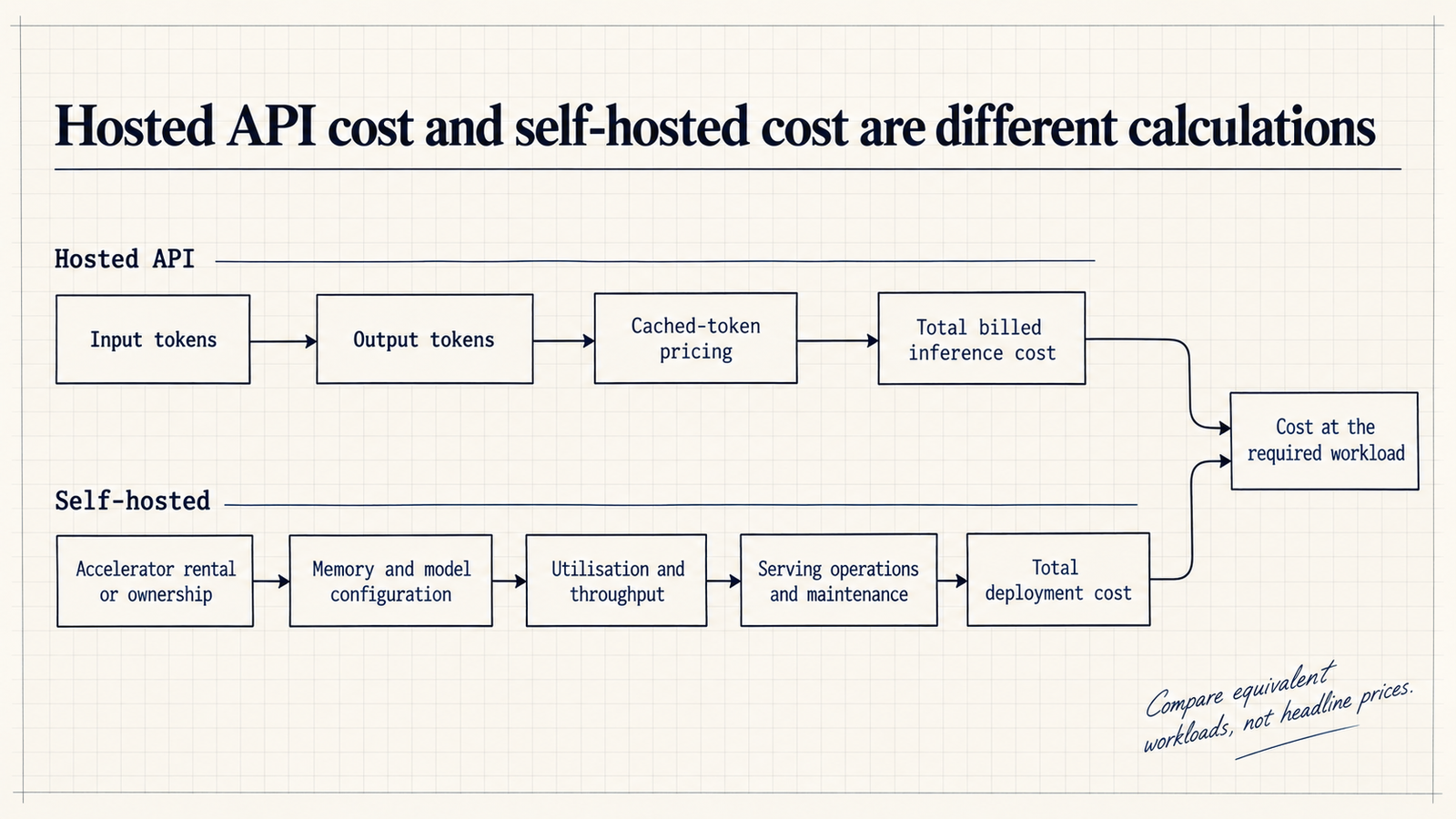
Kimi K3.1 Pro Hardware Requirements: GPUs, Memory, Cost

Kimi K3.1 Pro hardware requirements

Last updated: 5 November 2026. Kimi K3.1 Pro’s official weights are now on Hugging Face, so we’ve confirmed the parameter count, expert layout, MXFP4 format and checkpoint size, replaced the K3 licence terms with the published K3.1 Pro licence, corrected the attention layout and added a section on downloading the weights safely.

Before anyone argues about which GPU to rent, a smaller question settles most of the argument: how many bytes have to sit in accelerator memory before the first token comes out? For Kimi K3.1 Pro hardware requirements, that number already exists, even though the model’s own weights don’t.

Moonshot AI launched Kimi K3.1 Pro on its API on 23 October and describes it as a post-trained version of Kimi K3. K3’s weights have been public since July, and they occupy 1.561 TB. Unless Moonshot changes the format when it publishes K3.1 Pro, that’s the floor: about 1.56 TB of weights before a single cached token, activation buffer or draft model.

A model name doesn’t give you a GPU count. Weight format, memory per accelerator, the engine’s reservation, context length and concurrency do. This guide works through each with the arithmetic shown, so you can swap in your own numbers.

Quick Answer
  • Weights released: Kimi K3.1 Pro’s official weights went live on Hugging Face at the start of November 2026, under the moonshotai organisation.
  • Model size: 2.8T total parameters with 104B active, shipped as a 1.56 TB MXFP4 checkpoint split across 96 files.
  • Memory needed: about 1.6 TB of GPU memory for the weights alone, before KV cache.
  • Minimum GPUs: eight 288 GB GPUs (B300, GB300 or MI355X) as a floor, 16 B200 or H200 cards, or 24 to 32 H100s. These are our estimates, since Moonshot publishes no minimum hardware.
  • Long context: the 1M-token window adds up to about 18 GB per request on our revised estimate.
  • Licence: the Kimi K3.1-Pro License is MIT-style, with extra conditions above $20M in revenue or 100M monthly users.
  • Download safely: use only the official moonshotai repository and verify the files before you load them.
Key Takeaways
  • The official weights are out: 2.8T total parameters, 104B active, 1.56 TB across 96 safetensors shards on Hugging Face.
  • Fake and repackaged Kimi K3.1 Pro uploads are likely to follow, so download only from the moonshotai organisation and verify model weights before you download.
  • “2.8 TB at 8-bit” is arithmetic for a file that doesn’t exist. The native release is already 4-bit, trained that way.
  • Eight 288 GB GPUs in one node are the floor. B200, H200 and H100 fleets need two or more nodes just to hold the weights.
  • Every request costs a fixed 0.2 to 0.4 GB of KDA state plus about 14 KB per token of FP8 MLA cache, so short requests aren’t as cheap as their length suggests and million-token contexts are cheaper than on dense models.
  • A single on-demand AWS node costs about $102,540 a month before redundancy, staff or storage.
  • Matching the $2/$10 API on a 20k-in, 2k-out workload takes roughly 13,000 input and 1,300 output tokens per second, sustained around the clock. Measure whether your hardware can do that before you sign anything.
  • The K3 licence isn’t MIT: model-as-a-service businesses above $20 million in total company revenue need a separate agreement.

Quick Navigation


What is confirmed about Kimi K3.1 Pro

With the weights released on Hugging Face, every core specification on this page now comes from Moonshot’s own model card and config.json rather than from Kimi K3.

SpecificationKimi K3.1 ProSource
Total parameters2.8TModel card
Active parameters per token104BModel card
Layers93 (1 dense)Model card
Attention layout69 KDA (linear attention) + 24 Gated DSA (sparse attention)Model card, config.json
Experts896, with 16 routed + 2 shared per tokenconfig.json
Hidden size / attention heads7168 / 96Model card
Weight formatMXFP4 weights, MXFP8 activations, quantization-aware trainingModel card
Context window1,048,576 tokensconfig.json
Vision encoderMoonViT-V2, 401M parametersModel card
Checkpoint size1.56 TB, 96 safetensors shardsHugging Face file tree
Recommended enginesvLLM, SGLang, TokenSpeedModel card
APILive as kimi-k3.1-proKimi blog

One change from Kimi K3 matters for memory planning. K3.1 Pro swaps K3’s 24 full-attention Gated MLA layers for Gated DSA, a sparse attention design, which changes the KV cache figures below. Moonshot doesn’t state minimum hardware anywhere in the release, so the GPU counts on this page remain our estimates from the published sizes.

Calculating Kimi K3.1 Pro weight memory
Kimi K3.1 Pro hardware requirements

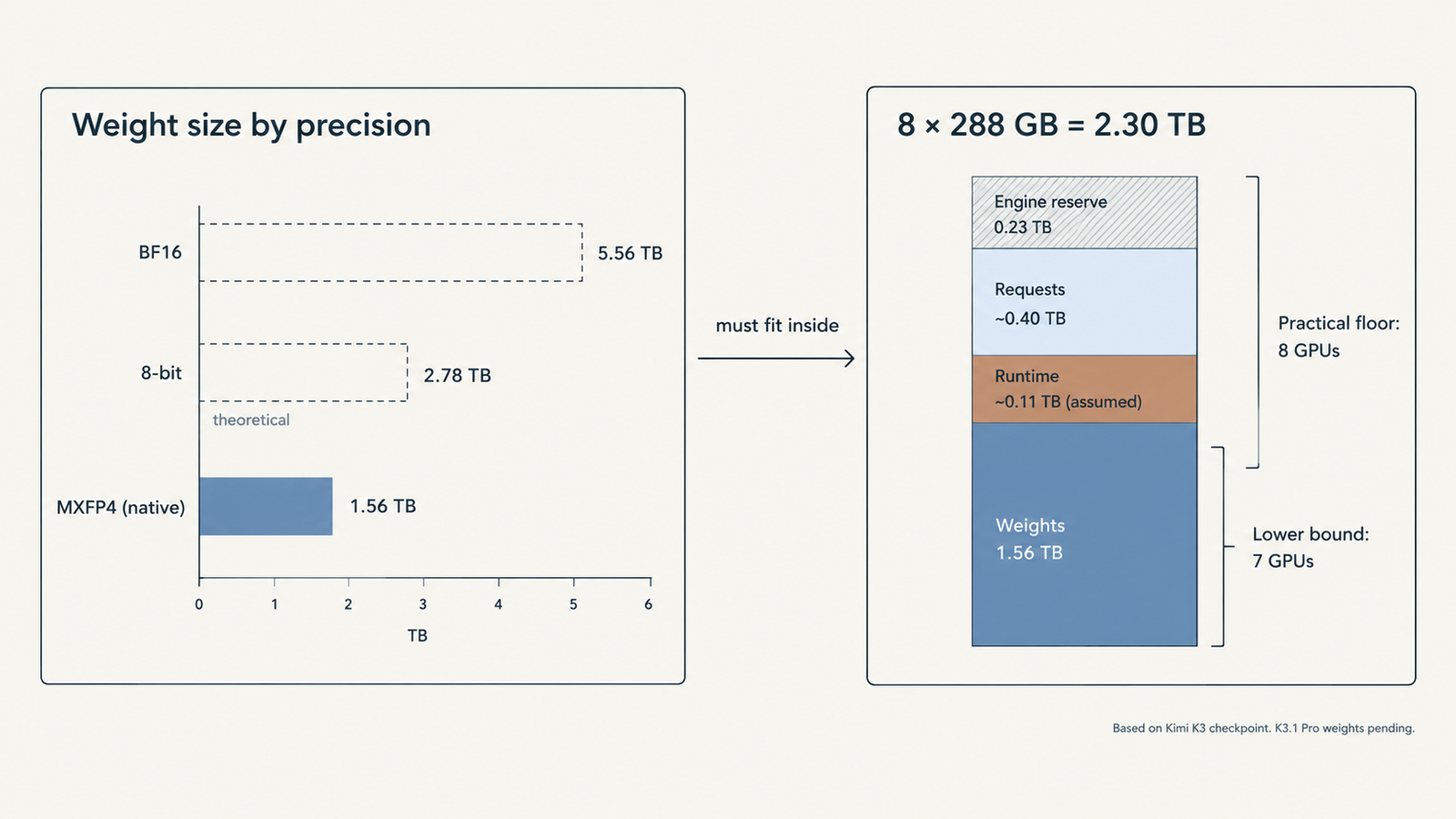
The formula is plain: weight bytes = parameters x bits per parameter ÷ 8. Using K3’s 2,779,931,837,184 parameters:

PrecisionBits per parameterDecimal TBBinary TiBWhat it represents
BF16165.5605.057Theoretical; no such release
8-bit (FP8/INT8)82.7802.528Theoretical
4-bit, no scales41.3901.264Theoretical minimum
MXFP4 everywhere4.251.4771.343Adds one 8-bit scale per 32 weights
Actual K3 checkpoint4.49 (effective)1.5611.420Published repository, 96 shards

The released checkpoint confirms the MXFP4 estimate. Moonshot’s config lists the format as mxfp4-pack-quantized with one scale per group of 32 weights, and the Hugging Face repository totals 1.56 TB across 96 shards. Plan for about 1.6 TB of memory for weights, plus room for the vision encoder, KV cache and runtime overhead.

All rows are weights only, with no runtime overhead. The brief’s “2.8 TB at 8-bit, 1.4 TB at 4-bit” is correct arithmetic for the wrong question. Moonshot trained K3 to run in MXFP4 from supervised fine-tuning onward, so there is no 8-bit release to plan around.

The gap between 1.39 TB and 1.561 TB has two sources. MXFP4 stores a shared 8-bit scale for every block of 32 weights, adding about 0.09 TB. And the config leaves attention, shared experts, the dense first-layer MLP, the output head and the vision encoder unquantized. The “5.6 TB” figures circulating for K3 come from assuming BF16.

Watch your units. TB is 10^12 bytes and TiB is 2^40, about 10% larger. NVIDIA lists a DGX B300’s total GPU memory as “2.1 TB”, yet eight 288 GB GPUs hold 2,304 GB, which is 2.10 TiB. Compare a TiB capacity with a TB weight file and you’ve lost a tenth of your headroom on paper.

How many GPUs Kimi K3.1 Pro needs

The lower bound is: GPUs = ceiling(weight bytes ÷ (memory per GPU x usable fraction)). vLLM’s Kimi K3 recipes run at 0.88 to 0.92 of GPU memory; this guide uses 0.90.

AcceleratorMemory per GPULower boundPractical layoutFits one 8-GPU node?
NVIDIA B300 / GB300288 GB78Yes, ~513 GB left after weights
AMD MI355X288 GB78Yes, same arithmetic
NVIDIA B200180 GB1016 (two nodes)No: 1,440 GB total
NVIDIA H200141 GB1316 (two nodes)No: 1,128 GB total
NVIDIA H10080 GB2224 to 32 (three to four nodes)No

Memory per GPU from AMD’s MI355X page (which also lists B200 at 180 GB) and NVIDIA. Seven 288 GB GPUs clear the bound, but tensor parallelism splits the 96 attention heads across GPUs, and 96 doesn’t divide by seven. Eight is the real floor, and it’s what the vLLM recipe states: at least 8x GB300, or 8x MI355X/MI350X on ROCm, with “multi-node for real production traffic”.

Eight GPUs are not one 2.3 TB pool. Each holds its own shard, and every layer exchanges activations between them. Inside a DGX B300 that traffic rides NVLink at 14.4 TB/s aggregate. Between nodes it crosses InfiniBand or Ethernet at up to 800 Gb/s per port, roughly 100 GB/s, which is why two-node recipes split the model into pipeline stages (TP8 x PP2) and why NVIDIA’s Dynamo recipes target GB200 and GB300 racks with NVLink spanning trays: 16 GB200s aggregated, or 32 split between prefill and decode.

Hopper is the awkward case. H100 and H200 lack native FP4 tensor cores, so MXFP4 experts run through dequantising kernels. The recipe page builds commands for H200, but its stated minimum is Blackwell or MI355X, and we found no published throughput for K3 on Hopper.

Can a single GPU or workstation run it?

No single GPU comes close. The workstation route is llama.cpp with the experts in system RAM. One published test loaded a ~554 GB 1-bit GGUF of K3 on a 160 GB VRAM machine with the MoE weights on CPU. Nobody has published quality figures for that quant. The 4-bit GGUF is 1,508.7 GB, barely smaller than the native file, because the native file is already 4-bit. It’s a way to poke at the model, not to serve users, and Now that the weights are public, community quants of Kimi K3.1 Pro can appear, but none are official, and their quality and memory use are unverified until someone tests them. The K3 result above (a 554 GB 1-bit GGUF reportedly running on 160 GB of VRAM) is the best guide for now. Before you run any community build, put it through the checks in our model weights verification guide..

The KV cache changes the Kimi K3.1 Pro calculation

This is the one part of the page where the release changed our numbers. Our first estimate assumed K3’s Gated MLA layers. Kimi K3.1 Pro uses Gated DSA in those 24 layers instead, and its config gives the inputs for a revised estimate.

  • DSA layers: the config keeps a 512-value compressed KV latent plus a 64-value positional key (576 values), and adds a lightning indexer with a 128-dimension key. Assuming each of the 24 layers caches both, as DeepSeek’s DSA does, that’s 24 × (576 + 128) = 16,896 values per token, or about 16.9 KB at FP8.
  • KDA layers: these keep a fixed-size state rather than a growing cache. At 69 layers × 96 heads × 128 × 128 values in BF16, that’s about 0.22 GB per request, whatever the context length.
Context lengthDSA cache (FP8)KDA stateTotal per request (estimate)
8K tokens0.14 GB0.22 GB0.36 GB
32K tokens0.55 GB0.22 GB0.77 GB
128K tokens2.21 GB0.22 GB2.43 GB
256K tokens4.43 GB0.22 GB4.65 GB
1M tokens17.72 GB0.22 GB17.93 GB

Treat these as planning estimates, not measured figures. Moonshot hasn’t published KV cache sizes, and vLLM or SGLang may store the cache differently. The indexer only picks the top 2,048 earlier tokens for each query (index_topk in the config), which saves compute, but the full cache still has to sit in memory. Check your engine’s own memory report once the model loads.

Two things fall out. Below about 16,000 tokens the fixed state outweighs the growing cache, so short chat traffic carries a per-request floor most sizing guides ignore. At the other end, long contexts are cheap: a 70B dense model with grouped-query attention needs about 160 KB per token, as our breakdown of AI memory costs works out, or roughly 172 GB for a million tokens against K3’s 14.7 GB.

On one 8x B300 node, 0.90 of 2,304 GB leaves about 2,074 GB, and weights take 1,561 GB. Set aside an assumed 110 GB for activations, CUDA graphs, communication buffers and the speculative draft model the recipes load, and roughly 400 GB remains for requests. That’s an upper bound of about 600 concurrent requests at 32K, 197 at 128K, or 27 at the full million.

Those counts assume the cache is spread across GPUs without duplication. vLLM’s decode context parallelism does that for MLA; without it, tensor-parallel ranks can each hold a copy and the numbers fall sharply. The recipes also spill to host RAM: one AMD prefill configuration budgets 1,799 GB of host DRAM for cache offload. Memory scales linearly with concurrency and context. Throughput at those concurrencies is a separate question that only measurement answers.

Where to download Kimi K3.1 Pro weights safely

The only official source is the moonshotai/Kimi-K3.1-Pro repository on Hugging Face. A 1.56 TB download is a big target for copycats, and a fake or tampered upload costs you days of transfer time and GPU hours before you notice anything is wrong.

There’s a second reason to be careful with this release. The repository ships its own Python files, and Moonshot’s usage example loads them with trust_remote_code=True. A mirror that changes those files can run code on your servers the moment you load the model. Our guide to spotting fake model weights walks through seven checks before you download. For Kimi K3.1 Pro, the short version is:

  1. Check the organisation. The repo should sit under moonshotai, the same Hugging Face account that hosts Moonshot’s earlier Kimi K3 release.
  2. Check the file list. Expect 96 safetensors shards totalling about 1.56 TB, plus config.json, the LICENSE and the custom code files. Pickle or .bin weight files are a warning sign.
  3. Read the custom code before you trust it. If you pull from anywhere other than the official repo, compare the .py files against Moonshot’s versions line by line.
  4. Compare hashes. Hugging Face shows a SHA-256 for each large file. Match your local copies against the official repo, not against the mirror you downloaded from.
  5. Treat quants as third-party software. Moonshot hasn’t released any official quantised variants. Any GGUF or lower-bit build is a community conversion, so check who made it and what it was built from.

Quantisation trade-offs

Weight quantisation and cache quantisation are separate levers, and the first one is mostly pulled already.

LeverMemory effectWhat you risk
Keep native MXFP4 weightsBaseline 1.561 TBNothing; this is how the model was trained
Up-cast to FP8 or BF161.8x to 3.6x moreHardware cost, with no documented quality gain
Community 1-bit or 2-bit quantsAbout 0.55 TB for the smallest published 1-bit GGUFUnmeasured quality loss; K3-only until K3.1 Pro weights ship
FP8 KV cacheHalves the MLA cache versus BF16Small accuracy risk; recipes use it by default
FP32 vs BF16 KDA stateDoubles or halves the fixed per-request stateSome low-latency backends require FP32

Because K3 went through quantization-aware training, its 4-bit weights aren’t a lossy copy of some better original that’s available to you. Going below 4 bits is a real compression, and nobody has published K3 or K3.1 Pro quality numbers for those quants. Run your own evaluation against the hosted API before trusting one.

Hardware matters here too. Blackwell and AMD’s CDNA 4 parts execute MXFP4 natively; AMD lists 10.1 PFLOPs of MXFP4 matrix throughput for the MI355X. Hopper doesn’t, which is a second reason the recipes start at Blackwell. The cache side has its own knobs: the latency-tuned GB300 profile switches the KDA state to FP32, doubling that per-request floor to about 0.43 GB.

The real cost of self-hosting Kimi K3.1 Pro
Kimi K3.1 Pro hardware requirements

Two dated price points for one 8x B300 node, on demand, 30 days at 24 hours:

ItemAWS p6-b300.48xlargeMedian specialist cloud
Hourly, 8x B300$142.42$65.44 ($8.18 per GPU)
30 days continuous (720 h)$102,540$47,117
Effective rate at 50% useful utilisation$284.83/h$130.88/h
Effective rate at 25% useful utilisation$569.66/h$261.76/h

AWS rate: us-east-1, Linux, on demand, per Vantage’s EC2 tracker, read 26 October 2026; the instance includes 4,096 GiB of host RAM and 8 x 3.84 TB local NVMe. Specialist rate: median across 10 providers per getdeploying, 8 September 2026; those offers may not match AWS on networking, storage or availability.

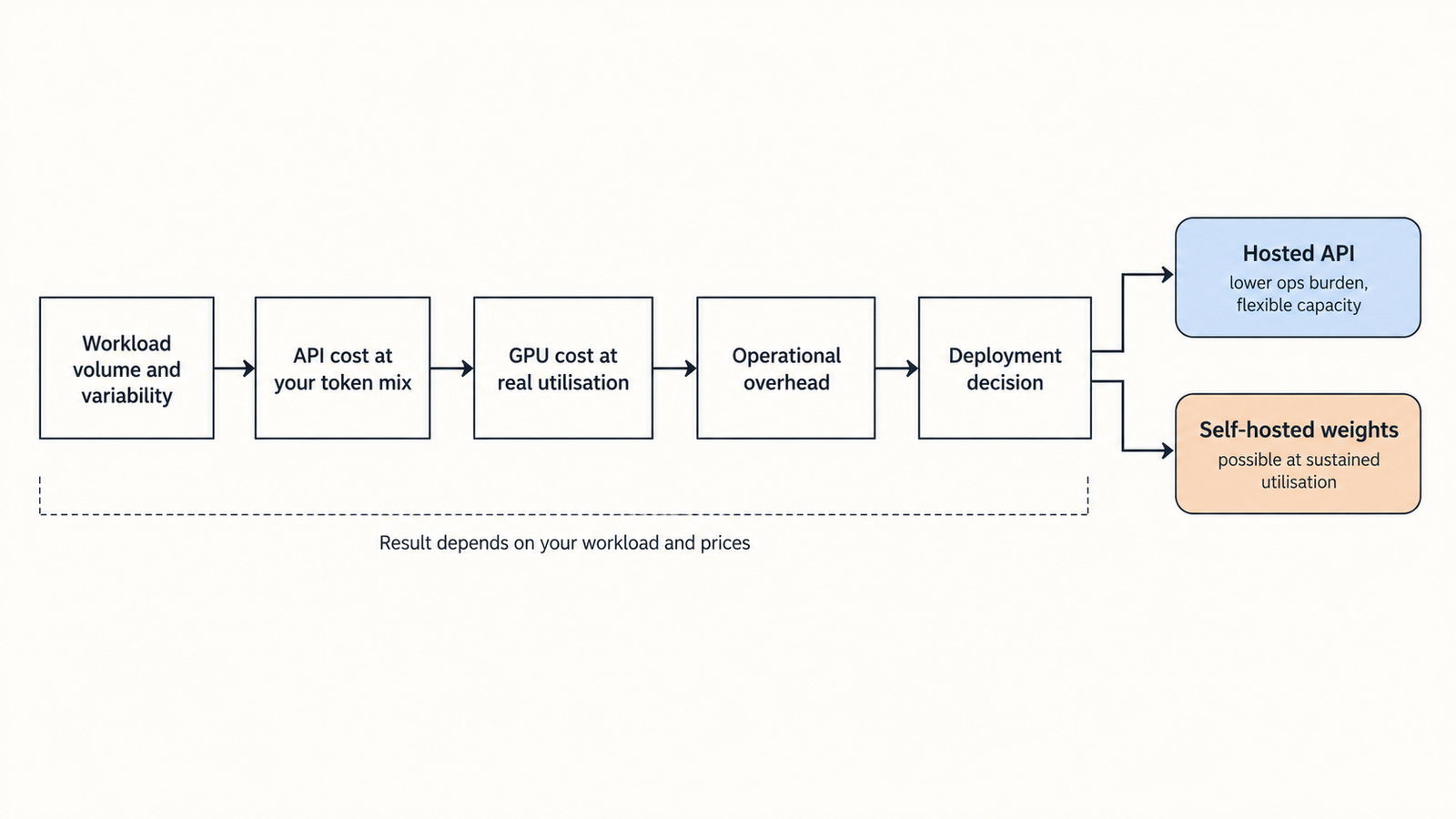
The effective-rate rows are the ones that matter. A node you pay for around the clock but keep busy half the time costs twice as much per useful hour, and real traffic has nights and weekends.

The GPU line also isn’t the bill. One node has no redundancy, so a production service needs a second, doubling the fixed cost before it serves an extra token. Add engineering time, monitoring, storage for 1.56 TB of weights plus staging on every node, egress, and the work of swapping in K3.1 Pro weights when they arrive. Published estimates of that total put it at 1.3 to 5 times the raw GPU rate, a range we unpack in the hidden fees in self-hosted LLM cost.

Kimi K3.1 Pro API vs self-hosting: the break-even

Moonshot’s API price for standard kimi-k3.1-pro is $2 per million input tokens, $10 per million output and $0.20 per million cached input, confirmed by Artificial Analysis. The Highspeed variant costs $4/$20. Cache writes are billed separately at a rate that wasn’t displayed when we checked.

The formula: API cost = (input tokens ÷ 1,000,000 x input rate) + (output tokens ÷ 1,000,000 x output rate).

Illustrative workload, an assumption: an agentic coding call with 20,000 input tokens and 2,000 output tokens, reasoning included. Uncached, that’s $0.04 + $0.02 = $0.06 per call. With 90% of input served from cache, it’s $0.0076 + $0.02 = $0.0276, before cache-write fees.

Break-even calls per month = monthly self-hosting cost ÷ API cost per call. Spread over 2,592,000 seconds in 30 days:

Scenario (GPU cost only)Calls/month to match APISustained calls/sInput tokens/sOutput tokens/s
AWS, no cache1.71M0.6613,1871,319
AWS, 90% cache hits3.72M1.4328,6672,867
Specialist cloud, no cache785K0.306,059606
Specialist cloud, 90% cache hits1.71M0.6613,1721,317

Caching makes the API cheaper, so it pushes break-even further away. And these are averages held for 720 hours straight. Peaks need headroom above them, so a fleet that just breaks even on average is running below capacity most of the day.

Can one node sustain those rates at an acceptable latency? There’s no independent published throughput for K3.1 Pro on 8x B300, so that’s the number to measure, not assume. Remember too that the right comparison is the cheapest API that meets your quality bar. Third-party hosts listed K3 below Moonshot’s own price on OpenRouter, and the same is likely once K3.1 Pro weights circulate. Our Kimi K3.1 Pro vs Sonnet 5.5 comparison covers per-task token use, which moves the API side of this equation more than the rate card does.

Self-hosting earns its place when data can’t leave your infrastructure, when load is high and steady enough to keep a node busy, when you need to fine-tune, or when you already own Blackwell capacity sitting idle.

Licence and operational constraints

Moonshot published the Kimi K3.1-Pro License with the weights. It starts as an MIT-style licence, then adds three conditions that matter for self-hosting.

  • Model-as-a-Service: if you sell access to the model and earn more than $20M in aggregate revenue over any consecutive 12 months, you need a separate agreement with Moonshot.
  • Attribution: a product with more than 100 million monthly active users, or more than $20M in monthly revenue, must prominently display “Kimi K3.1-Pro”.
  • Exemptions: internal use is exempt, as is use through Moonshot’s official products or certified inference partners.

For most teams running the model in-house, the licence won’t change the hardware decision. If you plan to resell inference at scale, email license@moonshot.ai before you buy GPUs. This is a summary, not legal advice, so have your counsel read the full text.

A practical Kimi K3.1 Pro deployment decision

  • Use the hosted API when traffic is small, spiky or unproven, or nobody on the team runs GPU clusters. Moonshot offers zero data retention to API customers, which settles some privacy objections without any hardware.
  • Rent one 8x B300 or MI355X node for evaluations, fine-tuning experiments or steady internal batch work you can keep busy. Accept that it has no redundancy.
  • Plan multi-node or rack-scale for production with latency targets, long contexts at high concurrency, or uptime commitments. Moonshot’s 64-plus accelerator guidance describes this tier.
  • Benchmark before you sign. Replay 50 to 200 real requests, measure tokens per second at your p95 latency target, and compare any quantised variant’s outputs with the hosted API.

What would change this estimate? The K3.1 Pro file size and precision; the KDA state dtype your engine uses; your measured throughput per node; GPU rental prices, which roughly doubled for B300 through 2026 according to price trackers; and the K3.1 Pro licence terms.

Conclusion

Kimi K3.1 Pro’s weights are now public, and they match the estimates this page made before launch: a 1.56 TB MXFP4 checkpoint that needs about 1.6 TB of GPU memory before KV cache. Eight 288 GB GPUs remain the practical floor, and the 1M-token context adds up to about 18 GB per request on our revised estimate. For most teams the API is still the cheaper route unless usage is heavy and steady. If you do self-host, start from the official moonshotai repository and verify the files before anything touches your cluster.

So don’t rent for Kimi K3.1 Pro hardware requirements yet. Use the API, log your real token mix and concurrency, and when the weights land, check the file size against 1.56 TB, then spend a week on one rented node measuring tokens per second at your latency target. If that number can’t clear the break-even rates in the table above with room for peaks and a second replica, the API was the cheaper machine all along.

Frequently asked questions

How much VRAM does Kimi K3.1 Pro need?

About 1.6 TB for the weights alone, based on the official 1.56 TB MXFP4 checkpoint, plus KV cache and overhead. That’s eight 288 GB GPUs at minimum, 16 B200 or H200 cards, or 24 to 32 H100s. Moonshot doesn’t publish minimum hardware, so these counts are our estimates.

Can Kimi K3.1 Pro run on one GPU?

No. The largest current accelerators, NVIDIA B300 and AMD MI355X, hold 288 GB each, under a fifth of the 1.56 TB weight file. Even heavily compressed community quants of K3 run to roughly 550 GB, which still needs several GPUs or large amounts of system RAM.

How many GPUs are needed for a model of this size?

Eight 288 GB GPUs are the practical minimum and match the vLLM recipe’s stated floor. With 180 GB B200s or 141 GB H200s you need 16 across two nodes. Moonshot recommends 64 or more accelerators for efficient production serving.

Does 4-bit quantisation reduce memory requirements?

For this model it’s already applied. Kimi K3 ships in MXFP4, a 4-bit format with shared scales, trained that way from fine-tuning onward. Converting to 8-bit would roughly double memory. Going below 4 bits shrinks the file further, but no published quality data exists for those quants.

How much does self-hosting cost per month?

One 8x B300 node costs about $102,540 for 30 days on AWS on demand, or about $47,117 at the median specialist-cloud rate (prices checked September to October 2026). Redundancy, staff, storage and idle time add substantially to that GPU line.

Is an API cheaper than running the model locally?

For most workloads, yes. At $2/$10 per million tokens, a self-hosted AWS node only matches the API if it sustains about 1.7 million 20k-token calls a month. Self-hosting can win on data control, steady high load or fine-tuning needs.

Can I run Kimi K3.1 Pro on a workstation?

Not at the official precision. The checkpoint is far larger than any workstation’s memory. Community quants may make heavily compressed versions possible, as a 1-bit GGUF did for Kimi K3, but none are official and quality is untested.

What licence applies to commercial deployment?

The Kimi K3.1-Pro License, an MIT-style licence with extra conditions. Model-as-a-Service businesses earning over $20M in 12 months need a separate agreement, and products above 100M monthly users or $20M monthly revenue must display “Kimi K3.1-Pro”. Internal use is exempt.

Where can I download Kimi K3.1 Pro safely?

Only from the official moonshotai/Kimi-K3.1-Pro repository on Hugging Face. Check the organisation, file list and hashes before downloading, and see our guide to verifying model weights for the full checklist.


Keep reading

Anthropic IPO valuation

Anthropic IPO: The $895 Billion Question Behind Its Valuation

Last updated: 9 November 2026. Latest confirmed development: Anthropic’s amended S-1, filed on 2 November, still leaves the share count and the IPO price range …
Claude Opus vs Sonnet

Claude Opus vs Sonnet: What the 2026 Price Gap Actually Buys
Last verified: 8 November 2026. All prices are Anthropic’s standard first-party API rates in US dollars per million tokens. They aren’t Claude Pro or Max …
RSA-1024

Did AI Break RSA? What DeepMind Actually Found

Last verified: 8 November 2026. Both papers are unreviewed working papers, and no outside group has reproduced the results yet. No, AI did not break …
Model Distillation

Model Distillation Explained: When AI Learning Becomes Extraction

Last verified: 7 November 2026. Government and company claims are attributed throughout. None has been tested in court. A support team trains a small, cheap …

Chinese Open-Weight Models Compared: DeepSeek vs Qwen & More

Chinese open-weight models

Research cutoff: 20 October 2026. Prices, licences and legal status were checked on that date and change often.

On 19 October, MiniMax priced its new M3.1 Flash at $0.15 per million input tokens and $0.60 per million output tokens. Those are, to the cent, the off-peak rates DeepSeek charges for V4.1 Flash. The next day, the US Department of Homeland Security published an order removing DeepSeek products from federal civilian IT systems. That pairing sums up where Chinese open-weight models stand: quality at the top has converged enough that licence terms, serving cost, hardware and the identity of your customer now decide the purchase.

This comparison covers the current release from DeepSeek, Alibaba’s Qwen, Moonshot AI’s Kimi, MiniMax and Zhipu AI’s GLM (sold internationally as Z.ai). It does not name a winner, because the evidence does not support one.

Key Takeaways
  • “Open-weight” covers five different licences. Only DeepSeek V4.1 Flash (MIT) and Qwen3.8-27B (Apache 2.0) come with standard permissive licences. Kimi K3, GLM-5.3, MiniMax-M3 and Qwen’s 2.4-trillion-parameter model all add custom conditions.
  • The downloadable model is not always the model you tested. Qwen3.8’s open-weight flagship is text-only and lacks the hosted Max model’s 1M-token context. MiniMax’s newest model, M3.1 Flash, has no weights yet.
  • Hosted prices for the same workload differ by about 25×. On the example workload below, the bill runs from roughly $167 a month (DeepSeek, off-peak) to $4,110 (Kimi K3).
  • Self-hosting the flagships is a cluster decision. The largest checkpoints need 1.4–4.9 TB of accelerator memory for weights alone. Only the 27B Qwen model fits on a single GPU.
  • Vendor benchmark tables are not mutually comparable. DeepSeek’s and MiniMax’s October tables report different Humanity’s Last Exam scores for the same Anthropic model.
  • The US order on DeepSeek is narrow but real. It covers federal civilian agency systems and procurement, including third-party products “developed using DeepSeek implementations”. The public notice does not extend it to private companies.

Quick Navigation


What this comparison measures

“Open-weight” means the trained parameters can be downloaded. It does not mean the training data or training code is public (none of the five publishes its training data), and it does not mean the licence permits every commercial use. Each family is assessed on its current release, with the downloadable checkpoint and the hosted API treated separately where they differ. Vendor-reported figures are labelled as such.

Master comparison of Chinese open-weight models

Table 1 — Release, weights and licence (checked 20 October 2026)

FamilyCurrent release assessedWeightsLicenceCommercial use
DeepSeekV4.1-Flash-1017 (Oct 2026)DownloadableMITPermitted
QwenQwen3.8-27B; Qwen3.8-2.4T-A95B (Aug 2026)Downloadable27B: Apache 2.0 (reported). 2.4T: custom “Qwen3.8-Max License”Permitted; conditions above stated thresholds for the 2.4T model
KimiKimi K3 (late July 2026)DownloadableCustom “Kimi K3 License” (MIT-derived)Permitted; conditions above thresholds
MiniMaxMiniMax-M3 (June 2026); M3.1 Flash (Oct 2026)M3: downloadable. M3.1 Flash: not yet releasedM3: “MiniMax Community License”M3: commercial use requires notice or written authorisation
GLMGLM-5.3 (weights 28 Aug 2026)DownloadableCustom “GLM-5.3 License”Permitted; security review for hosts above $10 billion revenue

Table 2 — Architecture, context and price

ModelTotal / active parametersContextInputsAPI price per 1M tokens (input / output)
DeepSeek V4.1 Flash552B reported; 763B in repository metadata / 8B–16B active (reported)1MText, image$0.15 / $0.60 off-peak; double at peak
Qwen3.8-27B27B dense262K native, 1M with YaRNText, image, videoNot verified
Qwen3.8-2.4T-A95B2.4T / 95BBelow the hosted model’s 1M (exact figure not published)Text onlyHosted Max: $2 / $6 (reported, not verified)
Kimi K32.8T / 104B1MText, image, video$3.00 / $15.00 ($0.30 cached input)
MiniMax-M3~428B / ~23B1MText, image, videoNot published
MiniMax M3.1 FlashNot disclosedNot stated officiallyText, image (reported)$0.15 / $0.60 ($0.015 cached input)
GLM-5.3~744–753B / ~40B1MNot confirmed (GLM-5.2 was text-only)$1.40 / $4.40

Every model except Qwen’s 27B has converged on a very large mixture-of-experts design with a 1M-token context, so architecture no longer separates them. Hosted prices do: they span more than an order of magnitude, from the two Flash models to Kimi K3.

Chinese open-weight models

What the benchmark tables establish

Less than they appear to. The October model cards from DeepSeek and MiniMax both compare against Kimi K3, GLM-5.3 and Anthropic’s Claude Opus 5, and both use some of the same benchmarks: DeepSWE v1.1, Terminal-Bench 4.0, NL2Repo-Bench and Humanity’s Last Exam (HLE).

Table 3 — Vendor-reported scores on shared benchmarks (October 2026)

BenchmarkDeepSeek V4.1-Flash-1017MiniMax M3.1 FlashKimi K3 (in DeepSeek’s table)GLM-5.3 (in DeepSeek’s table)
DeepSWE v1.177.073.767.566.9
Terminal-Bench 4.042.338.112.637.9
NL2Repo-Bench68.261.258.058.0
HLE (no tools)42.643.443.542.0 (text-only subset)

Sources: DeepSeek V4.1-Flash-1017 model card; MiniMax M3.1 Flash announcement. DeepSeek ran DeepSWE with the Mini-SWE-V2 harness and Terminal-Bench with the Claude Code harness; MiniMax’s footnotes cite several harnesses. All figures are company-reported.

DeepSeek’s table lists Claude Opus 5 at 56.3 on HLE without tools; MiniMax’s lists the same model at 55.6. The gap is small, but it shows that run conditions differ even when the labels match, and the four HLE scores above sit within 1.5 points of each other.

The Kimi row is the clearest warning. In DeepSeek’s table, Kimi K3 scores 12.6 on Terminal-Bench 4.0. Moonshot’s own card reports 88.3 on Terminal-Bench 2.1, an earlier version. Neither figure is necessarily wrong, but they cannot be compared, and a reader skimming two announcements could draw opposite conclusions.

Independent measurement helps a little. Artificial Analysis, as reported by The Decoder, puts DeepSeek V4.1-Flash-1017 at 45 on its Intelligence Index and M3.1 Flash at 42; its own page lists GLM-5.3 at 45. It also found that M3.1 Flash answered 56% of AA-Omniscience questions correctly but was confidently wrong in 93% of the cases it missed, a reliability signal absent from MiniMax’s table. None of this is your codebase or your latency budget. Use benchmarks to decide what to test.

Five families, five different trade-offs

DeepSeek: lowest price, cleanest licence, biggest procurement question

DeepSeek released V4.1 Flash on 10 September and an updated checkpoint, V4.1-Flash-1017, on 17–18 October, under the MIT licence with FP8 weights and a 1M-token context. SiliconANGLE’s launch report describes a 552B-parameter mixture-of-experts model activating 8B parameters on prompts and 16B when generating; the repository metadata shows 763B. DeepSeek has not explained the gap, and the higher figure is the one that sets your memory budget.

Price is DeepSeek’s strongest argument. Since 17 August, rates double during weekday peak hours (09:00–12:00 and 14:00–18:00 Beijing time). Off-peak, V4.1 Flash costs $0.15 per million uncached input tokens and $0.60 per million output tokens, and since 14 September calls to V4-Pro have been served and billed as V4.1 Flash. Two caveats: a nearly five-hour API outage on 15 October, and the US federal order covered below.

Qwen: the only realistic single-GPU option, and a split flagship

Qwen3.8-27B is the only strong small model in any family’s current generation. It is dense and multimodal, handles 262K tokens natively (1M with YaRN scaling), and The Decoder reports an Apache 2.0 licence. Its weights need about 54 GB in BF16 or 27 GB at FP8, so it fits on one 80 GB accelerator.

The flagship, Qwen3.8-2.4T-A95B (2.4 trillion total, 95 billion active parameters), is a different product from the hosted Qwen3.8-Max. Its model card says Max offers “more features, such as vision input & non-thinking support, 1M context length by default, official built-in tools”. The download is text-only, with a shorter context, under a custom licence whose thresholds appear in Table 4.

Kimi: the largest model, the highest price

Kimi K3 is the biggest model in the group: 2.8 trillion total parameters, 104 billion active, a 1M-token context, and text, image and video input. Moonshot trained it with quantisation-aware training, so the released weights are natively MXFP4, which is why a 2.8T model downloads at about 1.56 TB rather than 5.6 TB.

On Moonshot’s platform, K3 costs $3.00 per million input tokens ($0.30 cached) and $15.00 per million output tokens, 20 to 25 times DeepSeek’s off-peak rates. Moonshot reports strong agentic and multimodal results at maximum reasoning effort, including 91.2 on BrowseComp and 84.8 on OSWorld-Verified. Agent and computer-use workloads are where the premium could pay off; only your own tests can confirm it. The MIT-derived licence adds conditions for large resellers and very large products (Table 4).

MiniMax: two models, two different deals

MiniMax currently offers two different things under one brand. MiniMax-M3, released in June, is downloadable: about 428B total parameters, about 23B active, a 1M-token context through MiniMax’s sparse attention design, published in BF16. Its model card reports 80.5 on SWE-bench Verified and 78.1 on MMMU-Pro.

The M3 licence is the most restrictive here. The base grant covers non-commercial use; commercial use needs a one-time notice to MiniMax below $20 million in annual revenue, written authorisation above it, and a “Built with MiniMax M3” label. Serving the model through an API counts as commercial use, and military use is prohibited.

M3.1 Flash, launched on 19 October at $0.15 input, $0.60 output and $0.015 cached input per million tokens, ties DeepSeek on price. MiniMax says “model weights will be released later”. Until then it is an API product with no published licence, parameter count or context window.

GLM: MIT one release, custom the next

Zhipu’s GLM-5.2, released in June, was MIT-licensed and text-only. GLM-5.3 reached the API in August and open weights on 28 August, after a two-week safety hold: roughly 744–753B total parameters, about 40B active, a 1M-token context. Its new licence requires hosts with more than $10 billion in annual revenue to pass Z.ai’s security review. Few buyers will hit that threshold, but it shows a family’s licence can change between point releases.

At $1.40 input and $4.40 output, GLM-5.3 is mid-priced. Artificial Analysis measured 85.5 output tokens per second and a 2.44-second time to first token on Z.ai’s API. Z.ai’s vLLM recipe starts at one node of eight H200 or H20 accelerators for the FP8 checkpoint, which makes it the most practical large model to self-host.

Licences: what “open-weight” permits

A downloadable checkpoint only means you can obtain the file. The table summarises the clauses that decide what you can do with it; it is not legal advice.

Table 4 — Licence conditions that change a deployment decision

ModelRevenue or user triggerWhat it triggersExempt
DeepSeek V4.1 Flash (MIT)NoneKeep the copyright notice—
Qwen3.8-27B (Apache 2.0, reported)NoneNotice and licence retention—
Qwen3.8-2.4T-A95B>100M MAU or >$20M monthly revenue; MaaS/AI work-assistant revenue >$50M per yearDisplay model name; separate licenceInternal use
Kimi K3MaaS revenue >$20M per 12 months; >100M MAU or >$20M monthly revenueSeparate agreement; display “Kimi K3”Internal use; use via Moonshot or certified partners
GLM-5.3Hosting company revenue >$10B per 12 monthsZ.ai security reviewRouting, embedding
MiniMax-M3Any commercial use; >$20M annual revenueNotice; prior authorisation; “Built with MiniMax M3”None stated

The practical split is between internal use and resale. If you run a model only inside your company, the thresholds in the Kimi and large-Qwen licences generally do not apply. If you sell API access to a model, MiniMax-M3 requires permission at any scale, and Kimi K3 and Qwen’s flagship require agreements above their revenue thresholds.

Hosted API versus self-hosting economics

Headline prices are per token. A bill depends on how many of your tokens are input versus output, how many hit the cache, and, for DeepSeek, what time of day they arrive.

Example workload: 1 billion input tokens a month, of which 70% are cache hits, plus 200 million output tokens. This is roughly the shape of an agent or retrieval system that reuses long system prompts.

Table 5 — Monthly API bill for the example workload (prices checked 20 October 2026)

ModelCached inputUncached inputOutputMonthly total
DeepSeek V4.1 Flash (off-peak)700M × $0.003 = $2.10300M × $0.15 = $45.00200M × $0.60 = $120.00$167.10
DeepSeek V4.1 Flash (all at peak)$4.20$90.00$240.00$334.20
MiniMax M3.1 Flash700M × $0.015 = $10.50300M × $0.15 = $45.00200M × $0.60 = $120.00$175.50
Qwen3.8-Max (reported rates)700M × $0.20 = $140.00300M × $2.00 = $600.00200M × $6.00 = $1,200.00$1,940.00
GLM-5.3 (no cache discount assumed)—1,000M × $1.40 = $1,400.00200M × $4.40 = $880.00$2,280.00
Kimi K3700M × $0.30 = $210.00300M × $3.00 = $900.00200M × $15.00 = $3,000.00$4,110.00

The Qwen cache rate assumes explicit cache hits at 10% of the input price, as CloudZero reports for Alibaba Model Studio. GLM-5.3 is shown without a cache discount because Z.ai’s cached rate was not verified; its real bill would be lower. The DeepSeek cache-hit rate is taken from third-party transcriptions of DeepSeek’s pricing page.

Output is the largest line in every bill except GLM’s, where the missing cache discount inflates input. For Kimi K3 it is 73% of the total, so long answers or long reasoning traces widen the gap between vendors well beyond what input prices suggest.

Chinese open-weight models

Self-hosting changes what you pay for. In a mixture-of-experts model, only the active parameters are computed per token, but every parameter must sit in accelerator memory.

Table 6 — Weight memory before KV cache and activations

ModelReleased precisionWeights in memory (approx.)
Qwen3.8-27BBF16~54 GB (~27 GB at FP8)
MiniMax-M3BF16~856 GB (~428 GB if quantised to FP8)
DeepSeek V4.1-Flash-1017FP8~0.55–0.76 TB
GLM-5.3FP8~0.75 TB
Kimi K3MXFP4~1.56 TB (repository size)
Qwen3.8-2.4T-A95BFP8 / BF16~2.4 TB / ~4.9 TB

An eight-GPU H200 server holds 8 × 141 GB = 1,128 GB. GLM-5.3 and DeepSeek V4.1 Flash fit on one such node at FP8 with headroom for a modest KV cache, which is why Z.ai’s recipe starts there. Kimi K3 and Qwen’s 2.4T model do not fit and need either newer accelerators with more memory per device or a multi-node deployment.

To compare a node with an API bill, use monthly node cost = GPUs × hourly rate × 730 hours. At an assumed $3.00 per GPU-hour (a placeholder, not a quote), one eight-GPU node costs 8 × $3.00 × 730 = $17,520 a month, before redundancy, engineers or monitoring. That is about 4.3 times the Kimi K3 API bill for the example workload and more than 100 times DeepSeek’s off-peak bill. Self-hosting pays at much higher volume, under data-residency rules that exclude vendor APIs, or when the licence blocks the hosted route you need.

Utilisation decides the outcome: a node billed for 730 hours that is busy for 200 of them has more than tripled its effective cost per token. Measure throughput on your own prompts before trusting any published tokens-per-second figure.

Government restrictions and procurement

United States, federal civilian agencies. On 20 October 2026, DHS published a notice in the Federal Register (FR Doc. 2026-21447) of an exclusion and removal order under the Federal Acquisition Supply Chain Security Act of 2018. It covers information technology products and services from Hangzhou DeepSeek Artificial Intelligence Co. and its affiliates, plus “third-party products and services developed using DeepSeek implementations”, across federal civilian agency systems and procurement. The public notice gives no compliance deadline, does not say whether self-hosted copies of the MIT-licensed weights count as covered products, and makes no statement about private companies. The signed order sits in the docket (DHS-2026-0628), and federal suppliers should read it directly.

Earlier restrictions. Texas, New York, Virginia and Iowa barred DeepSeek on state government devices or networks in January and February 2025, and the US Navy told personnel not to use it in January 2025. The No Adversarial AI Act, introduced on 25 June 2025, would bar executive agencies from using AI from adversary-country companies; we found no evidence it has been enacted. None of these measures restricts private companies in general, but federal civilian contractors are exposed because the order reaches third-party products built on DeepSeek.

DeepSeek and Huawei. Reports of a hardware partnership are partly substantiated and partly not. In June 2026, a Huawei-led research group said, via the Shenzhen government, that it had post-trained DeepSeek V4-Pro on more than 1,000 Ascend 910C chips; DeepSeek did not comment. Bloomberg reported on 4 September that DeepSeek planned to buy at least 160,000 Ascend 950DT chips for inference while continuing to train on Nvidia hardware. The Information reported design collaboration on future chips. Neither company has confirmed a commercial arrangement.

Table 7 — Procurement checklist by family

CheckDeepSeekQwenKimiMiniMaxGLM
Weights downloadable nowYesYesYesM3 yes; M3.1 Flash noYes
Licence fits intended useMITDepends on model and scaleDepends on scaleNotice or authorisation for any commercial useYes, below $10B revenue
US federal civilian restrictionYes, FASCSA order (Oct 2026)None foundNone foundNone foundNone found
US state device bansTX, NY, VA, IA (2025)None foundNone foundNone foundNone found
Vendor API data locationVendor-operated; confirm in termsAlibaba Cloud regions incl. Singapore, Frankfurt, Virginia (reported)Vendor-operated; confirm in termsVendor-operated; confirm in termsVendor-operated; confirm in terms
Continuity signalFive-hour outage, 15 Oct 2026Hosted flagship ahead of open releaseSingle large modelWeights for newest model pendingLicence changed between point releases

Self-hosting puts data handling under your controls; a vendor API puts it under the vendor’s terms and jurisdiction. Where a model was trained does not by itself make either route safe or unsafe. Confirm the current position with your legal and procurement teams.

Which model fits which workload

  • Startup on hosted APIs: DeepSeek V4.1 Flash and MiniMax M3.1 Flash, the cheapest endpoints by far. Run DeepSeek batch jobs off-peak, and check M3.1 Flash’s factual reliability before using it for question-answering.
  • Self-hosting on one GPU: Qwen3.8-27B, the only current-generation option.
  • Self-hosting on one eight-GPU node: GLM-5.3 or DeepSeek V4.1 Flash; DeepSeek’s MIT licence is simpler unless you sell to US federal civilian agencies.
  • Software engineering: shortlist DeepSeek V4.1 Flash, MiniMax-M3 and GLM-5.3 and test them on your own repository, since vendor coding tables use different harnesses.
  • Chinese-language or multilingual products: none of the cards consulted reports a comparable multilingual benchmark, so test on your own corpus.
  • Reasoning and mathematics: HLE scores sit within 1.5 points, and Kimi K3’s 93.5 on GPQA Diamond has no like-for-like counterpart in the other cards. Run your own evaluation.
  • Multimodal: Kimi K3, Qwen3.8-27B or MiniMax-M3. Qwen’s 2.4T download is text-only, and GLM-5.3’s multimodal support was not confirmed.
  • Regulated or government-facing: exclude DeepSeek from US federal civilian supply chains; for the rest, check licence terms, data residency and vendor support.

A short evaluation protocol. Pick 50–200 tasks that represent real traffic. Run every candidate with the same prompts, tools, context limits and sampling settings. Record pass rate, time to first token, output speed, cost per successful task and failure types, and repeat after each model update.

Conclusion

The five families now differ more on rights and costs than on capability. DeepSeek has the cheapest API and the cleanest licence but sits under a federal civilian procurement order. Qwen has the only single-GPU option, and a flagship download that is narrower than what Alibaba hosts. Kimi posts strong agentic numbers on its own tables at the highest price. MiniMax’s licence requires notice for commercial use. GLM is mid-priced and the easiest large model to self-host. Choosing among Chinese open-weight models in 2026 means choosing which of those trade-offs your workload, budget and customers can accept, and then testing.

Frequently asked questions

What are Chinese open-weight models?

Large language models from Chinese developers whose trained weights can be downloaded and run on your own hardware, chiefly DeepSeek, Qwen, Kimi, MiniMax and GLM. The training data and code are not public, and commercial rights vary by licence.

Are DeepSeek and Qwen models open source?

Partly. DeepSeek V4.1 Flash (MIT) and Qwen3.8-27B (Apache 2.0) use standard permissive licences, but neither family publishes training data, and Qwen’s largest open model uses a custom licence.

Can Chinese open-weight models be used commercially?

Yes for most buyers, with model-specific conditions. MiniMax-M3 needs a notice to MiniMax for any commercial use; Kimi K3 and Qwen’s 2.4T model add conditions only above high revenue or user thresholds.

Which of these models can run on a single GPU?

Only Qwen3.8-27B. The other current flagships need hundreds of gigabytes to several terabytes of accelerator memory.

Is DeepSeek banned in the United States?

Not in general. DHS has ordered federal civilian agencies to remove DeepSeek products, and several states ban it on government devices; the published notice does not extend to private companies or individuals.

Is self-hosting cheaper than using an API?

Usually not at moderate volume. Self-hosting tends to win on data control, licence fit or very high, steady utilisation.

How should I compare benchmark results across vendors?

Only when benchmark version, harness and settings match, which is rare. Use scores to build a shortlist, then test it on your own tasks.


Keep reading

Anthropic IPO valuation

Anthropic IPO: The $895 Billion Question Behind Its Valuation

Last updated: 9 November 2026. Latest confirmed development: Anthropic’s amended S-1, filed on 2 November, still leaves the share count and the IPO price range …
Claude Opus vs Sonnet

Claude Opus vs Sonnet: What the 2026 Price Gap Actually Buys

Last verified: 8 November 2026. All prices are Anthropic’s standard first-party API rates in US dollars per million tokens. They aren’t Claude Pro or Max …
RSA-1024

Did AI Break RSA? What DeepMind Actually Found
Last verified: 8 November 2026. Both papers are unreviewed working papers, and no outside group has reproduced the results yet. No, AI did not break …
Model Distillation

Model Distillation Explained: When AI Learning Becomes Extraction

Last verified: 7 November 2026. Government and company claims are attributed throughout. None has been tested in court. A support team trains a small, cheap …

Inkling 975B: What the Open Weights Now Really Change

Inkling 975B: What the Open Weights Now Really Change

Thinking Machines Lab shipped Inkling on July 15, 2026. It runs 975 billion parameters. It ships under Apache 2.0. And it is the best open weights any US lab has put out.

That last sentence about open weights is doing a lot of quiet work. Inkling debuted at 41 on the Artificial Analysis Intelligence Index. Kimi K3 sits at roughly 57. GLM-5.2 sits at 51.

So the leading American open weights release lands third or fourth in its own category. The interesting question is not whether Inkling wins. It is what a 975B model with a permissive license actually changes for anyone downstream.

The honest answer: less than the launch suggests, and not what most coverage claims.

Key Takeaways on Frontier-Scale Open Weights

  • Inkling is a 975B-parameter MoE with 41B active per token, a 1M-token context window, and Apache 2.0 terms.
  • Running it at BF16 needs roughly 2TB of aggregated VRAM. Downloadable does not mean runnable.
  • Six labs shipped open weights above 100B in 2026. Five of them are Chinese.
  • licenses diverged sharply this year. Kimi K3 dropped Modified MIT for a bespoke document with a $20M revenue gate.
  • The real shift from open weights is control over deployment, not access to capability.

Quick Navigation

What Inkling 975B Actually Is

Start with the specification, because the shape explains why these open weights exist.

Inkling is a Mixture-of-Experts transformer: 975B total parameters, 41B active per token. It runs 66 decoder layers with 256 routed experts plus 2 shared experts, and routes each token to 6 of the routed set. If those terms are unfamiliar, our glossary covers MoE and context windows.

Pretraining used 45 trillion tokens of text, images, audio, and video. Training ran on NVIDIA GB300 NVL72 systems, using Muon for large matrix parameters and Adam for the rest.

Two design choices stand out in the architecture notes. Short convolutions inside the attention block give an explicit path for mixing nearby tokens. A separate RMSNorm sits directly after the embedding lookup.

Neither ships with an ablation, so their contribution is unmeasured.

The third choice is the practical one. Most post-training compute went to asynchronous reinforcement learning past 30 million rollouts, and that run produced a controllable effort dial. You set reasoning_effort and the model spends a different token budget.

The launch post is unusually candid. The company states plainly that Inkling is not the strongest model available today, open or closed.

That framing matters. The pitch is breadth and fine-tunability, not a leaderboard position. Open weights here are a distribution strategy, not a capability claim.

Every Open-Weight Release Above 100B in 2026

Here is the full open weights field, ordered by ship date. Parameter shape and license are the two facts that do not go stale in a week.

ModelLabReleasedTotal / ActiveContextLicence
Kimi K2.6Moonshot AI (CN)20 Apr 20261T / 32B256KModified MIT
DeepSeek V4DeepSeek (CN)24 Apr 2026 (preview)1.6T and 284B variants1MMIT
Mistral Medium 3.5Mistral (FR)29 Apr 2026128B dense—Modified MIT
MiniMax M3MiniMax (CN)1 Jun 2026Not disclosed1MNot verified
Kimi K2.7 CodeMoonshot AI (CN)13 Jun 2026~1T / 32B—Disputed (see below)
GLM-5.2Z.ai / Zhipu (CN)mid-Jun 2026744B / ~40B1MMIT
InklingThinking Machines (US)15 Jul 2026975B / 41B1MApache 2.0
Kimi K3Moonshot AI (CN)weights 26–27 Jul 20262.8T / 104B1MCustom “Kimi K3 License”

Caveats on the table

Three entries need flags, and no other roundup I found carries them.

MiniMax M3. Parameter count is not publicly specified in the sources I could verify. It is included on the strength of frontier positioning, not a confirmed figure.

Kimi K2.7 Code. Sources disagree on license. Some list Apache 2.0, others list the Modified MIT that governs the K2 line. Check the model card before building on it.

Kimi K3 dates. Hosted launch was 16 July. Weights landed 26 July, one day ahead of the stated 27 July target. Both dates appear in coverage.

Two exclusions from the open weights table

Gemma 4 is excluded from the open weights table because its largest variant is 31B dense. Llama 4 Scout is excluded as a 2025 release.

What the Licence Column Tells You About Open Weights

Read that table by license rather than parameter count and a different picture appears.

Apache 2.0 and MIT are permissive licences, not unconditional ones. They permit commercial use without a revenue or user-count gate, but Apache 2.0 and MIT have notice and redistribution conditions. Check the actual licence shipped with each model rather than treating “open weights” as a single legal category.

That is the strongest thing about the Inkling release. Among frontier-scale open weights, Apache 2.0 with no attached usage policy is the cleanest set of terms on offer.

Modified MIT sounds permissive, and mostly is. Still, open weights with a clause are not weights without one. The K2-family clause requires prominent “Kimi K2” attribution once a product passes 100 million monthly active users or $20 million in monthly revenue.

Most teams will never hit that. But it is a term, and terms compound across a stack.

Kimi K3 broke the open weights pattern. Moonshot replaced Modified MIT with a bespoke license, and the change went largely unexamined in launch coverage.

Simon Willison flagged the K2 lineage, and the K3 document goes further. Reports say firms above $20 million in annual revenue must sign a contract with Moonshot before offering K3 to outside customers as a service. Attribution rules apply on top.

So the largest open weights model in the world is not open by the Open Source Initiative definition. Neither is it uniquely restrictive. It is a commercial license wearing an open label. So read it with a lawyer, not a skim.

What Open Weights Actually Change

Three things genuinely shift when open weights ship publicly. None of them is “everyone can now run frontier AI.”

Open weights give you deployment control

Open weights let you choose where the model runs. That is the whole thing, and for regulated buyers it is enormous.

A hospital, a bank, or a defense firm can keep the model inside its own walls. No data leaves. The vendor never sees a prompt, and API terms cannot change under you mid-contract.

Price discipline

So open weights cap what closed vendors can charge for the same capability. When GLM-5.2 delivers similar coding performance at a fraction of frontier pricing, that becomes the reference point in every procurement conversation.

Still, the effect reaches teams who never self-host. They simply negotiate better, because open weights set the floor.

Modification rights

Fine-tuning on your own data is the pitch behind Inkling. Tinker exists to make that path short, and a broad base model adapts to more workflows than a narrow one.

Distillation matters here too. Permissive weights can support developing a smaller student model, subject to the applicable licence conditions and any other rights involved. Apache 2.0 should not be treated as a blanket promise that every resulting asset is owned free of third-party obligations.

What Open Weights Do Not Change

Now the correction, because open weights coverage overclaims here.

Open weights access is still gated by hardware

Inkling open weights need roughly 2TB of aggregated VRAM at BF16. NVFP4 quantization cuts that substantially but requires SM100-class hardware.

Kimi K3’s checkpoint runs 1.56TB across 96 shards. Self-hosting it realistically means eight to sixteen nodes of eight H100 or B200 accelerators.

So “open” in open weights describes the license, not the barrier. Memory and interconnect economics still set the ceiling, and those have not moved because a download link appeared.

Community quantization helps at the edges. One 1-bit GGUF cut Kimi K3 from 1.56TB to 594GB, keeping about 79% accuracy. Still a serious machine, though.

Reproducibility is not included

Thinking Machines says open weights rather than open source, and the distinction is precise. Training data and the training pipeline stay private.

Every release in that table does the same. So you get the artifact, never the recipe. That is the hard limit on what open weights can prove. So you cannot audit what went in, verify contamination claims, or rebuild the model from scratch.

Benchmarks still need care

Inkling’s Terminal Bench 2.1 figures come from an internal harness, while competitor scores are self-reported. Those are not directly comparable.

It also trails GLM-5.2 and Kimi K2.6 on HLE, Terminal Bench, and SWE-bench Verified, and posts 43.9% on SimpleQA Verified against DeepSeek V4 Pro’s 57.0%. We covered why leaderboard gaps at this level are hard to interpret.

One number does stand out. Inkling posts the highest FORTRESS adversarial score among compared open-weights models at 78.0%, which matters more for regulated deployment than another point of coding accuracy.

What Inkling-Small Changes

The open weights nobody can download yet may matter more than the ones that shipped.

Thinking Machines Lab released Inkling-Small and its full weights on 30 July 2026. It has 276B total parameters and 12B active. The released model’s model card should be used for specifications and evaluation settings, rather than carrying forward preview benchmark numbers.

Read that twice. So the small model wins on some benchmarks, while the big one carries the headline.

Why size beats score here

Active parameters describe the computation used per token, not the complete weight-memory requirement. Inkling-Small still has 276B total parameters. At BF16, weights alone imply roughly 552 GB before runtime overhead; quantization and offloading change that estimate. Hardware suitability therefore depends on precision, memory, context and serving configuration, not the 12B-active label alone.

The full Inkling-Small weights are now published. The practical access question has moved from release timing to the memory, throughput and operating-cost tradeoffs of a real deployment.

The Fine-Tuning Economics Behind Open Weights

Thinking Machines is not really selling open weights. It is selling a customization pipeline.

Tinker exists to make fine-tuning short. So Inkling was trained broadly rather than narrowly, because open weights only pay off if people adapt them. Breadth adapts to more workflows than a specialist base does.

Fine-tuning a frontier-scale model on your own data is expensive, and the result is yours. Calling a closed API is cheap per token, and the result is rented.

Open weights change which side of that trade is available. But switching costs rise once you adapt a model. So the lock-in moves rather than vanishing.

Why Five of Six Frontier Open Weights Are Chinese

The geography of frontier open weights is the most under discussed fact in that table.

Moonshot, DeepSeek, Z.ai, and MiniMax all ship at this scale routinely. American labs mostly do not, and Inkling is notable partly because it breaks a pattern.

Open weights are a share-capture move when you are behind on distribution. A downloadable model gets into stacks that would never sign an API contract with a Chinese vendor.

Export controls push the same way. If you cannot match a rival’s compute budget, giving the weights away buys reach instead. Reach compounds differently than revenue does.

But adoption of open weights is not purely technical. Moonshot has faced accusations, including from the White House OSTP director, that K3 was distilled from a competitor’s model. Those claims are unresolved.

Regulated US buyers weigh provenance alongside benchmarks. That is the gap Inkling aims at, even with a lower index score.

The Safety Argument Around Open Weights

The Safety Argument Around Open Weights

Publishing open weights is irreversible, and that drives most of the disagreement.

Once a checkpoint is out and mirrored, no vendor can pull it back or patch it. And anyone with modest compute can fine-tune the safety training away.

Critics argue frontier open weights hand capability to actors who could not build it. That concern centres on cyber and biological uplift, and it does not depend on the license at all.

Supporters point out that inspection requires access. Outside researchers cannot audit a model they can only query through a filtered API.

The MarkTechPost breakdown notes Thinking Machines flags role-play and indirect prompts as residual risks in its own project page. That kind of published limitation is only possible when someone can test for it.

Evidence has not settled either side, so this post will not settle it either. But the FORTRESS score in the Inkling release suggests labs are starting to compete on adversarial robustness, which is a healthier signal than benchmark parity.

How to Choose Among 2026 Open Weights

Skip the leaderboard for a moment. Four questions decide most open weights selections.

What can you actually run? Start with available VRAM, then filter the open weights list. A 744B model you can serve beats a 2.8T model you cannot.

What does the license require at your scale? Check revenue and user thresholds against your projections, not your current numbers. MIT and Apache 2.0 have neither.

Do you need the weights, or just the price? If you will call an API anyway, open weights matter to you only as negotiating leverage.

How much does provenance matter? For some buyers it decides everything, and no benchmark will move them. Open weights from a US lab answer a question a score cannot.

Conclusion: Open Weights Changed the Contract, Not the Compute

Inkling is a good model with excellent terms. Yet it will not top a leaderboard, and its makers said so first. Thinking Machines said so themselves, which is more than most launches manage.

The significance of these open weights sits elsewhere. The 2026 field now offers genuine frontier-scale capability under Apache 2.0 and MIT, which was not true two years ago.

But the constraint moved rather than disappearing. Access to weights is now free. Access to the two terabytes of memory needed to serve them is not, and that gap decides who actually benefits.

Watch deployment results for Inkling-Small now that its weights are available: memory use, useful throughput and cost at the required quality. Separately, compare the actual commercial and redistribution terms of each model licence rather than treating different open-weight releases as legally interchangeable.

What This Table Will Look Like in Six Months

Two forces will reshape it, and they pull opposite ways.

Scale keeps climbing. Kimi K3 crossed the 3-trillion class, so the next tier arrives before year end. Yet each jump narrows the pool of buyers who can serve the result.

Smaller active-parameter counts can reduce compute per token. Adoption still depends on total weight storage, usable throughput and the workload, so both active and total parameters belong in the comparison.

So expect this open weights table to split in two. One row set for labs proving capability, another for models people genuinely run.

FAQ About Inkling and 2026 Open Weights

What licence does Inkling use?

Apache 2.0, with no attached usage policy. That permits commercial deployment, fine-tuning, and redistribution without royalty or revenue thresholds. Thinking Machines describes the release as open-weights rather than open source, because training data and the training pipeline are not published.

What hardware do you need to run Inkling 975B?

Running the open weights takes roughly 2TB of aggregated VRAM at BF16. NVFP4 W4A4 quantization reduces that considerably but requires SM100-class hardware or newer. In practice this means a multi-node GPU cluster, not a workstation.

Is Inkling better than Kimi K3 or GLM-5.2?

Not on aggregate benchmarks, though license terms differ. Inkling debuted at 41 on the Artificial Analysis Intelligence Index against roughly 57 for Kimi K3 and 51 for GLM-5.2. It leads on FORTRESS adversarial robustness at 78.0% and carries the cleanest license of the three.

Which 2026 open weights have the most permissive license?

Inkling uses Apache 2.0. Apache 2.0 and MIT permit commercial use without revenue/user gates, but include notice and redistribution conditions. They should not be described as having no attribution requirements. Verify the exact current licence for each other model before relying on the comparison.

Does open weights mean open source?

No. Open weights means the trained parameters are downloadable. Open source, under the Open Source Initiative definition, additionally requires the training data and code, and a license without discriminatory conditions. Every frontier-scale release in 2026 publishes weights only.

Why do Chinese labs release open weights more often?

Distribution strategy under constraint drives most open weights releases. Open weights get a model into stacks that would not sign a vendor contract, and they convert compute-limited capability into ecosystem position. Export controls make that trade more attractive than competing on API revenue alone.

Keep reading

Anthropic IPO valuation

Anthropic IPO: The $895 Billion Question Behind Its Valuation

Last updated: 9 November 2026. Latest confirmed development: Anthropic’s amended S-1, filed on 2 November, still leaves the share count and the IPO price range …
Claude Opus vs Sonnet

Claude Opus vs Sonnet: What the 2026 Price Gap Actually Buys

Last verified: 8 November 2026. All prices are Anthropic’s standard first-party API rates in US dollars per million tokens. They aren’t Claude Pro or Max …
RSA-1024

Did AI Break RSA? What DeepMind Actually Found
Last verified: 8 November 2026. Both papers are unreviewed working papers, and no outside group has reproduced the results yet. No, AI did not break …
Model Distillation

Model Distillation Explained: When AI Learning Becomes Extraction

Last verified: 7 November 2026. Government and company claims are attributed throughout. None has been tested in court. A support team trains a small, cheap …