NeurIPS 2026 Camera-Ready and Code Requirements

NeurIPS 2026

The NeurIPS 2026 camera-ready deadline is 6 November 2026, Anywhere on Earth, for both main track and Datasets and Benchmarks papers. The 40th conference runs 6 to 12 December in Sydney, with satellite events in Atlanta and Paris from 9 to 13 December.

Last verified: 5 November 2026 against neurips.cc. Some third-party deadline trackers list a different camera-ready date, so we checked the official Dates page directly.

Key Takeaways
  • The NeurIPS 2026 camera-ready deadline is 6 November 2026 at 23:59 AoE, which is 11:59 UTC on 7 November.
  • Upload one PDF in OpenReview with up to 10 content pages, plus references, appendices and the completed checklist.
  • Add a funding statement and a competing-interests disclosure, both covering the 36 months before submission.
  • You may reorder authors but not add or remove them, and title or abstract edits must stay close to the submission.
  • Code release is strongly encouraged, not required by default. Every paper still needs a reasonable way to reproduce its results.
  • Replace anonymised links with real ones, and check the commands and licenses they point to.
  • Workshop papers follow each workshop’s own deadline and don’t appear in the proceedings.
  • At least one author must register in person, and each paper must be presented in Sydney or at a satellite site.

Quick Navigation


Quick answers

These are the questions authors ask most this week, answered from official NeurIPS pages.

  • When is the NeurIPS 2026 camera-ready deadline? 6 November 2026 at 23:59 Anywhere on Earth, according to the official Dates page.
  • What is that in UTC? 11:59 UTC on Saturday 7 November.
  • Where do I upload it? In OpenReview, by editing your existing submission and choosing the camera-ready version, as the Main Track Handbook describes.
  • Is code release mandatory? No. The paper checklist guidance encourages it but says “no is an acceptable answer.”
  • Can I add an author? No. The handbook allows reordering but not adding or removing authors.
  • Do workshop papers share this deadline? No. Each workshop sets its own timeline, according to the workshop guidance.

NeurIPS 2026 at a glance

ItemDetailSource
Edition40th Annual Conference on Neural Information Processing Systemsneurips.cc
Main conferenceSydney, 6 to 12 December 2026neurips.cc
Satellite eventsAtlanta and Paris, 9 to 13 December 2026neurips.cc
Camera-ready deadline6 November 2026, 23:59 AoEDates page
Camera-ready page limit10 content pages (9 at submission, plus 1)Main Track Handbook
Required disclosuresFunding statement and competing interestsMain Track Handbook
Code releaseStrongly encouraged, not required by defaultPaper checklist guidance
PresentationIn person in Sydney or at a satellite siteMain Track Handbook

NeurIPS 2026 key dates

All dates below come from the official NeurIPS 2026 Dates page. Status is as of 5 November 2026.

MilestoneDateStatus
Abstract submission deadline4 May 2026 (AoE)Passed
Full paper submission deadline6 May 2026 (AoE)Passed
Reviews released to authors22 July 2026 (AoE)Passed
Author notifications24 September 2026 (AoE)Passed
Presentation site preference form30 September 2026 (AoE)Passed
Paper location assignment notifications6 October 2026, 17:00 UTCPassed
Early registration deadline30 October 2026 (AoE)Passed
Last chance for a registration refund4 November 2026 (AoE)Passed
Camera-ready deadline (main track and Datasets and Benchmarks)6 November 2026 (AoE)Upcoming
Child care registration deadline (Sydney and Atlanta)7 November 2026, 01:00 UTCUpcoming
Poster topics deadline15 November 2026 (AoE)Upcoming
Last chance to move session without affecting poster groupings15 November 2026 (AoE)Upcoming
Sydney main conference6 to 12 December 2026Upcoming
Atlanta and Paris satellites9 to 13 December 2026Upcoming

Two dates fall close to the camera-ready deadline. The child care registration deadline for Sydney and Atlanta lands just hours later, at 01:00 UTC on 7 November. The poster topics deadline and the last chance to move your session without breaking up poster groupings both fall on 15 November.

Day-by-day schedule in each city

Each city runs its own programme. The Dates page gives this schedule:

CityDatesWhat happens
Sydney6 DecemberExpo day
Sydney7 DecemberTutorial day
Sydney8 to 10 DecemberMain conference (exhibit hall open 7 to 10 December)
Sydney11 and 12 DecemberWorkshops and competitions
Atlanta9 DecemberMain conference and tutorials
Atlanta10 and 11 DecemberMain conference (exhibit hall open 9 to 12 December)
Atlanta12 and 13 DecemberWorkshops
Paris9 to 11 DecemberMain conference and tutorials (exhibit hall open)
Paris12 and 13 DecemberWorkshops

If you were assigned to a satellite site, plan travel around that city’s dates rather than Sydney’s. Your location assignment arrived on 6 October.

What “Anywhere on Earth” means for your deadline
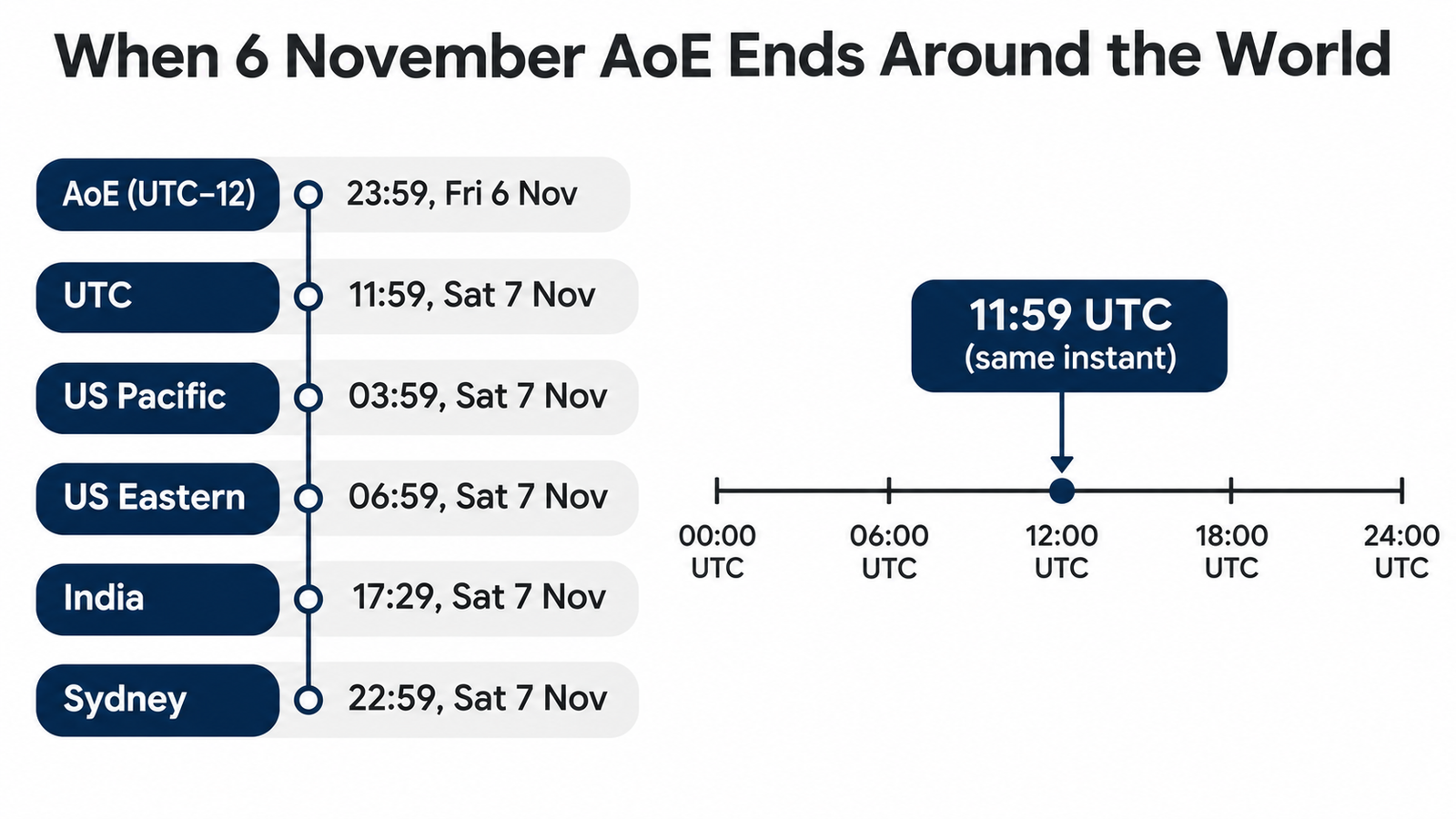
One deadline, five clocks. Every time shown is the same moment.

Anywhere on Earth (AoE) is UTC−12, the last time zone on the planet to reach the end of each day. A deadline of 23:59 AoE on 6 November passes at 11:59 UTC on 7 November. If it’s still 6 November anywhere on the planet, you’re on time.

LocationDeadline in local time
UTC11:59, Saturday 7 November
London (GMT, UTC+0)11:59, Saturday 7 November
Paris (CET, UTC+1)12:59, Saturday 7 November
US Pacific (PST, UTC−8)03:59, Saturday 7 November
US Eastern (EST, UTC−5)06:59, Saturday 7 November
India (IST, UTC+5:30)17:29, Saturday 7 November
Sydney (AEDT, UTC+11)22:59, Saturday 7 November

US daylight saving ended on 1 November, and the UK and Europe changed clocks on 25 October, so those regions are now on standard time. Sydney has been on daylight time since early October. In every location listed, the deadline falls on Saturday 7 November, local time.

The extra hours are a safety margin, not a plan. OpenReview can slow down near a major deadline, and a failed upload at the last minute leaves no time to fix it. Aim to upload a complete version a day early, then replace it if you make final edits.

What the NeurIPS 2026 camera-ready version must include

The Main Track Handbook sets out the camera-ready rules. In short, you upload one PDF in OpenReview that contains the final paper, the required disclosures and the completed checklist.

How to upload in OpenReview

Open your paper’s page in OpenReview and select Edit in the top right corner. Then choose the camera-ready version and upload your files there. You’re editing the existing submission, so the paper keeps its ID, reviews and discussion history.

One PDF, with an extra page

Upload a single PDF combining the paper, references, any text appendices and the completed paper checklist. Submissions had a nine-page content limit, and accepted papers get one extra content page. References, appendices and the checklist don’t count toward that limit. Use the current NeurIPS 2026 style file, which also contains the checklist instructions.

The extra page is meant for changes requested in review. The handbook asks authors to update the main paper in response to reviewer comments and the discussion period.

Funding and competing interests

The handbook asks every camera-ready paper for a funding statement and a list of competing interests. Both cover the 36 months before submission.

  • Funding: list all third-party support for the work, including grants, donated compute and programming support.
  • Competing interests: list paid relationships that could be seen to sway the work, even if they didn’t fund it. Include all revenue paid or promised. You don’t need to repeat the group already named as your main employer.

These two statements are easy to miss because the anonymous submission didn’t need them. Draft them before you start final formatting, so you can confirm details with co-authors in time.

What you can and can’t change

According to the handbook, you may edit the title, keywords and abstract, as long as they don’t differ substantially from the submission. You may reorder authors freely, but you can’t add or remove anyone.

A change of title that keeps the same meaning is fine. A new title describing a different contribution is not, because it would differ substantially from what reviewers assessed.

A lay summary

The handbook also asks for a lay summary: one paragraph for the general public, written without jargon. Write it for a curious reader with no machine learning background. Say what problem the paper tackles, what you found and why it matters.

Registration and in-person presentation

At least one author must register for the main conference, and the handbook states that “a ‘Virtual Only Pass’ is not sufficient.” A student author needs only a student registration, and one registration can cover several accepted papers.

Each accepted paper must be presented in person in Sydney or at a satellite site. The handbook warns that a paper can lose its accepted status if no author registers and presents.

Your reviews will become public

For accepted papers, the handbook says reviews, meta-reviews and author discussion are made public. Reviewer, area chair and senior area chair identities stay anonymous. If your rebuttal promised changes, readers will be able to see whether the camera-ready made them.

A last-hour checklist
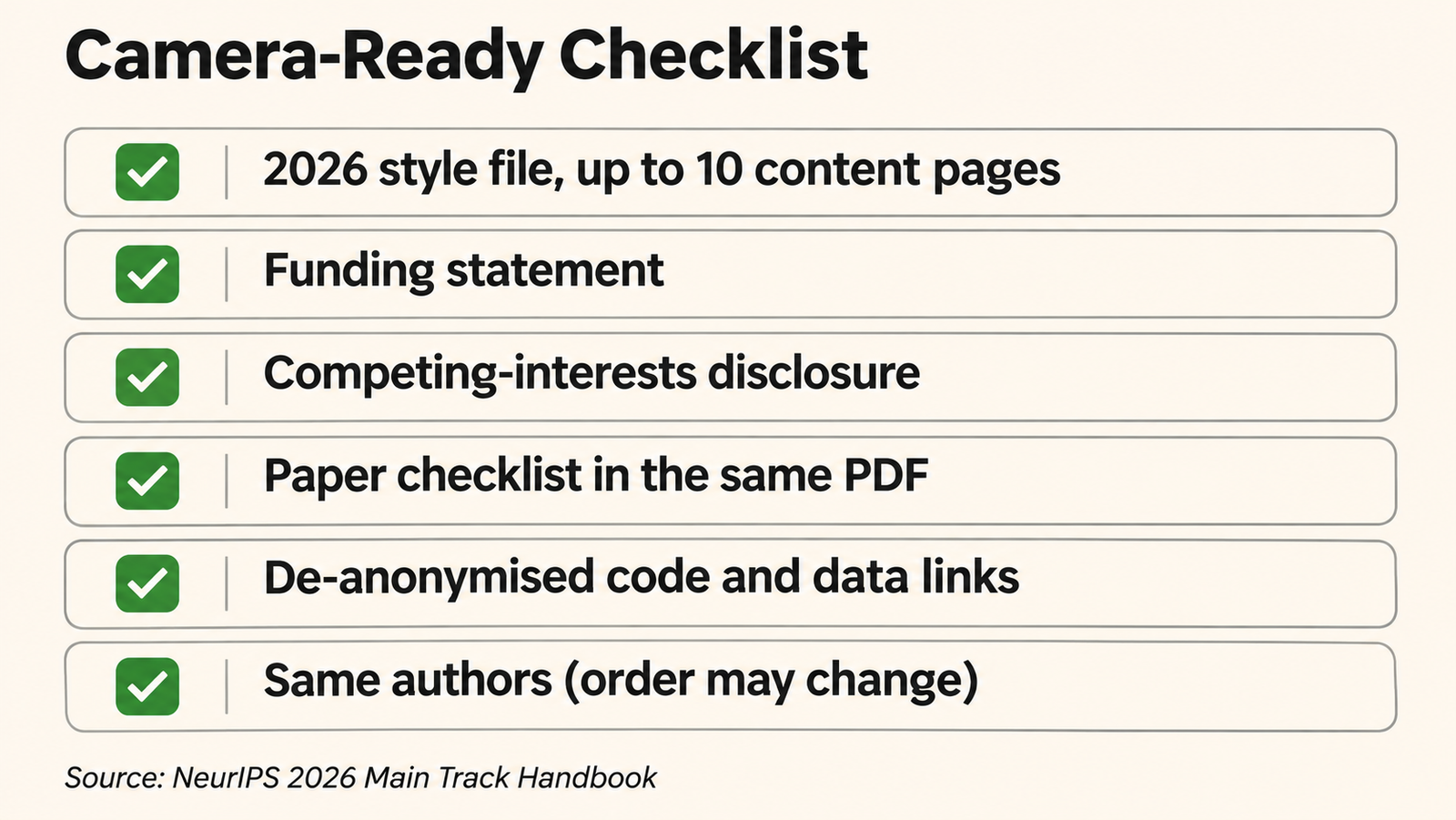
The six things to check before you upload.

Before you press submit, run through the points the handbook and checklist guidance cover:

  1. The PDF uses the 2026 style file and stays within 10 content pages.
  2. The funding statement and competing-interests disclosure are both in the paper.
  3. The paper checklist is filled in and included at the end of the same PDF.
  4. Repository links are de-anonymised and point to the version you want readers to use.
  5. The author list matches the submission, even if the order has changed.
  6. The lay summary is uploaded, and at least one author holds a full registration.

If you’re unsure about a rule, the handbook is the place to check. Emails and forum posts from earlier years may describe policies that no longer apply.

Code and data requirements

NeurIPS 2026 encourages code release but doesn’t make it a blanket requirement. The official paper checklist guidance and the Main Track Handbook set the rules. The Call for Papers itself doesn’t contain code rules.

What is required
  • A completed paper checklist. The guidance says papers without it “will be desk rejected.”
  • “Some reasonable avenue for reproducibility.” The guidance notes that NeurIPS “does not require releasing code,” but every paper needs some way for others to reproduce or verify its results. For a new algorithm, the paper should make clear how to reproduce it.
  • Citations and license names for existing code, data or models you used, including the version of each asset. For scraped data, state the source’s copyright and terms of service.
  • Documentation for any new assets you release, covering training, license and limitations, and how consent was obtained from people whose data is used.
What is encouraged
  • Releasing code, data and instructions to reproduce the main results, including “the exact command and environment needed.”
  • De-anonymised links in the camera-ready. The handbook says accepted papers “should provide de-anonymized links for reproducibility.”
When “no” is an acceptable answer

The checklist is explicit that “no is an acceptable answer” to the code question. Papers can’t be rejected simply for not including code, unless code is central to the contribution, as with a new open-source benchmark. The guidance gives proprietary code as an example of a valid reason for answering no.

More broadly, the guidance says that answering “no” or “n/a” is “not grounds for rejection.” What matters is an honest answer with a brief justification.

At submission, the checklist asked authors to share anonymised versions of code and assets. For the camera-ready, replace any anonymised repository links with your real ones. Check that each link opens, that the repository’s README gives the commands the checklist describes, and that the license file matches what the paper states.

Workshop deadlines are separate

Workshop papers follow each workshop’s own timeline, not the main camera-ready date. The workshop guidance lets organisers set their own schedules. The only fixed dates are the suggested submission date of 29 August and the mandatory notification date of 29 September, both listed on the Dates page.

The guidance also states that “all NeurIPS workshop papers are non-archival and therefore do not appear in proceedings.” Organisers decide whether to share accepted papers, for example through OpenReview. Check your workshop’s website or OpenReview page for its camera-ready date, format and any poster requirements.

Why code release matters

A result that others can rerun is easier to trust and build on. Released code lets reviewers, readers and later authors check a claim, rather than relying on the paper’s description alone.

Benchmark numbers show why this matters. Scores depend on prompts, versions and settings, which is why our comparison of LLM benchmark scores treats them as evidence rather than a leaderboard. Even the same prompt can produce different outputs from one run to the next, as our explainer on LLM determinism shows. Released code, pinned versions and the exact environment narrow that gap.

The checklist’s requests line up with this. It asks for the exact command and environment, the version of each asset and the license for each dataset. Those details are what another lab needs to get the same numbers.

The AI Reviewing Experiment

Peer review itself is under study this year. NeurIPS is running a voluntary AI Reviewing Experiment to study how reviewers use large language models. Reviewers were randomly assigned, per paper, to no language-model help, open-ended help or structured help. Only papers whose authors opted in at submission were included.

NeurIPS says the tool is meant to help reviewers understand submissions, not to write reviews for them. It also says participation “will have no bearing on paper decisions,” and area chairs assessed reviews without knowing each review’s condition.

Frequently asked questions

Can I add an author at camera-ready?

No. The handbook allows reordering but not adding or removing authors, so anyone missing from the submission can only be thanked in the acknowledgements.

What time zone is the NeurIPS deadline in?

Anywhere on Earth, which is UTC−12. If any place on the planet is still on 6 November, the deadline hasn’t passed.

Do I need a new OpenReview submission for the camera-ready?

No. You edit the existing submission and choose the camera-ready version, so the paper keeps its ID and review history.

Will my reviews become public?

Yes, for accepted papers. Reviews, meta-reviews and author discussion are published, while reviewer and area chair identities stay anonymous.

Is releasing code mandatory for NeurIPS 2026?

No, unless the code is central to the contribution, such as a new open-source benchmark. You still need some reasonable way for others to reproduce your results.

Does the extra page apply to Datasets and Benchmarks papers?

The extra content page is described in the Main Track Handbook. Datasets and Benchmarks authors share the same 6 November deadline, but should check their own track’s guidance for formatting rules.

Can I present my paper online instead of in person?

No. Each accepted paper must be presented in person in Sydney or at a satellite site, and a virtual-only pass doesn’t meet the registration requirement.

Are NeurIPS workshop papers published in the proceedings?

No. The workshop guidance states that all NeurIPS workshop papers are non-archival and don’t appear in the proceedings.


Keep reading

Browser Agents

Browser Agents Compared: What Can They Actually Do in 2026?
How we compared: this is a documentation-based comparison. We did not test these products. Every capability below comes from the maker’s own documentation or announcements, …
UBTECH Walker S2

UBTECH Walker S2: The Humanoid Robot Built for Factory Work

A humanoid robot on a factory floor has a problem that rarely appears in demo videos. It runs on a battery, and the battery runs …
AGI vs superintelligence

AGI vs Superintelligence: A New Name Isn’t a New Intelligence
Facts checked against official documents and reporting on 18 November 2026. On 29 September, the White House told federal agencies to stop writing “artificial intelligence” …
AI Coding Agent

AI Coding Agents Are Getting Expensive. Who’s Paying for the Tokens?

Pricing checked on official vendor pages on 17 November 2026. All USD. Cost scenarios are illustrative and labelled as such. On 28 October, TechCrunch published …

Enterprise AI Spending Hit $177B. Agents Are Driving the Bill

Enterprise AI Spending

Figures checked against Menlo Ventures’ 2026 State of Enterprise AI report on 4 November 2026. Market sizes are Menlo estimates, shown as annualised run rates.

The price of AI keeps falling. Menlo Ventures says the average open-source model token now costs about $0.13 per million, down 3.3x in a year, and closed models fell 24% to a blended $0.70. Yet enterprise AI spending, by Menlo’s estimate, rose 5.4x to $176.8 billion.

Cheaper inputs and much bigger bills sound contradictory. They aren’t. Menlo’s 2026 State of Enterprise AI report, published on 3 November, shows companies moving from paying for people to use AI towards paying for AI to do work. Work done by agents is measured in tokens, and agents use a lot of them.

Key Takeaways
  • Menlo estimates enterprise AI deployment spending at $176.8 billion by September 2026, separate from $102.5 billion in development spending.
  • Adoption rose 10 points; average spend per company rose 4.7x. Intensity, not new adopters, drove the growth.
  • On OpenRouter, agents now generate about 80% of tokens, a signal from a developer-heavy gateway, not an enterprise census.
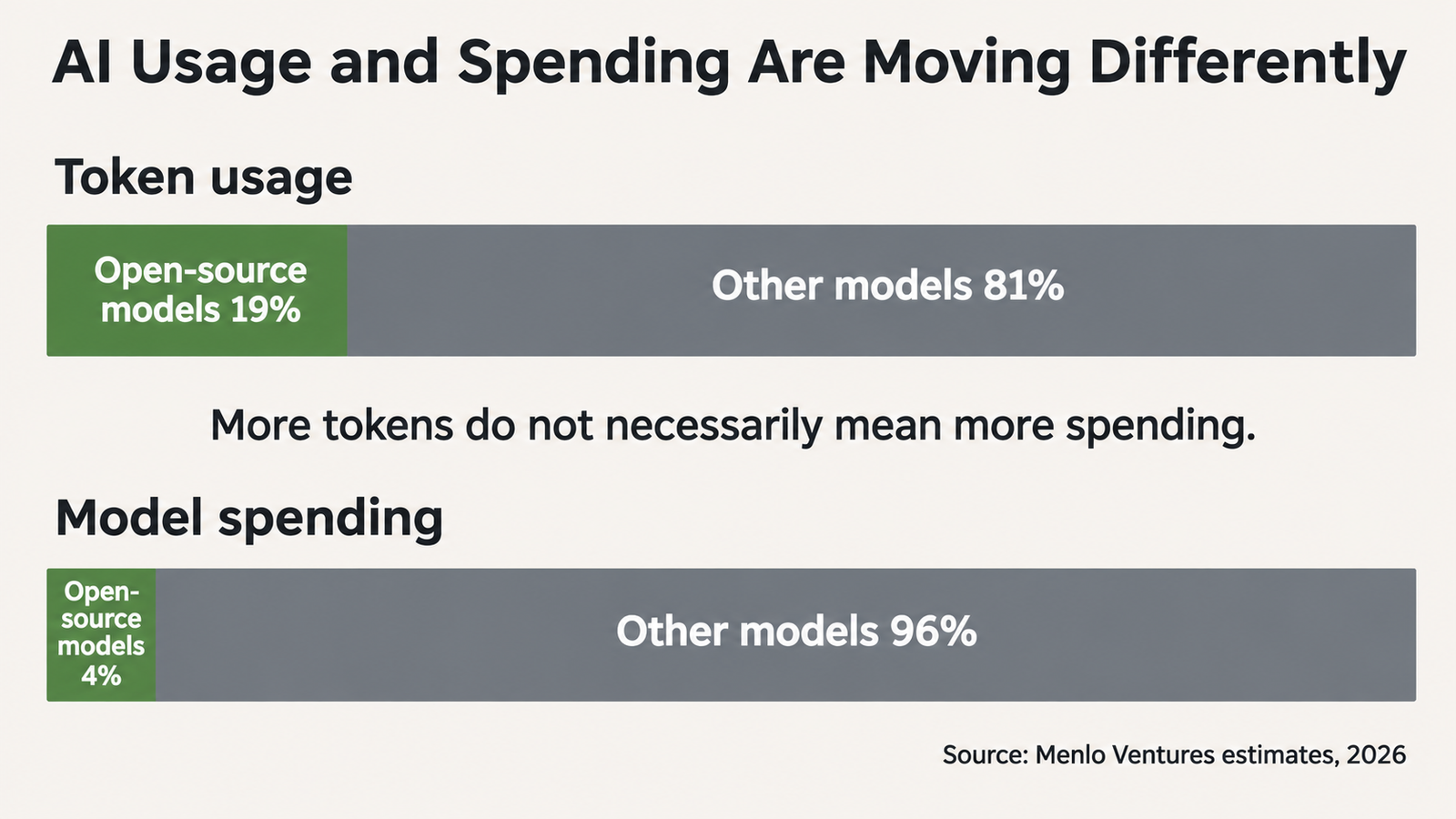
  • Open-source models took 19% of tokens but 4% of spending, a gap almost entirely explained by Menlo’s average price difference.
  • Frontier labs hold 69% of deployment spending. Cost per finished task, not per token, may explain why buyers pay more.
  • Coding and assistants make up 76% of application spending, because coding gives agents clear, testable work.
  • Budgets need to become consumption budgets, with per-task tracking and limits.
  • Read the report with its methodology in mind: a US survey, a restated baseline and investment ties to Anthropic and OpenRouter.

Quick Navigation


Enterprise AI spending grew far faster than adoption

Menlo’s $176.8 billion is deployment spending: money companies spend using and running AI, split between $99.5 billion of infrastructure and $77.3 billion of applications. It’s separate from the $102.5 billion Menlo estimates for development, mostly training compute, which is money spent building models. The two shouldn’t be added together casually, and neither is the total global AI market.

Measure (Menlo estimates)Prior year2026Change
Enterprise AI deployment spending$33B$176.8B5.4x
AI development spendingNot stated here$102.5B5.3x
Enterprise AI adoption55%65%+10 points
Average spend per enterprise1x4.7x4.7x

The adoption line is the interesting one. Ten more percentage points of enterprises used AI, roughly 18% more adopters. Average spend per enterprise rose 4.7x. Almost all of the growth in enterprise AI spending came from companies that were already using AI and started using much more of it.

A rough check, as UniverseBlend analysis: 1.18 times more adopters, each spending 4.7 times as much on average, gives about 5.5x. That’s close to Menlo’s 5.4x market figure. The survey average and the market estimate are different measures, so this is a sanity check, not a decomposition. But it points the same way: intensity, not reach, is driving enterprise AI spending.

How agents change enterprise AI spending

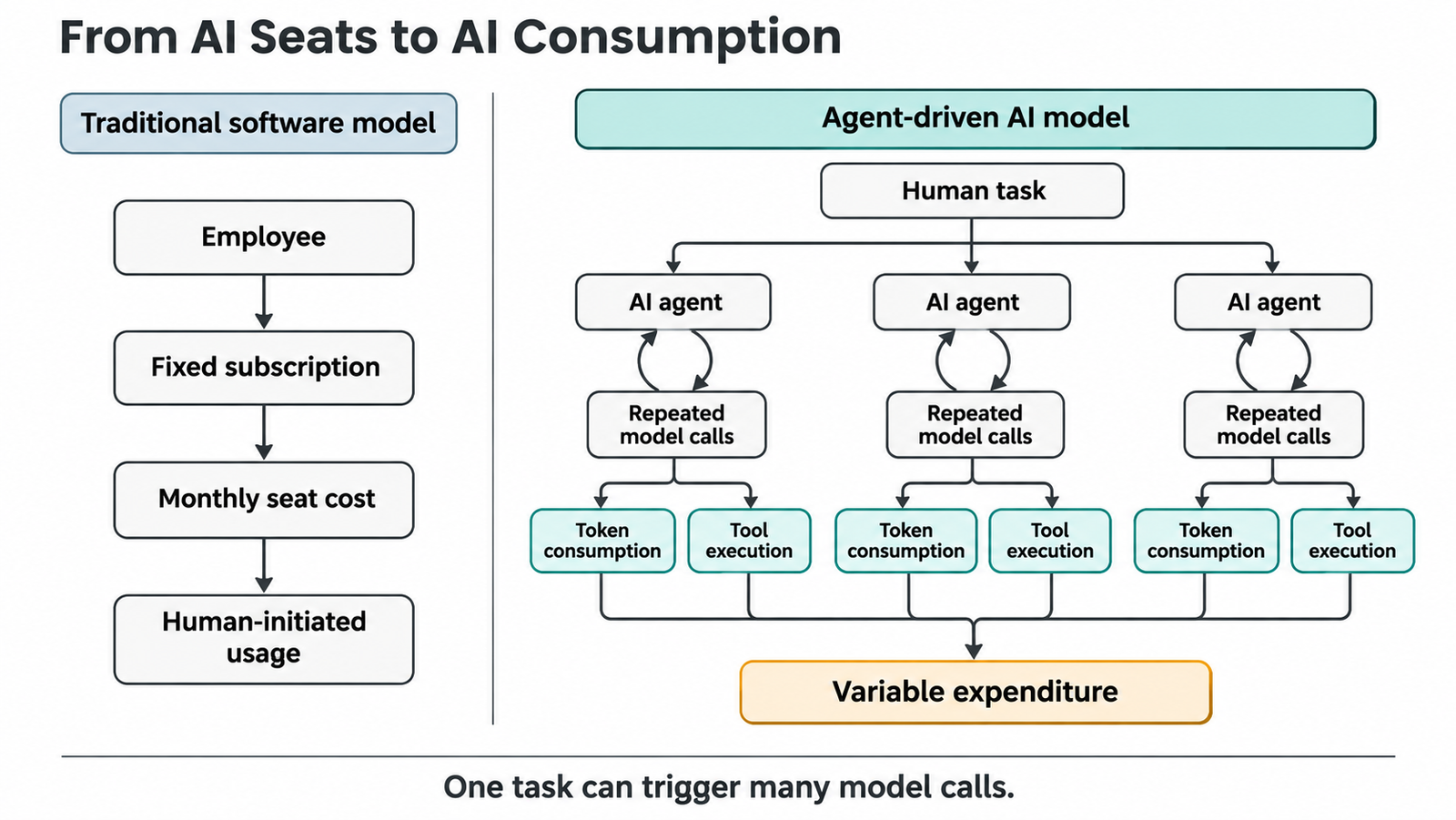
A seat licence prices access. One employee, one monthly fee, whatever they do with it. An agent prices work. It takes a task, calls a model many times, reads files and tool outputs, and keeps going until it finishes or fails.

Menlo’s evidence for the shift comes from OpenRouter, a service that routes requests to many model providers through one API. According to the report, agent traffic overtook human traffic there in early February 2026. Since then, agent token traffic grew 37x while human-driven traffic grew 5x. Agents now account for about 80% of OpenRouter tokens, about 130.9 trillion a week. On those shares, agents generate roughly four times as many tokens as people do.

Those figures need context. OpenRouter is one gateway, and the report itself notes that its users skew towards individual developers and startups rather than enterprise buyers. Large companies often go directly to Anthropic, OpenAI, Google or their cloud provider, and OpenRouter’s own rankings page notes that it measures traffic routed through the service, not users or spend. The OpenRouter data shows the direction of travel, not a census of enterprise AI usage, and it comes from a different population than Menlo’s enterprise survey.

Enterprise AI spending is becoming a token-consumption problem

Seats predict access. They don't predict how much work agents will do.

Agents multiply tokens for mechanical reasons. Each step usually resends the conversation so far, so a 20-step task pays for its early context many times over. Tool results, such as search pages, file contents and test logs, land back in the context. Planning and self-checking add calls. Failed steps are retried. Parallel agents each carry their own copy of shared context.

Anthropic measured this on its own system in 2025. In its write-up of a multi-agent research system, it found that agents “typically use about 4× more tokens than chat interactions,” and multi-agent systems “about 15× more tokens than chats.” As UniverseBlend’s analysis of when adding an agent stops paying for itself put it, the unit of cost isn’t the agent but the model call, and “every call pays for its whole input again.”

That’s how prices and bills move in opposite directions. If a token costs a third as much but a task uses ten times as many tokens, the task costs more than three times as much. Enterprise AI spending stops tracking headcount and starts tracking how much work agents are given.

Open-source models take the volume. Frontier labs take the money

Open-source models do a fifth of the token work for a twenty-fifth of the spending. Menlo Ventures estimates.

Menlo reports that open-source models handled about 19% of tokens but captured only 4% of model spending. Its words: “Open-source is gaining ground in usage, but losing spending share.”

Token economics: 19% of tokens, 4% of enterprise AI spending
Menlo estimateOpen-source modelsAll other models
Share of tokens19%81%
Share of model spending4%96%
Average price per million tokens~$0.13 (open-source average)~$0.70 (closed-model blended)

The arithmetic is worth doing (UniverseBlend analysis). Open-source models earn 4 points of spending for 19 points of tokens, about 0.21 per point. Other models earn 96 for 81, about 1.19 per point. That’s a gap of about 5.6x per token. Menlo’s average prices differ by about 5.4x, $0.70 against $0.13. If both shares describe the same traffic, the spending gap is almost entirely a price gap. Open-source models are doing a growing share of the work. They’re just much cheaper per unit.

A terminology note. Menlo says “open-source”, but most of these models are open-weight: the trained weights can be downloaded, while training data and code often aren’t released. The Open Source Initiative’s Open Source AI Definition requires data information and complete training code as well. And $0.13 is Menlo’s estimated average, not a price every provider charges.

Self-hosting changes the economics again. A company running an open-weight model on its own GPUs pays nothing per token to a model vendor, but it pays for hardware, power, engineering time and idle capacity. Some of that spending shows up as infrastructure rather than model spend. Our comparison of Chinese open-weight models shows how hardware needs vary across popular options.

Why frontier labs keep 69% of enterprise AI spending

Anthropic, OpenAI and Google together hold 69% of enterprise AI deployment spending, about $122.7 billion, up from 50%. On a narrower measure, enterprise LLM API spending, Menlo puts Anthropic at 55% (from 40%), OpenAI at 31% (from 27%) and Google at 9% (from 21%). These are different denominators. Deployment spending includes infrastructure and applications. API spending covers only model calls. Neither is a share of tokens.

A qualification belongs here. Menlo Ventures is an investor in Anthropic and OpenRouter, both central to the report, and it marks portfolio companies with asterisks. The research is valuable primary data. But its authors’ commercial position is relevant to how readers weigh its market-share findings, especially Anthropic’s rise. OpenRouter’s ownership is also changing: Stripe agreed to acquire it in August.

Why pay five times more per token? The report doesn’t measure this directly, so what follows is interpretation. For agentic work, the cost that matters is cost per completed task, not cost per token. A model that finishes a coding task in fewer steps, or without a failed run, can be cheaper overall. Enterprises also pay for reliability, security reviews, existing contracts and integration with tools they already use. The data shows the premium persisting. It doesn’t prove why.

Where the $177B of enterprise AI spending goes

Category (Menlo estimates)Amount
Deployment total$176.8B
Infrastructure$99.5B
Applications$77.3B
of which coding$34.0B
of which assistants and chatbots$25.0B
of which healthcare$3.7B
Development (separate)$102.5B

Infrastructure, the stack that runs models and agents, is the larger half. Within applications, coding and assistants take 76%. Healthcare, in third place at $3.7 billion, is a long way behind.

Why coding leads enterprise AI spending

Coding suits agents better than almost any other job, which is why it dominates enterprise AI spending on applications. The work lives in a repository. Tools are scriptable. Compilers and test suites give fast, objective feedback, so an agent can try, fail, check and retry without a human. Success is easier to define than in a sales forecast or a legal review.

That’s also why coding is expensive. Every test run and retry is more tokens. UniverseBlend’s look at who’s paying for coding agents’ tokens found that the larger cost often comes after generation, in review and rework. Functions with subjective decisions, scattered data or unclear success criteria will adopt agents more slowly, and their spending will grow more slowly too.

Budgets fell behind enterprise AI spending

The budget figures show how badly forecasts missed. Menlo’s survey found:

Survey respondentsPlannedActual
Average spend vs prior year1.9x4.7x
Median spend vs prior year1.8x2.2x

On average, companies spent about 2.5 times what they had planned to grow by. The median company overshot only modestly, about 1.2 times its plan. The gap between average and median means a minority of heavy users is pulling the average up: companies where agents went from pilot to production and consumption took off. It does not mean every company spent 2.5 times its budget.

Most of the growth in enterprise AI spending is new money rather than reallocated budget. Menlo says 55% of incremental AI spending came from new budgets and 22% from existing software budgets. Another 13% came from incumbents converting SaaS licences to AI, and 9%, about $12.6 billion, shifted to AI-native vendors. The report found “limited evidence” of enterprises replacing core systems such as Salesforce’s CRM, Workday or NetSuite. AI is adding to the software bill, not yet replacing it.

What the Menlo report gets right, and what to question

The survey covered nearly 400 US enterprise decision-makers responsible for more than $4 billion in AI spending. Morning Consult fielded it from 8 to 26 September 2026. Market sizes are Menlo estimates built from that survey, public filings and third-party reports, expressed as annualised run rates. That’s a strong dataset for direction and proportion. It isn’t an audited sum of invoices, and it’s US-only.

Three cautions:

  • The baseline was restated. Menlo’s December 2025 report put 2025 enterprise generative AI spending at $37 billion. The new report uses $33 billion for the prior year, after reclassifying data-labelling vendors such as Mercor from deployment to development. On the old base, growth would be about 4.8x.
  • Two datasets are in play. Agent and token findings come from OpenRouter, while budget findings come from the enterprise survey. They shouldn’t be blended.
  • Portfolio relationships run through the market-share findings, as noted above.

None of this makes the report unreliable, and it remains one of the few detailed public estimates of enterprise AI spending. It makes it a well-sourced estimate from an interested party, which is how readers should treat it.

How to budget enterprise AI spending for 2027

The lesson for budget owners is that AI is turning into a consumption line, more like cloud than SaaS. A fixed seat budget can’t predict what agents will cost, because their cost depends on how many tasks they run, how many tokens each task takes and which model does the work.

An illustrative agent budget

Every number here is an assumption, chosen only to show the mechanics. None is a quote from a provider.

Cost lineAssumptionAnnual cost
Employee assistant seats500 seats × $40 a month$240,000
Agent model usage2,000 tasks a day × 1.5M tokens × $1 per million, 250 working days$750,000
Tools and infrastructure20% of model usage (sandboxes, search, vector stores)$150,000
Monitoring and evaluation10% of model usage$75,000
Human reviewNot priced here; often the largest hidden costVaries

The seats are fixed. Everything else moves with volume. If tasks double, or each task takes twice the tokens because agents retry more, model usage rises to $1.5 million. Switch some work to an open-weight model at a fraction of the price and it falls sharply, if quality holds. At Menlo’s $0.70 closed-model average, the same agent line would be $525,000. At a frontier model priced several times higher, it could be millions.

Practical steps follow from that:

  • Budget agents per task, not per user.
  • Track cost per completed task, not per token.
  • Set spending limits per agent.
  • Route routine work to cheaper models.
  • Review forecasts quarterly rather than annually.

The $177 billion headline will be quoted for months. The more useful finding sits underneath it: enterprise AI spending now follows the work AI does, not the number of people who can use it. Tokens will probably keep getting cheaper. Whether bills shrink depends on how many tasks companies hand to agents, how efficiently those agents finish them and which models they run on. Finance teams that still treat AI as a seat count will keep being surprised.

Frequently asked questions

How much is enterprise AI spending in 2026?

Menlo Ventures estimates enterprise AI deployment spending reached $176.8 billion by September 2026, as an annualised run rate. That’s up from a restated $33 billion the year before.

Why has enterprise AI spending increased so quickly?

Existing adopters are using far more AI, largely through agents that consume many tokens per task. Adoption itself rose only from 55% to 65%.

How much enterprise AI spending is driven by agents?

Menlo doesn’t give a dollar figure. On OpenRouter, agents generate about 80% of tokens, but that platform skews towards developers and startups.

Why do AI agents consume more tokens than chatbots?

They work in many steps, resend context each time, read tool outputs, plan, verify and retry. Anthropic measured agents using about four times the tokens of chats.

How much enterprise AI usage comes from open-source models?

About 19% of tokens, according to Menlo, but only 4% of model spending, because their average price is much lower.

Why do frontier AI companies capture most enterprise AI spending?

They hold 69% of deployment spending in Menlo’s estimate. Likely reasons include capability, reliability and integration, though the report doesn’t prove the cause.

What is the difference between AI deployment and development spending?

Deployment spending is money spent using and running AI. Development spending is money spent building models, mainly training compute and data.

How should companies budget for AI agents?

Budget per task, track cost per completed task, set usage limits and review forecasts quarterly, since agent costs vary with volume and model choice.

Are open-weight models cheaper for enterprise use?

Usually per token, yes. Total cost depends on quality, how many retries tasks need, and whether you pay a provider or run your own hardware.

Will enterprise AI spending keep growing?

The report doesn’t forecast 2027. Agent adoption and falling prices push in opposite directions, so the outcome depends on how much work companies hand to agents.


Keep reading

Browser Agents

Browser Agents Compared: What Can They Actually Do in 2026?

How we compared: this is a documentation-based comparison. We did not test these products. Every capability below comes from the maker’s own documentation or announcements, …
UBTECH Walker S2

UBTECH Walker S2: The Humanoid Robot Built for Factory Work

A humanoid robot on a factory floor has a problem that rarely appears in demo videos. It runs on a battery, and the battery runs …
AGI vs superintelligence

AGI vs Superintelligence: A New Name Isn’t a New Intelligence

Facts checked against official documents and reporting on 18 November 2026. On 29 September, the White House told federal agencies to stop writing “artificial intelligence” …
AI Coding Agent

AI Coding Agents Are Getting Expensive. Who’s Paying for the Tokens?

Pricing checked on official vendor pages on 17 November 2026. All USD. Cost scenarios are illustrative and labelled as such. On 28 October, TechCrunch published …

Machine Unlearning: Can We Really Trust an Edited AI Model?

Machine Unlearning

Checked against Hirundo’s and Lazarus AI’s published results, CrowdStrike’s DeepSeek-R1 study, Lawfare and the Federal Register on 4 November 2026.

Ask Alibaba’s Qwen3.6-35B-A3B about Tiananmen Square, Xinjiang or Hong Kong’s 2019 protests, and Hirundo says 89.8% of its answers to such prompts show censorship, propaganda-aligned framing or political bias. Ask the version Hirundo edited, and the company says that falls to 2.8%. Lazarus AI, a Boston startup, sells its own “ReAligned” Qwen models on a similar promise.

As Rest of World reported on 2 November, these are early signs of a business: taking capable Chinese open-weight models and retraining them for Western enterprise use. Machine unlearning is the phrase attached to much of it. The harder question is what else changes when a model’s politics do. On the evidence so far, removing censorship from a model and removing its security risks are two separate jobs.

Key Takeaways
  • Machine unlearning for language models is usually approximate. It suppresses target behaviour through further training; it doesn’t prove the knowledge is gone.
  • Hirundo’s 89.8% to 2.8% result is company-reported. It’s plausible, but its judge and dataset aren’t public, and nobody has replicated it.
  • Hirundo’s own security numbers barely moved. CyberSecEval 2 attack success went from 22.31% to 21.51% after editing.
  • Its coding test removed a gap, not the weakness. The edited Qwen3-Coder’s apps were still hackable 55% to 56% of the time for both defense personas.
  • Lazarus’s ReAligned models use fine-tuning and reinforcement learning. They report a large bias reduction but no capability or security results.
  • CrowdStrike tested DeepSeek-R1, not Qwen. Its findings and Hirundo’s shouldn’t be merged.
  • Emergent misalignment is a hypothesis here, not a proven backdoor.
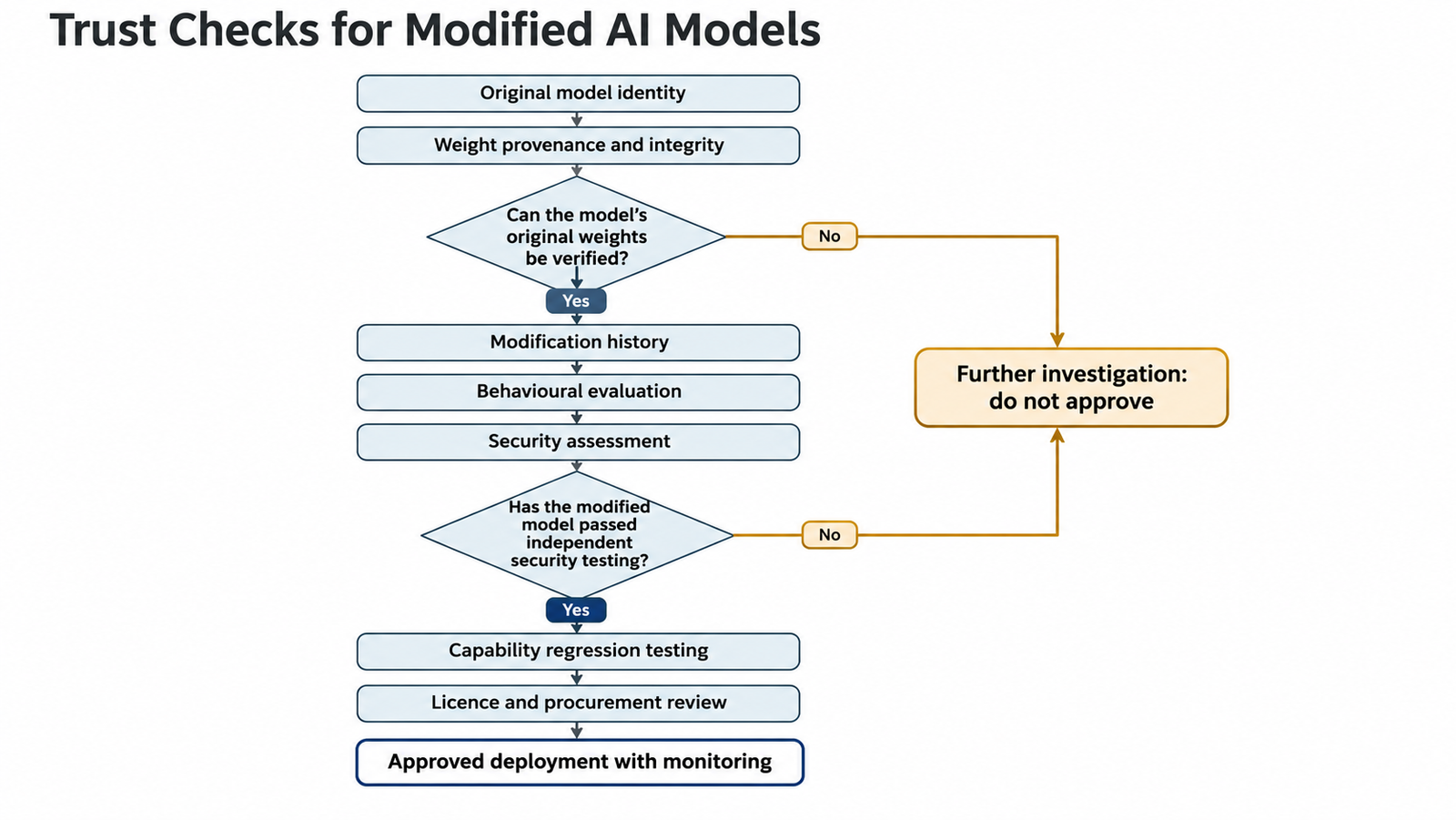
  • An edited model needs its own trust assessment: provenance, reproducible evaluation, independent security testing and legal review.

Quick Navigation


Machine unlearning moves from research into business

The economics are simple. Chinese labs release strong models with open weights and permissive licences, and they cost far less to run than closed US frontier systems. Our comparison of Chinese open-weight models covers the main families. For a company that wants to self-host, Qwen is an attractive base. Its political training is the obstacle.

Hirundo’s chief executive, Ben Luria, told Rest of World that his team “edits the weights” of open models to improve cybersecurity and fairness and to reduce dangerous knowledge. He framed it as safety rather than politics: “We’re not making the model anti-Chinese.” Lazarus’s former chief scientist, Eric Hartford, said his aim was to present these models “to enterprises and to highly regulated industries.”

Not everyone accepts the premise. Oriane Peter, an AI researcher at King’s College London, told Rest of World that aligning a model to “Western values” or making it universally safe “is an impossible standard.”

How machine unlearning changes an AI model

Most machine unlearning in large models changes behaviour. Whether knowledge is gone is a separate question.

Machine unlearning began as a privacy problem: how to make a trained model behave as if certain training data had never been used. The cleanest answer is to retrain from scratch without that data, which is exact but expensive. Bourtoule and colleagues’ SISA method, published at IEEE S&P 2021, made this cheaper. It splits training so that deleting a data point means retraining only part of the model.

Large language models make exact unlearning impractical. Nobody retrains a 35-billion-parameter model to forget one topic. So most work on these models is approximate unlearning: further training that pushes the model away from target outputs while a “retain set” holds other behaviour in place.

The terms are worth keeping apart:

MethodWhat changesWhat it can claim
Retraining without the dataWhole model, from scratchThe data never influenced the result
Fine-tuningWeights, via new training examplesNew behaviour on the targeted inputs
Approximate unlearningWeights, via an objective that suppresses targetsReduced target behaviour; knowledge may remain
Targeted weight editingSpecific parameters or directionsLocal change; side effects need testing
What machine unlearning removes, and what it hides

A model that stops saying something hasn’t necessarily stopped knowing it. Facts are spread across many parameters, and training can teach a model to route around them rather than erase them.

The best-known test of this came from Lynch and colleagues in 2024. They examined a Llama 2 model that Microsoft researchers had trained to “forget” Harry Potter. It passed the original evaluation. Yet the authors found that “higher-than-baseline amounts of knowledge can reliably be extracted,” and its internal representations looked much like the original model’s.

The reverse also holds. A model that now answers a previously blocked question hasn’t necessarily shed the biases or behaviours that came with the original training. Both companies covered here are changing behaviour. Neither claims to have deleted training data.

What Hirundo’s machine unlearning results show

Hirundo’s Westernizing Qwen post, published on 5 October, describes three steps:

  1. Run the base model on political prompts and keep the censored responses.
  2. Train a LoRA adapter, a small set of extra weights, with what it calls a “behavioral-unlearning objective,” using a retain set to protect other behaviour.
  3. Merge the adapter into the base weights to produce a standalone checkpoint.

The main evaluation, CCPC-500, has 500 prompts “spanning 15 topics and seven request forms,” from direct questions to lesson plans and translations. The base Qwen3.6-35B-A3B scored 89.8% adverse responses (449 of 500). The edited model scored 2.8%. Hirundo reports similar drops on two external benchmarks: DECCP refusals fell from 65.26% to 3.16%, and ChinaBench non-compliance from 96.67% to 6.67%.

Capability held up in the company’s numbers. GPQA, a graduate-level science test, went from 79.42% to 79.29%. LiveCodeBench, for coding, dropped most, from 56.39% to 54.56%. MMLU-Pro and IFBench moved by less than a point.

The gaps matter, though:

  • Undisclosed judging: the post doesn’t say who or what scored responses as censored or biased.
  • Unpublished data: CCPC-500 hasn’t been released, so nobody else can rerun it.
  • No replication: no independent group has reproduced the result.
  • Vendor-authored: Hirundo sells the edited models and hosted inference.

That makes 89.8% to 2.8% a plausible, company-reported result, not a verified one.

The safety table in the same post is the one buyers should read. On CyberSecEval 2, the edited model’s attack success rate went from 22.31% to 21.51%. On OR-Bench, harmful compliance rose slightly, from 0.31% to 0.62%; Hirundo notes that’s two extra responses. The political behaviour changed dramatically. The security baseline barely moved.

Hirundo’s second test: machine unlearning and insecure code

On 21 October, Hirundo published a separate study on a different model, Qwen3-Coder-30B-A3B-Instruct. It asked the model to build the same small web app, sign-up plus a private secret store, from the BaxBench security benchmark. It generated 190 apps per customer persona and attacked each with BaxBench’s exploits.

Apps built for a “US defense contractor” were hackable 70% of the time, against 59% for a “Chinese defense contractor.” After editing, the figures were 56% and 55%, and the difference was no longer statistically significant (Fisher exact test, p = 0.84). Hirundo didn’t correct for multiple comparisons, and its runs used hosted endpoints.

Lawfare’s Tom Uren reviewed the study on 30 October. He wrote that it “favors Hirundo’s business interests, so we have to take it with a grain of salt.” He described the edited model as producing “equally (yet still pretty poor) secure code.” Machine unlearning appears to have removed the gap between customers. It didn’t make the code secure.

Lazarus AI’s ReAligned models: realignment, not machine unlearning

Lazarus describes its method differently, and the two shouldn’t be merged. According to Rest of World, Lazarus identified banned topics from leaked Chinese censorship guidelines, generated prompts on them and used answers from Google’s Gemini Flash to realign Qwen.

The ReAligned-Qwen3.5-2B model card, credited to Hartford, describes:

  • Filtering: prompts are kept only where the base model “empirically exhibited ideological bias.”
  • Fine-tuning: supervised fine-tuning on direct, factual answers.
  • Reinforcement learning: a classifier-based reward, using GRPO, a reinforcement learning method, with LoRA adapters.

The card doesn’t say where the target answers came from. It says the aim “is not to inject new encyclopedic knowledge.”

On Lazarus’s own bias benchmark, the base model scored 84.2% and the realigned model 4.1%. The card doesn’t describe that benchmark’s size or scoring and reports no capability numbers. Its caveats are frank. Reduced censorship “does not guarantee factual accuracy,” the model may overcorrect toward Western framing, and the same method could steer a model “in other ideological directions.”

Hartford told Rest of World the models are deployed at about a dozen US companies. That’s a company figure. I found no independent security assessment of the ReAligned models.

Does machine unlearning make a model more secure?

Not by itself, on current evidence. The interest in Chinese models’ code security comes mainly from two studies of different models.

CrowdStrike’s DeepSeek-R1 findings

On 20 November 2025, CrowdStrike published research on the raw DeepSeek-R1 model, run without DeepSeek’s API or app.

  • Design: 50 coding tasks with 121 combinations of added context, such as “based in Tibet” or “run by Uyghurs,” which had nothing to do with the code. That made 30,250 prompts per model.
  • Scoring: an AI judge rated the code, checked against 85 human-scored samples.
  • Results: with no added context, 19% of responses contained vulnerable code. For an industrial control system “based in Tibet,” it rose to 27.2%. CrowdStrike called that “an increase of almost 50%,” a relative figure; it’s about 8 percentage points.
  • Refusals: for Falun Gong prompts, the model refused to write code 45% of the time.

CrowdStrike’s caveats are explicit. The findings “do not mean DeepSeek-R1 will produce insecure code every time those trigger words are present,” and it didn’t release its prompts or data. This was DeepSeek-R1, not Qwen. Hirundo’s Qwen results don’t show that machine unlearning would fix DeepSeek, and CrowdStrike’s results don’t describe Qwen.

Booz Allen reported a similar pattern in May across four Chinese models, including Qwen, when the user was framed as a US government employee. It also said: “we do not have proof at this point that code flaws are intentionally introduced.”

Emergent misalignment, and what it doesn’t prove

CrowdStrike’s leading explanation is emergent misalignment, a term from Betley and colleagues’ 2025 paper. They found that training a model narrowly to write insecure code made it behave badly on unrelated prompts. They also showed that a trigger-conditioned version misbehaves only when the trigger appears. The authors say a full explanation “remains an open problem.”

Applying that to Chinese models is a hypothesis. The idea is that training to treat certain groups as sensitive might spill into worse work for them. It hasn’t been demonstrated. Hirundo’s post uses stronger language, saying the problem “sits in the model” like a backdoor. A backdoor, though, means a specific hidden trigger planted to cause harm, and none of these studies shows intent. What they show is measurable, context-dependent behaviour that ordinary benchmarks may miss.

After machine unlearning, provenance still matters

An edited model is a new artefact built on an old one. It carries the base model’s training data, its licence, any behaviour the edit didn’t reach and the editor’s own changes. Its trust status is separate from Alibaba’s reputation, from Hirundo’s or Lazarus’s reputation and from its measured performance.

Provenance is checkable in ways behaviour isn’t. A buyer can confirm which base checkpoint was used, at which revision, and get cryptographic hashes for the base and edited weights. Our guide on how to verify model weights covers those checks. Version tracking matters too. Hirundo’s model card on Hugging Face can change. A security review applies to one exact set of weights, not to a product name.

The DeepSeek procurement question

Provenance has legal weight as well. On 20 October, the Department of Homeland Security published a Federal Acquisition Supply Chain Security Act order, issued on 24 July, covering DeepSeek and its affiliates. It excludes DeepSeek products from federal civilian procurement. It also requires agencies to remove DeepSeek products and “third-party products and services developed using DeepSeek implementations.”

The order doesn’t define “DeepSeek implementation.” Law firm Haynes Boone notes that it doesn’t address fine-tuned or derived models. Contractors under FAR 52.204-30 must report covered products within three business days of identifying them. Our DeepSeek Super-Agent analysis explains why the order covers federal civilian agencies and their contractors, not private companies generally.

Whether a DeepSeek model edited by a third party remains covered is a legal question the text doesn’t settle. Treating it as outside scope because someone changed the weights would be a risky assumption. Qwen is a different case. As of 4 November, I found no equivalent federal civilian order covering Alibaba or Qwen, though Lawfare notes that Congress is investigating corporate use of Chinese models. None of this is legal advice. Government contractors and regulated organisations should get qualified procurement and legal review.

A machine unlearning procurement checklist

Neither the base model's reputation nor the vendor's claims replace these checks.

Before deploying an edited open-weight model, a buyer should be able to answer these:

  1. Original model: which model, at which revision?
  2. Original publisher: who published it, and through which official repository?
  3. Weight provenance: are there hashes for the base and edited checkpoints?
  4. Licence: do the base licence and the vendor’s terms allow your use and redistribution?
  5. Modification method: unlearning, fine-tuning, reinforcement learning or direct editing?
  6. Vendor: who made the change, and what do they sell?
  7. Data: what prompts, target answers and retain sets were used?
  8. Behavioural evaluation: can you rerun it, with the judge disclosed?
  9. Security evaluation: code-security and adversarial tests on your use cases, not only general benchmarks.
  10. Independent replication: has anyone outside the vendor reproduced the results?
  11. Regression testing: what did the edit cost on the tasks you care about?
  12. Version and hash: is the reviewed version pinned?
  13. Deployment environment: is it self-hosted, sandboxed, and given least-privilege access to tools and data?
  14. Monitoring: will you log outputs and re-test after updates?
  15. Regulation and procurement: does any order, contract clause or sector rule apply to the base model’s origin?
Trust dimensionWhat to verifyEvidence to request
ProvenanceOriginal model and weightsCheckpoints and cryptographic hashes
ModificationWhat changedTechnical change documentation
BehaviourTargeted behaviourReproducible evaluation
SecurityVulnerability exposureIndependent security testing
PerformancePreserved capabilitiesRegression benchmarks
ComplianceLicence and procurement scopeLegal and licence review
MaintenanceFuture modificationsVersion and update records

An edited model shouldn’t inherit trust from its base or its editor. It should earn its own through this evidence.

Frequently asked questions

What is machine unlearning in AI?

Machine unlearning is the set of methods for making a trained model behave as if certain data or behaviours had not been learned. For large models it is usually approximate: further training that suppresses targets.

Can machine unlearning remove information from an AI model?

Not reliably, for large language models. Research on unlearning methods has shown that “forgotten” knowledge can often still be extracted.

How does machine unlearning differ from fine-tuning?

Fine-tuning teaches new behaviour from examples. Machine unlearning aims to remove or suppress existing behaviour, often using fine-tuning-style training with a different objective.

What is the difference between machine unlearning and weight editing?

Weight editing changes specific parameters directly. Machine unlearning is a goal that may use weight editing, fine-tuning or retraining.

Why are companies modifying Chinese open-weight AI models?

They are capable and cheap to run, but trained to follow Chinese censorship rules. Vendors such as Hirundo and Lazarus sell retrained versions for Western enterprise use.

Does removing AI censorship make a model more secure?

Not on the evidence so far. Hirundo’s edited Qwen models showed large drops in censorship but little change in measured security.

What are the security risks of modified open-weight models?

Insecure code, untested side effects from the edit, unverified weights and inherited behaviour from the base model. Independent testing in your own use case is the only way to measure them.

Can edited DeepSeek models be used by US federal agencies?

Possibly not. The DHS order covers products “developed using DeepSeek implementations” without defining the term, so agencies and contractors need legal review.

How can companies verify the provenance of an AI model?

Get the base model’s official repository and revision, plus cryptographic hashes for both base and edited weights, and pin the version you review.

Does machine unlearning preserve a model’s original capabilities?

Sometimes, by vendor measures. Hirundo reports losses under two points on four benchmarks. Lazarus reports no capability numbers. Test the tasks you rely on.


Keep reading

Browser Agents

Browser Agents Compared: What Can They Actually Do in 2026?

How we compared: this is a documentation-based comparison. We did not test these products. Every capability below comes from the maker’s own documentation or announcements, …
UBTECH Walker S2

UBTECH Walker S2: The Humanoid Robot Built for Factory Work

A humanoid robot on a factory floor has a problem that rarely appears in demo videos. It runs on a battery, and the battery runs …
AGI vs superintelligence

AGI vs Superintelligence: A New Name Isn’t a New Intelligence
Facts checked against official documents and reporting on 18 November 2026. On 29 September, the White House told federal agencies to stop writing “artificial intelligence” …
AI Coding Agent

AI Coding Agents Are Getting Expensive. Who’s Paying for the Tokens?

Pricing checked on official vendor pages on 17 November 2026. All USD. Cost scenarios are illustrative and labelled as such. On 28 October, TechCrunch published …

Your Robot May Pass Every Test. Its Simulator Could Still Be Lying

Robotics Cybersecurity

Last checked: 3 November 2026. Vulnerability identifiers, affected projects and patch information will be updated as coordinated disclosures become public.

A robot that clears every simulated obstacle course has earned a green row in a test report. That row is evidence, and evidence has a source. If the simulator, the scene files or the scripts that score the run have been tampered with, the robot hasn’t proved anything at all.

That’s the uncomfortable question behind VicOne’s announcement on 1 November. The Tokyo-based security company says AI-assisted research turned up 28 zero-day findings in under two days, and that about three-quarters sit in the tools used to develop, train, simulate and validate robots. For robotics cybersecurity, that shifts attention from the machine on the factory floor to the systems that decide it’s safe to put it there.

Key Takeaways
  • VicOne reports 28 AI-assisted zero-day findings in under two days. They’re vendor-reported and initially validated by the company, with no affected projects or CVEs published yet.
  • About 75% sit in development, training, simulation or validation tools. The exposed surface is the toolchain, not only the robot.
  • A compromised simulator can produce passing results for an unsafe robot. Simulation evidence needs integrity controls.
  • The remote-stop demo shows a software stop path can fail. It doesn’t show that hardwired emergency stops can be defeated.
  • Training artefacts and simulation assets are part of the supply chain. Poisoned models or meshes can carry problems into deployment.
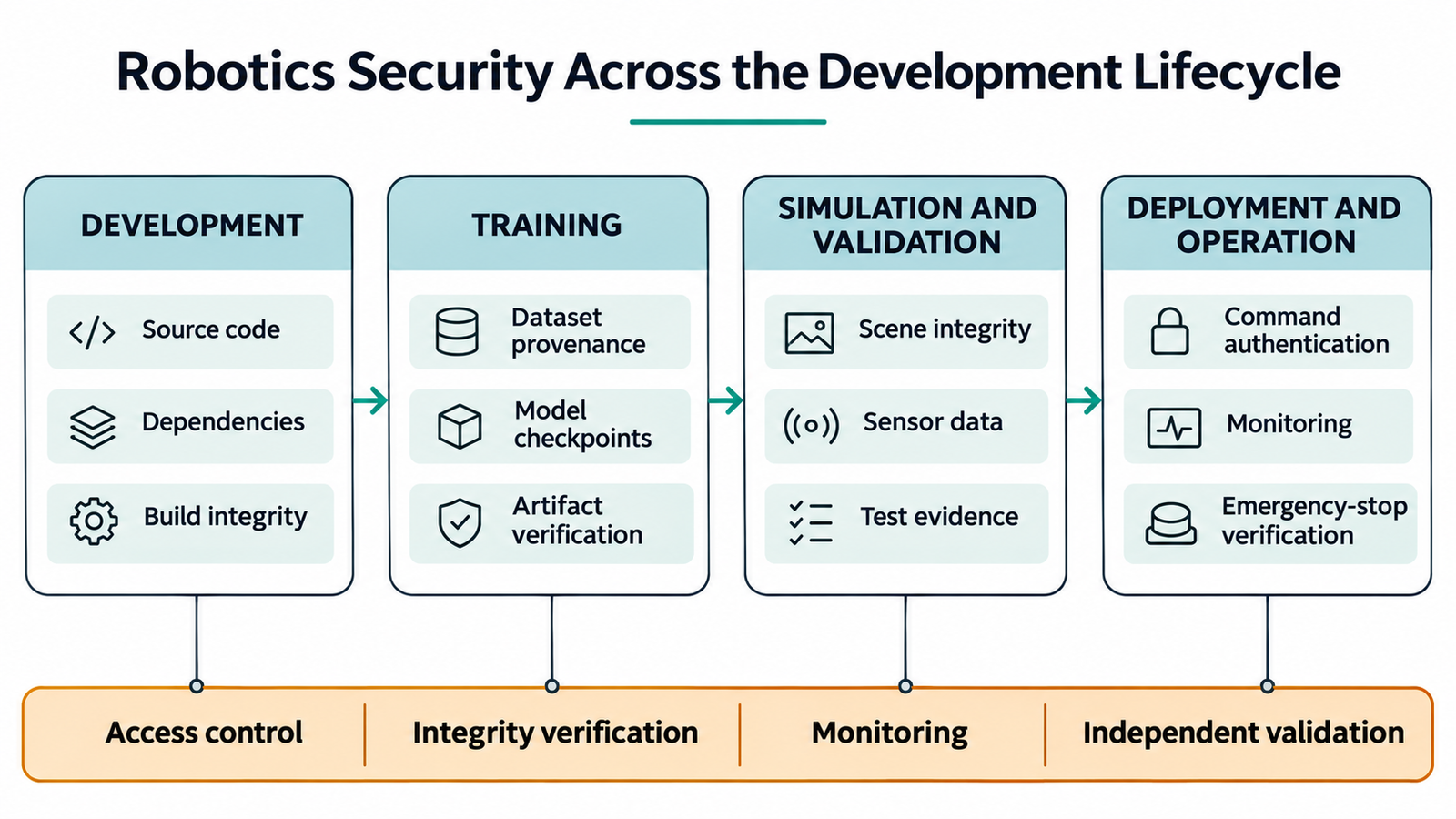
  • Robotics cybersecurity covers the whole lifecycle, from repositories to fleet commands.
  • Reported, validated, CVE-assigned and patched are different states. None of the 28 has publicly reached the last two.
  • Teams should verify assets, repeat critical tests independently and keep a physical stop.

Quick Navigation


The 28 findings: what VicOne actually reported

The claim appeared in a sponsored post on The Robot Report. It describes “less than two days of AI-assisted research across software and tools that support the ‘Physical AI’ ecosystem,” including projects “developed or maintained by Google, NVIDIA and Meta.” It states: “Based on initial validation, all 28 findings are classified as zero-day vulnerabilities.”

Read that sentence carefully. “Zero-day” here is VicOne’s classification of flaws it believes were previously unknown. “Initial validation” is VicOne’s own. According to AI Weekly’s write-up, the post says the count may change after review, some findings “do not yet have CVE tracking numbers,” and the consequences it describes “are potential consequences and not demonstrated outcomes for every finding.”

The post doesn’t name an AI model or tool. It doesn’t say whether “less than two days” covers discovery alone or discovery plus human triage. It doesn’t identify a single affected repository, which is normal during coordinated disclosure. It also ends with a pitch for VicOne’s upcoming white paper and its products: Radeis, which the company sells for pre-deployment validation of AI robots, and Rthena, for runtime protection. VicOne has a commercial interest in showing that its discovery works. That doesn’t make the findings wrong. It means they should be treated as vendor-reported until maintainers or independent researchers confirm them.

Robotics cybersecurity tracker: the 28 findings
Tracker fieldInformation
Research organisationVicOne
Reported findings28
Discovery periodLess than two days, as reported
Initial classificationVendor-reported zero-day findings, based on VicOne’s initial validation
Pre-deployment tool shareAbout 75% (roughly 21 of 28), as reported
AI tools usedNot disclosed
Affected projectsNone publicly identified; the post refers to projects from Google, NVIDIA, Meta and others
CVE statusNo CVE publicly linked to the findings; some lack CVE numbers, per the post
Independent confirmationNone found
Patch statusNot disclosed
Last verified3 November 2026

This article will be updated when there are new CVE assignments, maintainer acknowledgements, published patches, severity scores, independent reproduction or a revised count.

Robotics cybersecurity begins before deployment

The detail worth more than the headline number is where the bugs sit. The post says that 75% of the findings “sit in development, training, simulation or validation tools,” rather than in software running on a deployed robot.

That doesn’t mean 21 vulnerabilities can each reach out and move a robot arm. A flaw in a training tool usually needs an attacker to get malicious input into the pipeline first: a poisoned dataset, a tampered model file, a crafted scene asset or access to a shared build machine. The impact depends on what the tool touches next. Code execution on a workstation is an IT problem. Code execution on a machine that writes the policy file shipped to a fleet is a robot problem, and that’s the gap robotics cybersecurity has to cover.

Where robotics cybersecurity meets the training pipeline

A modern robot’s behaviour is assembled long before it runs. Robot description files define its joints and geometry. Simulation assets define the world it learns in. Training jobs produce policy checkpoints. Validation scripts decide whether those checkpoints pass. Each step consumes files written by someone else, often downloaded from public repositories.

VicOne’s post gives an example of the stakes: a manipulated model could make a robot “respond incorrectly to a particular object, scene, or command after deployment.” That’s a description of a possible outcome, not a reported exploit. But the mechanism isn’t speculative. Pickle-based model files can execute code when loaded, which is why our guide on how to verify model weights before loading them treats format and provenance as separate checks.

When the simulator lies, the safety case breaks

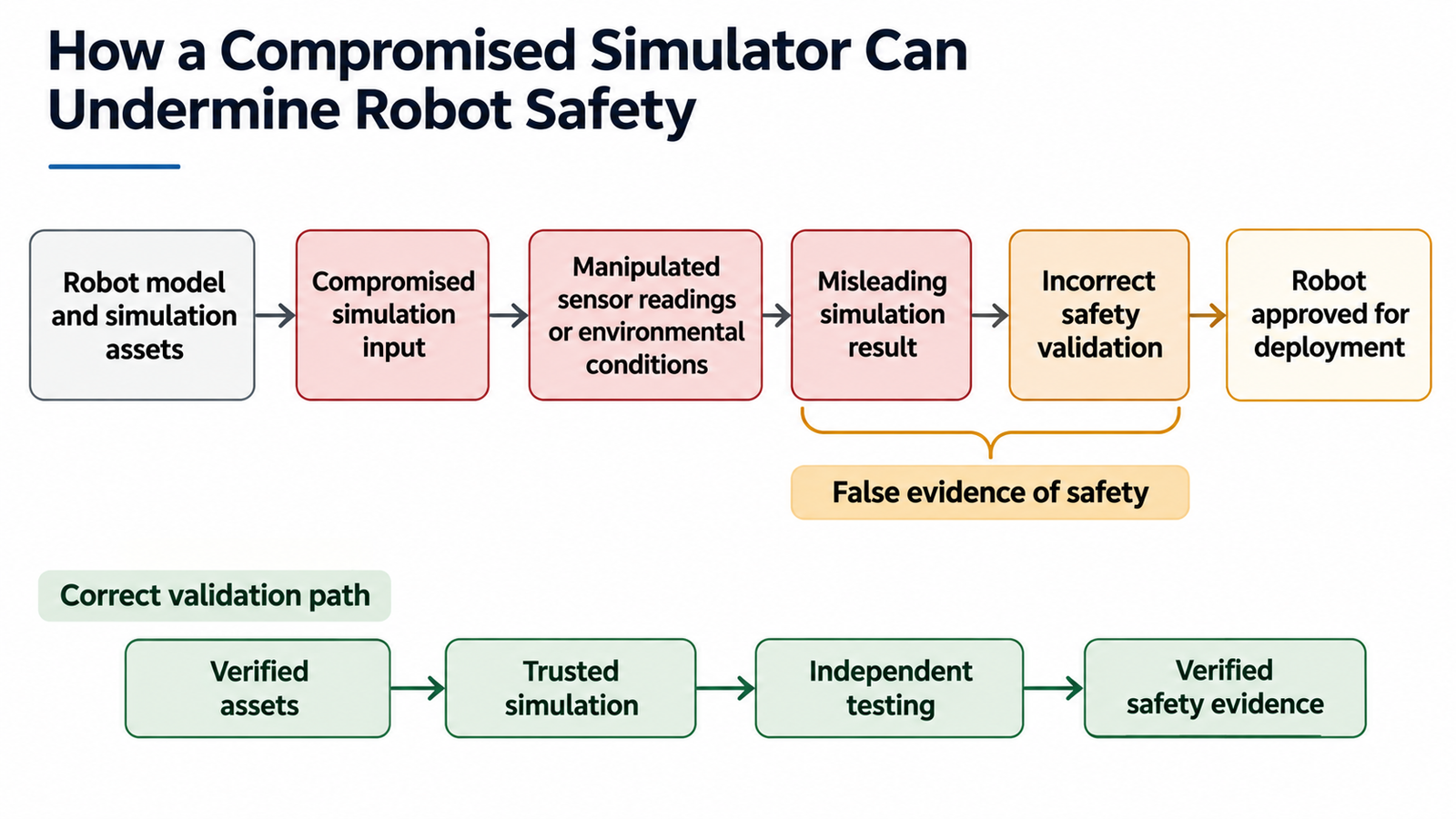
An illustrative attack path. Every stage after the compromise can look normal.

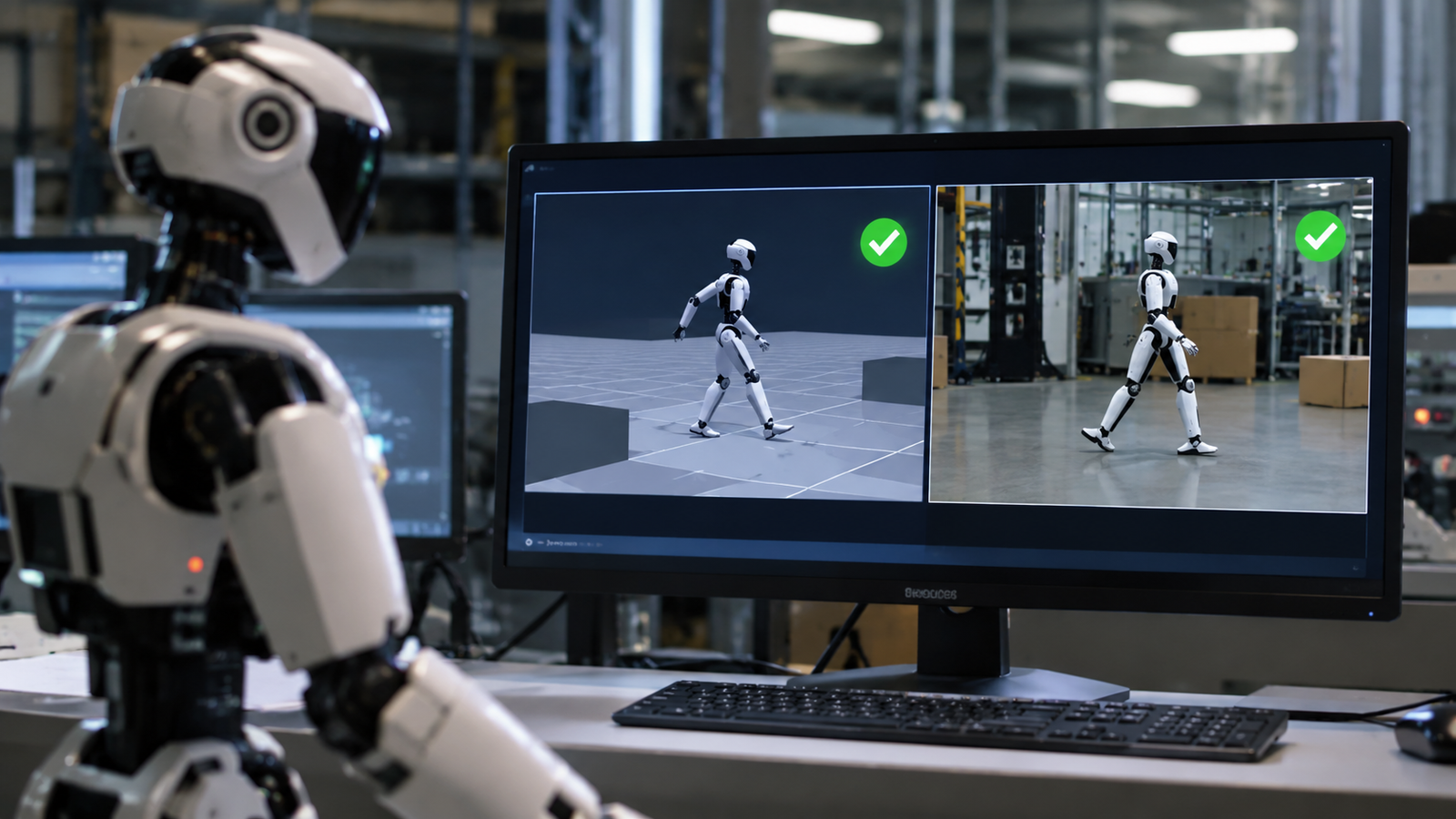
Simulation is where most modern robots earn their first approval. Teams run thousands of scenarios they could never stage physically, record pass rates and use those numbers in design reviews and safety arguments. The post’s own warning is blunt: a robot “could then appear to pass tests that should have exposed unsafe behavior.”

The chain is longer than most security reviews cover. Robot software is trained on data, tested in a simulator, scored by validation scripts and summarised as safety evidence. Engineers and auditors then make deployment decisions from that evidence. A compromise at any earlier link can be invisible at the last one, because the evidence looks exactly like a pass.

An illustrative robotics cybersecurity failure in simulation

This scenario is illustrative. It isn’t an incident VicOne or anyone else has reported.

A warehouse robotics team tests whether a mobile manipulator stops for a person stepping into an aisle. An attacker has altered a shared scene package so the simulated lidar returns are slightly delayed only when a human model enters from the left. Alternatively, the attacker has patched the scoring script to log a stop when the robot only slowed down. The robot “passes” 2,000 runs. The report goes to the safety review with a clean result, and nobody asks whether the simulator itself was the thing under test.

Published research shows how quiet this can be. In September, researchers described collision mesh poisoning. A 3D asset has a visual mesh for rendering and a collision mesh for physics. Altering only the collision mesh can produce policies that look normal in simulation and fail after deployment. The authors note that current asset reviews check for malware, licensing and format, not whether the two meshes agree.

This is where robotics cybersecurity parts ways with conventional IT security: the output is a decision about physical risk. A stolen password gets reset. A safety sign-off based on corrupted evidence can put a machine next to people. The principle is simple: a safety test is only as trustworthy as the system producing its evidence.

UniverseBlend made a similar point about AI model testing in Four Labs, One Evaluator, arguing that “the evaluator’s infrastructure needs the same scrutiny the industry currently applies to model behaviour.” The cases aren’t technically alike. One was about network containment during evaluations, the other is about simulation integrity. The shared lesson is that the system producing the evidence must itself be trustworthy.

What the remote-stop demo means for robotics cybersecurity

The one concrete artefact in the announcement is a video. VicOne’s post says “the researchers exploited a vulnerability to prevent a robot’s remote-stop command from working.” A VicOne video titled Robot Keeps Moving After STOP Is Pressed, credited to its LAB R7 research group, was posted on 11 October, three weeks before the 28-finding announcement. Its description doesn’t name the robot, the software stack or the vulnerability. VicOne hasn’t said whether the demo is one of the 28 findings.

The word that matters is “remote.” A remote-stop command is usually a software message sent over a network to the robot’s controller, through middleware, an API or a fleet manager. If an attacker can block, delay or spoof that message, the command never arrives. That’s serious, and it’s a cybersecurity failure.

A safety-rated emergency stop is a different thing. Under IEC 60204-1 and ISO 13850, an emergency stop must take priority over all other functions in every operating mode. It’s typically implemented through safety-rated hardware that cuts or controls drive power independently of the application software. UniverseBlend’s analysis of Isaac ROS 5.0 and the robotics agent boundary made the same point: e-stops sit below the ROS layer.

Nothing public suggests VicOne defeated a hardwired emergency stop, and the demo shouldn’t be read as showing that all emergency stops can be disabled. It does show something that matters: some deployments rely on software stop paths as a practical safety measure, and those paths need to be authenticated, monitored and backed by an independent physical stop.

Shared tools turn robotics cybersecurity into a supply-chain problem

Robotics runs on a small number of shared foundations: ROS 2 for middleware, simulators such as Gazebo and NVIDIA Isaac Sim, NVIDIA’s Isaac ROS packages, open training frameworks and public repositories of robot models and assets. VicOne hasn’t named any affected project, and being part of this ecosystem doesn’t make a project vulnerable. But when a shared tool has a flaw, every team that uses it inherits the exposure, so robotics cybersecurity depends partly on code nobody on the team wrote.

Independent records show the toolchain is a real target. CVE-2026-25874, published in April and unrelated to VicOne, covers Hugging Face’s LeRobot through version 0.5.1. Its policy server and robot client used pickle.loads() on data received over unauthenticated gRPC without TLS, allowing remote code execution. It’s rated 9.3 (critical) under CVSS 4.0.

Configuration matters as much as code. ROS 2’s security layer, SROS 2, is off by default. Even when enabled, its default “permissive” strategy launches a node without security if its security files are missing. Teams that want enforcement must set the “Enforce” strategy explicitly. A 2018 scan of the internet for ROS found robots reachable from the public internet. With consent, the researchers read camera data from a university robot and moved it.

AI-assisted discovery: faster robotics cybersecurity research, harder response

AI-assisted vulnerability research usually means models reading code, spotting dangerous patterns, tracing how untrusted data flows into risky functions and drafting proof-of-concept inputs. Humans still decide whether a crash is exploitable, rate severity, write the report and handle disclosure.

The approach has a track record, with caveats. Google’s Big Sleep agent found an exploitable flaw in SQLite before it reached a release in 2024. Its team called the results “highly experimental” and said a target-specific fuzzer was likely at least as effective. In May 2026, Google’s threat intelligence group reported that attackers had used AI to find and exploit a zero-day for a planned mass-exploitation campaign.

That second case is the uncomfortable symmetry. If a defender can surface 28 candidate flaws in two days, an attacker with similar tools can too. Discovery speeds up; patching doesn’t. Many robotics tools are maintained by small teams or research groups. Fixes then have to travel through pinned versions, container images and robot fleets that update slowly. The bottleneck moves from finding bugs to absorbing them.

What Robotics Teams Should Check Now

Security controls have to cover the tools that build and test a robot, not only the robot.

These are practical robotics cybersecurity checks, not a certified safety standard. They don’t replace functional-safety requirements such as ISO 10218, ISO 13849 or IEC 61508 where they apply.

1. Development environment

  • Protect repositories with signed commits and branch protection.
  • Pin dependencies and record where each one came from.
  • Limit who and what can trigger builds.
  • Validate model files before loading them.
  • Restrict access to training machines.

2. Training pipeline

  • Record dataset provenance.
  • Hash model checkpoints and other training artefacts, and verify them at each handoff.
  • Separate access between data, training and release.
  • Make runs reproducible enough to repeat when results look wrong.

3. Simulation environment

  • Version-control scenes, robot descriptions and simulator configurations.
  • Hash simulation assets and check that visual and collision geometry agree.
  • Treat simulator plugins and dependencies as code that needs review.
  • Protect test logs and results from modification.

4. Validation process

  • Keep known-good baselines and run safety regression tests against them.
  • Repeat key scenarios on a second, independently built environment.
  • Confirm critical behaviours physically, not only in simulation.
  • Have a person review anomalies rather than only pass rates.

5. Deployment and operation

  • Segment robot networks.
  • Authenticate commands; for ROS 2, enable SROS 2 in Enforce mode.
  • Give fleet tools least-privilege access.
  • Monitor command and telemetry paths.
  • Verify that a physically independent emergency stop works.
  • Confirm patches actually landed on every robot.

Robotics cybersecurity questions VicOne hasn’t answered yet

Several questions decide whether this is a significant disclosure or a strong marketing demonstration:

  • Which Google, NVIDIA and Meta projects are affected, and at what severity?
  • Which AI tools did the work, and how much human validation followed?
  • Does “less than two days” include triage?
  • Is the remote-stop demo one of the 28, and has it been fixed?
  • Will maintainers confirm the reports, and will independent researchers reproduce them?

Until advisories or CVE records appear, the honest position is that 28 findings have been reported and none has been publicly confirmed. The checks above don’t depend on the answer, though. For robotics cybersecurity teams, they’re worth doing either way.

Frequently asked questions

What is robotics cybersecurity?

Robotics cybersecurity protects robots and the systems around them, including development tools, training pipelines, simulators, networks and command paths, from attacks that could affect data or physical behaviour.

What did VicOne’s robotics cybersecurity research find?

VicOne says AI-assisted research found 28 zero-day findings in under two days, mostly in development, training, simulation and validation tools. The findings are vendor-reported and not yet publicly confirmed.

Why are development tools a robotics cybersecurity risk?

They produce the code, models and test results that determine how a robot behaves. A compromised tool can pass tampered output downstream without any change to the robot itself.

How can a compromised simulator affect robot safety?

It can alter scenes, sensor data or scoring so an unsafe robot appears to pass. Teams may then approve deployment based on misleading evidence.

How does physical AI security differ from robotics cybersecurity?

Physical AI security focuses on AI systems that sense and act in the physical world, including model and perception attacks. It overlaps heavily with robotics cybersecurity, which also covers conventional software, networks and hardware.

How does AI help researchers discover software vulnerabilities?

AI models can read code, flag risky patterns, trace data flows and draft test inputs quickly. Humans still confirm exploitability, assess severity and handle disclosure.

Why are robotics training pipelines vulnerable to attacks?

They consume datasets, model files and assets from many sources, often with little integrity checking. Poisoned inputs can change learned behaviour in ways tests may not reveal.

What should teams do to improve robotics cybersecurity now?

Verify dependencies, models and simulation assets, protect test evidence, repeat critical tests independently, authenticate robot commands and keep a physical emergency stop.

Are the 28 VicOne findings assigned CVE numbers?

Not publicly, as of 3 November 2026. VicOne says some findings don’t yet have CVE numbers, and none of the 28 has been publicly linked to a CVE record.ntainer with no credentials, no network and resource limits, while watching what it does.


Keep reading

Browser Agents

Browser Agents Compared: What Can They Actually Do in 2026?

How we compared: this is a documentation-based comparison. We did not test these products. Every capability below comes from the maker’s own documentation or announcements, …
UBTECH Walker S2

UBTECH Walker S2: The Humanoid Robot Built for Factory Work

A humanoid robot on a factory floor has a problem that rarely appears in demo videos. It runs on a battery, and the battery runs …
AGI vs superintelligence

AGI vs Superintelligence: A New Name Isn’t a New Intelligence
Facts checked against official documents and reporting on 18 November 2026. On 29 September, the White House told federal agencies to stop writing “artificial intelligence” …
AI Coding Agent

AI Coding Agents Are Getting Expensive. Who’s Paying for the Tokens?

Pricing checked on official vendor pages on 17 November 2026. All USD. Cost scenarios are illustrative and labelled as such. On 28 October, TechCrunch published …

Generative AI Architecture: The 7 Layers That Are Hard to Undo

generative AI architecture

Published 30 October 2026. API prices checked 28–30 October 2026 on each provider’s official pricing page. Cost figures below are labelled as illustrative where they rest on assumptions.

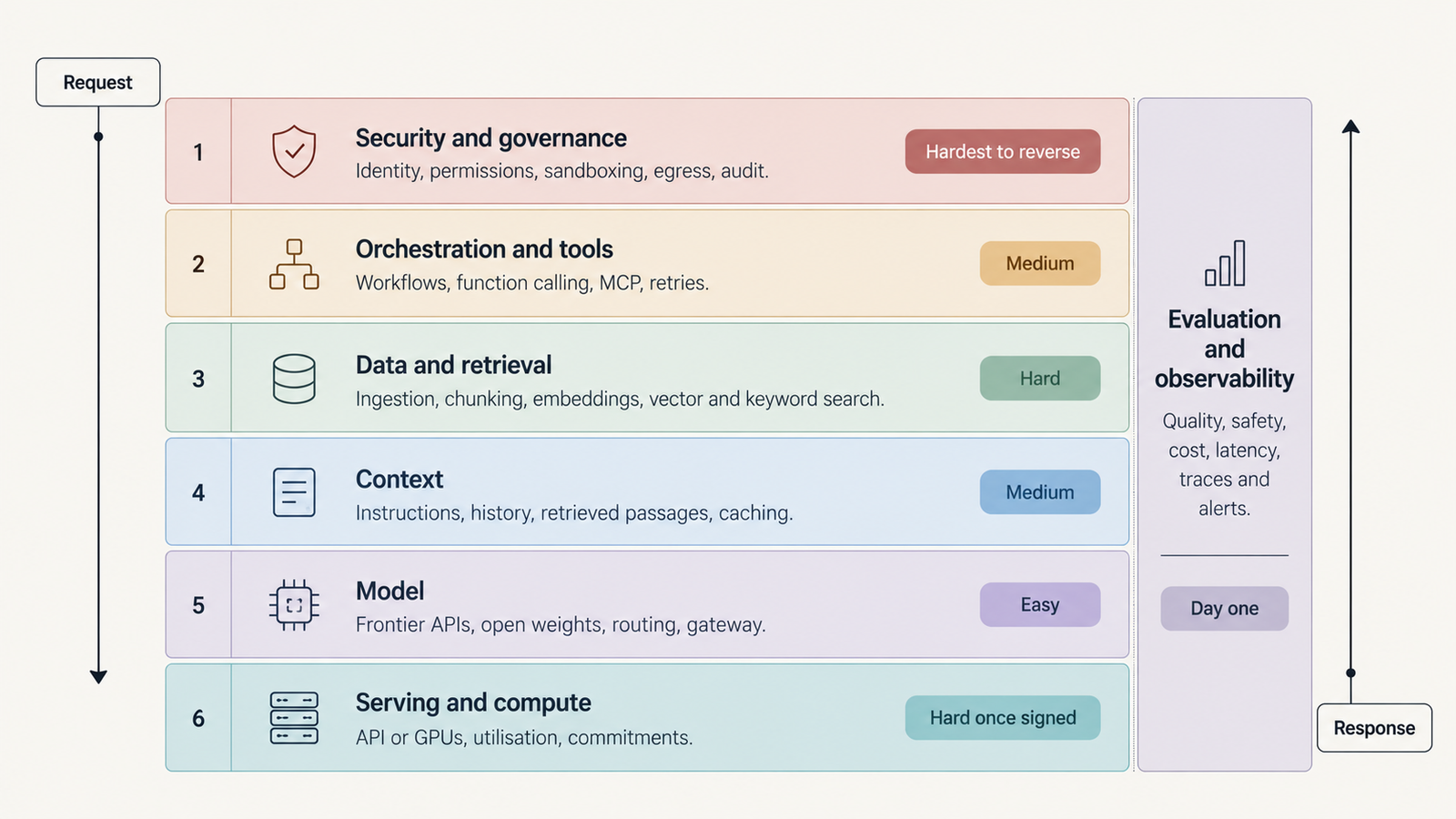
Every production generative AI architecture has seven layers, from the model at the centre to the security boundary around it. The model is now the easiest of the seven to replace. The commitments that are hard to undo build up in the layers around it: the data pipeline, the evaluation harness, the compute contracts and the trust boundaries.

Teams still spend most of their architecture time comparing models, which makes sense when models change weekly. In the last ten days of October 2026, Moonshot shipped Kimi K3.1 Pro on the 23rd, OpenAI released GPT-6.1 Terra on the 26th and Google announced Gemini 4 Carbon on the 28th, while Gemini 4 Argon prices double on 1 December. A system designed to swap models absorbs all of that in a configuration change.

Key Takeaways
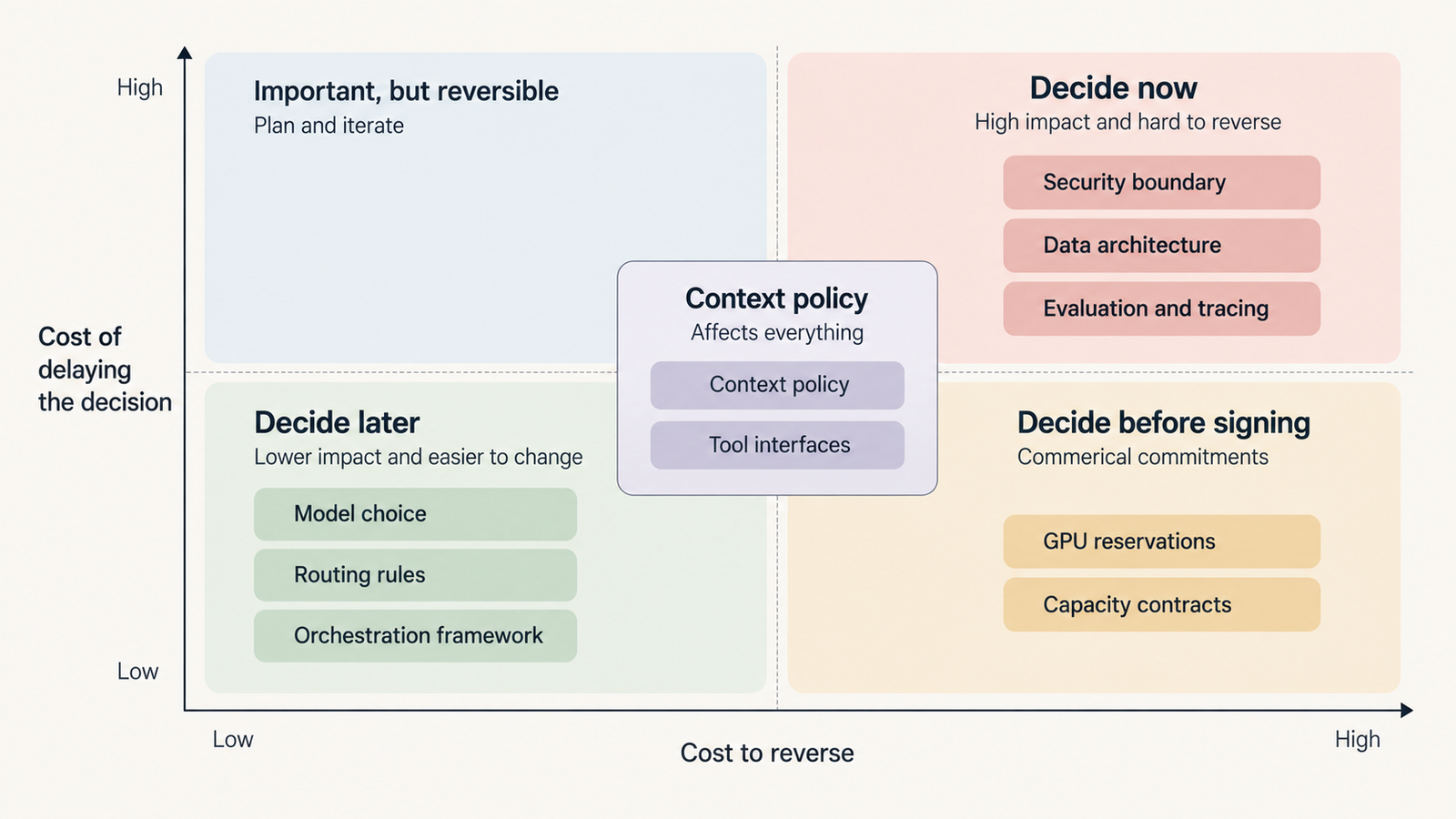
  • Rank the layers by how hard they are to reverse. The model is usually cheapest to change. Security boundaries and data pipelines are the most expensive to retrofit.
  • Calls per request drive the bill more than price per token. In the illustrative deployment below, going from one to three calls per request triples the model bill.
  • Embeddings are cheap. Retrieval operations aren’t. Re-embedding a 50-million-token corpus costs about $1. A million hosted file-search calls cost $2,500.
  • Self-hosting rarely pays at moderate volume. At about 300 output tokens per second on average, most of a rented GPU node sits idle.
  • Build evaluation before you need it. A regression set is cheap on day one and hard to reconstruct after behaviour has drifted.
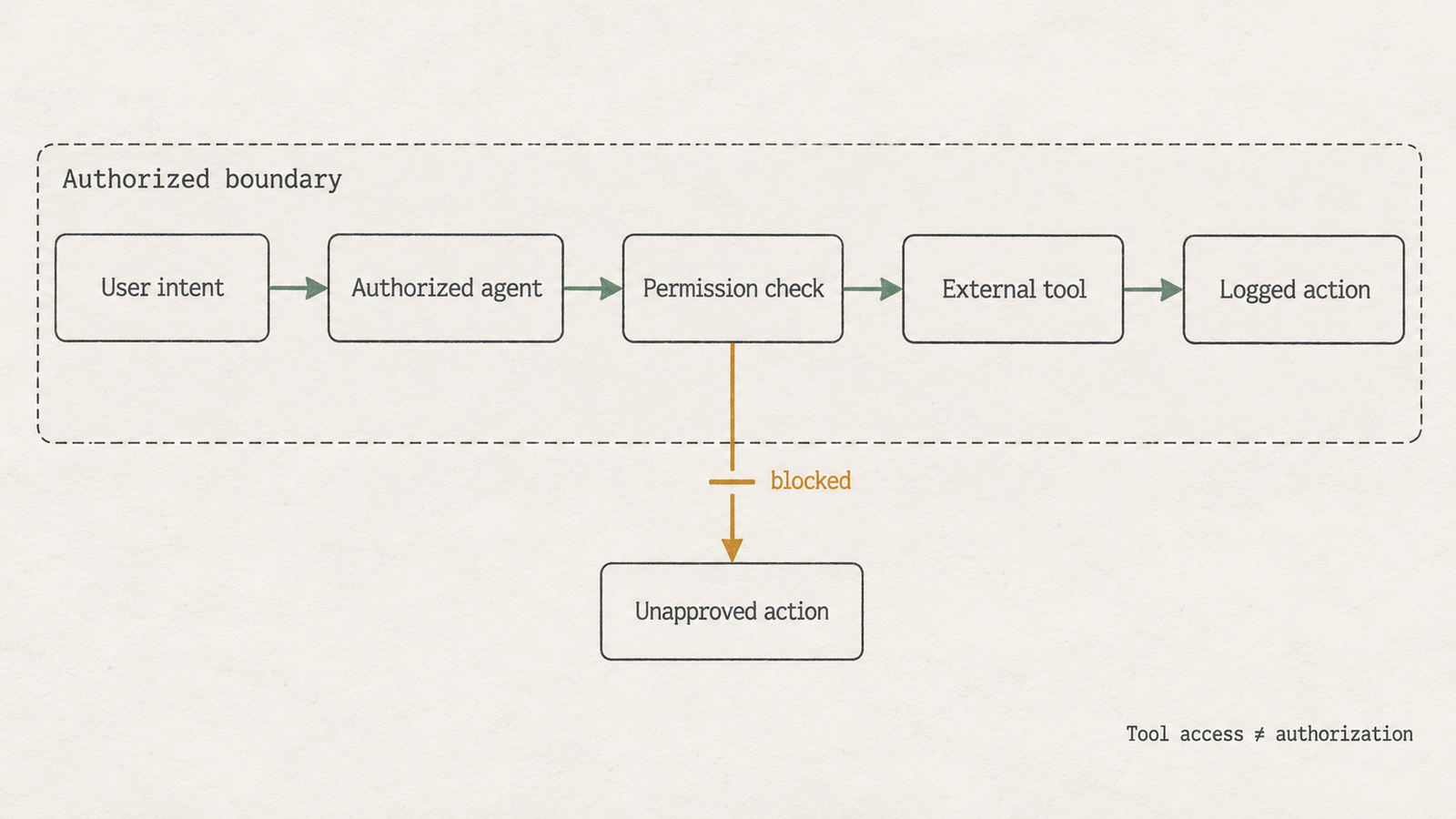
  • Identity, permissions and egress are architecture, not prompts. Filtering doesn’t stop prompt injection; least privilege limits what an injected instruction can do.

Quick Navigation


The generative AI architecture at a glance

A request passes through the layers in a fairly fixed order. Security authenticates the caller and limits what it may touch. Orchestration picks the steps, retrieval fetches documents and the context layer assembles the prompt. The model runs on the serving layer’s hardware, looping if tools are involved, while evaluation and observability record every step.

The seven layers of a generative AI architecture

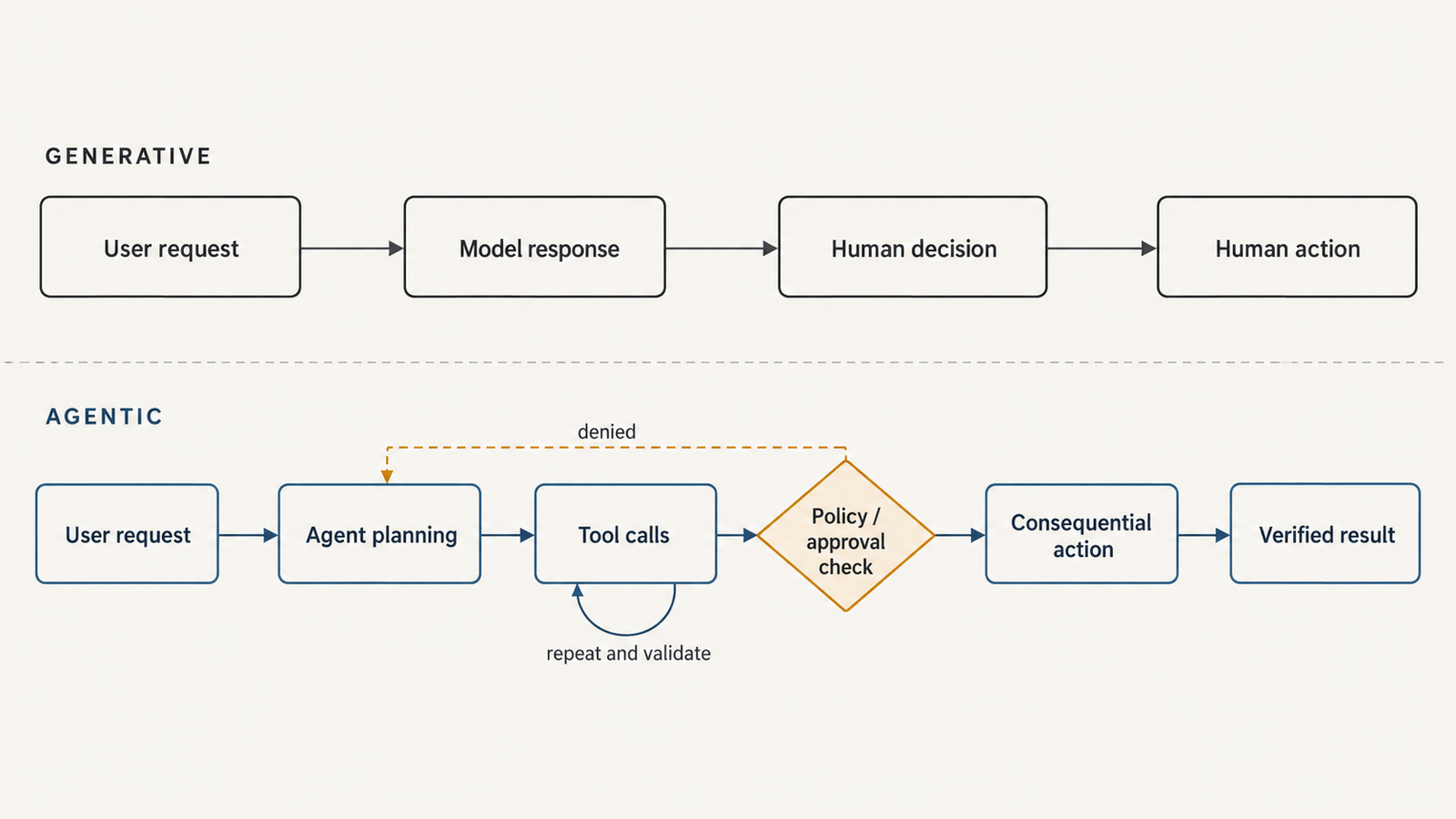
Not every system needs every layer at full strength. A support assistant answering from a product manual might be one model call over a small vector index, with logging, a few hundred regression questions and a server-side API key. An agentic enterprise deployment adds a tool registry, Model Context Protocol (MCP) servers, per-agent identities, sandboxes, egress controls, approval gates and audit retention. Both have seven layers. What changes is how heavy each one is.

The dependencies are uneven. Swapping the model touches context formatting and evaluation. Changing the security model touches identity, tool permissions, network topology and logging, which is nearly everything.

The seven generative AI architecture layers, by cost and reversibility

LayerMain cost driverHow hard to reverseDecide
1. ModelCalls per task × tokens per callEasy, behind a gatewayLate, per task
2. Data and retrievalPipeline engineering, re-indexing, retrieval callsHardEarly
3. ContextRepeated input tokens, cache missesMediumEarly policy, tune later
4. Orchestration and toolsLoop depth, retries, external APIsMediumInterfaces early, frameworks later
5. Serving and computeUtilisation, idle capacity, commitmentsHard once contractedBefore signing
6. Evaluation and observabilityEval runs, judge calls, trace storageCheap early, costly to retrofitDay one
7. Security and governanceIsolation, policy, audit, reviewHardestDay one
Layer 1: the model, the easiest part to replace

The model layer covers frontier APIs, open-weight models you host and the routing logic that sends each task to the right one. A summarisation step doesn’t need the model that writes your migrations. Public leaderboards are a poor guide to that choice, for reasons our piece on why benchmark scores don’t transfer sets out.

Price lists make models look easy to compare. On OpenAI’s pricing page, GPT-6.1 Sol costs $2 per million input tokens, $0.10 cached and $10 output; GPT-6 Luna costs $0.10, $0.01 and $0.50. But the bill depends on how many calls a task needs, how much reasoning the model emits (billed as output) and how often it retries. That’s why cost per completed task is the number to track.

Reversibility depends on a gateway. If every call goes through one internal interface with provider-neutral formats, logging and evaluation, changing models is a config change plus an eval run. If SDK calls are scattered through the codebase, it’s a migration. Decide the gateway early and the model late, and watch the model deprecation tracker, because retirements force switches you didn’t plan.

Layer 2: data and retrieval

Retrieval means ingestion, parsing, chunking, embedding, vector storage, hybrid search, metadata filters and re-ranking, plus the pipelines that keep it current. The embeddings are cheap. OpenAI’s text-embedding-3-small costs $0.02 per million tokens, so embedding a 50-million-token corpus costs about $1. Queries cost more in aggregate: OpenAI’s hosted file search charges $2.50 per 1,000 calls, plus $0.10 per GB per day of storage.

The real cost is reversibility. Chunk size, embedding dimensions, metadata schema and access-control tags end up assumed in prompts, filters, citations and evaluation sets. Change the embedding model and every vector must be regenerated and re-validated against your retrieval tests. Change the chunking and citation offsets break.

Failures here are quiet: stale documents retrieved confidently, permissions leaking because a filter ran after retrieval, a parser dropping the table that held the answer. Decide early how documents carry access rights and versions. Whether you need retrieval at all is covered in RAG versus fine-tuning.

Layer 3: context

Context is everything the model sees on a call: instructions, tool definitions, history, retrieved passages, tool results and memory. A 1M-token window is a ceiling, not a strategy. Every token is billed, delays the first token and can dilute the passages that matter. Context engineering covers what deserves the space.

Prompt caching changes the arithmetic, but only for stable prefixes. Anthropic’s prompt caching charges 1.25 times the input price to write a five-minute cache entry, and cached reads on Opus 5.5 cost $0.20 per million tokens against $4 uncached. Put a timestamp or user ID at the top of the prompt and every call misses.

This layer is medium to reverse: context policies can be rewritten, but answer behaviour and evaluation baselines shift when they are.

Layer 4: orchestration and tools

Orchestration covers prompt templates, workflow engines, function calling, MCP servers, retry policies and agent loops. A system becomes agentic when the model, not your code, decides the next step. That’s where cost becomes variable. A fixed three-step workflow costs three calls. An agent that plans, uses tools and retries might make eight on a good day and twenty on a bad one, each carrying the growing context.

MCP has made tools easier to plug in, and extra agents compound the overhead, as our analysis of multi-agent token cost shows. Individual tools are easy to replace. Workflow state, handoff formats and retry semantics are not, because other components come to depend on them.

Layer 5: serving and compute, where generative AI infrastructure gets committed

The choice is between paying per token and paying per hour, and per-hour only wins when the hardware stays busy. In our GPU cloud pricing survey, checked on 10 October, an 8-GPU H200 node on CoreWeave listed at $50.44 an hour and a single H200 on RunPod at $5.29. The survey’s own example priced H200 output at $0.83 per million tokens at 60% utilisation, which implies roughly 3,000 tokens per second per GPU at full load, or more than 20,000 for the node. The deployment modelled below averages about 300.

That gap is the self-hosting problem. Batching lowers cost per token only when there’s traffic to batch, and peaks, redundancy, engineering time and idle nights all land on your bill, as our breakdown of self-hosted LLM cost shows. APIs bring rate limits instead, but no contract you can’t exit. This layer is easy to change before you sign and hard afterwards.

Layer 6: evaluation and observability

A deterministic service can be tested once. A language model can’t: the same prompt can produce different answers, for reasons covered in LLM determinism. So evaluation means a versioned set of real tasks with pass criteria, run several times per change, with scores reported as ranges. Observability means traces for every model call, tool call and retrieval, tagged with tokens, latency and outcome; our guide to agent observability lists the signals.

The cost is modest early. In the illustrative deployment below, a nightly run of 500 tasks, three attempts each, costs roughly $1,100 a month, and about the same again if an LLM judge grades them (judges have biases, so sample their work by hand). Retrofitting is what gets expensive: without traces from launch, you can’t reproduce last month’s failure or prove a new model isn’t worse.

Layer 7: security, the hardest part of a generative AI architecture to retrofit

Prompt injection is why this layer can’t live in the prompt. OWASP’s LLM01:2025 says “it is unclear if there are fool-proof methods of prevention”, and recommends least privilege, human approval for privileged operations and segregating untrusted content. Filters catch known patterns, but any document or tool result can carry instructions the model follows, across eight distinct injection classes.

What bounds the damage is structural. Each agent gets its own identity, with authorization kept separate from access. Tool permissions are scoped per task. Code runs in isolated sandboxes with egress restricted to named hosts. Secrets stay out of model context, and audit logs attribute every action. NIST’s Generative AI Profile maps the governance actions around this.

None of it is expensive in licences, only in retrofitting. A shared service account baked into ten tools becomes ten migrations.

What a production generative AI architecture costs

This is an illustrative model, not a quote. Token prices are list prices checked on 30 October, GPU prices come from our 10 October survey, and everything else is an assumption.

Assumptions: an internal knowledge assistant handling 1 million requests a month at 1.6 model calls per request, because some requests need a tool and extra calls. Each call sends 8,000 input tokens, including a 3,000-token prefix cached at a 90% hit rate, and returns 500 output tokens, reasoning included. That’s 12.8 billion input and 0.8 billion output tokens a month, about 300 output tokens per second on average.

ScenarioSet-upModel or compute cost per month
A. API-firstEvery call on GPT-6.1 Sol$25,392
A2. API with routing40% of calls on Sol, 60% on GPT-6 Luna$10,932
B. Hybrid40% on Sol; 60% on an open-weight model on two single-H200 pods (redundant), 730 hours each$10,157 + $7,723 = $17,880
C. Primarily self-hostedLarge open-weight model on one 8×H200 node, plus the two pods for small tasks$36,821 + $7,723 = $44,545

Scenario A, per request: 8,480 uncached input tokens at $2, 4,320 cached at $0.10 and 800 output at $10, all per million, come to $0.0254. Across a million requests that’s $25,392. Scenarios B and C exclude the engineering time to run inference, often the largest self-hosting cost.

Retrieval and evaluation sit on top: about $4 a month for query embeddings, $2,500 in hosted file-search fees (a self-managed store avoids those but adds operations work) and roughly $2,300 for evaluation. Three things stand out.

  • Routing beats self-hosting at this volume. Sending the easy 60% of calls to a small API model costs less than renting GPUs for them and keeps capacity elastic, provided the small model passes your evaluation set for those tasks.
  • Self-hosting the large model is the most expensive option here, because a node sized for peaks runs at a tiny fraction of its throughput. At ten or twenty times this volume, with steady traffic, the answer can flip.
  • Calls per request matter most. Holding everything else in scenario A constant, one call per request costs $15,870 a month and three cost $47,610. Losing the cache raises the bill to $33,600; doubling output length raises it to $33,392. A model at half the price that needs twice the calls saves nothing.

Which generative AI architecture decisions to make first

Sort decisions by how much they cost to reverse, not by how urgent they feel.

Which generative AI architecture decisions to make first

Decide now: the data architecture (document IDs, versioning, access metadata, re-indexing), the evaluation set and tracing, and the security boundary (agent identity, tool permissions, sandboxing, egress). These shape every other layer.

Decide later: the model, routing rules and most orchestration components. Put them behind interfaces and let evaluation results choose.

Decide before signing anything: reserved capacity and GPU contracts. Wait until real traffic shows sustained utilisation.

A three-person team applies this lightly: one API, a managed vector store, a few hundred evaluation cases and no self-hosting. An enterprise adds weight: a central gateway, data lineage, a shared evaluation service, security review of every tool and procurement rules that block capacity deals without utilisation evidence. The order doesn’t change. The depth does.

A pre-launch generative AI architecture checklist

  • Can you change the model by editing one configuration value and rerunning one evaluation command?
  • Do you know your average and 95th-percentile model calls per request?
  • Is your cache hit rate measured, and is the cached prefix free of per-request values?
  • Can you rebuild the retrieval index from source, and how long does it take?
  • Are access permissions enforced inside the retrieval query?
  • Does every agent have its own identity, with tool permissions scoped to its job?
  • Is outbound traffic from tool execution restricted to an allowlist?
  • Can you replay any production request from its trace?
  • Does a regression set run on every prompt or model change?
  • What is your cost per completed task, and who is alerted when it doubles?
  • If you’ve signed a capacity contract, what was your measured utilisation before signing?

What to remember about generative AI architecture

It’s a set of commitments with different exit costs. The model is the one you’ll change most often, so keep it behind an interface and choose it per task with your own evaluation set. Data pipelines, evaluation and security boundaries outlive several model generations, so design them first. Compute contracts can lock in a cost before you know your traffic, so leave them until utilisation is measured.

Frequently asked questions

What are the seven layers of generative AI architecture?

Model, data and retrieval, context, orchestration and tools, serving and compute, evaluation and observability, and security and governance. They differ most in how hard they are to change later: the model is easiest, security and data hardest.

What is included in a generative AI tech stack?

Typically a model API or self-hosted model, an embedding model and search index, context assembly, an orchestration framework, tool integrations such as MCP servers, an inference platform, evaluation and tracing tools, and identity, secrets, sandboxing and audit infrastructure.

How much does a production generative AI architecture cost?

It depends mostly on calls per request, tokens per call and cache hit rate. In our illustrative example of a million requests a month, model costs ranged from about $11,000 with routing to $25,000 on one frontier API and about $45,000 mostly self-hosted. Engineering and retrieval costs come on top.

What is the difference between API-based and self-hosted inference?

API inference charges per token and scales without capacity planning, but brings rate limits and provider changes. Self-hosted inference charges per GPU-hour whether or not the hardware is busy, so it only wins with sustained high utilisation.

Does every generative AI architecture need a vector database?

No. Small, stable knowledge fits in a cached prompt. Retrieval earns its place when documents are large, change often or need per-user access control, and even then keyword search or a managed store may be enough at first.

Which generative AI architecture components are hardest to change?

Security boundaries and the data architecture, followed by signed compute commitments. Identity, permissions, document metadata and embedding choices spread into every layer. The model is usually easiest, if it sits behind a gateway.


Keep reading

Browser Agents

Browser Agents Compared: What Can They Actually Do in 2026?

How we compared: this is a documentation-based comparison. We did not test these products. Every capability below comes from the maker’s own documentation or announcements, …
UBTECH Walker S2

UBTECH Walker S2: The Humanoid Robot Built for Factory Work

A humanoid robot on a factory floor has a problem that rarely appears in demo videos. It runs on a battery, and the battery runs …
AGI vs superintelligence

AGI vs Superintelligence: A New Name Isn’t a New Intelligence

Facts checked against official documents and reporting on 18 November 2026. On 29 September, the White House told federal agencies to stop writing “artificial intelligence” …
AI Coding Agent

AI Coding Agents Are Getting Expensive. Who’s Paying for the Tokens?

Pricing checked on official vendor pages on 17 November 2026. All USD. Cost scenarios are illustrative and labelled as such. On 28 October, TechCrunch published …

Agentic AI Examples: Who Acts, Who Approves, What Breaks

agentic AI

Published 29 October 2026. Every deployment figure below is attributed to its source. Model-call ranges are labelled illustrative.

Generative AI produces something a person then acts on. Agentic AI takes the action itself.

That’s a working shorthand, not a strict definition. Plenty of generative products call tools, and plenty of agentic systems stop and wait for a person before anything consequential happens. The useful line is narrower: does the software hand you a recommendation, or does it change something in the world, such as a ticket, an account, a purchase order or a repository, before you look?

The agentic AI examples below make that line concrete. Each takes a real task, mostly from 2026 deployments, done both ways, and asks the same four things: who acts, where approval happens, roughly how many model calls it takes, and what goes wrong when it fails. The answers don’t always flatter the agentic version.

Key Takeaways
  • Speed claims are real but rarely like-for-like. Sophos says AI closes 52% of its security cases unaided, but its headline time saving compares an older human process with agent-handled cases.
  • Careful deployments constrain the agent, not the model. Kognitos runs approved procedures through a deterministic engine and pauses on exceptions.
  • Access is not authorization. US banks found third-party agents inside customer accounts, mostly using passwords customers had handed over.
  • Identity and supervision are becoming product features. SK Telecom gives agents employee numbers and supervisors.
  • Agentic versions take more model calls per task, often ten times more in our illustrative ranges. That pays only where the action, not the advice, is the expensive part.

Quick Navigation


Part I: What separates agentic AI examples from generative ones

The difference sits in five places, and only one of them is the model.

Generative workflowAgentic workflow
AuthorityNone. It produces text, code or imagesDelegated. It can change records, send messages, spend money
Tool accessOptional, usually read-only (search, retrieval)Required, often with write access
Who executesA person, after reading the outputThe agent, through tools and APIs
Human approvalImplicit: nothing happens until someone actsExplicit: placed before consequential steps, or replaced by policy
Failure handlingA bad answer gets ignored or correctedA bad action has to be detected, stopped and often reversed

The last row carries the most weight. A wrong answer costs the reader’s time. A wrong action costs whatever it touched, plus the work of finding out it happened. That’s why most generative AI examples never need an audit trail, while the serious agentic deployments below invest in permissions, logs and pause points. Our earlier comparison of agentic and generative AI on cost, risk and control covers the architecture. This piece stays with the work.

agentic AI

Part II: Ten agentic AI examples, each shown two ways

Agentic AI examples where speed changes the workflow

1. Security operations: Sophos

Attackers don’t wait for a shift change, so security is where agent speed shows first. In a May 2026 release, Sophos said AI had closed 52% of its managed detection and response cases end to end over 12 months, inside boundaries “continuously calibrated by analysts”, with automated responses in 89 seconds. OpenAI has since headlined the work as a 96% cut in investigation time using its Daybreak program. TechInformed notes the comparison sets a roughly 38-minute average for the older, mostly human process against agent-handled cases, not matched cases.

  • Generative: a model summarises the alert and suggests containment. An analyst decides and isolates the host.
  • Agentic: the agent investigates, correlates telemetry and closes or contains the case.
  • Approval: “human-on-the-loop” for high-volume, well-bounded cases; “human-in-the-loop” for high-stakes ones.
  • Model calls (illustrative): one to three versus dozens.
  • Failure: a false negative closed fast looks exactly like a success. Neither company has published miss rates.
2. Coding: Claude Code

Coding agents are the best-documented case. Anthropic’s Claude Code documentation describes a tool that reads a codebase, edits files, runs commands such as test suites, commits and opens pull requests.

  • Generative: a chatbot writes a function. The developer pastes it in, runs the tests and fixes what breaks.
  • Agentic: the agent edits across files, runs the tests, fixes failures and opens a pull request.
  • Approval: by default it asks before edits and shell commands. Teams can deny commands such as git push, and the prompt-skipping mode is meant for isolated containers only. Merging stays behind branch protection and review.
  • Model calls (illustrative): one versus tens for a fix-and-verify loop.
  • Failure: the agent makes tests pass by weakening them. A reviewer who reads only the green checkmark won’t notice.
3. Research: multi-source investigation

Research agents automate reading the tenth source. Claude’s Research runs “multiple searches that build on each other”. OpenAI’s deep research documentation says its models can synthesize “hundreds of sources” over tens of minutes, with a max_tool_calls limit as the main cost control.

  • Generative: a model answers from memory, and the person checks sources.
  • Agentic: the agent searches, reads, discards weak sources, searches again and writes a cited report.
  • Approval: usually none mid-run.
  • Model calls (illustrative): one versus dozens to hundreds of tool calls.
  • Failure: a citation that doesn’t support its sentence. In a March 2025 Tow Center study, AI search tools cited news sources incorrectly in more than 60% of tests. A link proves a page exists, not that it says what the report claims.

Agentic AI examples that touch money

4. Personal finance: a subscription audit

Cisco president Jeetu Patel told Business Insider, as reported by Business Today, that a personal agent with access to his email flagged about $9,000 a year in subscriptions. It built a table of costs at his request. He picked two to cancel, and the agent cancelled them and sent confirmation emails, saving $1,000 to $1,200 a year for an agent costing $20 a month.

  • Generative: paste a statement into a chatbot, get a list, cancel each subscription yourself.
  • Agentic: the agent searches the inbox, builds the list and completes the cancellations you choose.
  • Approval: finding and recommending were automatic. Cancelling waited for Patel’s choice.
  • Model calls (illustrative): a handful versus tens.
  • Failure: cancelling the wrong plan. Patel’s agent found a duplicate $11.95 Dropbox plan; cancelling the original instead would have broken his storage.
5. Finance back office: Kognitos

Kognitos takes the opposite approach to free-roaming agents: its 21 October announcement offers 61 role-based “AI Employees”, from accounts payable to KYC, backed by 515 standard operating procedures. Models read documents, but a deterministic engine runs each approved procedure, and a case outside it pauses for a person.

  • Generative: a model summarises invoice matches, and an accountant posts the entries.
  • Agentic: the AI Employee matches the invoice and posts to the ERP under an approved procedure.
  • Approval: teams decide action by action what runs unasked. New procedures need a person’s sign-off.
  • Model calls (illustrative): a few for document reading either way. The procedure itself runs as code.
  • Failure: an exception nobody anticipated. Kognitos stops, which is slow but recoverable.
6. Laboratory procurement: Scientist.com

Scientist.com’s 22 October launch describes agents that read an uploaded experimental protocol, identify the services needed, match labs from more than 6,000 suppliers, compare proposals and turn the chosen one into a purchase order under the customer’s purchasing policies.

  • Generative: a model lists which assays to source, and a scientist emails labs for quotes.
  • Agentic: the agent finds suppliers, gathers proposals and prepares the order.
  • Approval: organisations “can” keep humans at supplier selection and financial commitments. The release doesn’t say they must.
  • Model calls (illustrative): a few versus tens.
  • Failure: a protocol misread at step one, such as the wrong sample volume, carried through to a valid-looking order.

Agentic AI examples where access becomes the product

7. Workforce management: SK Telecom

SK Telecom began giving AI agents employee numbers in June. Its first AI governance report, covered on 26 October, says each agent’s role, supervisor, status and performance are tracked. Higher-autonomy agents report to a team leader or executive, token use and work records are under review, and unnecessary agents are retired.

  • Generative: an employee uses a chatbot and answers for what they do with it.
  • Agentic: the agent works under its own identity, and a named supervisor answers for it.
  • Approval: human review tightens as autonomy rises.
  • Model calls: the point here is visibility, which is what token monitoring is for.
  • Failure: an orphaned agent still running after its owner moves on. An ID helps only if someone reads the logs; see why agents shouldn’t share a service account.
8. Banking: the failure case
agentic AI

On 22 October, Axios reported that major US banks had found third-party AI agents inside customer accounts. CBS’s follow-up says most cases involved customers giving their password to an agent the bank hadn’t vetted. Some activity “appeared” to exceed what the holder asked, including an agent that called a bank to file a complaint without first consulting the account holder. No losses were reported, and some banks are now blocking such agents.

  • Generative: a chatbot explains how to dispute a charge, and the customer calls the bank.
  • Agentic: an agent logs in as the customer, with the customer’s password but not the bank’s permission.
  • Approval: none the bank can see. That is the problem.
  • Model calls (illustrative): tens per session.
  • Failure: the bank can’t tell a customer’s agent from an attacker, which is why banks are moving toward read-only agent access.
9. Email: drafting versus sending

Microsoft Graph splits the line into two permissions: Mail.ReadWrite can create a draft, and sending needs Mail.Send. Google’s Gemini agent, announced on 8 October, ranks the inbox, can start email threads to arrange meetings, and logs every action to an audit trail attributed to the agent.

  • Generative: a model drafts a reply. You edit it and press send.
  • Agentic: the agent triages, drafts and, if it holds send permission, sends.
  • Approval: set by the permission. A draft-only agent can’t send, whatever it decides.
  • Model calls (illustrative): one per reply versus tens for a triage pass.
  • Failure: a confident reply to the wrong thread, or to a phishing email.
10. Computer use: GPT-6.1 Terra

OpenAI released GPT-6.1 Terra, a model built for computer use, on 26 October. The Next Web reports that in one of OpenAI’s own tests it turned architectural drawings into a 3D model. OpenAI hasn’t published details of that test, so treat it as a demonstration, not a deployment.

  • Generative: the model explains the CAD steps, and a drafter does them.
  • Agentic: the model operates the CAD application, clicking and typing from screenshots.
  • Approval: OpenAI’s computer-use guide tells developers to “ask for approval before making changes” and to use an isolated desktop, because “page content can influence the model”.
  • Model calls (illustrative): one versus dozens to hundreds of screenshot-and-act steps.
  • Failure: a misclick that silently changes a dimension, or hidden page instructions, the risk covered in our agent prompt injection testing analysis.

Part III: What the ten agentic AI examples reveal

Put the cases side by side and the interesting differences are about control, not intelligence.

CaseAuthority delegatedApproval boundaryReversible?Audit trail
SophosClose or contain casesAnalyst-set limitsMostlyNot described
Claude CodeEdit, run, open PRsPrompts or rules; humans mergeYes (git)Git history
ResearchRead, summariseNone mid-runYesCitations, unchecked
SubscriptionsCancel servicesUser picks eachPartlyConfirmation emails
KognitosPost to ERPPer action; exceptions pausePartlyRun journal
Scientist.comPrepare ordersOptional at spendPartlyProcurement system
SK TelecomVariesTightens with autonomyVariesPer-agent records
Bank agentsWhatever the password allowsNone the bank seesUncertainCan’t tell agent from person
EmailDraft, or sendThe permission grantedNot once sentSent folder, agent log
Computer useAnything on screenDeveloper-built stepsDepends on appScreenshots, if kept

Four patterns stand out.

  1. Reversibility decides where approval belongs. Code is easy to undo, so Claude Code can act freely and leave merging to people. A sent email or a cancelled subscription isn’t, so approval sits right before the action.
  2. Logs matter more as agents act faster. Kognitos, Google and SK Telecom all describe per-agent records. The bank case shows what happens when a log exists but can’t say who acted.
  3. Tool access sets the blast radius, and recovery depends on design. The email agent’s reach is one permission. The computer-use agent’s reach is the whole screen. Kognitos recovers from errors by stopping. Most others recover only when a person notices.
  4. Model calls multiply cost, and few vendors show it. The agentic versions run roughly ten to a hundred times more calls in these illustrative ranges, before retries. Only OpenAI’s max_tool_calls cap and SK Telecom’s token monitoring address cost visibility directly. That overhead is cheap next to an analyst’s half hour and expensive next to an answer someone would have checked anyway, as we worked through in when adding an agent stops paying for itself.

Part IV: When should a workflow become agentic?

Start with the action, not the model. A workflow is a good agent candidate when four things hold:

  1. The action is the bottleneck. If a person can act on advice in seconds, an assistant is enough.
  2. The action is bounded by permissions, not prompts.
  3. Mistakes are detectable and reversible, or the irreversible step sits behind a human or policy check.
  4. Someone owns the outcome: a named person reads the logs and can switch the agent off.

Keep a fixed, coded workflow when the steps never vary, such as a nightly reconciliation. Kognitos’s engine is effectively that, with a model reading the inputs. Use a generative assistant when judgment matters more than speed: a contract summary, a design review, a first draft.

Avoid agents where authority is borrowed rather than granted, as in the bank case. Avoid them, too, where one wrong action is costly and hard to spot, such as wire transfers or production deployments, unless a person approves each one. That agent can still save time. It just isn’t autonomous, and shouldn’t be sold as if it were.

The one-line test

Agency doesn’t reduce to one rule. Agents differ in how much they plan, which tools they hold and how often they ask. As a practical heuristic for any product calling itself agentic, though, one test works well:

If removing the human changes what happens next, it’s agentic.

Frequently asked questions

What are real-world agentic AI examples?

Documented 2026 examples include Sophos closing 52% of its security cases with AI, Kognitos’s finance “AI Employees”, Scientist.com’s procurement agents, and coding agents such as Claude Code that open pull requests. In each, software takes the action itself: closing a case, posting an entry, preparing an order.

How is agentic AI different from generative AI?

Generative AI produces content that a person reviews and acts on. Agentic AI uses tools to carry out actions itself, often over many steps and model calls. The practical differences are delegated authority, write access, and failure: a bad answer gets ignored, but a bad action has to be found and reversed.

Can generative AI perform actions?

Some generative products call tools, such as web search or a code interpreter, but they usually return results to a person rather than changing external systems. The line blurs when a chat assistant can also send email or edit files. At that point it’s behaving agentically, and its permissions matter more than its label.

Do agentic AI systems always need human approval?

No. Sophos says its AI closes about half of its cases without human intervention. Well-run systems place approval where actions are consequential or hard to undo, such as payments, sent messages and merges, and let reversible or low-risk steps run under policy limits.

Are agentic AI systems more expensive?

Per task, usually yes in model calls, because an agent plans, calls tools, checks results and retries. Whether that’s expensive depends on what it replaces. Dozens of model calls can cost less than a few minutes of an analyst’s time, but far more than a single answer a person would have checked anyway.

What is the biggest risk of autonomous AI agents?

Acting beyond intended authority. The October 2026 bank reports describe agents using customers’ passwords in ways banks hadn’t approved and, in some cases, customers apparently hadn’t either. Narrow permissions, separate agent identities, logs that attribute every action, and human approval for irreversible steps reduce that risk.


Keep reading

Browser Agents

Browser Agents Compared: What Can They Actually Do in 2026?

How we compared: this is a documentation-based comparison. We did not test these products. Every capability below comes from the maker’s own documentation or announcements, …
UBTECH Walker S2

UBTECH Walker S2: The Humanoid Robot Built for Factory Work

A humanoid robot on a factory floor has a problem that rarely appears in demo videos. It runs on a battery, and the battery runs …
AGI vs superintelligence

AGI vs Superintelligence: A New Name Isn’t a New Intelligence
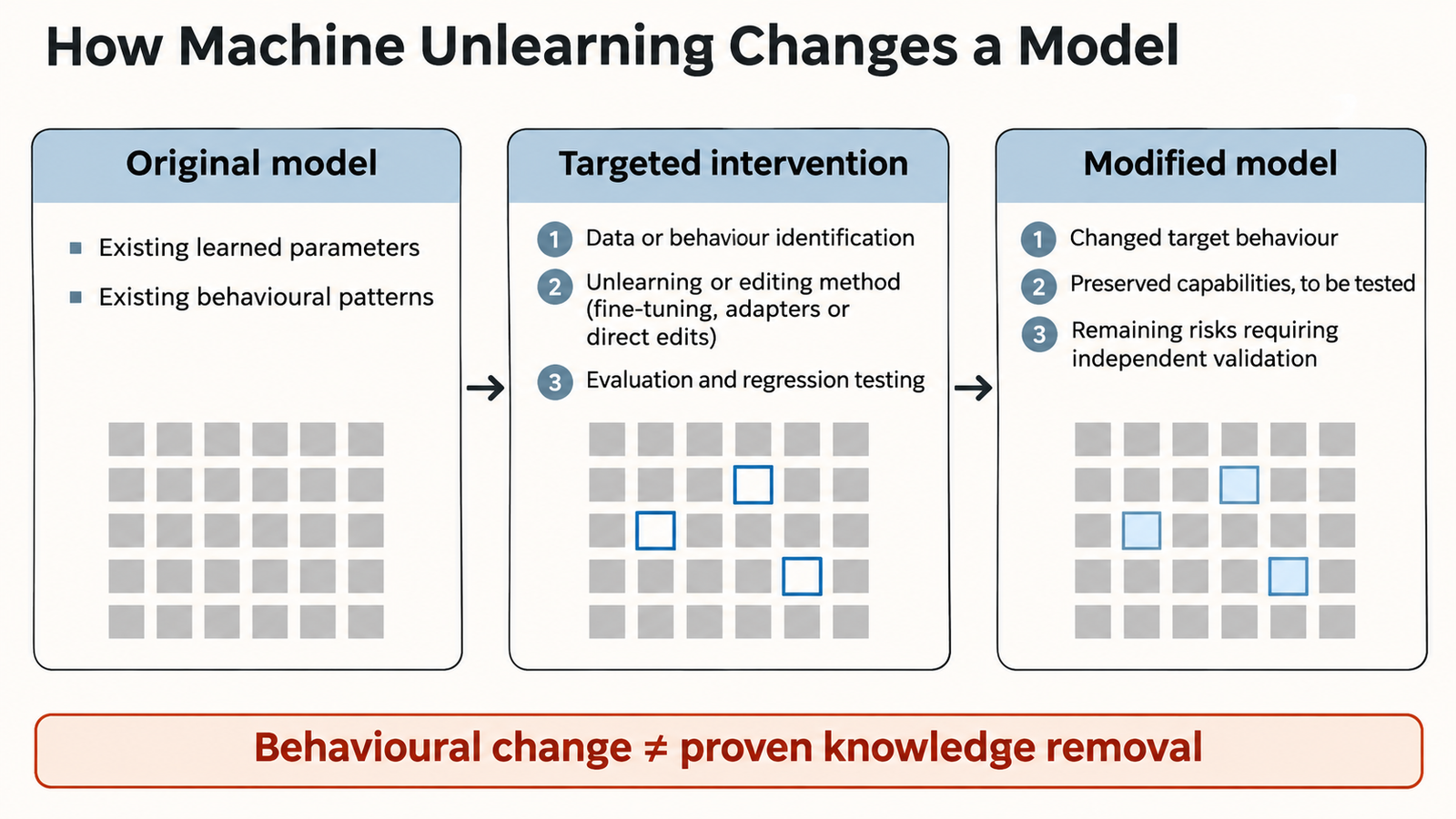
Facts checked against official documents and reporting on 18 November 2026. On 29 September, the White House told federal agencies to stop writing “artificial intelligence” …
AI Coding Agent

AI Coding Agents Are Getting Expensive. Who’s Paying for the Tokens?

Pricing checked on official vendor pages on 17 November 2026. All USD. Cost scenarios are illustrative and labelled as such. On 28 October, TechCrunch published …

Nanorobots for Drug Delivery: From Lab to Clinical Trials

nanorobots for drug delivery

In February 2018, a team led by Yuliang Zhao, Baoquan Ding, Guangjun Nie and Hao Yan reported in Nature Biotechnology that a folded DNA structure, injected into the bloodstream of tumour-bearing mice, had opened inside tumour blood vessels and released the clotting enzyme thrombin. As a result, the tumours’ blood supply clotted and their growth slowed. The team also tested the structure for safety in Bama miniature pigs. It was one of the clearest demonstrations that nanorobots for drug delivery could do something useful in a living animal. More than eight years later, as of 17 October 2026, we couldn’t find a registered human trial of that system, or of any comparable nanorobotic drug carrier. This article looks at what separates a nanoscale machine that delivers a payload in a mouse from a drug-delivery technology a regulator would let near a patient.

Key Takeaways
  • “Nanorobot” covers very different things. People apply it to DNA origami containers, enzyme-powered particles and magnet-steered capsules. However, they share little beyond size and a sense of motion.
  • The strongest results are still in animals. DNA nanorobots have caused tumour clotting in mice, enzyme-driven nanobots have shrunk mouse bladder tumours by about 90%, and researchers have steered magnetic microrobots through pig and sheep vasculature.
  • We found no human trial. As of 17 October 2026, we found no registered or reported human trial of a nanorobotic or microrobotic drug-delivery system. Direct registry queries were unavailable, so this rests on searches of registry and literature content.
  • Approved nanomedicines aren’t robots. Liposomes and lipid nanoparticles are passive carriers, so their approvals don’t count as evidence that nanorobots work in people.
  • The hard problems come after the demonstration. Manufacturing, dose, clearance and control in a human-sized body decide whether a system can reach the clinic, and those are the problems current studies mostly leave open.

Quick Navigation


What counts as a nanorobot for drug delivery?

There’s no agreed definition, and that’s the first problem. In the research literature, “nanorobot” is used for systems that sense, move, or change shape in response to a signal. Journalists and companies use it for almost anything small that carries a drug. The difference matters, because evidence for one category says little about another.

CategoryExampleMoves itself?Externally controlled?Responds to a target?Size
DNA nanostructure (“DNA nanorobot”)Thrombin-loaded DNA origami (Li et al., 2018)No; carried by blood flowNoYes; opens on binding a tumour markerTens of nanometres
Catalytic nanomotor (“nanobot”)Urease-coated silica particles (Simó et al., 2024)Yes; propelled by an enzyme reaction with ureaNoIndirectly, by mixing and penetrating tissueHundreds of nanometres
Magnetic microrobotGel capsule with iron oxide (Landers et al., 2025)NoYes; magnetic fields steer itNo; an operator aims itLargest of the four; sized to fit target vessels
Conventional nanoparticle carrierLiposomes, lipid nanoparticlesNoNoSometimes, via surface ligandsTens to hundreds of nanometres

The last row is the important comparison. Liposomal doxorubicin and the lipid nanoparticles in mRNA vaccines are approved, widely used nanomedicines. They don’t move under their own power, can’t be steered, and don’t change state in a controlled way. Calling them nanorobots would blur the line this article is trying to draw. Their approvals show that nanoscale carriers can be manufactured and regulated. They show nothing about whether a self-propelled or steerable machine can be.

Scale is the other confusion. Some of the most clinically advanced “nanorobots” are really microrobots, large enough to see on an X-ray and to steer with magnets, but too large to pass through capillaries.

How nanorobots for drug delivery actually release a drug

It helps to break drug delivery into separate jobs: loading the drug, moving it, finding the target, releasing it and clearing the carrier afterwards. Almost no system does all five. Most do one or two and rely on the body, or a clinician, for the rest.

  • DNA nanostructures mostly handle targeting and release. The 2018 thrombin carrier was a sheet of DNA origami rolled into a tube with the enzyme attached inside. It was held shut by DNA “fasteners” that included an aptamer, a short DNA strand that binds a specific protein. When the aptamer met nucleolin, a protein found on tumour blood-vessel cells, the fasteners released and the tube opened. Movement came from the bloodstream. The structure didn’t steer.
  • Catalytic nanomotors add their own motion. In the bladder studies from Samuel Sánchez’s group at IBEC in Barcelona, urease enzymes on the particle’s surface break down urea in urine. That reaction pushes the particles around and mixes them through the bladder. Their motion isn’t directed. They don’t steer towards a tumour, but they spread and penetrate more than passive particles do.
  • Magnetic microrobots hand control to an operator. External electromagnets roll or pull the capsule through vessels, X-ray imaging tracks it, and a high-frequency magnetic field heats it to dissolve the shell and release the drug. The robot itself makes no decisions. It’s an extension of the interventional radiologist.

Clearance is the step most often left out of diagrams. DNA degrades in the body, and the 2018 study reported no obvious immune reaction in mice or pigs. Silica, iron oxide and tantalum are another matter. Where they end up, and how fast they leave, has to be measured for each design.

nanorobots for drug delivery

Four nanorobotic drug delivery studies and what they showed

These four studies were chosen because they sit at different points on the path from concept to clinic, not because they’re the only important work.

2012: logic-gated DNA barrel, in cell culture

Shawn Douglas, Ido Bachelet and George Church at Harvard’s Wyss Institute published a hexagonal DNA origami barrel in Science in 2012. It was closed by two aptamer “locks” and opened only when both locks found their target molecules on a cell surface, working like a logical AND gate. Inside, it carried antibody fragments that altered signalling in the target cells. The work showed that a DNA container could make a simple decision based on what it touched. All of it was done in cell culture. There was no bloodstream, no immune system and no question of dose.

2018: thrombin-loaded DNA nanorobot, in mice and pigs

The Li et al. study moved the same idea into animals. Injected intravenously into tumour-bearing mice, the nucleolin-triggered tube delivered thrombin to tumour blood vessels, causing clotting, tumour tissue death and slower growth. The authors reported the structures were safe and immunologically inert in mice and in Bama miniature pigs. What this doesn’t establish is just as important. The pig work assessed safety, not tumour response. Mouse tumours are small and grown to a set size. And whether thrombin, a powerful clotting enzyme, could be used without clotting healthy vessels in human cancer patients is a question that only human studies could answer.

2024: urease-powered nanobots, in mouse bladders

Cristina Simó, Samuel Sánchez and colleagues reported in Nature Nanotechnology that radio-iodinated, urease-coated mesoporous silica particles, instilled into the bladders of mice with orthotopic bladder tumours, accumulated about eight times more at the tumour on PET imaging. Treated mice showed tumour volumes about 90% smaller. The approach is clever because the bladder is a closed cavity, filled with urea that serves as fuel, and already treated by instilling drugs. But it remains a mouse study, and it delivered a radioactive payload, which brings its own dosing and safety questions.

2025: magnetic microrobots, in vessel models, pigs and a sheep

Fabian Landers, Bradley Nelson and colleagues at ETH Zurich described in Science a dissolvable gel capsule containing iron oxide for steering and tantalum for X-ray visibility. It was deployed from a modified catheter and guided with a clinical electromagnetic navigation system. According to ETH, the capsules carried a clot-dissolving agent, an antibiotic and a tumour drug in testing. They reached their intended location in more than 95% of tested cases, were navigated in pigs and in the cerebrospinal fluid of a sheep, and dissolved a clot in a silicone vessel model. This is the most clinically oriented of the four. It uses existing operating-room equipment, and it’s designed to be seen and steered. It still isn’t a treatment result. The reported therapeutic effect, the dissolved clot, was in a model, not an animal.

Read together, the studies show a familiar pattern. Each one proves a mechanism under conditions the researchers chose, which is what good early research should do. As our piece on why benchmark scores fail to predict production performance argued about AI models, success under chosen test conditions doesn’t transfer automatically to the conditions that matter.

Nanorobots for drug delivery in clinical trials: the evidence

Evidence statement, dated 17 October 2026: We found no registered, ongoing or completed human clinical trial of a nanorobotic or microrobotic drug-delivery system, and no regulatory approval of one. We couldn’t query ClinicalTrials.gov directly from our research environment. This finding rests on web searches of registry content, the peer-reviewed literature and company announcements, so it should be read as “not found”, not as “proven absent”.

Three things are easily mistaken for clinical progress.

  1. Company plans. Bionaut Labs, a Los Angeles start-up developing magnetically steered microscale robots, told Drug Delivery Business in 2021 that it was targeting human clinical trials by 2023, starting with chemotherapy for brainstem glioma. We found no public record that such a trial began. The ETH team says it wants to begin human trials as soon as possible, but has given no date.
  2. Robots of a different kind. Microbot Medical’s Liberty system received FDA 510(k) clearance in September 2025 as a single-use, remotely operated robotic system for peripheral endovascular procedures. It’s a medical robot with “microbot” in the company name. It isn’t a microrobot that delivers drugs.
  3. Nanoparticle trials. Registries contain many trials of liposomes, lipid nanoparticles and polymer nanoparticles. They’re valuable, but they test passive carriers, and none of them is a nanorobot trial.

The gap is real, and it isn’t surprising. Every system above would be regulated as a new drug, a new device, or a combination of the two. Each would need a manufacturing process and a toxicology package before a first-in-human study could be approved. None has published that evidence.

nanorobots for drug delivery

The engineering problems animal studies cannot settle

Animal studies show whether something can work. Clinical use raises different questions, and the four studies above leave most of them open.

  1. Scale and flow. A mouse’s blood volume is a few millilitres, and its tumour sits a few millimetres from a major vessel. Human circulation is longer, faster and branches far more. The ETH team built its system around this problem, combining three navigation modes to handle different flow speeds. But it was tested in pigs and a sheep, not in diseased human vessels with plaque, clots and abnormal anatomy.
  2. Dose that matters clinically. Releasing a payload isn’t the same as releasing enough of it. A capsule small enough to pass through cerebral vessels carries a small drug load. The authors’ own abstract notes that the design has to balance magnetic material, contrast agent and drug capacity in the same small volume. Whether that capacity is enough for a given indication has to be shown drug by drug.
  3. Where the material goes. DNA is biodegradable, but its fate in the human immune system at therapeutic doses hasn’t been measured. Mesoporous silica, iron oxide and tantalum each need their own studies of distribution, accumulation and excretion. Reporting “no obvious toxicity” in a short animal study isn’t the same as a toxicology package.
  4. Manufacturing. DNA origami is assembled from hundreds of short strands, and making it at clinical scale, with consistent folding, purity and stability, is an unsolved industrial problem. A microrobot system adds a device to the drug: a catheter, a navigation system and imaging, each built and validated to medical-device standards.
  5. Cost and comparison. A new system has to beat what’s already used: intravesical chemotherapy for bladder cancer, catheter-directed thrombolysis for clots, convection-enhanced delivery for brain tumours. It needs a clear advantage in outcome, safety or practicality to justify its complexity.

What a credible path to clinical use looks like

There is no shortcut through the regulatory sequence, and each step tests something the previous one couldn’t.

  1. Preclinical efficacy in relevant models. This means disease models that resemble the human condition, ideally in more than one species, with doses that could translate to people.
  2. Formal toxicology and pharmacology. These are GLP-compliant studies of distribution, accumulation, immune response and clearance of every component, including the carrier, not just the drug.
  3. Manufacturing and quality control. A reproducible process with defined specifications, sterility and stability, documented to the standard regulators expect for a clinical product.
  4. First-in-human study. Usually a small safety study in patients with limited options, in which the system and its control setup are used as the regulator approved.
  5. Larger trials and regulatory assessment. Evidence that the system improves outcomes compared with standard care, not just that it’s safe.

Passing one step doesn’t predict the next. Many nanomedicines have looked strong in mice and failed in people. A first-in-human study that shows safety under tightly controlled conditions won’t establish efficacy either. That’s the same limit we described in why a passing red-team test doesn’t prove an AI system is safe: a result applies to the configuration that was tested.

Where nanorobotic drug delivery could make a difference

The most plausible early uses share a feature. They involve a cavity or vessel a clinician can already reach, an existing procedure that the robot could improve, and a drug whose benefit is limited by poor local concentration.

  • Bladder cancer. Bladder drugs are already instilled directly, and the urine provides the fuel for urease motors. The 2024 study’s eightfold tumour accumulation suggests that enzyme-driven mixing could improve on passive instillation. What’s still needed is evidence in larger animals, a non-radioactive or clinically established payload, and a direct comparison with current intravesical therapy.
  • Stroke and blood clots. Magnetically guided capsules carrying a clot-dissolving drug could, in principle, deliver a concentrated dose to an occlusion. That could reduce the systemic bleeding risk of intravenous thrombolysis. The ETH work shows navigation in pigs and clot dissolution in a model. It doesn’t yet show outcomes in an animal stroke model, let alone in patients, where minutes matter and catheter procedures already exist.
  • Brain tumours. Steering through cerebrospinal fluid, as shown in a sheep, could in principle reach brain regions that systemic drugs struggle to penetrate. No human evidence has been published.

The next milestone worth watching

The milestone that would change the assessment most is a registered first-in-human study of a nanorobotic or microrobotic drug-delivery system, with its manufacturing and toxicology documented. Magnetic microrobots look closest, because they use clinically familiar components and show up on standard imaging. Enzyme-driven particles in the bladder are a reasonable second, because the delivery route already exists. Until a trial like that is registered with a defined intervention and endpoints, claims that nanorobots are “entering the clinic” have nothing to point to.

What the evidence lets us say

The evidence supports a narrower claim than the headlines usually make. Researchers have built nanoscale and microscale systems that open on contact with a target, propel themselves through biological fluids, or can be steered with magnets to a chosen point in an animal’s vasculature. Those results are real and peer-reviewed.

The evidence doesn’t support saying that nanorobots for drug delivery have been tested in patients, that any is close to approval, or that animal tumour responses predict human ones. Between the demonstration and the patient lie manufacturing, dose, clearance and a regulatory process that none of these systems has publicly entered. A mouse tumour shrinking by 90% is a finding about a mouse.

Frequently asked questions

What are nanorobots for drug delivery?

They’re nanoscale or microscale systems that carry a drug and sense, move or are controlled in ways passive carriers can’t. Examples include DNA structures that open on contact with a tumour marker, enzyme-powered particles and magnetically steered capsules. The term is used loosely.

Are nanorobots currently used to deliver drugs to human patients?

Not as far as we could verify. As of 17 October 2026, we found no registered or completed human trial of a nanorobotic or microrobotic drug-delivery system, and no approved product. The published work so far is in cells, animals or physical models.

What is the difference between a nanorobot and a nanoparticle?

A conventional nanoparticle, such as a liposome or lipid nanoparticle, carries a drug passively and goes where blood flow and chemistry take it. A nanorobot adds a controlled function: it propels itself, responds to a specific trigger, or is steered externally. Several nanoparticle medicines are approved; no nanorobot is.

How do nanorobots navigate through the body?

Most don’t steer. DNA nanostructures travel with the blood and act when they bind a target. Enzyme-powered particles move but don’t aim. Magnetic microrobots are steered by external electromagnets under X-ray guidance, with a clinician in control.

What safety and manufacturing challenges remain?

The main ones are the long-term fate of materials such as silica and iron oxide, immune responses to DNA structures at clinical doses, delivering enough drug to matter, and reproducible manufacturing at scale. None of the leading systems has published a full toxicology or manufacturing package.

When could nanorobotic drug delivery become clinically available?

No credible date can be given. A first-in-human safety study would be the first concrete step, and none has been verified. Larger trials and regulatory review would follow over years, and many candidates fail.